Mendeleev Communications
RUS  ENG    JOURNALS   PEOPLE   ORGANISATIONS   CONFERENCES   SEMINARS   VIDEO LIBRARY   PACKAGE AMSBIB  
General information
Latest issue
Archive

Search papers
Search references

RSS
Latest issue
Current issues
Archive issues
What is RSS


Mendeleev Commun.:
Year:
Volume:
Issue:
Page:
Find


Personal entry:
Login:
Password:
Save password
Enter
Forgotten password?
Register


Mendeleev Communications, 2020, Volume 30, Issue 4, Pages 531–533
DOI: https://doi.org/10.1016/j.mencom.2020.07.043
(Mi mendc1248)
 

This article is cited in 5 scientific papers (total in 5 papers)

Communications

Radiolytic degradation of explosives in aqueous solutions and ‘red’ wastewater

Yu.-R. Kima, A. V. Ponomarevb

a Central Research Institute, Samsung Heavy Industries Co., Ltd., Taejeon, Republic of Korea
b A.N. Frumkin Institute of Physical Chemistry and Electrochemistry, Russian Academy of Sciences, Moscow, Russian Federation
Full-text PDF (346 kB) Citations (5)
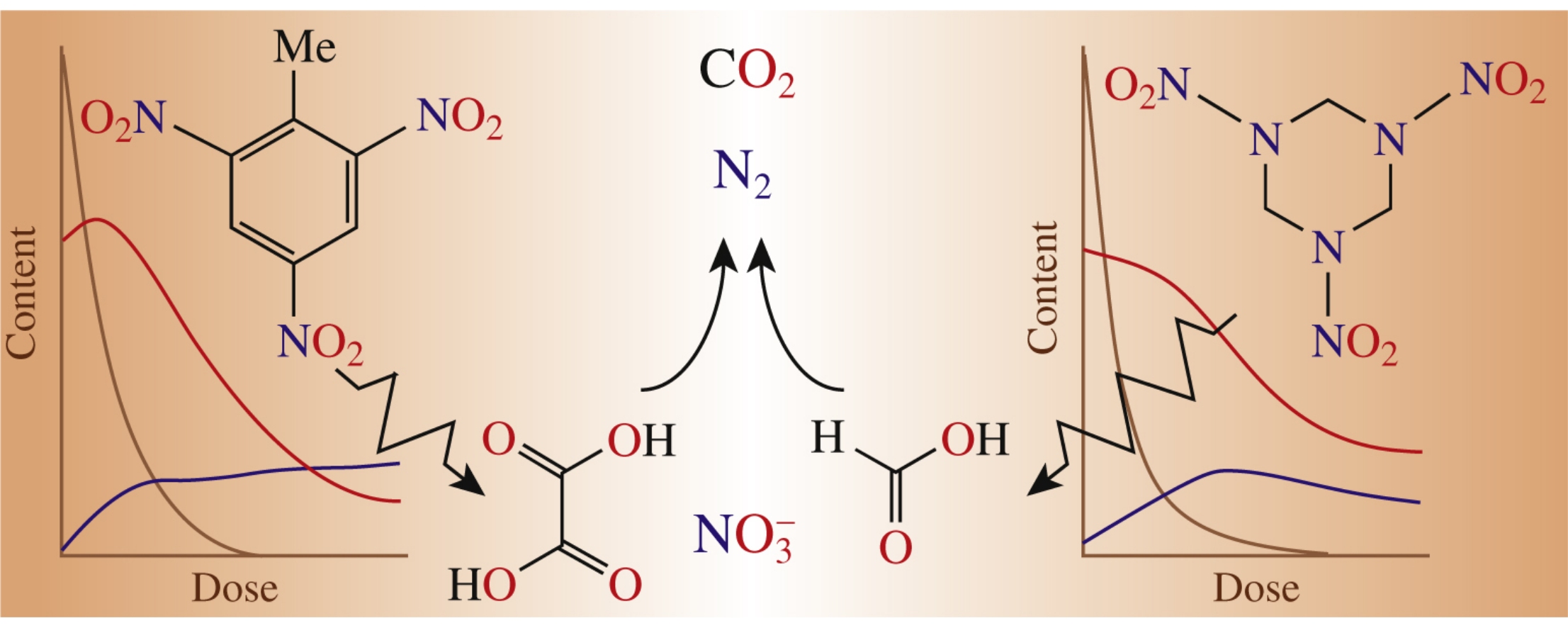
Abstract: Electron beam treatment would cause conversion of trinitrotoluene and 1,3,5-trinitrohexahydro-1,3,5-triazine into biodegradable products and thus can be employed for the practical decontamination of ‘red’ wastewater in combination with bio-treatment.
Keywords: electron-beam treatment, trinitrotoluene, trinitrotriazine, red water, denitration, mineralization, biodegradation.
Bibliographic databases:
Document Type: Article
Language: English


Citation: Yu.-R. Kim, A. V. Ponomarev, “Radiolytic degradation of explosives in aqueous solutions and ‘red’ wastewater”, Mendeleev Commun., 30:4 (2020), 531–533
Linking options:
  • https://www.mathnet.ru/eng/mendc1248
  • https://www.mathnet.ru/eng/mendc/v30/i4/p531
  • This publication is cited in the following 5 articles:
    Citing articles in Google Scholar: Russian citations, English citations
    Related articles in Google Scholar: Russian articles, English articles
    Mendeleev Communications
     
      Contact us:
     Terms of Use  Registration to the website  Logotypes © Steklov Mathematical Institute RAS, 2025