Mendeleev Communications
RUS  ENG    JOURNALS   PEOPLE   ORGANISATIONS   CONFERENCES   SEMINARS   VIDEO LIBRARY   PACKAGE AMSBIB  
General information
Latest issue
Archive

Search papers
Search references

RSS
Latest issue
Current issues
Archive issues
What is RSS


Mendeleev Commun.:
Year:
Volume:
Issue:
Page:
Find


Personal entry:
Login:
Password:
Save password
Enter
Forgotten password?
Register


Mendeleev Communications, 2017, Volume 27, Issue 3, Pages 213–223
DOI: https://doi.org/10.1016/j.mencom.2017.05.001
(Mi mendc1948)
 

This article is cited in 7 scientific papers (total in 7 papers)

Focus Article

Kinetic aspects of operando studies: state-of-the-art and unexplored possibilities

A. F. Schmidt, A. A. Kurokhtina, E. V. Larina

Department of Chemistry, Irkutsk State University, Irkutsk, Russian Federation
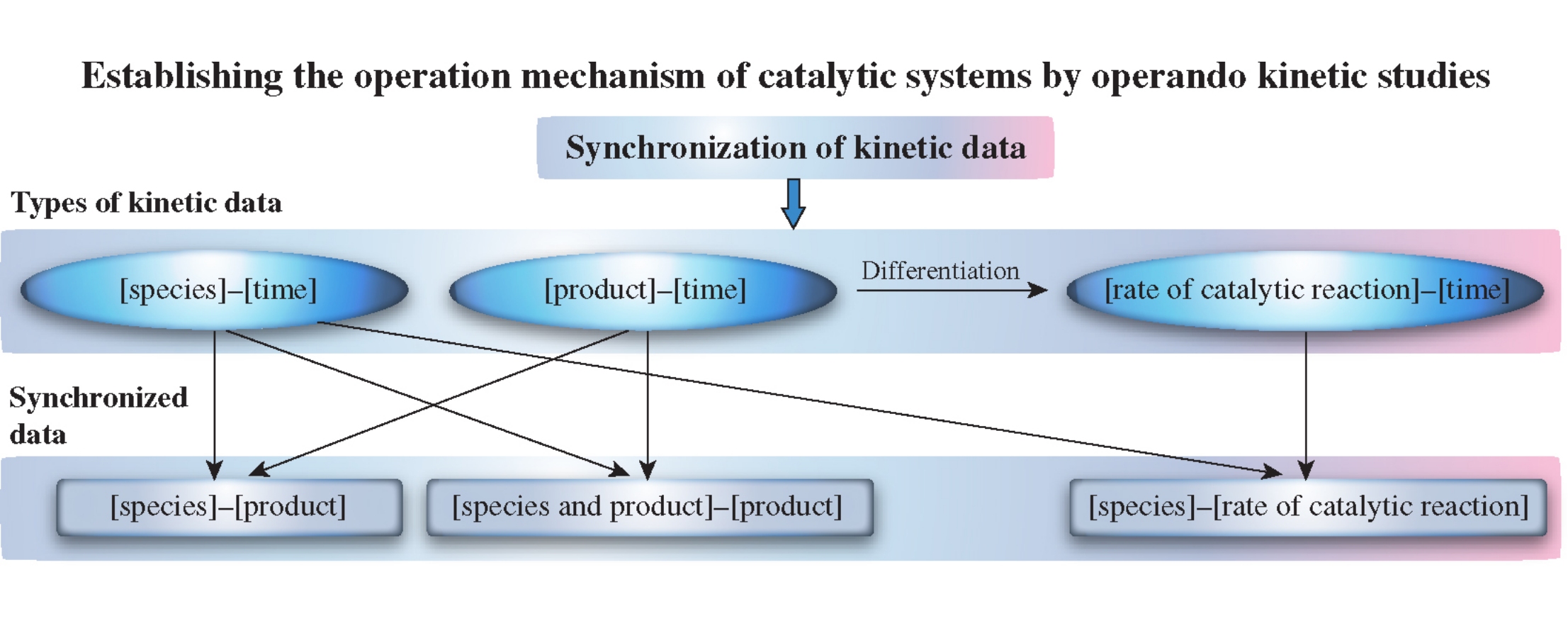
Abstract: Operando spectroscopy is one of the most effective tools for investigating catalytic systems, providing unique experimental data that has long been required for kinetic studies of catalytic reactions. However, the utilization of kinetic methods in operando studies is frequently not taken into account. To address this issue, this article provides a discussion of the current status, problems, and prospects of operando kinetic studies of complex catalytic reactions.
Bibliographic databases:
Document Type: Article
Language: English
Supplementary materials:
Supplementary_data_1.pdf (488.7 Kb)


Citation: A. F. Schmidt, A. A. Kurokhtina, E. V. Larina, “Kinetic aspects of operando studies: state-of-the-art and unexplored possibilities”, Mendeleev Commun., 27:3 (2017), 213–223
Linking options:
  • https://www.mathnet.ru/eng/mendc1948
  • https://www.mathnet.ru/eng/mendc/v27/i3/p213
  • This publication is cited in the following 7 articles:
    Citing articles in Google Scholar: Russian citations, English citations
    Related articles in Google Scholar: Russian articles, English articles
    Mendeleev Communications
     
      Contact us:
     Terms of Use  Registration to the website  Logotypes © Steklov Mathematical Institute RAS, 2025