Abstract:
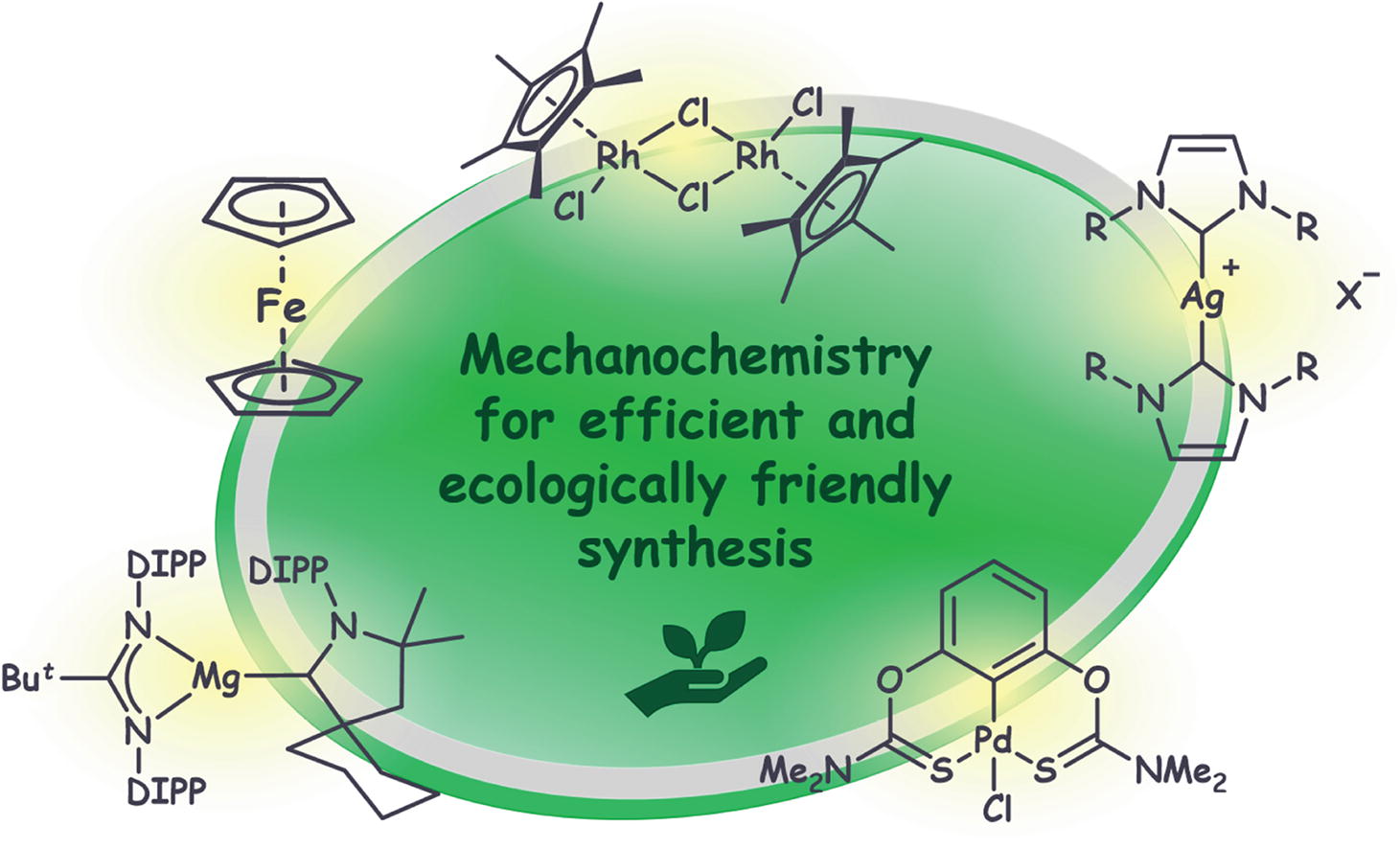
In response to rising environmental concerns, chemistry is experiencing a considerable change in both concepts and practices to adopt more efficient and sustainable technologies. One of the alternative technologies that offer many advantages over the conventional solution-based techniques is mechanochemistry which utilizes mechanical energy to induce chemical reactions. Despite the fact that mechanochemistry has reached high significance in the creation of advanced materials, such as alloys, ceramics, electrode materials, and nanocomposites, in the field of small molecule synthesis its potential remains largely untapped. This review highlights the opportunities and prospects of different mechanochemical tools in the synthesis of organometallic compounds, including transition metal complexes with N-heterocyclic carbene, arene, and cyclopentadienyl ligands, monometallacyclic and pincer derivatives, as well as main group metal compounds (e.g., allyl complexes and the Grignard reagents). Many important organometallic transformations such as C–H bond metalation, transmetalation, and oxidative addition can be successfully implemented under mechanochemical conditions in a highly productive and energy-saving manner. Furthermore, the postmodification of metal-containing species upon grinding or milling is shown to be a powerful route to both new discrete metal complexes and different supramolecular architectures (metal-containing organic cages, macrocylces, networks).
Citation:
D. V. Aleksanyan, V. A. Kozlov, “Mechanochemical tools in the synthesis of organometallic compounds”, Mendeleev Commun., 33:3 (2023), 287–301
Linking options:
https://www.mathnet.ru/eng/mendc378
https://www.mathnet.ru/eng/mendc/v33/i3/p287
This publication is cited in the following 21 articles:










 Contact us: