Abstract:
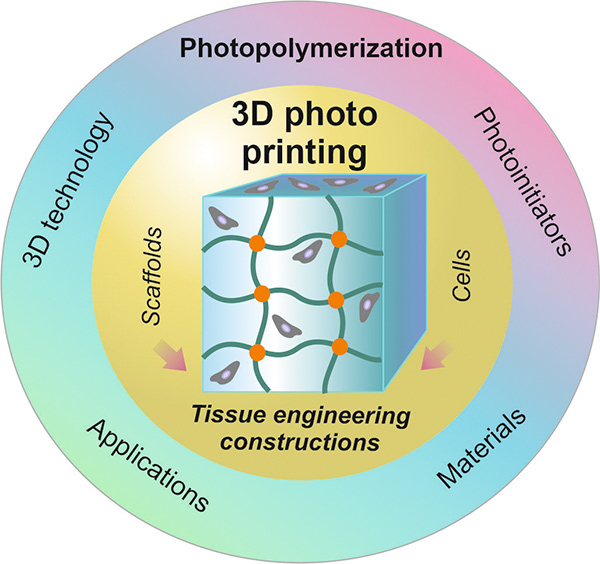
The progress in the field of tissue engineering is largely driven by the development of 3D laser printing technologies, which allow precise creation of hydrogel scaffolds containing cells (the so-called tissue-engineered constructs), using photoinduced radical reactions of polymerization and crosslinking. The review considers the main mechanisms and features of such reactions, presents the most common materials for photocompositions, including natural and synthetic polymers and precursors, and describes various mechanisms for photoinitiator activation. Advances in the field of photopolymerization enable application of modern laser 3D printing techniques based on extrusion and stereolithography to design tissue-engineered constructs in a wide range of sizes and shapes with a finely organized architecture. The integration of such methods with the methods of bioengineering and cell technology is discussed, including for the creation of tissue-specific and in vivo polymerized constructs.
The bibliography includes 225 references.
Keywords:
3D photopolymerization, scaffolds, tissue engineering constructions, hydrogels, photoinitiators, 3D printing, extrusion, stereolithography.
Citation:
A. N. Generalova, P. A. Demina, R. A. Akasov, E. V. Khaidukov, “Photopolymerization in 3D printing of tissue-engineered constructs for regenerative medicine”, Usp. Khim., 92:2 (2023), RCR5068; Russian Chem. Reviews, 92:2 (2023), RCR5068
Linking options:
https://www.mathnet.ru/eng/rcr4414
https://doi.org/10.57634/RCR5068
This publication is cited in the following 21 articles:










 Contact us: