Abstract:
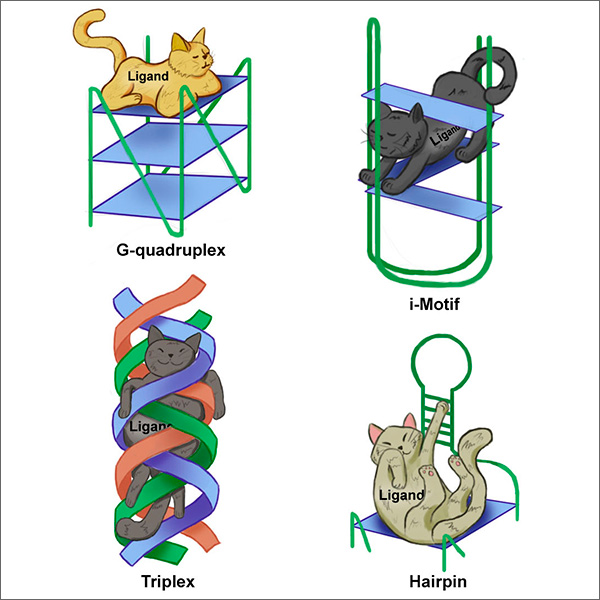
Nucleic acids are important targets for many anticancer drugs. Apart from the canonical B-DNA double helix, DNA forms a number of non-canonical structures (G-quadruplexes, i-motifs, hairpins, triplexes, etc.), which play an important role in the regulation of biological processes. Binding to non-canonical DNA structures occurs mainly by π–π-stacking. Therefore, aromatic and heteroaromatic compounds, in particular fused poly-aromatic compounds (acridines, anthraquinones, carbazoles), porphyrins, benzothiazoles, benzimidazoles, pyridines, and quinolines, as well as their complexes are used as ligands for secondary structures. These ligands should possess not only high selectivity to non-canonical structures compared to double-stranded DNA, but also relatively high solubility and penetration through cell membranes. This review summarizes the achievements of 2020–2024 in the synthesis and biological studies of (hetero)arenes (acridines, anthraquinones, benzazoles, xanthones, porphyrins) and coordination compounds that have exhibited anticancer activity as a result of binding to non-canonical DNA or RNA structures. Ligands of various types of non-canonical nucleic acid structures (G-quadruplexes, i-motifs, triplexes, hairpins) are considered and their cytotoxic activity and structure–property relationships are compared. The bibliography includes 166 references.
Citation:
M. S. Abramovich, P. V. Zaikina, E. S. Barskaya, E. K. Beloglazkina, “Synthesis and biological properties of small molecules — ligands of non-canonical DNA and RNA structures”, Usp. Khim., 93:9 (2024), RCR5134; Russian Chem. Reviews, 93:9 (2024), RCR5134
Linking options:
https://www.mathnet.ru/eng/rcr4475
https://doi.org/10.59761/RCR5134
This publication is cited in the following 2 articles:









 Contact us: