Russian Chemical Reviews
RUS  ENG    JOURNALS   PEOPLE   ORGANISATIONS   CONFERENCES   SEMINARS   VIDEO LIBRARY   PACKAGE AMSBIB  
General information
Latest issue
Archive
Impact factor
Guidelines for authors

Search papers
Search references

RSS
Latest issue
Current issues
Archive issues
What is RSS


Usp. Khim.:
Year:
Volume:
Issue:
Page:
Find


Personal entry:
Login:
Password:
Save password
Enter
Forgotten password?
Register


Russian Chemical Reviews, 2025, Volume 94, Issue 1, RCR5152
DOI: https://doi.org/10.59761/RCR5152
 

This article is cited in 6 scientific papers (total in 6 papers)

Polymers based on triphenylamine: synthesis, properties, and applications

I. A. Chuykoa, P. A. Troshinbc, S. A. Ponomarenkoa, Yu. N. Luponosova

a Enikolopov Institute of Synthetic Polymeric Materials, Russian Academy of Sciences, Moscow, Russian Federation
b Federal Research Center of Problems of Chemical Physics and Medicinal Chemistry, Russian Academy of Sciences, Chernogolovka, Moscow Region, Russian Federation
c Zhengzhou Research Institute of HIT, Zhengzhou, Henan Province, 450000, China
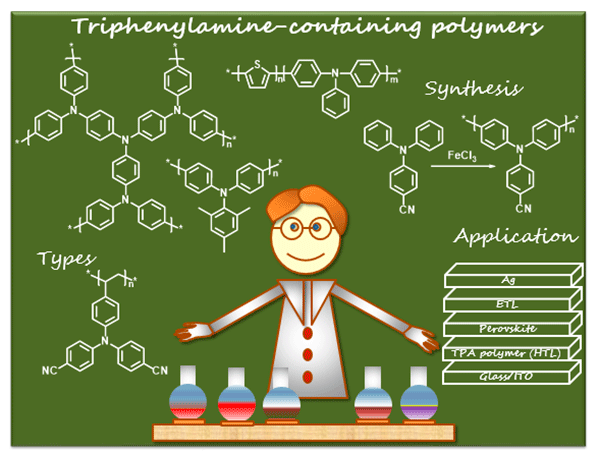
Abstract: Triphenylamine-based conjugated polymers are a class of organic semiconductor compounds used in a variety of devices in the field of organic and hybrid optoelectronics, owing to a number of properties such as high hole mobility, efficient luminescence, high stability, and the ability to form films from solutions. The modern methods of organic and polymer synthesis make it possible to implement a variety of molecular designs for these polymers, ranging from simple conjugated macromolecules to intricate branched and cross-linked copolymers. This review analyzes the currently existing diversity of triphenylamine-based polymer structures, proposes their classification for the first time, considers the main approaches to the polymer synthesis, and, using numerous examples, demonstrates how the properties of such materials can be tuned using molecular design. Examples of application of these polymers in various modern devices are given, including perovskite solar cells, metal-ion batteries, electrochromic devices, organic light-emitting diodes, and sensors of various types.
The bibliography includes 281 references.
Keywords: poly(triphenylamine), TPA, donor-acceptor polymer, hole-transport polymer, perovskite solar cell, organic light-emitting diode, OLED, sensor.
Received: 17.09.2024
Bibliographic databases:
Document Type: Article
Language: English
Original paper language: Russian


Citation: I. A. Chuyko, P. A. Troshin, S. A. Ponomarenko, Yu. N. Luponosov, “Polymers based on triphenylamine: synthesis, properties, and applications”, Usp. Khim., 94:1 (2025), RCR5152; Russian Chem. Reviews, 94:1 (2025), RCR5152
Linking options:
  • https://www.mathnet.ru/eng/rcr4491
  • https://doi.org/10.59761/RCR5152
  • This publication is cited in the following 6 articles:
    Citing articles in Google Scholar: Russian citations, English citations
    Related articles in Google Scholar: Russian articles, English articles
    Uspekhi Khimii Uspekhi Khimii
     
      Contact us:
     Terms of Use  Registration to the website  Logotypes © Steklov Mathematical Institute RAS, 2025