Abstract:
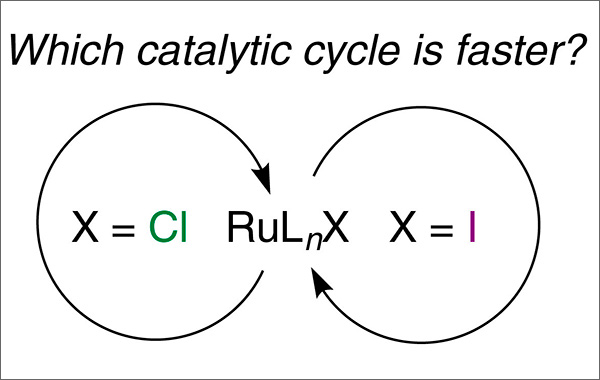
The development of new catalysts is evolving in few ways. One is to design complexes with increasingly complicated ligands. Although effective in terms of the selectivity achieved, this approach has the disadvantage of making catalytic systems progressively more expensive. Another path is to boost catalytic activity by modifying the common elements of the ligand environment. In particular, to date, there have been excellent reviews of the physical and chemical properties of various halogen-containing complexes but a systematic comparison of their catalytic performancy is lacking. The present review partially fills this gap by comparing the activity and selectivity of catalysts containing Ru-I and Ru-Cl bonds. Though the influence of numerous parameters, viz., the leaving ability of a halogen, the stability of the complex, its redox potential, etc., does not allow for a reliable prognosis of their outcome for the catalyst efficiency in the general case, certain predictions and explanations can be made within some classes of reactions. Some of them are given in this review. The bibliography includes 131 references.
Citation:
A. R. Fatkulin, O. I. Afanasyev, D. A. Chusov, “The halogen effect in ruthenium catalysis”, Usp. Khim., 94:6 (2025), RCR5170; Russian Chem. Reviews, 94:6 (2025), RCR5170
Linking options:
https://www.mathnet.ru/eng/rcr4506
https://doi.org/10.59761/RCR5170
This publication is cited in the following 2 articles:









 Contact us: