Abstract:
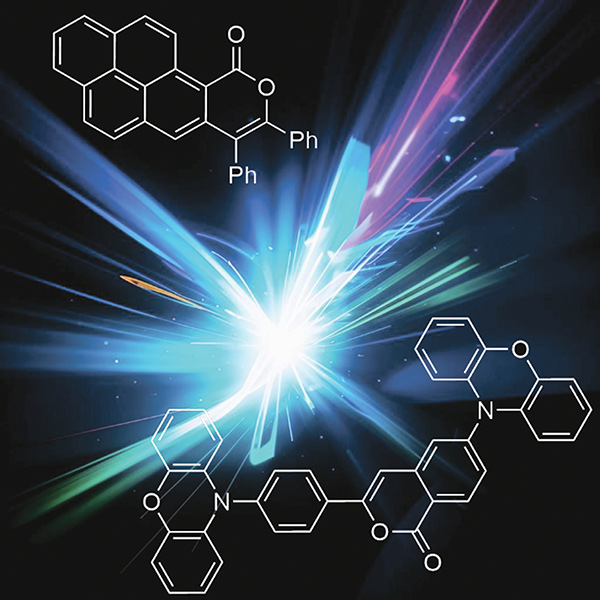
Isocoumarins are isomers of a widely known class of aromatic organic lactones, coumarins, which possess unique photophysical properties. Despite the structural similarity of coumarins and isocoumarins, applications of the latter have long been limited to medicine and agriculture, in view of their fungicidal, antibacterial, and anti-inflammatory activities. Most organic compounds of this class have been isolated from living organisms. The effective method for the synthesis of isocoumarins discovered in the beginning of the 21st century, which is based on C–Н coupling of benzoic acids with acetylenes, made these compounds easily accessible. This gave impetus for their wide use in the design of materials for organic photonics and optoelectronics. The present review focuses on the photophysical properties of isocoumarins in comparison with coumarins and covers known methods for the design of the isocoumarin core published before March, 2025. The bibliography includes 249 references.
Citation:
M. A. Arsenov, D. A. Loginov, “Synthesis and photophysical properties of isocoumarins”, Usp. Khim., 94:7 (2025), RCR5179; Russian Chem. Reviews, 94:7 (2025), RCR5179
Linking options:
https://www.mathnet.ru/eng/rcr4509
https://doi.org/10.59761/RCR5179
This publication is cited in the following 1 articles:









 Contact us: