This article is cited in 1 scientific paper (total in 1 paper)
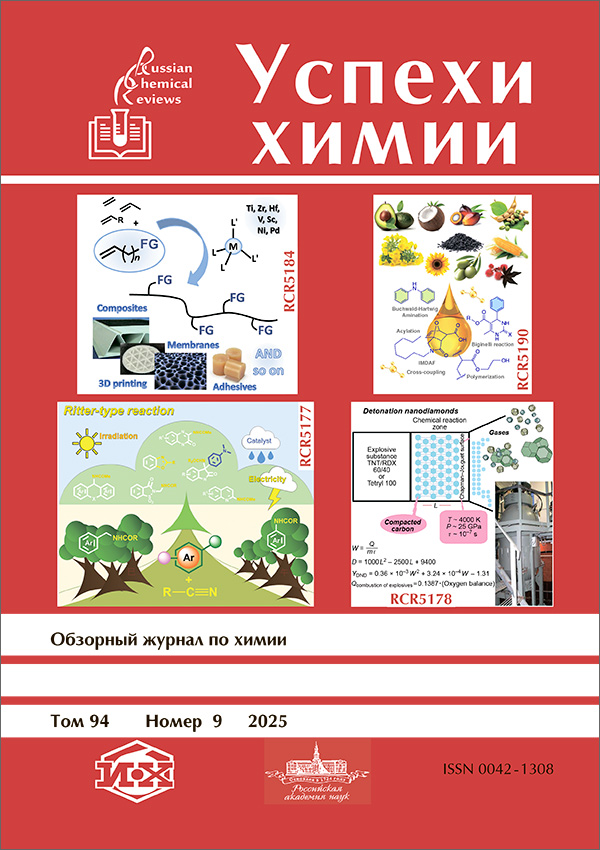
Coordination copolymerization of α-olefins with non-conjugated polar vinyl monomers: current catalytic approaches and prospects for practical applications
Abstract:
The reactivity of polar vinyl monomers, unsaturated compounds containing functional groups, depends on the presence or absence of conjugation between the C=C bond and the neighbouring unsaturated moieties or donor heteroatoms. Conjugated polar vinyl monomers (acrylates, vinyl ethers, etc.) (co)polymerize upon free-radical initiation. The reaction is widely used to produce numerous polymer materials that qualitatively differ from polyolefins in their characteristics. Copolymerization of ethylene, propylene, and higher α-olefins with nonconjugated vinyl monomers containing polar or reactive functional groups gives so-called 'functional polyolefins', that is, polymer materials with unique mechanical and rheological characteristics, increased thermal and oxidative stability, and controlled hydrophilicity. In the synthesis of functional polyolefins, only coordination polymerization, catalyzed by complex compounds of Group 4 metals, V, Sc, Ni, and Pd is effective. This review summarizes for the first time data on the (co)polymerization of polar vinyl monomers catalyzed by early transition metal complexes, discusses the current results achieved in the catalysis of copolymerization of polar vinyl monomers by Group 10 metal complexes, and considers the prospects for practical application of functional polyolefins and for organization of their industrial production. The bibliography includes 272 references.
Citation:
G. I. Sadrtdinova, I. E. Nifant'ev, A. A. Vinogradov, P. V. Ivchenko, “Coordination copolymerization of α-olefins with non-conjugated polar vinyl monomers: current catalytic approaches and prospects for practical applications”, Usp. Khim., 94:9 (2025), RCR5184; Russian Chem. Reviews, 94:9 (2025), RCR5184
Linking options:
https://www.mathnet.ru/eng/rcr4516
https://doi.org/10.59761/RCR5184
This publication is cited in the following 1 articles:







 Contact us: