| Russian Mathematical Surveys |
|
|


|
|


|
This article is cited in 1 scientific paper (total in 1 paper) How to enhance categories, and why? D. B. Kaledinab a Steklov Mathematical Institute of Russian Academy of Sciences, Moscow, Russia b National Research University "Higher School of Economics", Moscow, Russia
Bibliographic databases:
    IntroductionWhile both homology and homotopy originally appeared within algebraic topology, it became clear quite soon that the former properly belongs elsewhere. At least since [10], we understand that homological algebra is not at all about homology of topological spaces; rather, it deals with abelian categories, derived functors, short exact sequences, and suchlike. For homotopy, the picture even now is much less obvious, and some of its essential parts are still missing. What seems clear, though, is that the main subject of homotopical algebra is localization – the act of changing a category by formally inverting a class of maps. Philosophically speaking, localization aims at clarifying things by throwing out irrelevant information. Given a set, we might declare that some of its elements are indistinguishable by imposing an equivalence relation and forcing them to become equal. For a category, this is not a good idea, since objects in a category can never be equal. Instead, we force certain maps to become isomorphisms. The term ‘localization’ comes from algebraic geometry where localizing the ring of functions on an affine scheme corresponds to replacing the scheme with its open subset. In that context, localization is one of the simplest and best-behaved operations, but this is only because the rings of functions are commutative. Once you have a non-commutative algebra, or even simply a monoid, inverting a set of elements typically creates something large and hard to control. For categories – that is, monoids with several objects – the situation is even worse. If the category in question is large, localization may not even exist. Historically, probably the first general example of a localization problem that is controllable appeared in the definition of the derived category given by Verdier in his thesis [27]. Formally, the derived category of an abelian category is obtained by localizing the category of chain complexes with respect to the class of quasi-isomorphisms, but Verdier does it in two steps. First, he passes to the so-called homotopy category of chain complexes and chain-homotopy classes of maps (this can also be obtained by localization with respect to the class of chain-homotopy equivalences, but a direct description is simpler). Then he shows that the homotopy category admits an additional structure of a triangulated category, and proves a general localization theorem for those. This construction is not perfect, but to some extent, it works. However, it is limited in scope: in many respects, triangulated categories are linear objects (at the very least, they are additive). In a non-linear situation, things are much more complicated. The great breakthrough here was Quillen’s [22] that actually gave a name to the subject, and essentially determined how we think about it even today. No non-linear analogue of a triangulated structure is known; instead, Quillen controls localization by introducing the notion of a model category, another additional structure one can put on a category one wants to localize. Unlike Verdier localization, this can be only used once, since the localization of a model category is no longer a model category – in fact, axiom $0$ is that a model category is finitely complete and cocomplete, and localization by its very nature tends to destroy this. However, if we do have a model category to begin with, its localization is at least as controllable as the Verdier localization, and one can use this control to construct adjoint pairs of functors (this is known as ‘Quillen adjunction’) and mutually inverse equivalences between localizations (‘Quillen equivalence’). In a sense, the latter is the main point of the exercise: this gives a formal meaning to saying that two categories ‘model the same homotopy theory’. The ‘homotopy theory’ in question includes the localized category itself, but there is more. For example, if a category $h(\mathcal{C})$ is obtained by localizing a model category $\mathcal{C}$, one can define not only the sets $\operatorname{Hom}(c,c')$ of morphisms between two objects $c,c' \in h(\mathcal{C})$, but a whole homotopy type $ {\mathcal{H}{\it om}} (c,c')$. The ‘naive’ $\operatorname{Hom}(c,c')$ is the set $\pi_0( {\mathcal{H}{\it om}} (c,c'))$ of its connected components, but it can also have non-trivial higher homotopy groups. Invariants such as these are preserved by Quillen equivalences, but they cannot be recovered simply from $h(\mathcal{C})$. Thus the result of the localization procedure is not just a category; it should come equipped with an additional structure known as ‘enhancement’. In fact, a triangulated structure in the sense of [27] is already a form of enhancement, and it allows one to recover something – for instance, the higher homotopy groups $\pi_ {\smash{\scriptscriptstyle\bullet}} ( {\mathcal{H}{\it om}} (c,c'))$ appear as groups of maps from $c$ to homological shifts of $c'$. But this enhancement is much too weak: triangulated functors do not form a triangulated category, one cannot do gluing constructions, and so on, and so forth (for a longer but still not exhaustive list of problems, see, for example, [16], the introduction). Moreover, it only makes sense in the linear setting anyway. For a general notion of an enhancement one should look elsewhere. However, a moment’s reflection shows that the problem is not easy from the purely logical point of view. Namely, we say that we want a ‘homotopy type’ of morphisms $ {\mathcal{H}{\it om}} (c,c')$; but what is a homotopy type? It is either a topological space considered up to a homotopy equivalence, or a simplicial set considered up to a weak equivalence, or maybe something else, but still defined ‘up to’ something – that is, an object in a category obtained by localization. But should not we enhance this ambient category, too? – and if yes, in what sense? Among many people bothered by this over the years, the most prominent was perhaps Grothendieck, with his famous ‘thousand pages long letter’ to Quillen [12]. Unfortunately, there are no theorems there, but there are lots of fantastic ideas. One such is that of ‘higher categories’. Roughly speaking, homotopy types that only have $\pi_0$ and $\pi_1$ are very efficiently parameterized by small groupoids: objects correspond to points, and morphisms correspond to homotopy classes of paths. Should not there be a higher notion of an ‘$\infty$-groupoid’, and maybe even ‘$\infty$-category’, that not only has objects and morphisms, but also morphisms between morphisms, morphisms between morphisms between morphisms, and so on? Well, maybe, but let us spell out something that is usually not spelled out explicitly: Or at least, nobody has been able to make it work, in the forty-something years that [12] has been around. The problem is the ‘and so on’ part: there is no ‘so on’. It is not possible to describe the resulting full structure of higher compatibilities and constraints.In retrospect, this is not too surprising, since doing this would in particular give a purely combinatorial effective description of homotopy groups of spheres, and it is safe to assume that this cannot be done (although those with a surfeit of spare time and ambition are welcome to try). In practice, all the notions of ‘$\infty$-groupoids’ that appeared in the literature were still, at the end of the day, defined up to a weak equivalence of some sort, and then it was not clear why bother – fibrant simplicial sets of Kan have been around since the 1950s. Effectively, in modern usage, ‘$\infty$-groupoid’ is simply a fancy name for a fibrant simplicial set. It is doubtful that such rebranding helps one to prove something. In any case, as far as enhancements are concerned, one option would be to just declare that an enhanced category is the same thing as a model category ‘considered up to a Quillen equivalence’, but this is not enough since not all localizations needed in practice appear in this way (essentially because of axiom $0$ mentioned above). Thus the current thinking goes along more-or-less the following lines.
Of course, all of the above might be the nature of things: if one cannot do better, it is better to do something rather than nothing. The situation might just be similar to the definition of an algorithmically computable function, where we have several alternative definitions, none of them too natural, but they are all provably equivalent, so Church’s Thesis just declares that this is it. The point of the present paper, however, is that one can do better. This is based on another fantastic idea of [12], and this idea indeed works. Roughly speaking, what one wants to do is the following. If it is inevitable that enhanced categories are only defined up to an equivalence of some sort, let us at least make this equivalence as easy to control as possible. Then observe that there is another type of controlled localization that is so common and widespread that it usually goes unnoticed by its users: the category $\operatorname{Cat}$ of small categories, and the class $W$ of, well, equivalences of categories. In principle, this can be localized by using model category techniques, but this is akin to smelling roses through a gas mask. The answer is actually much simpler, and similar to the homotopy category of chain complexes: objects are small categories, morphisms are isomorphism classes of functors. Moreover, we can also consider families of small categories indexed by some category $I$. This is conveniently packaged by the Grothendieck construction of [11] into a Grothendieck fibration $\mathcal{C} \to I$ with small fibres, with morphisms between fibrations given by functors $\mathcal{C} \to \mathcal{C}'$ cartesian over $I$. Then again, localizing the category of fibrations with respect to equivalences gives the category with the same objects, and isomorphism classes of cartesian functors as morphisms (for precise definitions, see below § 1.4). Now, whatever an enhanced category $\mathcal{C}$ is, it should come equipped with its underlying usual category $h(\mathcal{C})$, but there is more: for any small category $I$, we should also have the enhanced category $\mathcal{C}^I$ of functors $I \to \mathcal{C}$, and its underlying usual category $h(\mathcal{C}^I)$. Thus we actually have a whole family of categories indexed by $\operatorname{Cat}$. This has been described in [12] under the name of a derivator; the question was, is it enough to recover $\mathcal{C}$? Our answer is: with some modifications, yes. The notion of a derivator has been studied by many people over the years, and seems to have become a standard term with a well-defined meaning (see, for instance, [9] for an overview); to avoid gratuitous rebranding, let us just call our objects enhanced categories. The main modification compared to [12] is that it is not necessary, nor in fact desirable to index our enhanced categories over the whole $\operatorname{Cat}$ – it is sufficient to consider the category $\operatorname{PoSets}$ of partially ordered sets. We actually use an even smaller category $\operatorname{Pos}^+$ of left-bounded partially ordered sets, see Definition 2.2 and the paragraph below it, but any enhanced category defined over $\operatorname{Pos}^+$ extends canonically to a family over $\operatorname{PoSets}$. What seems important here is that partially ordered sets considered as categories are rigid, that is, the only isomorphisms are the identity maps. Therefore, $\operatorname{PoSets}$ has no $2$-categorical structure, and treating it as simply a category is a reasonable thing to do. One thing that seems not possible to do is to cut down even further and index our enhanced categories on finite partially ordered sets. As things stand, $\operatorname{Pos}^+$ is a large category, so one has to check that our enhanced categories only admit a set of isomorphism classes of functors between them (they do). The first thing we prove is comparison with the standard theories of enhancements. Our basis for comparison is given by complete Segal spaces of Rezk [24], mostly because they are the closest to intuition (quasi-categories of Joyal and Lurie [20] allow for simpler proofs, but for our purposes this is immaterial). We define a comparison functor from the homotopy category of complete Segal spaces to the category of fibrations $\mathcal{C} \to \operatorname{Pos}^+$ with small fibres, and isomorphism classes of cartesian functors between them, and we prove that this comparison functor is fully faithful. We then describe its essential image by imposing several axioms on a fibration – roughly five in total (or six if one wants to look at fibrations over the whole $\operatorname{PoSets}$ rather than just $\operatorname{Pos}^+$). This defines an enhanced category. After that, we use standard category theory techniques to bootstrap the whole theory – an enhancement for the category of small enhanced categories, enhanced categories of enhanced functors, enhanced limits and colimits, the Yoneda embedding, the enhanced version of the Grothendieck construction, and so on. It is perhaps instructive to mention how our theory describes homotopy types. These correspond to enhanced groupoids, that is, enhanced categories given by fibrations $\mathcal{C} \to \operatorname{Pos}^+$ whose fibres are groupoids. In a sense, the whole gadget exhibits a sort of an Eckmann–Hilton duality between the ideas of order (exemplified by partially ordered sets $J \in \operatorname{Pos}^+$) and symmetry (exemplified by the groupoids $\mathcal{C}_J$). In another sense, it restores the original idea of ‘symmetries between symmetries’, but in different guise. There are no ‘higher groupoids’, there are just groupoids in the usual sense – but a whole bunch of them (just as a scheme can be thought of as a bunch of sets of its points over various affine schemes). One feature of our approach to enhancements that we think is an improvement over the existing alternatives is that it follows very closely the usual categorical intuition and way of thinking. Thus all the definitions, constructions, and statements are quite simple and natural, and can be explained in a reasonably concise way. The proofs can not. Therefore, on some reflection, we have decided to split the exposition into two parts. The long and technical [18] contains all the proofs, and is completely independent of the present paper. The present paper is an overview with all the constructions and definitions, but no proofs at all; those are replaced by precise references to [18]. The idea is to give a toolkit that is sufficient for practical applications, with all the proofs safely hidden in the black box. The paper is organized as follows. Subsection 1.1 contains a very brief overview of standard category theory. This is needed because there are no convenient textbooks, but it also serves a dual purpose. Firstly, we fix notation and terminology, and spell out precisely things that need to be spelled out precisely. Secondly, we give a template that we will then repeat in the enhanced setting. The short § 2 contains the necessary technical preliminaries about partially ordered sets, Segal spaces, and so on; this is kept to an absolute minimum. Section 3 contains the main definitions and structural results, including the comparison theorem mentioned above, and § 4 describes the more advanced parts of the theory (the Grothendieck construction, the Yoneda package, limits, and Kan extensions). Finally, § 5 is an appendix where we explain, to an interested reader, the main ideas behind the proofs. Needless to say, it can safely be skipped. AcknowledgementsThis paper together with [18] is the result of a project of some duration; it is hopeless to try to mention here all the colleagues who helped me along the way. I try to give at least a partial list in [18] (the introduction). Here, let me just go back to the beginning and express my deep gratitude to Vladimir Voevodsky and to my Ph. D. advisor David Kazhdan, who introduced me to polycategories back in 1991, and generously tolerated my childish attempts to dabble in the topic. Vladimir later on moved to other things, but David remained consistently interested in the subject through all these years, and I owe much of my understanding to continued conversations with him. The same goes for Vladimir Hinich and Sasha Beilinson. I am also very grateful to the referee for the meticulous work on the manuscript and many suggested improvements. 1. Category theory1.1. Categories and functorsWe work in a minimal set-theoretic setup limited to small and large categories; we do not assume the universe axiom. Even for a large category, $\operatorname{Hom}$-sets are small. We use ‘map’, ‘morphism’, and ‘arrow’ interchangeably. For any category $\mathcal{C}$, we write $c \in \mathcal{C}$ as shorthand for ‘$c$ is an object of $\mathcal{C}$’. For any category $\mathcal{C}$, we denote by $\mathcal{C}^o$ the opposite category, and for any functor $\gamma\colon\mathcal{C}_0 \to \mathcal{C}_1$, we denote by $\gamma^o\colon\mathcal{C}_0^o \to \mathcal{C}_1^o$ the opposite functor. A morphism $f\colon c \to c'$ defines a morphism from $c'$ to $c$ in $\mathcal{C}^o$, which we denote by $f^o\colon c' \to c$. We denote by ${\sf pt}$ the point category (a single object, a single morphism), and we denote by $[1]$ the ‘single arrow category’ with two objects $0,1 \in [1]$ and a single non-identity arrow $0 \to 1$. For any category $\mathcal{C}$ and object $c \in \mathcal{C}$, we denote by $\varepsilon(c)\colon{\sf pt} \to \mathcal{C}$ the functor with value $c$. Morphisms in a category $\mathcal{C}$ correspond to functors $[1] \to \mathcal{C}$, and commutative squares in $\mathcal{C}$ correspond to functors $[1]^2 \to \mathcal{C}$. For any categories $\mathcal{C}$, $\mathcal{C}'$, giving a functor $\gamma\colon\mathcal{C} \times [1] \to \mathcal{C}'$ is equivalent to giving functors $\gamma_0,\gamma_1\colon\mathcal{C} \to \mathcal{C}'$ and a map $\gamma_0 \to \gamma_1$. A projector in a category $\mathcal{C}$ is an endomorphism $p\colon c \to c$ of an object $c \in \mathcal{C}$ such that $p^2=p$; an image of a projector $p\colon c \to c$ is an object $c' \in \mathcal{C}$ equipped with maps $a\colon c' \to c$, $b\colon c \to c'$ such that $p=a\circ b$ and $b \circ a=\operatorname{\sf id}$. An image is unique up to a unique isomorphism if it exists, so it is properly called ‘the image’, and it is automatically preserved by any functor $\mathcal{C} \to \mathcal{C}'$. A category is Karoubi-closed if all projectors have images. The Karoubi completion $\mathcal{C}'$ of a category $\mathcal{C}$ is the category of pairs $\langle c,p \rangle$, $c \in \mathcal{C}$, $p\colon c \to c$ a projector, with morphisms $\langle c,p \rangle \to \langle c',p' \rangle$ given by morphisms $f\colon c \to c'$ such that $p' \circ f=f=f \circ p$. Then $\mathcal{C}'$ is Karoubi-closed, we have a functor $\varepsilon\colon \mathcal{C} \to \mathcal{C}'$, $c\mapsto \langle c,\operatorname{\sf id} \rangle$, and any functor $\gamma\colon\mathcal{C} \to \mathcal{E}$ to a Karoubi-closed category $\mathcal{E}$ factors through $\varepsilon$, uniquely up to a unique isomorphism. A functor $\gamma\colon\mathcal{C} \to \mathcal{C}'$ is full, respectively, faithful if it is surjective, respectively, injective on $\operatorname{Hom}$-sets, and essentially surjective if it is surjective on isomorphism classes of objects. A functor $\gamma$ is conservative if any map $f$ with invertible $\gamma(f)$ is itself invertible. A functor is an equivalence if it is fully faithful and essentially surjective – or equivalently, if it is invertible up to an isomorphism – and we say that a functor is an epivalence if it is essentially surjective, full, and conservative (but maybe not faithful). A category is essentially small if it is equivalent to a small category, and a functor $\gamma\colon\mathcal{C}' \to \mathcal{C}$ is small if the preimage $\gamma^{-1}(\mathcal{C}_0)$ of any essentially small full subcategory $\mathcal{C}_0 \subset \mathcal{C}$ is essentially small. A commutative square of categories and functors is a square of categories and functors equipped with an isomorphism $\gamma_1 \circ \gamma_{01}^1 \cong \gamma_0 \circ \gamma_{01}^0$. We denote by $\mathcal{C}_0 \times_{\mathcal{C}} \mathcal{C}_1$ the category of triples $\langle c_0,c_1,\alpha \rangle$ of objects $c_l \in \mathcal{C}_l$, $l=0,1$, and an isomorphism $\alpha\colon\gamma_0(c_0) \cong \gamma_1(c_1)$. We write $\mathcal{C}_0 \times_{\mathcal{C}}\mathcal{C}_1=\gamma_0^*\mathcal{C}_1$ when we want to emphasize the dependence on $\gamma_0$. A square (1.1) induces a functor
$$
\begin{equation}
\mathcal{C}_{01} \to \mathcal{C}_0 \times_{\mathcal{C}} \mathcal{C}_1,
\end{equation}
\tag{1.2}
$$
and a square is cartesian, respectively, semicartesian if (1.2) is an equivalence, respectively, an epivalence. A commutative square (1.1) is cocartesian if for any category $\mathcal{C}'$, functors $\gamma'_l\colon\mathcal{C}_l \to \mathcal{C}'$, $l=0,1$, and an isomorphism $\gamma'_0 \circ \gamma^0_{01} \cong \gamma_1' \circ \gamma^1_{01}$, there exist a functor $\gamma\colon\mathcal{C}\to \mathcal{C}'$ and isomorphisms $\alpha_l\colon\gamma \circ \gamma_l \cong \gamma_l'$, $l=0,1$, and the triple $\langle \gamma,\alpha_0,\alpha_1 \rangle$ is unique up to a unique isomorphism. An adjoint pair of functors between categories $\mathcal{C}$, $\mathcal{C}'$ is a pair of functors
$$
\begin{equation*}
\lambda\colon\mathcal{C}' \to \mathcal{C},\qquad \rho\colon\mathcal{C} \to \mathcal{C}'
\end{equation*}
\notag
$$
equipped with adjunction maps
$$
\begin{equation*}
a_\unicode{8224}\colon\operatorname{\sf id} \to \rho \circ \lambda,\qquad a^\unicode{8224}\colon\lambda \circ \rho \to \operatorname{\sf id}
\end{equation*}
\notag
$$
such that the compositions
$$
\begin{equation}
\begin{gathered} \, \rho \xrightarrow{\ \ a_\unicode{8224} \circ \rho\ \ } \rho \circ \lambda \circ \rho \xrightarrow{\ \ \rho(a^\unicode{8224})\ \ } \rho, \\ \lambda \xrightarrow{\ \ \lambda(a_\unicode{8224})\ \ } \lambda \circ \rho \circ \lambda \xrightarrow{\ \ a^\unicode{8224} \circ \lambda\ \ } \lambda \end{gathered}
\end{equation}
\tag{1.3}
$$
are both equal to the identity. The functor $\lambda$ is left-adjoint to $\rho$, and the functor $\rho$ is right-adjoint to $\lambda$. The adjunction maps induce isomorphisms
$$
\begin{equation}
\operatorname{Hom}_{\mathcal{C}}(\lambda(c'),c) \cong \operatorname{Hom}_{\mathcal{C}'}(c',\rho(c)), \qquad c \in \mathcal{C},\quad c' \in \mathcal{C}',
\end{equation}
\tag{1.4}
$$
functorial in $c$ and $c'$. In any adjoint pair, either one of the functors $\lambda$, $\rho$ determines the other one and the adjunction maps uniquely up to a unique isomorphism, so that having an adjoint is a condition and not a structure. If we already have $\rho$ and $\lambda$, then either of the maps $a_\unicode{8224}$, $a^\unicode{8224}$ uniquely defines the other one, so this is again a condition; if the other map exists, we will say that $a_\unicode{8224}$, respectively, $a^\unicode{8224}$ defines an adjunction between $\rho$ and $\lambda$. For brevity, we will say that a functor $\varphi\colon\mathcal{C} \to \mathcal{C}'$ is left, respectively, right-reflexive if it admits a left-adjoint $\varphi_\unicode{8224}\colon\mathcal{C}' \to \mathcal{C}$, respectively, a right-adjoint $\varphi^\unicode{8224}\colon\mathcal{C}' \to \mathcal{C}$. A full subcategory $\mathcal{C}' \subset \mathcal{C}$ is left, respectively, right-admissible if the embedding functor $\gamma\colon\mathcal{C}' \to \mathcal{C}$ is left, respectively, right-reflexive. If we have a commutative square (1.1) such that $\gamma_0$ and $\gamma_{01}^1$ are right-reflexive, then the isomorphism $\gamma_0 \circ \gamma^0_{01} \cong \gamma_1 \circ \gamma^1_{01}$ defines by adjunction a map
$$
\begin{equation}
\gamma^1_{01} \circ \gamma^{0\unicode{8224}}_{01} \to \gamma_0^\unicode{8224} \circ \gamma_1,
\end{equation}
\tag{1.5}
$$
and dually for left-reflexive functors. We will call the maps (1.5) the base change maps. A small category is discrete if all its maps are identity maps, so that a discrete small category is the same thing as a set. We denote by $\operatorname{Sets}$, respectively, $\operatorname{Cat}$ the categories of sets, respectively, small categories, and we have the full embedding $\operatorname{Sets} \subset \operatorname{Cat}$ identifying discrete categories and sets. We denote by $\iota\colon\operatorname{Cat} \to \operatorname{Cat}$ the involution $\mathcal{C} \mapsto \mathcal{C}^o$. A category is rigid if its only isomorphisms are identity maps. Conversely, a category is a groupoid if all its maps are isomorphisms. Any functor between groupoids is trivially conservative, so it is an epivalence as soon as it is essentially surjective and full. A left or right-reflexive functor between groupoids is an equivalence (because the adjunction maps are automatically invertible). For any group $G$, we denote by ${\sf pt}_G$ the groupoid with a single object with automorphism group $G$. The isomorphism groupoid $\mathcal{C}_\star \subset \mathcal{C}$ of a category $\mathcal{C}$ has the same objects as $\mathcal{C}$, and those maps between them that are invertible. For any category $\mathcal{C}$ and essentially small category $I$, functors $I \to \mathcal{C}$ form a category that we denote $\operatorname{Fun}(I,\mathcal{C})$, and we simplify notation by writing $I^o\mathcal{C}=\operatorname{Fun}(I^o,\mathcal{C})$. If $\mathcal{C}$ is equipped with a functor $\pi\colon\mathcal{C} \to I$, we define the category $\operatorname{Sec}(I,\mathcal{C})$ of sections of the functor $\pi$ by the cartesian square where the bottom arrow is the embedding onto $\operatorname{\sf id}\colon I \to I$. Explicitly, a section is a functor $s\colon I \to \mathcal{C}$ equipped with an isomorphism $\alpha\colon\pi \circ s \to \operatorname{\sf id}$, and $\operatorname{Sec}(I,\mathcal{C})$ is the category of pairs $\langle s,\alpha \rangle$. In general, $\operatorname{Fun}(I,\mathcal{C})$ comes equipped with the evaluation pairing $\operatorname{\sf ev}\colon I \times \operatorname{Fun}(I,\mathcal{C}) \to \mathcal{C}$, and for any category $I'$, a pairing $\gamma\colon I \times I' \to \mathcal{C}$ factors as
$$
\begin{equation}
I \times I' \xrightarrow{\ \ \mathsf{id} \times \widetilde{\gamma}\ \ } I \times \operatorname{Fun}(I,\mathcal{C}) \xrightarrow{\ \ \mathsf{ev}\ \ } \mathcal{C}
\end{equation}
\tag{1.7}
$$
for a functor $\widetilde{\gamma}\colon I' \to \operatorname{Fun}(I,\mathcal{C})$, unique up to a unique isomorphism. In particular, any essentially small category $I$ comes equipped with a $\operatorname{Hom}$-pairing $\operatorname{Hom}_I(-,-)\colon I^o \times I \to \operatorname{Sets}$, and (1.7) then gives rise to the fully faithful Yoneda embedding For any functor $\gamma\colon I' \to I$ between essentially small $I$ and $I'$, we denote by $\gamma^*\colon\operatorname{Fun}(I,\mathcal{C}) \to \operatorname{Fun}(I',\mathcal{C})$ the pullback functor obtained by precomposition with $\gamma$. If $I=[1]$, then $\operatorname{Fun}([1],\mathcal{C})=\operatorname{\sf ar}(\mathcal{C})$ is the arrow category of the category $\mathcal{C}$: its objects are arrows $c_0 \to c_1$ in $\mathcal{C}$, and morphisms are given by commutative squares. We let $\sigma,\tau\colon\operatorname{\sf ar}(\mathcal{C}) \to \mathcal{C}$ be the functors sending an arrow $c_0 \to c_1$ to its source $c_0$, respectively, target $c_1$, and we let $\eta\colon\mathcal{C} \to \operatorname{\sf ar}(\mathcal{C})$ send $c$ to $\operatorname{\sf id}\colon c \to c$; then $\eta$ is left-adjoint to $\sigma$ and right-adjoint to $\tau$. For any category $\mathcal{C}$, we denote by $\mathcal{C}^<$, respectively, $\mathcal{C}^>$ the category obtained by adding the new initial, respectively, terminal object $o$ to $\mathcal{C}$, and we let $\varepsilon\colon\mathcal{C} \to \mathcal{C}^>$, $\varepsilon\colon\mathcal{C} \to \mathcal{C}^<$ be the embeddings, and $o\colon\mathcal{C} \to \mathcal{C}^>$, $o\colon\mathcal{C} \to \mathcal{C}^<$ be the constant functors with value $o$. For any functor $\gamma\colon\mathcal{C}_0 \to \mathcal{C}_1$, the cylinder ${\sf C}(\gamma)$ and the dual cylinder ${\sf C}^o(\gamma)$ are defined by cartesian squares where the bottom arrows correspond to tautological maps $\varepsilon \to o$, respectively, $o \to \varepsilon$, and we note that we have cocartesian squares where $s=\varepsilon(0),t=\varepsilon(1)\colon{\sf pt} \to [1]$ are the embedding onto $0,1 \in [1]$. Explicitly, the collection of objects in ${\sf C}(\gamma)$ is the disjoint union of objects in $\mathcal{C}_0$ and $\mathcal{C}_1$, and similarly for ${\sf C}^o(\gamma)$, while morphisms are given by
$$
\begin{equation}
\begin{aligned} \, {\sf C}(\gamma)(c,c') &= \begin{cases} \mathcal{C}_l(c,c'), & c,c' \in \mathcal{C}_l,\ l=0,1, \\ \mathcal{C}_1(\gamma(c),c'), & c \in \mathcal{C}_0,\ c' \in \mathcal{C}_1, \\ \varnothing, & c \in \mathcal{C}_1,\ c' \in \mathcal{C}_0, \end{cases} \\ {\sf C}^o(\gamma)(c,c')&=\begin{cases} \mathcal{C}_l(c,c'), & c,c' \in \mathcal{C}_l,\ l=0,1, \\ \mathcal{C}_1(c,\gamma(c')), & c \in \mathcal{C}_1,\ c' \in \mathcal{C}_0, \\ \varnothing, & c \in \mathcal{C}_0,\ c' \in \mathcal{C}_1. \end{cases} \end{aligned}
\end{equation}
\tag{1.11}
$$
The embeddings $s$, $t$ induce full embeddings $s\colon\mathcal{C}_0 \to {\sf C}(\gamma)$, $t\colon\mathcal{C}_1 \to {\sf C}(\gamma)$, the embedding $t$ is left-reflexive, with the adjoint functor $t_\unicode{8224}$, and $\gamma \cong t_\unicode{8224} \circ s$. Dually, we also have full embeddings $s\colon\mathcal{C}_1 \to {\sf C}^o(\gamma)$, $t\colon\mathcal{C}_0 \to {\sf C}^o(\gamma)$, $s$ is right-reflexive with right-adjoint $s^\unicode{8224}$, and $\gamma \cong s^\unicode{8224} \circ t$. Altogether, $\gamma$ has two canonical factorizations
$$
\begin{equation}
\mathcal{C}_0 \xrightarrow{s} {\sf C}(\gamma) \xrightarrow{t_\unicode{8224}} \mathcal{C}_1, \qquad \mathcal{C}_0 \xrightarrow{t} {\sf C}^o(\gamma) \xrightarrow{s^\unicode{8224}} \mathcal{C}_1.
\end{equation}
\tag{1.12}
$$
For any functors $\rho\colon\mathcal{C} \to \mathcal{C}'$, $\lambda\colon\mathcal{C}' \to \mathcal{C}$, an adjunction between $\rho$ and $\lambda$ defines an equivalence $\alpha\colon{\sf C}(\lambda) \cong {\sf C}^o(\rho)$ equipped with isomorphisms $a_s\colon\alpha \circ s \cong s$, $a_t\colon\alpha \circ t \cong t$, and isomorphism classes of triples $\langle \alpha,a_s,a_t \rangle$ correspond bijectively to pairs of adjunction maps $a$, $a^\unicode{8224}$ such that (1.3) are the identity maps. If $\tau\colon\mathcal{C} \to {\sf pt}$ is the tautological projection, we have $\mathcal{C}^> \cong {\sf C}(\tau)$, $\mathcal{C}^<\cong {\sf C}^o(\tau)$. We also have $s \cong \varepsilon\colon\mathcal{C} \to \mathcal{C}^>$, $t \cong \varepsilon(o)\colon{\sf pt} \to \mathcal{C}^>$, and dually for $\mathcal{C}^<$. For any functor $\pi\colon\mathcal{C} \to I$, the left, respectively, right comma-category $\mathcal{C}\kern1pt /_\pi \kern1pt I$, respectively, $I \setminus_\pi \mathcal{C}$ are defined by cartesian squares and come equipped with functors
$$
\begin{equation}
\tau\colon\mathcal{C} \kern1pt\kern1pt /_\pi \kern1pt \kern1pt I \to I, \qquad \sigma\colon I \setminus_\pi \mathcal{C} \to I.
\end{equation}
\tag{1.14}
$$
Explicitly, objects in $\mathcal{C} \kern1pt /_\pi \kern1pt I$ are triples $\langle c,i,\alpha\rangle$, $c \in \mathcal{C}$, $i \in I$, $\alpha\colon\pi(c) \to i$ a map, and dually for $I \setminus_\pi \mathcal{C}$. The functor $\tau\colon I \setminus_\pi\mathcal{C}$ in (1.13) has a right-adjoint $\eta\colon\mathcal{C} \to I\setminus_\pi \mathcal{C}$ induced by $\eta\colon I \to \operatorname{\sf ar}(I)$, and dually, $\sigma$ in (1.13) has a left-adjoint $\eta\colon\mathcal{C} \to \mathcal{C}/_\pi \kern1pt I$. The functor $\pi\colon\mathcal{C} \to I$ then decomposes as
$$
\begin{equation}
\mathcal{C}\xrightarrow{\eta} \mathcal{C} \kern1pt /_\pi \kern1pt I \xrightarrow{\tau} I,\qquad \mathcal{C} \xrightarrow{\eta} I \setminus_\pi \mathcal{C} \xrightarrow{\sigma} I,
\end{equation}
\tag{1.15}
$$
where $\sigma$ and $\tau$ are the functors (1.14). For any object $i \in I$, the fibre $\mathcal{C}_i$ of the functor $\pi$ is given by $\mathcal{C}_i=\varepsilon(i)^*\mathcal{C}$, where $\varepsilon(i)\colon{\sf pt} \to I$ is the embedding onto $i$, and the left, respectively, right comma-fibres are the fibres
$$
\begin{equation*}
\mathcal{C}\kern1pt /_\pi \kern1pt i=(\mathcal{C}\kern1pt /_\pi \kern1pt I)_i,\qquad i\setminus_\pi \mathcal{C}=(I \setminus_\pi \mathcal{C})_i
\end{equation*}
\notag
$$
of the functors (1.14). We will drop $\pi$ from notation when it is clear from the context. In particular, if $\mathcal{C}=I$ and $\pi=\operatorname{\sf id}$ is the identity functor, then $I\kern1pt / \kern1pt I \cong I \setminus I \cong \operatorname{\sf ar}(I)$, and for any $i \in I$, $I/i$, respectively, $i \setminus I$ is the category of objects $i' \in I$ equipped with a morphism $i' \to i$, respectively, $i \to i'$. 1.2. Fibrations and cofibrationsA functor $\pi\colon\mathcal{C} \to I$ is a fibration if the induced functor $\pi\setminus\operatorname{\sf id}\colon \operatorname{\sf ar}(\mathcal{C}) \cong \mathcal{C} \setminus \mathcal{C} \to I \setminus_\pi \mathcal{C}$ admits a fully faithful right-adjoint $(\pi\setminus\operatorname{\sf id})^\unicode{8224}$. In this case, a map $f$ in $\mathcal{C}$ is cartesian if the corresponding object in $\operatorname{\sf ar}(\mathcal{C})$ lies in the essential image of the functor $(\pi\setminus\operatorname{\sf id})^\unicode{8224}$. The composition of cartesian maps is automatically cartesian, so that all objects $c \in \mathcal{C}$ and cartesian maps between them form a subcategory $\mathcal{C}_\flat \subset \mathcal{C}$. For any fibration $\pi\colon\mathcal{C} \to I$ and functor $\gamma\colon I' \to I$, the projection $\gamma^*\mathcal{C} \to I'$ is a fibration, and for any functor $\gamma\colon\mathcal{C} \to I$, $\sigma$ in (1.14) is automatically a fibration. For any functor $\gamma\colon\mathcal{C}_0 \to \mathcal{C}_1$, the projection ${\sf C}^o(\gamma) \to \mathcal{C}_0\times [1] \to [1]$ is a fibration, and it is clear from (1.11) that all fibrations over $[1]$ arise in this way. Thus for any fibration $\pi\colon\mathcal{C} \to I$ and map $f\colon i \to i'$ in $I$, with the corresponding functor $\varepsilon(f)\colon [1] \to I$, we have $\varepsilon(f)^* \cong {\sf C}^o(f^*)$ for a unique functor $f^*\colon\mathcal{C}_{i'} \to \mathcal{C}_i$ called the transition functor of the fibration $\mathcal{C} \to I$. ‘Unique’ here means ‘unique up to a unique isomorphism’, so that a composable pair of maps $f\colon i \to i'$, $g\colon i' \to i'$ gives rise to a canonical isomorphism $(g \circ f)^* \cong f^* \circ g^*$ satisfying a compatibility condition for composable triples; the whole gadget is called a ‘pseudofunctor’. Both the notion of a fibration and a description of fibrations in terms of pseudofunctors – and vice versa – were introduced by Grothendieck in [11], and these days, this is known as the Grothendieck construction. A fibration $\mathcal{C} \to I$ is constant along a map $f\colon i \to i'$ in $I$ if the transition functor $f^*$ is an equivalence. A fibration $\mathcal{C} \to [1]^2$ is the same thing as a commutative square (1.1), and we say that a fibration $\mathcal{C}\to I$ is cartesian, respectively, semicartesian over a commutative square $\varepsilon\colon[1]^2 \to I$ if so is the square (1.1) corresponding to $\varepsilon^*\mathcal{C} \to [1]^2$. We say that a functor $\pi\colon\mathcal{C} \to I$ is a family of groupoids if $\pi\setminus\operatorname{\sf id}\colon\operatorname{\sf ar}(\mathcal{C}) \to I \setminus_\pi \mathcal{C}$ is an equivalence, or equivalently, if $\pi$ is a fibration whose fibres $\mathcal{C}_i$, $i \in I$, are groupoids. A functor $X\colon I^o \to \operatorname{Sets} \subset \operatorname{Cat}$ defines a small fibration $IX \to X$ with discrete fibres, it is a family of groupoids, and any small fibration with discrete fibres arises in this way. One calls $IX$ the category of elements of the functor $X$. Dually, a functor $\pi\colon\mathcal{C} \to I$ is a cofibration if $\pi^o\colon\mathcal{C}^o \to I^o$ is a fibration, or equivalently, if $\operatorname{\sf id}/\kern1pt \pi\colon\operatorname{\sf ar}(\mathcal{C}) \to \mathcal{C} \kern1pt /_\pi \kern1pt I$ has a fully faithful left-adjoint; then $\tau$ in (1.14) is a cofibration, cofibrations are preserved by pullback, cofibrations over $[1]$ are given by cylinders ${\sf C}(\gamma)$, and for any cofibration $\mathcal{C} \to I$ and map $f\colon i \to i'$ in $I$, we have the canonical transition functor $f_!\colon\mathcal{C}_i \to \mathcal{C}_{i'}$. A functor $\mathcal{C} \to I$ is a bifibration if it is both a fibration and a cofibration; in this case, $f_!$ is left-adjoint to $f^*$ for any map $f$ in $I$, and conversely, a fibration is a bifibration if all its transition functors $f^*$ are left-reflexive. For any fibration $\pi\colon\mathcal{C} \to I$, with fibres $\mathcal{C}_i$, $i \in I$, and transition functors $f^*\colon\mathcal{C}_{i'} \to \mathcal{C}_i$ for morphisms $f\colon i \to i'$ in $I$, one can construct the transpose cofibration $\pi_\perp\colon\mathcal{C}_\perp \to I^o$ with the same fibres $(\mathcal{C}_\perp)_i=\mathcal{C}_i$, $i \in I$, and transition functors $f^o_!=f^*$; the isomorphisms $(f^o \circ g^o)_! \cong f^o_! \circ g^o_!$ are inverse to the canonical isomorphisms $f^* \circ g^* \cong(g \circ f)^*$. More invariantly, $\mathcal{C}_\perp$ is the category with the same objects as $\mathcal{C}$, and morphisms from $c$ to $c'$ in $\mathcal{C}_\perp$ are given by isomorphism classes of span diagrams in $\mathcal{C}$ such that $\pi(v)$ is invertible, and $f$ is cartesian over $I$. One checks that diagrams (1.16) have no non-trivial automorphisms, and their composition is obtained by taking the appropriate pullbacks in $\mathcal{C}$, which exist since $\pi\colon\mathcal{C} \to I$ is a fibration. The functor $\pi_\perp$ sends $c \in \mathcal{C}_\perp$ to $\pi(c)$, and a diagram (1.16) goes to
$$
\begin{equation*}
(\pi(v)^{-1}\circ \pi(f))^o\colon \pi(c') \to \pi(c).
\end{equation*}
\notag
$$
The opposite functor $\pi^o_\perp\colon\mathcal{C}^o_\perp \to I$ is a fibration with fibres $\mathcal{C}_i^o$ and transition functors $(f^*)^o$. If we have another fibration $\mathcal{C}'\to I$, then a functor $\gamma\colon\mathcal{C} \to \mathcal{C}'$ cartesian over $I$ induces a functor $\gamma_\perp\colon\mathcal{C}_\perp \to \mathcal{C}'_\perp$ cocartesian over $I^o$. A fully faithful functor $\pi\colon\mathcal{C}' \to \mathcal{C}$ is a fibration if and only if it is left-closed, in the sense that for any map $c \to c'$ in $\mathcal{C}$ such that $c' \in \mathcal{C}'$, we also have $c \in \mathcal{C}'$. For example, the embedding $s=\varepsilon(0)\colon{\sf pt} \to [1]$ onto $0 \in [1]$ is left-closed, and this example is in fact universal: for any left-closed full embedding $\mathcal{C}' \to \mathcal{C}$, we have $\mathcal{C}' \cong \chi^*{\sf pt}$ for a unique functor $\chi\colon\mathcal{C} \to [1]$. This is actually the Grothendieck construction again: the fibres of a fully faithful functor are either ${\sf pt}$ or empty, and the full subcategory in $\operatorname{Cat}$ spanned by ${\sf pt}$ and $\varnothing$ is $[1]$. Dually, a fully faithful $\pi\colon\mathcal{C}' \to \mathcal{C}$ is right-closed if $\pi^o$ is left-closed, this happens if and only if $\pi$ is a cofibration, and the universal right-closed full embedding is the embedding $t=\varepsilon(1)\colon{\sf pt} \to [1]$ onto $1 \in [1]$. Remark 1.1. Technically, the definition of a fibration in [11] is slightly different: a functor $\pi\colon\mathcal{C} \to I$ is a fibration in our sense if and only if $I \times_I \kern1pt \mathcal{C} \to I$ is a fibration in the original sense of Grothendieck. Since we have a canonical equivalence $\mathcal{C} \cong I \times_I \kern1pt \mathcal{C}$, this does not create any problems. We allow ourselves to modify the definition since we want all categorical notions to be invariant under equivalences. Remark 1.2. These days, what we call a cofibration is sometimes called an ‘opfibration’, to avoid a clash of terminology with Quillen’s machinery of model categories. At the time of [11], this machinery did not exist, so there was no problem. In our approach to homotopical algebra, model categories are not much used either, so we allow ourselves to go full circle and return to the original terminology of [11]. For any categories $\mathcal{C}_0$, $\mathcal{C}_1$ equipped with functors $\pi_l\colon\mathcal{C}_l\to I$, $l=0,1$, a lax functor from $\mathcal{C}_0$ to $\mathcal{C}_1$ over $I$ is a pair $\langle \gamma,\alpha \rangle$ of a functor $\gamma\colon\mathcal{C}_0 \to \mathcal{C}_1$ and a morphism $\alpha\colon\pi_0 \to \pi_1 \circ \gamma$. A functor over $I$ is a lax functor $\langle\gamma,\alpha \rangle$ over $I$ with invertible $\alpha$. We note that there is a more general motion of a lax functor used in the theory of $2$-categories (see, for instance, [17]), but we will not need it. For any two lax functors $\langle \gamma,\alpha \rangle$, $\langle \gamma',\alpha' \rangle$, a morphism $\langle \gamma,\alpha \rangle \to \langle \gamma',\alpha' \rangle$ over $I$ is a morphism $b\colon\gamma \to \gamma'$ such that $\pi_1(b)\circ \alpha=\alpha'$. Dually, for any categories $\mathcal{C}_0$, $\mathcal{C}_1$ equipped with functors $\varphi_l\colon I \to \mathcal{C}_l$, a lax functor from $\mathcal{C}_0$ to $\mathcal{C}_1$ under $I$ is a pair $\langle \gamma,\alpha\rangle$ of a functor $\gamma\colon\mathcal{C}_0 \to \mathcal{C}_1$ and a morphism $\alpha\colon\varphi_0 \to \varphi_1 \circ \gamma$. A functor under $I$ is a lax functor $\langle \varphi,\alpha \rangle$ under $I$ such that $\alpha$ is an isomorphism. A morphism $\langle \gamma,\alpha \rangle \to \langle \gamma',\alpha \rangle$ over $I$ between two lax functors under $I$ is a morphism $b\colon\gamma \to \gamma'$ such that $\alpha' \circ \varphi_1(b)=\alpha$. If a functor $\gamma$ over $I$ is left or right-reflexive, with some adjoint $\gamma^\unicode{8224}$, then we say that $\gamma$ is left, respectively, right-reflexive over $I$ if the corresponding base change maps (1.5) are isomorphisms, so that $\gamma^\unicode{8224}$ is also a functor over $I$. If $\pi_0$ and $\pi_1$ are fibrations, then a functor $\gamma\colon\mathcal{C}_0 \to \mathcal{C}_1$ over $I$ is cartesian if it sends cartesian maps to cartesian maps (or equivalently, the base change map (1.5) for the adjoint functor $(\operatorname{\sf id}\setminus\pi_l)^\unicode{8224}$, $l=0,1$, is an isomorphism). Dually, if $\pi_0$ and $\pi_1$ are cofibrations, then $\gamma$ over $I$ is cocartesian if $\gamma^o$ is cartesian. More generally, if we are given a commutative square (1.1) such that $\gamma_1$ and $\gamma_{01}^0$ are fibrations, respectively, cofibrations, then we say that $\gamma_{01}^1$ is cartesian, respectively, cocartesian over $\gamma_0$ if it sends cartesian, respectively, cocartesian maps to cartesian, respectively, cocartesian maps (or equivalently, if (1.2) is cartesian, respectively, cocartesian over $\mathcal{C}_0$). As a slightly non-trivial application of the Grothendieck construction, one can construct a relative version of the functor categories $\operatorname{Fun}(-,-)$ of § 1.1. Assume given a functor $I' \to I$, and some category $\mathcal{E}$. The relative functor category $\operatorname{Fun}(I'\mid I,\mathcal{E})$ is a category over $I$ equipped with an evaluation functor $I' \times_I \operatorname{Fun}(I'\mid I,\mathcal{E}) \to \mathcal{E}$ such that for any category $\mathcal{C}$ over $I$, a functor $\gamma\colon I' \times_I \kern1pt \mathcal{C} \to \mathcal{E}$ factors as
$$
\begin{equation}
I' \times_I \kern1pt \mathcal{C} \xrightarrow{\operatorname{\sf id} \times \widetilde{\gamma}} I' \times_I \operatorname{Fun}(I'\mid I,\mathcal{E}) \xrightarrow{\operatorname{\sf ev}} \mathcal{E}
\end{equation}
\tag{1.17}
$$
for a functor $\widetilde{\gamma}\colon\mathcal{C} \to \operatorname{Fun}(I'\mid I,\mathcal{C})$ over $I$, unique up to a unique isomorphism. Then while it is not true that relative functor categories exist for any functor $I' \to I$, it is true when the functor is a small fibration or cofibration ([18], Lemma 1.4.1.2 and Remark 1.4.1.5). In this case, $\operatorname{Fun}(I'\mid I,\mathcal{E}) \to I$ is a cofibration, respectively, fibration with fibres $\operatorname{Fun}(I'\colon I,\mathcal{E})_i\cong \operatorname{Fun}(I'_i,\mathcal{E})$, $i \in I$. 1.3. Limits and Kan extensionsFor any categories $I$, $\mathcal{E}$, a cone of a functor $E\colon I\to\mathcal{E}$ is a functor $E_>\colon I^>\to\mathcal{E}$ equipped with an isomorphism $\varepsilon^*E_> \cong E$, and $E_>(o) \in \mathcal{E}$ is the vertex of the cone. All cones for a fixed $E$ form a category, and a cone is universal if it is an initial object in this category. If the universal cone exists, then $E$ has a colimit, and the colimit $\operatorname{\sf colim}_I E$ is the vertex of this universal cone. A functor $F\colon\mathcal{E}\to \mathcal{E}'$ preserves the colimit $\operatorname{\sf colim}_IE$ if the cone $F \circ E_>$ for $F \circ E$ is universal. For example, we have $[1]^2 \cong {\sf V}^>$, where is the category with three objects $o$, $0$, $1$ and two non-identity maps $o \to 0,1$; then any commutative square in a category $\mathcal{E}$ is the cone of a functor ${\sf V} \to \mathcal{E}$, and the cone is universal if and only if the square is cocartesian. Coproducts are colimits over discrete categories.More generally, for any functor $\gamma\colon I \to I'$, a relative cone of a functor $E\colon I \to \mathcal{E}$ is a functor $E_>\colon{\sf C}(\gamma) \to \mathcal{E}$ equipped with an isomorphism $s^*E_> \cong E$, where $s\colon I \to {\sf C}(\gamma)$ is the embedding (1.12). Again, a relative cone is universal if it admits a unique map into any other relative cone. If a universal relative cone $E_>$ exists, then $E$ has a left Kan extension with respect to $\gamma$, and this left Kan extension is $\gamma_!E=t^*E_>$. A functor $F\colon\mathcal{E} \to \mathcal{E}'$ preserves the Kan extension $\gamma_!E$ if $F \circ E_>$ is a universal relative cone. Sometimes all functors admit left Kan extensions; for example, this happens if $\gamma$ is right-reflexive, with adjoint $\gamma^\unicode{8224}$, and then functorially with respect to $E$. Alternatively, one can impose conditions on $E$. For example, a category $E$ is cocomplete if any functor $I \to E$ from an essentially small $I$ has a colimit; in this case, for any functor $\gamma\colon I \to I'$ between essentially small categories, $\gamma_!\colon I' \to \mathcal{E}$ exists for any $E\colon I \to \mathcal{E}$. If $I$ and $I'$ are small, and $\gamma_!E$ exists for any $E\colon I \to \mathcal{E}$, then it is functorial in $E$ and defines a functor $\gamma_!\colon\operatorname{Fun}(I,\mathcal{E}) \to \operatorname{Fun}(I',\mathcal{E})$ left-adjoint to the pullback functor $\gamma^*\colon\operatorname{Fun}(I',\mathcal{E}) \to \operatorname{Fun}(I,\mathcal{E})$. For any cocomplete category $\mathcal{E}$ and essentially small $I$, $\operatorname{Fun}(I,\mathcal{E})$ is cocomplete; in particular, $\operatorname{Sets}$ is cocomplete, and then so are $\operatorname{Fun}(I,\operatorname{Sets})$ and $I^o\operatorname{Sets}$.In practice, to compute left Kan extensions, one can use the following base change result. Assume given a diagram of essentially small categories and functors such that the squares are commutative and cartesian, $\pi$ and $\pi \circ \gamma$ are cofibrations, and $\gamma$ is cocartesian over $I$. Then for any target category $\mathcal{E}$ such that $\gamma_!\colon\operatorname{Fun}(I_0,\mathcal{E}) \to \operatorname{Fun}(I_1,\mathcal{E})$ and $\gamma'_!\colon\operatorname{Fun}(I'_0,\mathcal{E}) \to \operatorname{Fun}(I_1,\mathcal{E})$ exist, the base change map
$$
\begin{equation}
\gamma'_! \circ \varphi_0^* \to \varphi_1^* \circ \gamma_!
\end{equation}
\tag{1.21}
$$
of functors $\operatorname{Fun}(I_0,\mathcal{E}) \to \operatorname{Fun}(I',\mathcal{E})$ is an isomorphism. In particular, if one takes $I'={\sf pt}$ and $\pi=\operatorname{\sf id}$, then (1.21) allows one to compute left Kan extensions $\gamma_!E$ along a cofibration $\gamma$ pointwise; combining this with (1.19) and using the decomposition (1.15), one obtains a functorial isomorphism
$$
\begin{equation}
\gamma_!E(i) \cong \operatorname{\sf colim}_{I'\kern1pt /\kern1pt i}E, \qquad i \in I,\quad E \in \operatorname{Fun}(I',\mathcal{E}),
\end{equation}
\tag{1.22}
$$
for any functor $\gamma\colon I' \to I$ between essentially small categories, and any target category $\mathcal{E}$ that admits all the colimits on the right-hand side. Dually, the limit $\operatorname{\sf lim} E$ of a functor $E\colon I \to \mathcal{E}$ is $\operatorname{\sf lim}_I E= (\operatorname{\sf colim}_{I^o}E^o)^o$, the right Kan extension $\gamma_*E$ with respect to a functor $\gamma\colon I \to I'$ is given by and both have the dual versions of all the properties of colimits and left Kan extensions. In particular, we have base change isomorphisms for diagrams (1.20) of fibrations and cartesian functors, and a dual version of the functorial isomorphisms (1.21). If we are given a functor $\gamma\colon I' \to I$ between essentially small categories, and any functor $E\colon I' \to \mathcal{E}$, we then have isomorphisms
$$
\begin{equation}
\gamma_*E(i) \cong \operatorname{\sf lim}_{i \setminus I'}E, \qquad i \in I,\quad E \in \operatorname{Fun}(I',\mathcal{E}),
\end{equation}
\tag{1.23}
$$
a dual version of (1.22); if all the limits on the right-hand side exist, then $f_*E$ also exists, and is given by (1.23). Limits over discrete categories are products, and limits over ${\sf V}^o=\{0,1\}^<$ are cartesian squares. A category $\mathcal{E}$ is complete if it has limits of all functors $I \to \mathcal{E}$ from an essentially small $I$, and in this case, $\operatorname{Fun}(I,\mathcal{E})$ is also complete, and all the right Kan extensions with target $\mathcal{E}$ exist. In particular, $\operatorname{Sets}$ is complete, and so is $I^o\operatorname{Sets}$ for any essentially small $I$. The category $\operatorname{Cat}$ is also complete (in fact, it is also cocomplete, but colimits in $\operatorname{Cat}$ are pathological – this is where the whole need for enhancements comes from). Remark 1.3. It might happen that the right Kan extension $\gamma_*E$ of a functor $E\colon I' \to \mathcal{E}$ along a functor $\gamma\colon I' \to I$ between essentially small categories exists even while some of the limits in (1.23) do not (see, for instance, [18], Remark 7.5.3.10). If the target category $\mathcal{E}$ is essentially small, one can say that a right Kan extension is universal if it is preserved by the Yoneda embedding ${\sf Y}\colon\mathcal{E} \to \mathcal{E}^o\operatorname{Sets}$. Even if $\mathcal{E}$ is not essentially small, $E$ together with $\gamma_*E$ factor through an essentially small full subcategory $\mathcal{E}' \subset \mathcal{E}$; one says that $\gamma_*E$ is universal if it is universal as Kan extension of functors $I' \to \mathcal{E}'$, for any such $\mathcal{E}'$. Then all limits are automatically universal, and a universal Kan extension $\gamma_*E$ exists if and only if so do all the limits in (1.23). The situation for colimits and left Kan extensions is dual. A category $\mathcal{C}$ with finite products is cartesian-closed if for any $c \in \mathcal{C}$, the functor $c \times -\colon\mathcal{C} \to \mathcal{C}$ has a right-adjoint $ {\mathcal{H}{\it om}} (c,-)$. The categories $\operatorname{Sets}$, $\operatorname{Cat}$ are cartesian-closed, and so are the categories $I^o\operatorname{Sets}$, $I^o\operatorname{Cat}$ for any essentially small $I$. 1.4. Localization and the Yoneda embeddingsA localization $h^W(\mathcal{C})$ of a category $\mathcal{C}$ with respect to a class of morphisms $W$ is defined by a cocartesian square if it exists (equivalently, the localization functor $h\colon \mathcal{C} \to h^W(\mathcal{C})$ inverts all maps $w \in W$ and is universal with this property). By universality, the localization is unique up to a unique isomorphism. Existence is usually non-trivial; if it holds, one says that $\mathcal{C}$ is localizable with respect to the class $W$. It always holds when $\mathcal{C}$ is small, but even then, it is usually quite hard to describe the resulting category $h^W(\mathcal{C})$. One situation when it is easy is when $\mathcal{C}=\operatorname{Cat}$, and $W$ is the class of all equivalences. In this case, $h^W(\operatorname{Cat})$ is the category $\operatorname{Cat}^0$ whose objects are small categories, and whose morphisms are isomorphisms classes of functors. More generally, for any small category $I$, we can localize $I^o\operatorname{Cat}$ with respect to pointwise equivalences; the result is the category $(I^o\operatorname{Cat})^0$ of functors $I^o \to \operatorname{Cat}$ and pointwise functors between them considered modulo pointwise isomorphisms. Note that this is not the same as considering functors to $\operatorname{Cat}^0$ – we always have a tautological functor
$$
\begin{equation}
(I^o\operatorname{Cat})^0 \to I^o\operatorname{Cat}^0,
\end{equation}
\tag{1.25}
$$
but it is only an equivalence if $I$ is discrete. Sometimes it is an epivalence (for instance, when $I=[1]$ or $I={\sf V}$, see [18], Lemma 4.1.1.9). For any category $I$, we denote by $\operatorname{Cat} \kern1pt /\!\!/ \kern1pt I$ the category of small categories $\mathcal{C}$ equipped with a functor $\pi\colon\mathcal{C} \to I$, with morphisms given by lax functors over $I$, and we let $\operatorname{Cat} \operatorname{/\!\!/\!_\star} \kern1pt I \subset \operatorname{Cat} \kern1pt /\!\!/ \kern1pt I$ be the subcategory with the same objects and morphisms given by functors over $I$. The forgetful functor
$$
\begin{equation}
\operatorname{Cat} \kern1pt /\!\!/ \kern1pt I \to \operatorname{Cat}, \qquad \langle \mathcal{C},\pi \rangle \mapsto \mathcal{C},
\end{equation}
\tag{1.26}
$$
is a fibration with fibres $(\operatorname{Cat} \kern1pt /\!\!/ \kern1pt I)_{\mathcal{C}} \cong \operatorname{Fun}(\mathcal{C},I)$, and $\operatorname{Cat} \operatorname{/\!\!/\!_\star} \kern1pt I \subset \operatorname{Cat} \kern1pt /\!\!/ \kern1pt I$ is the subcategory of maps cartesian over $\operatorname{Cat}$. Dually, if $I$ is essentially small, we denote by $I \kern1pt {\setminus\!\!\setminus} \kern1pt \operatorname{Cat}$ the category of small categories $\mathcal{C}$ equipped with a functor $\varphi\colon I \to \mathcal{C}$, with morphisms given by lax functors under $I$, and we let $I \kern1pt {\setminus\!\!\setminus} _\star \operatorname{Cat} \subset I \kern1pt {\setminus\!\!\setminus} \kern1pt \operatorname{Cat}$ be the subcategory with the same objects and morphisms given by functors under $I$. The forgetful functor $I \kern1pt {\setminus\!\!\setminus} \kern1pt \operatorname{Cat} \to \operatorname{Cat}$ is a cofibration with fibres $(I \kern1pt {\setminus\!\!\setminus} \kern1pt \operatorname{Cat})_{\mathcal{C}} \cong \operatorname{Fun}(I,\mathcal{C})$, and $I \kern1pt {\setminus\!\!\setminus} _\star \operatorname{Cat} \subset I \kern1pt {\setminus\!\!\setminus} \kern1pt \operatorname{Cat}$ is the subcategory of maps cocartesian over $\operatorname{Cat}$. We let $\operatorname{Cat}_ {\smash{\scriptscriptstyle\bullet}} ={\sf pt} {\setminus\!\!\setminus} \operatorname{Cat}$; explicitly, this is the category of pairs $\langle \mathcal{C},c \rangle$, $c \in \mathcal{C} \in \operatorname{Cat}$, and the cofibration $\operatorname{Cat}_ {\smash{\scriptscriptstyle\bullet}} \to \operatorname{Cat}$ has fibres $(\operatorname{Cat}_ {\smash{\scriptscriptstyle\bullet}} )_{\mathcal{C}} \cong \mathcal{C}$. For any category $I$, we have
$$
\begin{equation}
\operatorname{Cat} \kern1pt /\!\!/ \kern1pt I \cong \operatorname{Fun} (\operatorname{Cat}_ {\smash{\scriptscriptstyle\bullet}} \mid\operatorname{Cat},I),
\end{equation}
\tag{1.27}
$$
where $\operatorname{Fun}(\operatorname{Cat}_ {\smash{\scriptscriptstyle\bullet}} \mid\operatorname{Cat},-)$ is the relative functor category of § 1.2 (indeed, both categories are fibred over $\operatorname{Cat}$, with fibre $\operatorname{Fun}(\mathcal{C},I)$ over $\mathcal{C} \in \operatorname{Cat}$). If $I$ is essentially small, we have a full embedding
$$
\begin{equation}
{\sf Y}\colon\operatorname{Cat} \kern1pt /\!\!/ \kern1pt I \to I^o\operatorname{Cat}
\end{equation}
\tag{1.28}
$$
sending $\langle \mathcal{C},\pi \rangle$ to the functor $i \mapsto i \setminus_\pi \mathcal{C}$; this is an extended version of the Yoneda embedding (and restricts to the usual Yoneda embedding (1.8) on the fibre $(\operatorname{Cat} \kern1pt /\!\!/ \kern1pt I)_{{\sf pt}}\! \cong \operatorname{Fun}({\sf pt},I) \cong I$ of the forgetful fibration (1.27)). To understand the Yoneda lemma in this language, it is useful to distinguish an even smaller subcategory $\operatorname{Cat} \operatorname{/\!\!/\!_\flat} \kern1pt I \subset \operatorname{Cat} \operatorname{/\!\!/\!_\star} \kern1pt I$ of fibrations and cartesian functors over $I$ (and dually, the subcategory $\operatorname{Cat} \operatorname{/\!\!/\!_\sharp} I \subset \operatorname{Cat} \operatorname{/\!\!/\!_\star} \kern1pt I$ of cofibrations and cocartesian functors). Altogether, we have a circular diagram
$$
\begin{equation}
\operatorname{Cat} \operatorname{/\!\!/\!_\flat} \kern1pt I \xrightarrow{a} \operatorname{Cat} \operatorname{/\!\!/\!_\star} \kern1pt I \xrightarrow{b} \operatorname{Cat} \kern1pt /\!\!/ \kern1pt I \xrightarrow{y} \operatorname{Cat} \operatorname{/\!\!/\!_\flat} \kern1pt I,
\end{equation}
\tag{1.29}
$$
where $a$ and $b$ are the embeddings, and $y$ sends $\pi\colon\mathcal{C}\! \to\! I$ to the fibration $\sigma\colon I \setminus_\pi \kern0.5pt \mathcal{C} \to I$ of (1.14). For any $\pi\colon\mathcal{C} \to I$, the decomposition (1.15) provides a functor $\eta\colon\mathcal{C} \to I \setminus_\pi \mathcal{C}$ over $I$, its left-adjoint $\tau\colon I \setminus_\pi \mathcal{C} \to \mathcal{C}$ is canonically a lax functor over $I$, and if $\pi$ is a fibration, then $\eta$ also has a right-adjoint $\eta^\unicode{8224}= \sigma \circ(\pi\setminus\operatorname{\sf id})^\unicode{8224}\colon I \setminus_\pi \mathcal{C} \to \mathcal{C}$ cartesian over $I$. In terms of (1.29), this defines maps $\operatorname{\sf id} \to a \circ y \circ b$, $\operatorname{\sf id} \to b \circ a \circ y$, $y \circ b \circ a \to \operatorname{\sf id}$ that provide a sort of a $2$-categorical adjunction between $a$ and $y \circ b$ and between $a \circ y$ and $b$. To make it into a genuine adjunction, one can localize with respect to equivalences. Just as in the absolute case $I={\sf pt}$, all the categories in (1.29) admit localizations $(\operatorname{Cat} \operatorname{/\!\!/\!_\flat} \kern1pt I)^0$, $(\operatorname{Cat} \operatorname{/\!\!/\!_\star} \kern1pt I)^0$, $(\operatorname{Cat} /\!\!/ \kern1pt I)^0$; these have the same objects as the categories we localize, and morphisms are cartesian functors, functors, or, respectively, lax functors considered up to an isomorphism over $I$. Then (1.29) induces a diagram of localized categories where $a$ is genuinely left-adjoint to $y \circ b$, and $a \circ y$ is genuinely right-adjoint to $b$. It is a purely formal consequences of this fact (see [18], Lemma 1.2.7) that
$$
\begin{equation}
y\colon(\operatorname{Cat} /\!\!/ \,I)^0 \to (\operatorname{Cat} \operatorname{/\!\!/\!_\flat} \kern1pt I)^0
\end{equation}
\tag{1.30}
$$
is fully faithful. The Grothendieck construction provides an equivalence $(I^o\operatorname{Cat})^0 \cong (\operatorname{Cat} \operatorname{/\!\!/\!_\flat} \kern1pt I)^0$, and under this identification, (1.30) is induced by the extended Yoneda embedding (1.28). The localized categories $\operatorname{Cat}^0$, $(I^o\operatorname{Cat})^0 \cong (\operatorname{Cat} \operatorname{/\!\!/\!_\flat} \kern1pt I)^0$ are still cartesian-closed, but they are no longer complete, nor cocomplete, and neither are they the categories $(\operatorname{Cat} \kern1pt /\!\!/ \kern1pt I)^0$, $(\operatorname{Cat} / \kern1pt I)^0$ (to observe this, note that already cartesian squares (1.1) of small categories are not cartesian squares in $\operatorname{Cat}^0$ – the universal property needs the actual isomorphism $\alpha\colon\gamma_0 \circ \gamma^0_{01} \to \gamma_1 \circ \gamma^1_{01}$, not just the fact that some isomorphism exists, and passing to $\operatorname{Cat}^0$ forgets $\alpha$). Analogously, localizing the category $I \kern1pt {\setminus\!\!\setminus} \operatorname{Cat}$ with respect to equivalences gives the category $(I \kern1pt {\setminus\!\!\setminus} \operatorname{Cat})^0$ of functors $\varphi\colon I \to \mathcal{C}$, with morphisms given by lax functors under $I$ considered up to an isomorphism under $I$, and this category is neither complete nor cocomplete either. Moreover, the projection $(\operatorname{Cat} /\!\!/ \kern1pt I)^0 \to \operatorname{Cat}^0$ is not a fibration, and the projection
$$
\begin{equation*}
(I \kern2pt {\setminus\!\!\setminus} \operatorname{Cat})^0 \to \operatorname{Cat}^0
\end{equation*}
\notag
$$
is no longer a cofibration. If we take
$$
\begin{equation*}
I={\sf pt},\qquad \operatorname{Cat}_ {\smash{\scriptscriptstyle\bullet}} ^0=({\sf pt} \kern1pt {\setminus\!\!\setminus} \operatorname{Cat})^0,
\end{equation*}
\notag
$$
then we have a commutative square and this square is semicartesian, but not cartesian. To see this effect explicitly, consider a group $G$, with the corresponding groupoid ${\sf pt}_G \in \operatorname{Cat}$. Then we have an exact sequence
$$
\begin{equation}
1 \to Z \to G \xrightarrow{a'} \operatorname{Aut}(G) \to G' \to 1,
\end{equation}
\tag{1.32}
$$
where $Z \subset G$ is the centre of the group $G$, $\operatorname{Aut}(G)$ is the automorphism group of $G$, and $a$ is the adjoint action map. In terms of (1.32), we have
$$
\begin{equation*}
\operatorname{Aut}_{\operatorname{Cat}}({\sf pt}_G)=\operatorname{Aut}(G) \quad\text{and}\quad \operatorname{Aut}_{\operatorname{Cat}^0}({\sf pt}_G)=G'.
\end{equation*}
\notag
$$
Moreover, since ${\sf pt}_G$ has a unique object, it canonically defines an object in $\operatorname{Cat}_ {\smash{\scriptscriptstyle\bullet}} $, and we have
$$
\begin{equation*}
\operatorname{Aut}_{\operatorname{Cat}_ {\smash{\scriptscriptstyle\bullet}} }({\sf pt}_G) \cong G \rtimes {\operatorname{Aut}}(G),\qquad \operatorname{Aut}_{\operatorname{Cat}_ {\smash{\scriptscriptstyle\bullet}} ^0}({\sf pt}_G) \cong (G \rtimes {\operatorname{Aut}}(G))/\kern1pt G \cong\operatorname{Aut}(G).
\end{equation*}
\notag
$$
Then (1.31) induces a semicartesian square and this square is not cartesian unless $Z$ is trivial. 1.5. Accessible categoriesAs we mentioned in § 1.1, even in a large category, $\operatorname{Hom}$-sets are assumed to be small, and this has the well-known unpleasant side effect: functors between two large categories may not form a category (there may be too many morphisms between them). To circumvent this difficulty, one can only consider functors that preserve some sort of colimits, and the standard way to do it is to use filtered colimits and accessible categories. This theory was originated by Grothendieck in [2]–[4] and developed by Gabriel and Ulmer [8]; in its present from, the theory appeared in [21], and then in [1]. The latter is a wonderful book that is the standard reference on the subject, so we only recall the bare details (an overview that uses the same notation and technology as in this paper is available in [19]). As usual, a cardinal is an isomorphism class of sets. For any set $S$, $|S|$ is its cardinality, and we write $|S| \leqslant |S'|$ if there is an injective map $S \to S'$. A chain in a small category $I$ is a diagram of some length $n \geqslant 0$, and a chain is non-degenerate if none of the maps $i_l \to i_{l+1}$ is an identity map. We write $\operatorname{Ch}(I)$ for the set of all non-degenerate chains in a small category $I$, and we denote $|I|=|\operatorname{Ch}(I)|$. For any cardinal $\kappa$, we let $\operatorname{Sets}_\kappa \subset \operatorname{Sets}$, respectively, $\operatorname{Cat}_\kappa\subset \operatorname{Cat}$ be the full subcategory spanned by sets $S$, respectively, small categories $I$ such that $|S| < \kappa$, respectively, $|I| <\kappa$. A category $\mathcal{E}$ is $\kappa$-complete, respectively, $\kappa$-cocomplete if $\operatorname{\sf lim} E$, respectively, $\operatorname{\sf colim} E$ exists for any functor $E\colon I \to E$ from a small category $I$ such that $|I| < \kappa$. A cardinal $\kappa$ is regular if $\operatorname{Sets}_\kappa$ is $\kappa$-cocomplete. A category $\mathcal{E}$ is $\kappa$-filtered if any functor $E\colon I \to \mathcal{E}$ from a small category $I$ with $|I| <\kappa$ admits a cone $E_>$. A category $\mathcal{E}$ is $\kappa$-filtered-cocomplete if $\operatorname{\sf colim} E$ exists for any functor $E\colon I \to \mathcal{E}$ from a $\kappa$-filtered $I$ (that is, $\mathcal{E}$ has all $\kappa$-filtered colimits). An object $e \in \mathcal{E}$ in a $\kappa$-filtered-cocomplete category $\mathcal{E}$ is $\kappa$-compact if $\operatorname{Hom}(e,-)\colon\mathcal{E} \to \operatorname{Sets}$ preserves $\kappa$-filtered colimits, and we denote by $\operatorname{Comp}_\kappa(\mathcal{E}) \subset \mathcal{E}$ the full subcategory of $\kappa$-compact objects. For any category $\mathcal{C}$, the $\kappa$-inductive completion $\operatorname{Ind}_\kappa(\mathcal{C})$ is the category of pairs $\langle I,c \rangle$ of a $\kappa$-filtered small category $\mathcal{I}$ and a functor $c\colon I \to \mathcal{C}$, with morphisms from $\langle I,c\rangle$ to $\langle I',c' \rangle$ given by
$$
\begin{equation}
\operatorname{Hom}(\langle I,c\rangle,\langle I',c' \rangle)= \operatorname{\sf lim}_{i \in I^o}\operatorname{\sf colim}_{i' \in I'} \operatorname{Hom}(c(i),c'(i')).
\end{equation}
\tag{1.34}
$$
We have a fully faithful embedding $\mathcal{C} \to \operatorname{Ind}_\kappa(\mathcal{C})$, the category $\operatorname{Ind}_\kappa(\mathcal{C})$ is $\kappa$-filtered-cocomplete, and it is universal with this property: any functor $\mathcal{C} \to \mathcal{E}$ to a $\kappa$-filtered-cocomplete category $\mathcal{E}$ extends to a functor $\operatorname{Ind}_\kappa(\mathcal{C}) \to \mathcal{E}$ that preserves $\kappa$-filtered colimits, and such an extension is unique up to a unique isomorphism. In particular, if a category $\mathcal{C}$ is already $\kappa$-filtered-cocomplete, we have a unique comparison functor
$$
\begin{equation}
\operatorname{Ind}_\kappa(\operatorname{Comp}_\kappa(\mathcal{C})) \to \mathcal{C}
\end{equation}
\tag{1.35}
$$
that preserves $\kappa$-filtered colimits. It is easy to see from (1.34) that this functor is automatically fully faithful. Definition 1.4. For any regular cardinal $\kappa$, a category $\mathcal{C}$ is $\kappa$-accessible if it is $\kappa$-filtered-cocomplete, $\operatorname{Comp}_\kappa(\mathcal{C})$ is essentially small, and the fully faithful embedding (1.35) is an equivalence. A $\kappa$-accessible category is $\kappa$-presentable if it is cocomplete. A functor $\mathcal{C} \to \mathcal{C}'$ between $\kappa$-accessible categories is $\kappa$-accessible if it preserves $\kappa$-filtered colimits. A category $\mathcal{C}$ is accessible, respectively, presentable if it is $\kappa$-accessible, respectively, $\kappa$-presentable for some regular cardinal $\kappa$, and a functor $\mathcal{C} \to \mathcal{C}'$ between accessible categories is accessible if it is $\kappa$-accessible for some $\kappa$ such that both $\mathcal{C}$ and $\mathcal{C}'$ are $\kappa$-accessible. If a category $\mathcal{C}$ is $\kappa$-presentable, then it is also $\mu$-presentable for any regular cardinal $\mu > \kappa$. For accessible categories, this is not necessarily true, but for any regular $\kappa$, there exists a cofinal collection of cardinals $\mu$ such that the same conclusion holds (for the precise condition on $\mu$, see, for instance, [18], Definition 2.1.6.4). Thus one can ‘raise the accessibility index’ indefinitely, and in any small collection of accessible categories and functors between them, one can choose a single $\kappa$ that works for all of them. Moreover, we have the following two fundamental facts.
We note that both in (i) and in (ii) it is essential that we are allowed to raise the accessibility index (in (i), it suffices to take the successor cardinal $\kappa^+$ to the given cardinal $\kappa$). Every small category becomes accessible after Karoubi completion. Most of the large categories one works with – such as $\operatorname{Sets}$, $\operatorname{Cat}$, the categories of schemes, smooth manifolds, algebras, modules, and so on, and so forth – are accessible. One is tempted to conclude that all categories ‘in nature’ are accessible, at least up to the Karoubi completion, and simply working in the accessible world solves all the problems. However, there is a caveat: the category $\operatorname{Sets}^o$ opposite to the category of $\operatorname{Sets}$ is not accessible, and in general, only rarely passing to the opposite category preserves accessibility. Thus in the accessible world, simply taking the opposite category is not allowed. Whether it is a bug or a feature depends on the point of view. 2. Orders and simplices2.1. Partially ordered setsWe denote the category of partially ordered sets by $\operatorname{PoSets}$. Every partially ordered set is a small category in the standard way, so we have a full embedding $\operatorname{PoSets} \to \operatorname{Cat}$. The subcategory $\operatorname{PoSets} \subset \operatorname{Cat}$ contains $\operatorname{Sets} \subset \operatorname{Cat}$, and is closed under limits and coproducts (but not colimits). All partially ordered sets are rigid as categories, so that a commutative square (1.1) of partially ordered sets is simply a commutative square in $\operatorname{PoSets}$, and it is cartesian if and only if it is cartesian in $\operatorname{PoSets}$. For any $J \in \operatorname{PoSets}$, the opposite category $J^o$ is also a partially ordered set, and we denote by $\iota\colon\operatorname{PoSets} \to \operatorname{PoSets}$ the involution $J \mapsto J^o$. The categories $J^>$, $J^<$ are also partially ordered sets, and for any small category $\mathcal{C} \in \operatorname{Cat}$, $\operatorname{Fun}(\mathcal{C},J)$ is a partially ordered set. For any map $f\colon J_0 \to J_1$ in $\operatorname{PoSets}$, the comma-categories $J_0 \kern1pt /_f \kern1pt J_1$, $J_1 \setminus_f J_0$ and the cylinder and the dual cylinder ${\sf C}(f)$, ${\sf C}^o(f)$ are also partially ordered sets. We say that a map $f\colon J' \to J$ is a full embedding, or left-closed, or right-closed when this holds in $\operatorname{Cat}$. Since partially ordered sets are rigid, the Grothendieck construction identifies cofibrations $J' \to J$ in $\operatorname{PoSets}$ with honest functors $J \to \operatorname{PoSets}$. Thus we have an equivalence
$$
\begin{equation}
\operatorname{PoSets} /\!\!/ \operatorname{PoSets} \cong \operatorname{\sf ar}_{c}(\operatorname{PoSets}),
\end{equation}
\tag{2.1}
$$
where $\operatorname{\sf ar}_{c}(\operatorname{PoSets}) \subset \operatorname{\sf ar}(\operatorname{PoSets})$ stands for the subcategory spanned by cofibrations $f\colon J' \to J$, with maps from $f_0\colon J'_0 \to J_0$ to $f_1\colon J'_1 \to J_1$ given by commutative squares such that $g'$ is cocartesian over $g$. The fibration $\operatorname{PoSets} /\!\!/ \operatorname{PoSets}\to \operatorname{PoSets}$ then corresponds to $\tau\colon\operatorname{\sf ar}_{c}(\operatorname{PoSets}) \to \operatorname{PoSets}$ that becomes a fibration after restriction to $\operatorname{\sf ar}_{c}(\operatorname{PoSets}) \subset \operatorname{\sf ar}(\operatorname{PoSets})$. We denote by ${\mathbb N}$ the partially ordered set of integers $n \geqslant 0$, with the usual order, and for any $n \in {\mathbb N}$, we denote by $[n]={\mathbb N}\kern1pt /\kern1pt n$ the partially ordered set of integers $l$, $0 \leqslant l \leqslant n$. We have $[0]={\sf pt}$, and for any $n \geqslant 0$, we let $e\colon[n] \to [0]$ be the tautological map. For any $n \geqslant m \geqslant 0$, we denote by $s\colon[m] \to [n]$, respectively, $t\colon[m] \to [n]$ the unique left-closed, respectively, right-closed full embedding (explicitly, $s(l)=l$ and $t(l)=l+n-m$ for any $l \in [m]=\{0,\dots,m\}$). Note that $[1]$ is the single arrow category, with embeddings $s,t\colon[0] \to [1]$ onto $0$, respectively, $1$, so the notation is consistent. For any $n > l > 0$, we have a commutative square The product $[1]^2$ is also a partially ordered set, and so is ${\sf V}=\{0,1\}^<$.The squares (2.3) are both cartesian and cocartesian both in $\operatorname{PoSets}$ and in $\operatorname{Cat}$, and stay cartesian and cocartesian after applying the forgetful functor $\operatorname{PoSets} \to \operatorname{Sets}$. In general, $\operatorname{PoSets}$ has all colimits, but they often behave badly (in particular, they need not be preserved by the embedding $\operatorname{PoSets} \to \operatorname{Cat}$ or the forgetful functor $\operatorname{PoSets} \to \operatorname{Sets}$). Another example of a well-behaved colimit is the following: if we have left-closed full embeddings $J_{01} \to J_0$, $J_{01} \to J_1$, then there exists a cocartesian square in $\operatorname{PoSets}$. The square is also cocartesian in $\operatorname{Cat}$ and cartesian – in effect, we have two left-closed full subsets $J_0,J_1 \subset J$, and $J_{01}=J_0 \cap J_1$. We call such squares standard pushout squares. If $J_{01}=[0]$ and $J_0=J_1=[1]$, then $J=[1]\sqcup_{[0]} [1] \cong {\sf V}$, and this example is universal: for every standard pushout square (2.4), there exists a unique characteristic map $\chi\colon J \to {\sf V}$ such that $J_l=[1] \times_{\sf V} J= J / l$, $l=0,1$, and $J_{01}=[0] \times_{\sf V} J=J_o$.For some of our purposes, the category $\operatorname{PoSets}$ is too big, and we will need to restrict our attention to smaller full subcategories that are still large enough. The precise meaning of ‘large enough’ is as follows. Definition 2.1. A full subcategory $\mathcal{I} \subset \operatorname{PoSets}$ is ample if it is closed under finite limits and standard pushouts (2.4), contains any subset $J' \subset J$ of some set $J \in \mathcal{I}$, and contains all finite partially ordered sets. In particular, Definition 2.1 implies that for any cofibration $J' \to J$ in an ample $\mathcal{I} \subset \operatorname{PoSets}$, all the fibres $J'_j \subset J'$, $j \in J$, are also in $\mathcal{I}$, so that (2.1) induces a full embedding
$$
\begin{equation}
\operatorname{\sf ar}_{c}(\mathcal{I}) \to \mathcal{I} /\!\!/ \mathcal{I}.
\end{equation}
\tag{2.5}
$$
Ample categories that we will need are described by using the following notion of ‘dimension’. Definition 2.2. A partially ordered set $J$ has chain dimension $\leqslant n$ for some integer $n \geqslant 0$ if for any injective map $f\colon [m] \to I$, $m \geqslant 0$, we have $m \leqslant n$. A partially ordered set $J$ has finite chain dimension if it has chain dimension $\leqslant n$ for some $n \geqslant 0$. In this case, $\dim J$ is the smallest such integer $n$. The full subcategory spanned by $J \in \operatorname{PoSets}$ of finite chain dimension is ample, and we denote it by $\operatorname{Pos} \subset \operatorname{PoSets}$. We say that $J \in \operatorname{PoSets}$ is left-finite, respectively, left-bounded if for any $j \in J$, the comma-set $J/j=\{j' \in J\mid j' \leqslant j \}$ is finite, respectively, has finite chain dimension. We denote by $\operatorname{Pos}^\pm,\operatorname{Pos}^+ \subset \operatorname{PoSets}$ the full subcategories spanned by left-finite, respectively, left-bounded sets; both are ample. The involution $\iota\colon\operatorname{PoSets} \to \operatorname{PoSets}$, $J \mapsto J^o$, sends $\operatorname{Pos} \subset \operatorname{PoSets}$ into itself – in fact, we have $\dim J^o=\dim J$ – but does not preserve either $\operatorname{Pos}^\pm$ or $\operatorname{Pos}^+$. The simplest example of a left-finite set that is not of finite chain dimension is ${\mathbb N}$. 2.2. Standard squaresOur enhanced categories are defined as fibrations over $\operatorname{PoSets}$ or its ample subcategories that are cartesian or semicartesian over certain commutative squares including but not limited to (2.4); let us describe these additional squares. Firstly, the barycentric subdivision $B(J)$ of a partially ordered set $J$ is the set of all finite non-empty totally ordered subsets $S \subset J$, ordered by inclusion, and we define $ \kern1.0pt\overline{\vphantom{B}\kern7pt}\kern-7.4pt B\kern0.1pt (J)$ by the cartesian square where $\overline{J}$ is $J$ with the discrete order, $i\colon\overline{J}\to J$ is the tautological embedding, and $\xi\colon BJ \to J$ sends $S \subset J$ to its maximal element. We note that $B(J) \cong B(J^o)$ canonically, $B(J)$ is always left-finite, and if $J$ has finite chain dimension, then so does $B(J)$, and $\dim B(J)=\dim J$.Next, take some set $S \in \operatorname{Sets} \subset \operatorname{PoSets}$, and let $S^\natural=B(S^>)^o$. Explicitly, $S^\natural$ fits into a standard pushout square (2.4) of the form where the top arrow is the canonical embedding onto $S \cong S^> \setminus \{o\}$ – in other words, $S^\natural$ is obtained by taking the product $S \times [1]$, and adding a single new element $o$ with the order relations $s \times 0 \leqslant o$, $s \in S$. The map $\xi$ of (2.6) then fits into a cartesian cocartesian square where the arrow on the right is the embedding onto $o \in S^<$ (and the arrow on the left then appears in the standard pushout square (2.7)).Now consider ${\mathbb N}$ with the standard order, and look at the embedding ${\mathbb N} \to B({\mathbb N})$ sending an even integer $2n \in {\mathbb N}$ to the single-element subset $\{n\} \subset{\mathbb N}$, and an odd integer $2n+1$ to the two-element subset $\{n,n+1\} \subset {\mathbb N}$. The embedding is of course not order-preserving, so ${\mathbb N}$ inherits a new partial order; denote ${\mathbb N}$ with this new order by ${\sf Z}_\infty \subset B({\mathbb N})$. Explicitly, the order relations in ${\sf Z}_\infty$ are so that ${\sf Z}_\infty$ can be visualized as an infinite zigzag. The map $\xi\colon B({\mathbb N}) \to {\mathbb N}$ of (2.6) restricts to a map
$$
\begin{equation*}
\zeta\colon {\sf Z}_\infty \to {\mathbb N},\quad \zeta(2n-l)=n,\quad n \geqslant 0,\quad l=0,1,
\end{equation*}
\notag
$$
that fits into a cartesian cocartesian square where as in (2.6), $\overline{\mathbb N}$ is ${\mathbb N}$ with discrete order, and $q$ sends $n$ to $n+1$. Moreover, for any $m \geqslant 0$, we can let ${\sf Z}_m=\{0,\dots,m\}\subset {\sf Z}_\infty$, and then $\zeta$ induces a map $\zeta_m\colon{\sf Z}_m\to [n] \subset {\mathbb N}$ for any $m=2n-l$, $l=0,1$. In particular, we have a map $\zeta_3\colon{\sf Z}_3 \to [2]$, and (2.9) induces a cartesian cocartesian square where the arrow on the right is the embedding onto $1 \in [2]=\{0,1,2\}$.All the squares (2.8), (2.9), (2.10) lie in $\operatorname{Pos}^+ \subset \operatorname{PoSets}$. The square (2.10) also lies both in $\operatorname{Pos}$ and in $\operatorname{Pos}^\pm$, the square (2.9) lies in $\operatorname{Pos}^\pm$, and the square (2.8) lies in $\operatorname{Pos}$ but not in $\operatorname{Pos}^\pm$ (because $S^>$ is not left-finite as soon as $S$ is infinite). The latter is somewhat inconvenient, so we modify (2.7) by defining a partially ordered set $S^{\natural\natural}$ via the standard pushout square where the top arrow $S=B(S) \to B(S^>)$ is the left-closed embedding induced by the standard embedding $\varepsilon\colon S \to S^>$. Then $S^{\natural\natural}$ is left-finite, and we have a cartesian cocartesian square where the map on the left is the composition of $\operatorname{\sf id} \mathrel{\sqcup} \xi\colon S^{\natural\natural} \to S^\natural$ and the map $\xi^o\colon S^\natural \to S^<$ of (2.8). The square (2.12) lies both in $\operatorname{Pos}$ and in $\operatorname{Pos}^\pm$.Now, a useful property of the cartesian cocartesian squares (2.8), (2.9), (2.10), and (2.12) is that they produce many other cartesian cocartesian squares by pullbacks. Namely, for any partially ordered set $J$ equipped with a map $J \to S^<$, with the fibre $J_o$ over $o \in S^<$, the squares (2.8) and (2.12) produce cartesian squares and both are also cocartesian. Analogously, for any $J \in \operatorname{PoSets}$ equipped with a map $J \to {\mathbb N}$, with the corresponding cofibration $\tau\colon J / {\mathbb N} \to {\mathbb N}$, (2.9) produces a cartesian cocartesian square For the square (2.10), one has to be more careful: simply taking some map $J \to [2]$ would produce a cartesian square that is not necessarily cocartesian. However, one can consider the arrow set $\operatorname{\sf ar}([1]) \cong [1]/[1]$, and it is easy to see that it is totally ordered, thus can canonically be identified with $[2]$; under this identification, the projection $\tau\colon[1] / [1] \to [1]$ sends $0 \in [2]$ to $0 \in [1]$ and $1,2 \in [2]$ to $1 \in [1]$. Then for any partially ordered set $J$ equipped with a map $\chi\colon J \to [1]$, we have the comma-set $J/[1]$ equipped with the map $\chi/\operatorname{\sf id}\colon J/[1] \to [1]/[1] \cong [2]$, and (2.10) produces a cartesian cocartesian square where $J_0=\chi^{-1}(0) \subset J$ is the fibre of the map $\chi$ over $0 \in [1]$.2.3. Nerves and Segal spacesAs usual, we let $\Delta \subset \operatorname{PoSets}$ be the full subcategory spanned by $[n]$, $n \geqslant 0$. Equivalently, $\Delta$ is the category of all finite non-empty totally ordered sets. A simplicial object in a category $\mathcal{C}$ is a functor $\Delta^o \to \mathcal{C}$. For any category $I$, we can consider the preimage $\Delta /\!\!/ I \subset\operatorname{Cat} \kern1pt /\!\!/ \kern1pt I$ of $\Delta \subset \operatorname{Cat}$ under the fibration $\operatorname{Cat} \kern1pt /\!\!/ \kern1pt I \to \operatorname{Cat}$, and we have the subcategory $\Delta \operatorname{/\!\!/\!_\star} I \subset \Delta /\!\!/ I$ formed by maps cartesian over $\Delta$. Then $\Delta \operatorname{/\!\!/\!_\star} I \to \Delta$ is a family of groupoids; explicitly, its fibre over $[n] \in \Delta$ is the groupoid of functors $[n] \to I$ and isomorphisms between these functors. To recover $I$ from $\Delta \operatorname{/\!\!/\!_\star} I$, say that a map $f\colon [m] \to [n]$ in $\Delta$ is special if $f(m)=n$ – or equivalently, if $f$ is left-reflexive – and for any fibration $\pi\colon\mathcal{C} \to \Delta$, let $+$ be the class of maps $f$ in $\mathcal{C}$ with special $\pi(f)$. Then $I \cong h^+(\Delta \operatorname{/\!\!/\!_\star} I)$ (for a proof of this, see, for instance, [18], Lemma 4.2.1.1). One can also characterize families of groupoids $\mathcal{C} \to \Delta$ that arise as $\Delta \operatorname{/\!\!/\!_\star} I$ for some $I$. To do this, say that $\mathcal{C}$ is a Segal family if it is cartesian over the square (2.3) for any $n > l > 0$. Then let $\mu_l\colon[1] \to [3]$, $l=0,1$, be the embeddings given by $\mu_l(a)=2a+l$, consider the commutative square where $\delta$ is the diagonal embedding, and say that the family $\mathcal{C}$ is complete if the square (2.16) is cartesian. In these terms, a family of groupoids $\mathcal{C} \to \Delta$ is a complete Segal family if and only if $\mathcal{C} \cong \Delta \operatorname{/\!\!/\!_\star} I$ for some category $I$, and if this holds, then we have a canonical equivalence $I \cong h^+(\mathcal{C})$ (for a proof, see, for instance, [18], Proposition 4.2.3.3).Remark 2.3. The square (2.16) is essentially induced by a commutative square of finite partially ordered sets, and this is an example of a cocartesian square in $\operatorname{PoSets}$ that is not cocartesian in $\operatorname{Cat}$. Neither is it a cocartesian commutative square of categories in the sense of § 1.1; to turn it into such a cocartesian square, one has to replace ${\sf pt}=[0]$ in the bottom right corner with an equivalent category $e(\{0,1\})$ (where for any set $S$, we let $e(S)$ be the small category whose objects are elements $s \in S$, and that has exactly one morphism between any two objects). If the category $I$ is small, one can also construct a small discrete fibration $\Delta I \!\to\! \Delta$ called the simplicial replacement for $I$. To do this, define the nerve functor $N$ by
$$
\begin{equation}
N=\varphi_*{\sf Y}\colon\operatorname{Cat} \to \Delta^o\operatorname{Sets},
\end{equation}
\tag{2.18}
$$
where ${\sf Y}$ is the Yoneda embedding (1.8) for $\Delta$, and $\varphi\colon\Delta \to \operatorname{Cat}$ is the standard full embedding, and let $\Delta I=\Delta N(I)$. Then explicitly, if one computes the right Kan extension in (2.18) by (1.23), one observes that $N(I)([n])$ is the set of functors $[n] \to I$, and then $\Delta I \to \Delta$ is the discrete fibration whose fibres $(\Delta I)_{[n]}$ are these sets. We have a natural embedding $\Delta I \to \Delta \operatorname{/\!\!/\!_\star} I$ that is bijective on objects, but $\Delta \operatorname{/\!\!/\!_\star} I$ has more morphisms: we allow isomorphisms between functors $[n] \to I$. We still have $I=h^+(\Delta I)$, so passing to $\Delta I$ loses no information – in fact, (2.18) is a fully faithful embedding – but $\Delta \operatorname{/\!\!/\!_\star} I$ has better functoriality with respect to equivalences: an equivalence $\gamma\colon I \to I'$ induces an equivalence $\Delta \operatorname{/\!\!/\!_\star} I \to \Delta \operatorname{/\!\!/\!_\star} I'$, while the induced functor $\Delta I \to \Delta I'$ is only an equivalence if $\gamma$ is an isomorphism. The price to pay is that $\Delta \operatorname{/\!\!/\!_\star} I$ is only a family of groupoids, and does not correspond to a simplicial set. To remedy this, one can observe that $\Delta \operatorname{/\!\!/\!_\star} I$ is actually rigid enough to correspond to a simplicial object in $\operatorname{Cat}$, and then again take the nerve. The result is a bisimplicial set, that is, a functor $N^2(I)\colon\Delta^o \to \Delta^o\operatorname{Sets}$, given by
$$
\begin{equation}
N^2(I)([n])=N(\operatorname{Fun}([n],I)_\star), \qquad [n] \in \Delta,
\end{equation}
\tag{2.19}
$$
where $\operatorname{Fun}([n],I)_\star \subset \operatorname{Fun}([n],I)$ is the isomorphism groupoid of the small category $\operatorname{Fun}([n],I)$. Then $N^2 I \in \Delta^o\Delta^o\operatorname{Sets} \cong (\Delta \times \Delta)^o\operatorname{Sets}$ defines a discrete fibration $\pi\colon\Delta^2 I \to \Delta^2=\Delta \times \Delta$, and $I \cong h^E(\Delta^2I)$, where $E=+\times\natural$ is the class of maps $f$ such that $\pi(f)=f_0 \times f_1$ is the product of a special map $f_0$ in the first factor $\Delta$, and any map $f_1$ in the second one. A beautiful idea of Rezk [24] is that, roughly speaking, it is the double nerve (2.19) that should be generalized to a homotopical setting. Namely, $\Delta^o\operatorname{Sets}$ has the standard model structure of [22] where, in particular, nerves of small groupoids are fibrant, and a functor $\gamma\colon I \to I'$ between small groupoids is an equivalence if and only if $N(\gamma)\colon N(I) \to N(I')$ is a weak equivalence. Moreover, since $\Delta$ is a Reedy category (see [23], [14]), $\Delta^o\Delta^o\operatorname{Sets}$ acquires a Reedy model structure, with weak equivalences given by pointwise weak equivalences. Recall that a commutative square in a model category is homotopy cartesian if it is weakly equivalent to a cartesian square of fibrant object and fibrations. Recall also that $\Delta^o\Delta^o\operatorname{Sets} \cong (\Delta \times \Delta)^o\operatorname{Sets}$ is cartesian-closed, and for any $X \in \Delta^o\Delta^o\operatorname{Sets}$ and partially ordered set $J$, denote
$$
\begin{equation}
X(J)^{(2)}= {\mathcal{H}{\it om}} _{\Delta^o\Delta^o\operatorname{Sets}}(N^2(J),X) \in \Delta^o\Delta^o\operatorname{Sets}.
\end{equation}
\tag{2.20}
$$
Note that since partially ordered sets $J$ are rigid, their double nerves $N^2(J)$ are constant along the second factor $\Delta$, so that where $\pi_1\colon\Delta \times \Delta \to \Delta$ is the projection onto the first factor. In particular, if $X$ is constant along the first factor, then
$$
\begin{equation*}
X([n])^{(2)} \cong X([0])^{(2)}\quad \text{for any}\ n \geqslant 0.
\end{equation*}
\notag
$$
Definition 2.4. A Segal space is a fibrant bisimplicial set $X\colon\Delta^o \to \Delta^o\operatorname{Sets}$ such that for any $n > l > 0$, the square induced by (2.3) is homotopy cartesian. A Segal space $X$ is complete if the square induced by (2.17) is homotopy cartesian as well. Then, in particular, for any small category $I$, its double nerve $N^2(I)$ of (2.19) is a complete Segal space, and a functor $\gamma\colon I \to I'$ is an equivalence if and only if $N^2(\gamma)\colon N^2(I) \to N^2(I')$ is a weak equivalence of bisimplicial sets. More generally, for any complete Segal space $X$, one can consider the discrete fibration $\Delta^2 X \to \Delta^2$, and define its truncation by $h^{+ \times \natural}(\Delta^2 X)$. The space $X$ itself – considered up to a weak equivalence, of course – provides a homotopical enhancement for its truncation, and as far as enhancements based on model category techniques are concerned, this is as good as it gets. 3. Enhanced categories3.1. Reflexive familiesWe are now ready to give our main definitions. We start with the notion of a ‘reflexive family’ – this is a somewhat technical gadget that nevertheless allows one to prove something. Fix a full subcategory $\mathcal{I} \subset \operatorname{PoSets}$ ample in the sense of Definition 2.1. By a family of categories over $\mathcal{I}$ we will understand a fibration $\mathcal{C} \to \mathcal{I}$. For any such family $\mathcal{C}$ and $J \in \mathcal{I}$, we have a functor
$$
\begin{equation}
\prod_{j \in J}\varepsilon(j)^*\colon\mathcal{C}_J \to \prod_{j \in J}\mathcal{C}_{\sf pt},
\end{equation}
\tag{3.1}
$$
where $\varepsilon(j)\colon{\sf pt} \to J$ is the embedding onto $j \in J$. Say that the family $\mathcal{C}$ is non-degenerate if all the functors (3.1) are conservative. Moreover, for any $J$, let $s,t\colon J \to J \times [1]$ be the embeddings onto $J \times \{0\}$, $J \times \{1\}$, and let $e\colon J \times [1] \to J$ be the projection onto the first factor, so that $e \circ s=e \circ t=\operatorname{\sf id}$. Definition 3.1. A family of categories $\mathcal{C} \to \mathcal{I}$ is reflexive if for any $J \in \mathcal{I}$, the isomorphism $s^* \circ e^* \cong \operatorname{\sf id}$ induced by $e \circ s=\operatorname{\sf id}$ defines an adjunction between the transition functors $e^*\colon\mathcal{C}_J \to \mathcal{C}_{J \times [1]}$ and $s^*\colon\mathcal{C}_{J \times [1]} \to \mathcal{C}_J$. For any reflexive family of categories $\mathcal{C} \to \mathcal{I}$ and $J \in \mathcal{I}$, $c \in \mathcal{C}_{J \times [1]}$, the second adjunction map $a(c)\colon c \to e^*s^*c$ is functorial with respect to $c$, and sending $c$ to the arrow $t^*a(c)$ in $\mathcal{C}_J$ provides a functor
$$
\begin{equation}
\nu_J\colon\mathcal{C}_{J \times [1]} \to \operatorname{\sf ar}(\mathcal{C}_J).
\end{equation}
\tag{3.2}
$$
The family $\mathcal{C}$ is separated if (3.2) is an epivalence for any $J \in \mathcal{I}$. For any category $\mathcal{E}$, we denote $K(\mathcal{I},\mathcal{E})=\iota(\mathcal{I}) /\!\!/ \mathcal{E}$, where $\iota(\mathcal{I}) \subset \operatorname{PoSets}$ is the image of $\mathcal{I} \subset \operatorname{PoSets}$ under the involution $\iota\colon\operatorname{PoSets} \to \operatorname{PoSets}$, $J \mapsto J^o$. Explicitly, objects in the category $K(\mathcal{I},\mathcal{E})$ are pairs $\langle J,\alpha \rangle$ of $J \in \mathcal{I}$ and a functor $\alpha\colon J \to \mathcal{E}^o$, with morphisms $\langle J,\alpha \rangle \to \langle J',\alpha' \rangle$ given by pairs of a map $f\colon J \to J'$ and a morphism $f^*\alpha' \to \alpha$. Then the forgetful functor $K(\mathcal{I},\mathcal{E}) \to \mathcal{I}$, $\langle J,\alpha \rangle \mapsto J$, is a fibration with fibres $K(\mathcal{I},\mathcal{E})_J \cong J^o\mathcal{E}$, so that $K(\mathcal{I},\mathcal{E})$ is a family of categories over $\mathcal{I}$, and this family is non-degenerate, reflexive, and separated (for the latter, note that (3.2) for $K(\mathcal{I},\mathcal{E})$ is an equivalence). A functor $\gamma\colon\mathcal{E} \to \mathcal{E}'$ to some category $\mathcal{E}'$ induces a functor $K(\gamma)\colon K(\mathcal{I},\mathcal{E}) \to K(I,\mathcal{E}')$, cartesian over $\mathcal{I}$. Proposition 3.2. For any reflexive family $\mathcal{C} \to \mathcal{I}$, there exists a truncation functor cartesian over $\mathcal{I}$, such that for any category $\mathcal{E}$ and functor $\gamma\colon\mathcal{C} \to K(\mathcal{I},\mathcal{E})$ cartesian over $I$, we have a unique isomorphism $\gamma \cong K(\gamma_{\sf pt}) \circ k(\mathcal{C})$ that restricts to $\operatorname{\sf id}$ over ${\sf pt} \in \mathcal{I}$. In particular, the fibre of the truncation functor (3.3) over some $J \in \mathcal{I}$ is a functor and we also have the functors (3.2). One can actually define an even more general family of functors that includes both (3.2) and (3.4). Namely, let $\mathcal{E}$ be the category $\mathcal{I}$ itself. Then (2.5) provides a fully faithful embedding
$$
\begin{equation}
\operatorname{\sf ar}_{f}(\mathcal{I}) \to K(\mathcal{I},\mathcal{I}),
\end{equation}
\tag{3.5}
$$
where $\operatorname{\sf ar}_{f}(\mathcal{I}) \subset \operatorname{\sf ar}(\mathcal{I})$ consists of fibrations $J' \to J$, with maps given by squares (2.2) such that $g'\colon J_0' \to J_1'$ is cartesian over $g\colon J_0 \to J_1$. The projection $\tau\colon\operatorname{\sf ar}_{f}(\mathcal{I}) \to \mathcal{I}$ is a fibration that turns $\operatorname{\sf ar}_{f}(\mathcal{I})$ into a reflexive family of $\mathcal{I}$, and the full embedding (3.5) is cartesian over $\mathcal{I}$. However, we also have the projection $\sigma\colon\operatorname{\sf ar}_{f}(\mathcal{I}) \to \mathcal{I}$. Lemma 3.3. For any reflexive family $\pi\colon\mathcal{C} \to \mathcal{I}$, the category $\sigma^*\mathcal{C}$ with the projection $\tau \circ \sigma^*(\pi)\colon\sigma^*\mathcal{C} \to \operatorname{\sf ar}_{f}(\mathcal{I}) \to \mathcal{I}$ is a reflexive family. By virtue of Lemma 3.3, we can apply Proposition 3.2 to the family $\sigma^*\mathcal{C}$ and consider the corresponding truncation functor (3.3) and its components (3.4). Explicitly, for any fibration $J' \to J$ in $\mathcal{I}$, we obtain a functor
$$
\begin{equation}
\mathcal{C}_{J'} \to \operatorname{Sec}(J,(j_ {\smash{\scriptscriptstyle\bullet}} ^*\mathcal{C})_\perp),
\end{equation}
\tag{3.6}
$$
where $j_ {\smash{\scriptscriptstyle\bullet}} \colon J^o \to \mathcal{I}$ corresponds to $J' \to J$ under (3.5), and $(j_ {\smash{\scriptscriptstyle\bullet}} ^*\mathcal{C})_\perp \to J$ is the transpose cofibration. When $J'=J$, this gives (3.4), and the fibration $J \times [1] \to [1]$ recovers (3.2). It is also useful to restrict the family $\sigma^*\mathcal{C}$ of Lemma 3.3 to various subcategories in $\operatorname{\sf ar}_{f}(\mathcal{I})$. In particular, for any $J \in \mathcal{I}$, we have the embedding $j\colon\mathcal{I} \to \operatorname{\sf ar}_{f}(\mathcal{I})$ sending $J' \in \mathcal{I}$ to the projection $J' \times J \to J'$ (in terms of (3.5), this corresponds to equipping $J'$ with the constant functor $\alpha\colon{J'}^o \to \mathcal{I}$ with value $J$). If we let then we have the following result.Lemma 3.4. For any $J \in \mathcal{I}$ and reflexive family $\mathcal{C} \to \mathcal{I}$, $J^o_h\mathcal{C} \to \mathcal{I}$ is a reflexive family over $\mathcal{I}$, and there exists a functor cartesian over $\mathcal{I}$, with the following universal property: for any reflexive family $\mathcal{C}' \to \mathcal{I}$, a functor $\gamma\colon K(\mathcal{I},J^o)\times_\mathcal{I} \mathcal{C}' \to \mathcal{C}$ cartesian over $\mathcal{I}$ factors as for a certain functor $\widetilde{\gamma}\colon\mathcal{C}' \to J^o_h\mathcal{C}$ cartesian over $\mathcal{I}$ and unique up to a unique isomorphism. 3.2. Enhanced categories and functorsNow recall that we have a collection of cartesian cocartesian squares (2.13), (2.14), and (2.15) in $\operatorname{PoSets}$. At the insistence of the referee, and for the convenience of the reader, here they are again: To distinguish between the two squares on the left and right in (2.13), let us denote them by (2.13i) and (2.13ii), respectively. Recall that we also have standard pushout squares (2.4).Definition 3.5. Assume given a family of categories $\mathcal{C} \to \mathcal{I}$ over an ample full subcategory $\mathcal{I} \subset \operatorname{PoSets}$. Then $\mathcal{C}$ is additive if for any $J \in \mathcal{I}$ equipped with a map $J \to S$ to a discrete $S \in \operatorname{Sets} \subset \operatorname{PoSets}$, the product of transition functors $\mathcal{C}_J \to \mathcal{C}_{J_s}$ for the embeddings $J_s \to J$ is an equivalence. The family $\mathcal{C}$ is semiexact if it is semicartesian over any standard pushout square (2.4) in $\mathcal{I}$. The family $\mathcal{C}$ satisfies excision, respectively, modified excision if it is cartesian over any square (2.13i), respectively, (2.13ii) in $\mathcal{I}$. The family $\mathcal{C}$ is semicontinuous, respectively, satisfies the cylinder axiom if it is cartesian over any square (2.14), respectively, (2.15) in $\mathcal{I}$. Definition 3.6. An enhanced category is a non-degenerate separated reflexive family of categories $\mathcal{C} \to \operatorname{Pos}^+$ that is additive, semiexact, semicontinuous and satisfies excision and the cylinder axiom. An enhanced category $\mathcal{C}$ is small if so is the fibration $\mathcal{C} \to \operatorname{Pos}^+$, and a small enhanced category is $\kappa$-bounded, for a regular cardinal $\kappa$, if $|\mathcal{C}_J| < \kappa$ for any finite $J \in \operatorname{Pos}^+$. An enhanced functor between enhanced categories $\mathcal{C}$, $\mathcal{C}'$ is a functor $\gamma\colon\mathcal{C} \to \mathcal{C}'$ cartesian over $\operatorname{Pos}^+$, and an enhanced map between enhanced functors $\gamma$, $\gamma'$ is a map $\gamma \to \gamma'$ over $\operatorname{Pos}^+$. For any enhanced categories $\mathcal{C}$, $\mathcal{C}'$, their coproduct $\mathcal{C} \mathrel{\sqcup} \mathcal{C}'$ is an enhanced category, and so is their product over $\operatorname{Pos}^+$ that we denote by
$$
\begin{equation}
\mathcal{C} \times^h \mathcal{C}'=\mathcal{C} \times_{\operatorname{Pos}^+} \mathcal{C}'.
\end{equation}
\tag{3.9}
$$
For any category $\mathcal{E}$, the reflexive family $K(\mathcal{E})=K(\operatorname{Pos}^+,\mathcal{E})$ is an enhanced category ([18], Example 7.2.1.16). We recall that explicitly, $K(\mathcal{E}) \to \operatorname{Pos}^+$ is a fibration with fibres $K(\mathcal{E})_J \cong J^o\mathcal{E}$, $J \in \operatorname{Pos}^+$. For any functor $\gamma\colon\mathcal{E}' \to \mathcal{E}$, the functor $K(\gamma)\colon K(\mathcal{E}') \to K(\mathcal{E})$ is an enhanced functor ([18], Example 7.2.2.2), and all enhanced functors $K(\mathcal{E}') \to K(\mathcal{E})$ are of this form, for some $\gamma\colon\mathcal{E} \to \mathcal{E}'$ unique up to a unique isomorphism ([18], Proposition 7.1.2.1). Enhanced maps $K(\gamma) \to K(\gamma')$ correspond bijectively to maps $\gamma \to \gamma'$. If we have a cartesian square where $\mathcal{C}$ is an enhanced category and $\pi$ is an enhanced functor, then $\mathcal{C}'$ is an enhanced category, and $\pi'$, $\widetilde{\gamma}$ are enhanced functors ([18], Lemma 7.2.2.4). In general, we think of an enhanced category $\mathcal{C}$ as providing an ‘enhancement’ for its ‘truncation’ $\mathcal{C}_{\sf pt}$; if $\pi$ in (3.10) is the truncation functor (3.3), then we see that any category $\mathcal{E}'$ equipped with a functor $\mathcal{E}' \to \mathcal{E}=\mathcal{C}_{\sf pt}$ inherits an enhancement. In particular, say that a class $v$ of morphisms in a category $I$ is closed if it is closed under compositions and contains all the identity maps, and for any closed class $v$, denote by $I_v \subset I$ the subcategory with the same objects as $I$ and only those morphisms that are in $v$. Then for any closed class $v$ of morphisms in $\mathcal{C}_{\sf pt}$, (3.10) provides an enhanced category
$$
\begin{equation}
\mathcal{C}_{hv}=K(\mathcal{C}_{{\sf pt}, v}) \times_{K(\mathcal{C}_{\sf pt})} \mathcal{C}.
\end{equation}
\tag{3.11}
$$
For any enhanced category $\mathcal{C}$, the reflexive family $\sigma^*\mathcal{C} \to \operatorname{Pos}^+$ of Lemma 3.3 is an enhanced category ([18], Lemma 7.2.4.4); since we have $(\sigma^*\mathcal{C})_{\sf pt} \cong \mathcal{C}$, this means that $\mathcal{C}$ itself treated simply as a category also inherits a canonical enhancement. The terminal enhanced category is $K({\sf pt}) \cong \operatorname{Pos}^+$, and we denote it by ${\sf pt}^h=K({\sf pt})$. An enhanced object in an enhanced category is an object $c \in \mathcal{C}_{\sf pt}$ in the truncation $\mathcal{C}_{\sf pt}$; these correspond bijectively to enhanced functors $\varepsilon^h(c)\colon{\sf pt}^h \to \mathcal{C}$. An enhanced morphism between enhanced objects $c$, $c'$ is an enhanced functor $f\colon K([1]) \to \mathcal{C}$ equipped with isomorphisms $K(s)^*f \cong c$, $K(t)^*f \cong c'$. Alternatively, for any $J \in \operatorname{Pos}^+$ and enhanced category $\mathcal{C}$, the reflexive family $J^o_h\mathcal{C}$ of Lemma 3.4 is an enhanced category ([18], Corollary 7.2.4.6); we define the enhanced arrow category $\operatorname{\sf ar}^h(\mathcal{C})$ as $\operatorname{\sf ar}^h(\mathcal{C}) \cong [1]^o_h\mathcal{C}$, with the enhanced functors
$$
\begin{equation}
\eta=e^*\colon\mathcal{C} \to \operatorname{\sf ar}^h(\mathcal{C}), \qquad \sigma=t^*,\, \tau=s^*\colon\operatorname{\sf ar}^h(\mathcal{C}) \to \mathcal{C}
\end{equation}
\tag{3.12}
$$
induced by the projection $e\colon[1] \to [0]={\sf pt}$ and embeddings $s,t\colon[0] \to [1]$. Then enhanced morphisms in $\mathcal{C}$ correspond to enhanced objects in $\operatorname{\sf ar}^h(\mathcal{C})$, or equivalently, to objects in $\mathcal{C}_{[1]} \cong \operatorname{\sf ar}^h(\mathcal{C})_{\sf pt}$. Since $\mathcal{C}$ is separated, (3.2) for $J={\sf pt}$ is an epivalence, so that isomorphism classes of enhanced morphisms $c \to c'$ are the same thing as morphisms $c \to c'$ in $\mathcal{C}_{\sf pt}$; however, enhanced morphisms form a groupoid, not a set, so two of them cannot be equal. An enhanced functor $\mathcal{C}' \to \mathcal{C}$ is fully faithful if it is fully faithful as a functor. Then $\mathcal{C}'_{\sf pt} \to \mathcal{C}_{\sf pt}$ is also fully faithful, and $\mathcal{C}'$ fits into a cartesian square (3.10), where $\pi$ is the truncation functor (3.3), and $\gamma\colon\mathcal{C}'_{\sf pt} \to \mathcal{C}_{\sf pt}$ is the embedding ([18], Corollary 7.2.2.18). In words, full enhanced subcategories $\mathcal{C}' \subset \mathcal{C}$ correspond bijectively to full subcategories $\mathcal{C}'_{\sf pt} \subset \mathcal{C}_{\sf pt}$, or equivalently, to collections of enhanced objects in $\mathcal{C}$. In other words, the concept of a full embedding is simply inherited from the usual category theory, with no changes. Another such concept is that of adjunction. Definition 3.7. An enhanced functor $\gamma\colon\mathcal{C} \to \mathcal{C}'$ is left, respectively, right-reflexive if it is left, respectively, right-reflexive over $\operatorname{Pos}^+$, and the adjoint functor $\gamma_\unicode{8224}$, respectively, $\gamma^\unicode{8224}$ is also cartesian over $\operatorname{Pos}^+$. Explicitly, an enhanced adjunction between two given enhanced functors $\lambda\colon\mathcal{C} \to \mathcal{C}'$, $\rho\colon\mathcal{C}' \to \mathcal{C}$ is defined by enhanced maps $\lambda \circ \rho \to \operatorname{\sf id}$, $\operatorname{\sf id} \to \rho \circ \lambda$ such that the compositions (1.3) are identity maps. If this happens, $\lambda$ is left-reflexive, $\rho$ is right-reflexive, and we have canonical isomorphisms $\rho \cong \lambda_\unicode{8224}$ and $\lambda \cong \rho^\unicode{8224}$. For example, for any enhanced category $\mathcal{C}$, $\sigma$, respectively, $\tau$ in (3.12) is right, respectively, left-adjoint to $\eta$, with adjunction defined by isomorphisms $\tau \circ \eta \cong \operatorname{\sf id} \cong \sigma \circ \eta$; by adjunction, $\eta$ is a fully faithful embedding, and the other adjunction maps $\eta \circ \sigma \to \operatorname{\sf id} \to \eta \circ \tau$ define an enhanced map between enhanced functors $\eta \circ \sigma,\,\eta \circ\tau\colon \operatorname{\sf ar}^h(\mathcal{C}) \to \mathcal{C} \to \operatorname{\sf ar}^h(\mathcal{C})$.Since for any non-degenerate reflexive family $\mathcal{C} \to \operatorname{Pos}^+$, the truncation functor (3.3) is conservative, an enhanced category $\mathcal{C} \to \operatorname{Pos}^+$ is a family of groupoids if and only if $\mathcal{C}_{\sf pt}$ is a groupoid. In this case, we say that $\mathcal{C}$ is an enhanced groupoid. A family of groupoids $\mathcal{C} \to \operatorname{Pos}^+$ is trivially non-degenerate, and it is reflexive if and only if it is constant over $e\colon J \times [1] \to [1]$ for any $J \in \operatorname{Pos}^+$, so it is automatically separated. The cylinder axiom of Definition 3.5 is also automatic: a reflexive family of groupoids $\mathcal{C} \to \operatorname{Pos}^+$ is an enhanced groupoid if and only if it is additive, semiexact, semicontinuous, and satisfies excision. For any enhanced category $\mathcal{C}$, (3.11) for the closed class $v=\star$ of all invertible maps in $\mathcal{C}_{\sf pt}$ gives the enhanced isomorphism groupoid
$$
\begin{equation}
\mathcal{C}_{h\star}=K(\mathcal{C}_{{\sf pt},\star}) \times_{K(\mathcal{C}_{\sf pt})} \mathcal{C}
\end{equation}
\tag{3.14}
$$
of the enhanced category $\mathcal{C}$. The truncation $\mathcal{C}_{h\star,{\sf pt}} \cong \mathcal{C}_{{\sf pt},\star}$ is the isomorphism groupoid of the truncation $\mathcal{C}_{\sf pt}$, and the whole enhanced groupoid (3.14) has the same universal property: an enhanced functor $\mathcal{E} \to \mathcal{C}$ from an enhanced groupoid $\mathcal{E}$ factors through $\mathcal{C}_{h\star} \to \mathcal{C}$, uniquely up to a unique isomorphism. An enhanced object $o\colon\operatorname{Pos}^+ \to \mathcal{C}$ in an enhanced category $\mathcal{C}$ is initial, respectively, terminal if $\varepsilon^h(o)$ is right, respectively, left-reflexive in the sense of Definition 3.7. Note that the embedding functors $s=\varepsilon^h(0)$, $t=\varepsilon^h(1)\colon{\sf pt}^h \to K([1])$ corresponding to objects $0,1 \in [1]$ admit right-adjoints $s^\unicode{8224},t^\unicode{8224}\colon K([1])\to {\sf pt}^h$ sending $\langle J,\alpha \rangle \in K([1])$ to $s^*J$, respectively, $t^*J$, and then for any enhanced category $\mathcal{C}$, we can define families of categories
$$
\begin{equation}
\mathcal{C}^{h>}=s^{\unicode{8224}*}\mathcal{C} \to K([1]) \to \operatorname{Pos}^+, \qquad \mathcal{C}^{h<}=t^{\unicode{8224}*}\mathcal{C} \to K([1]) \to \operatorname{Pos}^+.
\end{equation}
\tag{3.15}
$$
Both are enhanced categories ([18], Example 7.2.2.16), and we have identifications
$$
\begin{equation*}
\mathcal{C}^{h>}_{\sf pt} \cong (\mathcal{C}_{\sf pt})^>,\qquad \mathcal{C}^{h<}_{\sf pt}\cong (\mathcal{C}_{\sf pt})^<,
\end{equation*}
\notag
$$
and the enhanced object $o$ in $\mathcal{C}^{h>}$, respectively, $\mathcal{C}^{h<}$ corresponding to $o \in \mathcal{C}^>_{\sf pt}$, respectively, $\mathcal{C}^<_{\sf pt}$ is terminal, respectively, initial. The adjunction maps $s \circ s^\unicode{8224},\,t \circ t^\unicode{8224} \to \operatorname{\sf id}$ then induce enhanced functors
$$
\begin{equation}
\mathcal{C} \times^h K([1]) \to \mathcal{C}^{h>}, \qquad \mathcal{C} \times^h K([1]) \to \mathcal{C}^{h<},
\end{equation}
\tag{3.16}
$$
an enhanced version of the bottom arrows in (1.10). 3.3. Extensions and restrictionsThe main reason we have chosen $\operatorname{Pos}^+$ as the domain of definition for enhanced categories is that this minimizes the axioms one need to impose in Definition 3.6. However, it is actually sufficient to define enhanced categories over $\operatorname{Pos}^\pm \subset \operatorname{Pos}^+$, and one can canonically extend them to families of categories over the whole $\operatorname{PoSets}$. Definition 3.8. A family of categories over $\operatorname{PoSets}$ is bar-invariant if it is cartesian over the square (2.6) for any $J \in \operatorname{PoSets}$. Proposition 3.9. The restriction of an enhanced category $\mathcal{C}\to\operatorname{Pos}^+$ to $\operatorname{Pos}^\pm \subset \operatorname{Pos}^+$ satisfies modified excision in the sense of Definition 3.5. Conversely, any non-degenerate separated reflexive family $\mathcal{C} \to \operatorname{Pos}^+$ that is additive, semiexact, semicontinuous, and satisfies the cylinder axiom and modified excision extends to a bar-invariant family of categories $\mathcal{C}^\natural \to \operatorname{PoSets}$ that is non-degenerate, reflexive, separated, additive, semiexact, semicontinuous, and satisfies excision and the cylinder axiom, so that its restriction to $\operatorname{Pos}^+ \subset \operatorname{PoSets}$ is an enhanced category. Moreover, for any two such families $\mathcal{C}_0,\mathcal{C}_1\to \operatorname{Pos}^\pm$ with such extensions $\mathcal{C}_0^\natural,\mathcal{C}_1^\natural \to \operatorname{PoSets}$, a functor $\gamma\colon\mathcal{C}_0 \to \mathcal{C}_1$ cartesian over $\operatorname{Pos}^\pm$ extends to a functor $\gamma^\natural\colon\mathcal{C}_0^\natural \to \mathcal{C}_1^\natural$ cartesian over $\operatorname{PoSets}$, and a map $f\colon\gamma_0 \to \gamma_1$ over $\operatorname{Pos}^\pm$ between two such functors uniquely extends to a map $f^\natural\colon\gamma^\natural_0\to \gamma^\natural_1$ over $\operatorname{PoSets}$. One immediate application of canonical extensions of Proposition 3.9 is the definition of an opposite enhanced category. Proposition 3.10. For any enhanced category $\mathcal{C} \to \operatorname{Pos}^+$, with canonical extension $\mathcal{C}^\natural \to \operatorname{PoSets}$, the fibration $\iota^*(\mathcal{C}^\natural)^o_\perp\to\operatorname{PoSets}$ is a canonical extension of an enhanced category $\mathcal{C}^\iota \to \operatorname{Pos}^+$. Definition 3.11. The enhanced category $\mathcal{C}^\iota$ of Proposition 3.10 is the enhanced opposite of the enhanced category $\mathcal{C}$. By virtue of the functoriality part of Proposition 3.9, an enhanced functor $\gamma\colon\mathcal{C}_0 \to \mathcal{C}_1$ induces a canonical enhanced-opposite functor $\gamma^\iota\colon\mathcal{C}_0^\iota \to \mathcal{C}_1^\iota$, and any enhanced map $\gamma_0 \to \gamma_1$ induces an enhanced map $\gamma_1^\iota \to \gamma_0^\iota$. An enhanced functor $\gamma$ is left, respectively, right-reflexive if and only if its enhanced-opposite $\gamma^\iota$ is right, respectively, left-reflexive, and
$$
\begin{equation*}
(\gamma_\unicode{8224})^\iota \cong (\gamma^\iota)^\unicode{8224},\qquad (\gamma^\unicode{8224})^\iota \cong (\gamma^\iota)_\unicode{8224}.
\end{equation*}
\notag
$$
We have $K(\mathcal{E})^\iota \cong K(\mathcal{E}^o)$ for any $\mathcal{E}$, and $K(\gamma)^\iota \cong K(\gamma^o)$ for any functor $\gamma\colon\mathcal{E} \to \mathcal{E}'$. While Proposition 3.9 requires a proof, the extension procedure itself is very straightforward and dictated by bar-invariance: since for any partially ordered set $J$, both $B(J)$ and $ \kern1.0pt\overline{\vphantom{B}\kern7pt}\kern-7.4pt B\kern0.1pt (J)$ are left-finite, and so is $\overline{J}$, $\mathcal{C}^\natural$ is simply given by the cartesian square where the functor $S\colon\operatorname{PoSets} \to \operatorname{Sets} \subset \operatorname{PoSets}$ sends $J$ to the underlying discrete set $\overline{J}$. One can then describe the enhanced-opposite category $\mathcal{C}^\iota$ purely in terms of $\mathcal{C}$: it is given by the cartesian square induced by (2.6) for $J^o$.Another extension result ([18], Proposition 7.1.5.2) says that an enhanced category $\mathcal{C} \to \operatorname{Pos}^+$ is completely determined by the subcategory $\mathcal{C}_\flat \subset \mathcal{C}$ with the same objects and maps cartesian over $\operatorname{Pos}^+$. By definition, $\mathcal{C}_\flat \to \operatorname{Pos}^+$ is a family of groupoids. If $\mathcal{C}$ is an enhanced groupoid, then $\mathcal{C}_\flat=\mathcal{C}$. In general, $\mathcal{C} \supset \mathcal{C}_\flat$ is bigger, but one can still recover the whole $\mathcal{C}$ from the family of groupoids $\mathcal{C}_\flat$, and there is also a characterization of families of groupoids that appear in this way (in particular, they are additive, semiexact, semicontinuous, and satisfy excision and the cylinder axiom in the sense of Definition 3.5). We do not reproduce this result here since it is technical rather than genuinely useful; however, here is the corresponding reconstruction result for enhanced functors. Lemma 3.12. For any enhanced categories $\mathcal{C},\mathcal{C}' \to \operatorname{Pos}^+$, with the underlying families of groupoids $\mathcal{C}_\flat,\mathcal{C}'_\flat \to \operatorname{Pos}^+$ of cartesian maps, a functor $\gamma_\flat\colon\mathcal{C}_\flat \to \mathcal{C}'_\flat$ over $\operatorname{Pos}^+$ extends to an enhanced functor $\gamma\colon\mathcal{C} \to \mathcal{C}'$, uniquely up to a unique isomorphism. Finally, we note that the extension $\mathcal{C}^\natural$ given by Proposition 3.9 is really canonical, in that it actually recovers functors up to a unique isomorphism. If one is only interested in small enhanced categories and isomorphism classes of functors, then there is a further extension result that allows one to only consider families over $\operatorname{Pos}$ and drop one more axiom. Definition 3.13. A restricted enhanced category is an additive semiexact non-degenerate reflexive separated small fibration $\mathcal{C} \to \operatorname{Pos}$ that satisfies excision and the cylinder axiom. A restricted enhanced functor between restricted enhanced categories $\mathcal{C}$, $\mathcal{C}'$ is a functor $\mathcal{C} \to \mathcal{C}'$ cartesian over $\operatorname{Pos}$. Proposition 3.14. Let $i\colon\operatorname{Pos} \to \operatorname{Pos}^+$ be the embedding. Then for any restricted enhanced category $\mathcal{C} \to \operatorname{Pos}$, there exist a small enhanced category $\mathcal{C}^+$ and an equivalence $\mathcal{C} \cong \mathcal{C}^+$. Moreover, for any two small enhanced categories $\mathcal{C}^+_0$, $\mathcal{C}^+_1$ and a restricted enhanced functor $\gamma\colon i^*\mathcal{C}^+_0 \to \mathcal{C}^+_1$, there exist an enhanced functor $\gamma^+\colon\mathcal{C}^+_0 \to \mathcal{C}^+_1$ and an isomorphism $i^*(\gamma^+) \cong \gamma$, and $\gamma^+$ is unique up to an isomorphism. We also have a version of Proposition 3.14 for enhanced groupoids, where we ask that $\mathcal{C}$ is a family of groupoids, and drop the conditions that are automatic: a small reflexive family of groupoids $\mathcal{C} \to \operatorname{Pos}$ that is additive, semiexact and satisfies excision extends to an enhanced groupoid $\mathcal{C}^+ \to \operatorname{Pos}^+$, and any restricted enhanced functor $\gamma\colon\mathcal{C}_0 \to \mathcal{C}_1$ extends to an enhanced functor $\gamma^+\colon\mathcal{C}_0^+ \to \mathcal{C}_1^+$, uniquely up to an isomorphism that need not be unique. This is Lemma 7.2.1.10 (combined with Corollary 7.3.1.5) of [18]. 3.4. ExamplesTrivial examples of enhanced categories are those of the form $K(\mathcal{E})$, for a category $\mathcal{E}$. The first non-trivial example is enhancement for the category $\operatorname{Cat}^0$ of small categories and isomorphism classes of functors. Define a category ${\mathcal{C}\kern-1pt{\it at}}$ as follows. Its objects are pairs $\langle J,\mathcal{C} \rangle$ of $J \in \operatorname{Pos}^+$ and a small category $\mathcal{C}$ equipped with a fibration $\mathcal{C} \to J$. Morphisms from $\langle J',\mathcal{C}'\rangle$ to $\langle J,\mathcal{C}\rangle$ are commutative squares where $f$ is a map in $\operatorname{Pos}^+$, and $\varphi$ is cartesian over $f$. Squares (3.19) are considered modulo an isomorphism. More generally, assume given a category $\mathcal{E}$, and define a category ${\mathcal{C}\kern-1pt{\it at}} /\!\!/ \mathcal{E}$ as follows. Objects are triples $\langle J,\mathcal{C},\alpha \rangle$ of some $\langle J,\mathcal{C} \rangle \in {\mathcal{C}\kern-1pt{\it at}}$ and a functor $\alpha\colon\mathcal{C}_\perp \to \mathcal{E}$, where $\mathcal{C}_\perp \to J^o$ is the transpose cofibration to the fibration $\mathcal{C} \to J$. Morphisms from $\langle J',\mathcal{C}',\alpha'\rangle$ to $\langle J,\mathcal{C},\alpha\rangle$ are triples $\langle f,\varphi,a \rangle$ of a square (3.19) defining a morphism in ${\mathcal{C}\kern-1pt{\it at}}$, and a map $a\colon\alpha'\to \alpha \circ \varphi_\perp$; these triples are considered modulo isomorphisms $b\colon\varphi' \cong \varphi$ such that $a=a' \circ \alpha(b_\perp)$. We have the forgetful functors
$$
\begin{equation}
{\mathcal{C}\kern-1pt{\it at}} /\!\!/ \kern1pt \mathcal{E} \to {\mathcal{C}\kern-1pt{\it at}}, \qquad \langle J,\mathcal{C},\alpha \rangle \mapsto \langle J,\mathcal{C} \rangle,
\end{equation}
\tag{3.20}
$$
and
$$
\begin{equation}
{\mathcal{C}\kern-1pt{\it at}} \to \operatorname{Pos}^+, \qquad \langle J,\mathcal{C} \rangle \mapsto J.
\end{equation}
\tag{3.21}
$$
We note that while (3.21) and the composition ${\mathcal{C}\kern-1pt{\it at}} /\!\!/ \kern1pt \mathcal{E} \to \operatorname{Pos}^+$ of (3.20) and (3.21) are fibrations, (3.20) itself is not (already over ${\sf pt} \in \operatorname{Pos}^+$). We have
$$
\begin{equation*}
{\mathcal{C}\kern-1pt{\it at}}_{\sf pt} \cong \operatorname{Cat}^0,\qquad ({\mathcal{C}\kern-1pt{\it at}} /\!\!/ \kern1pt \mathcal{E})_{\sf pt}\cong (\operatorname{Cat} /\!\!/ \kern1pt \mathcal{E})^0,
\end{equation*}
\notag
$$
and we can also define the extended versions ${\mathcal{C}\kern-1pt{\it at}}^\natural, {\mathcal{C}\kern-1pt{\it at}}^\natural /\!\!/ \kern1pt \mathcal{E} \to \operatorname{PoSets}$ of the families ${\mathcal{C}\kern-1pt{\it at}}, {\mathcal{C}\kern-1pt{\it at}} /\!\!/ \kern1pt \mathcal{E} \to \operatorname{Pos}^+$ by allowing $J$ to be an arbitrary partially ordered set. Moreover, if the category $\mathcal{E}$ is essentially small, we can also construct an enhancement $\mathcal{E}\kern1pt {\setminus\!\!\setminus} {\mathcal{C}\kern-1pt{\it at}}$ for the category $\mathcal{E} \kern1pt {\setminus\!\!\setminus} \operatorname{Cat}$. Its objects are triples $\langle J,\mathcal{C},\alpha \rangle$ of $\langle J,\mathcal{C} \rangle \in \operatorname{Cat}$ and a functor $\alpha\colon\mathcal{E} \times J^o \to \mathcal{C}_\perp$ over $J^o$, and morphisms from $\langle J',\mathcal{C}',\alpha'\rangle$ to $\langle J,\mathcal{C},\alpha \rangle$ are triples $\langle f,\varphi,a \rangle$ of a square (3.19) defining a morphism in ${\mathcal{C}\kern-1pt{\it at}}$, and a map $a\colon\alpha \circ \varphi_\perp \circ (\operatorname{\sf id} \times f^o)\to \alpha'$; these triples are considered modulo isomorphisms $b\colon\varphi' \cong \varphi$ such that $a=\alpha(b_\perp) \circ a'$. We again have the forgetful functor
$$
\begin{equation}
\mathcal{E} \kern1pt {\setminus\!\!\setminus} {\mathcal{C}\kern-1pt{\it at}} \to {\mathcal{C}\kern-1pt{\it at}}, \qquad \langle J,\mathcal{C},\alpha \rangle \mapsto\langle J,\mathcal{C} \rangle,
\end{equation}
\tag{3.22}
$$
whose composition with (3.21) is a fibration. We denote ${\mathcal{C}\kern-1pt{\it at}}_ {\smash{\scriptscriptstyle\bullet}} ={\sf pt} \kern1pt {\setminus\!\!\setminus} {\mathcal{C}\kern-1pt{\it at}}$, so that $({\mathcal{C}\kern-1pt{\it at}}_ {\smash{\scriptscriptstyle\bullet}} )_{\sf pt} \cong \operatorname{Cat}^0_ {\smash{\scriptscriptstyle\bullet}} $ is the category of (1.31). Proposition 3.15. The family ${\mathcal{C}\kern-1pt{\it at}} \to \operatorname{Pos}^+$ is an enhanced category, and so is the family ${\mathcal{C}\kern-1pt{\it at}} /\!\!/ \mathcal{E} \to \operatorname{Pos}^+$ for any category $\mathcal{E}$, while ${\mathcal{C}\kern-1pt{\it at}}^\natural$, respectively, ${\mathcal{C}\kern-1pt{\it at}}^\natural /\!\!/ \mathcal{E}$ are their canonical bar-invariant extensions provided by Proposition 3.9. If the category $\mathcal{E}$ is essentially small, then the family $\mathcal{E} \kern1pt {\setminus\!\!\setminus} {\mathcal{C}\kern-1pt{\it at}} \to \operatorname{Pos}^+$ is also an enhanced category. Proof. As explained in § 7.3.6 of [18], the statement for ${\mathcal{C}\kern-1pt{\it at}}$ is actually a part of Proposition 7.3.6.1 of [18] complemented by Lemma 7.3.6.2 there, while the statements for the lax functor categories are then parts of Propositions 7.3.2.1 and 7.3.7.4 of [18]. $\Box$ The enhancement ${\mathcal{C}\kern-1pt{\it at}} /\!\!/ \kern1pt\mathcal{E}$ for $(\operatorname{Cat} /\!\!/ \kern1pt \mathcal{E})^0$ given by Proposition 3.15 induces enhancements for the other two categories of (1.29) by cartesian squares where the vertical arrow on the right is the truncation functor (3.3), and the categories on the left only make sense when $\mathcal{E}$ is essentially small. Explicitly, ${\mathcal{C}\kern-1pt{\it at}} \operatorname{/\!\!/\!_\star} \kern1pt \mathcal{E} \subset {\mathcal{C}\kern-1pt{\it at}} /\!\!/ \kern1pt \mathcal{E}$ is the subcategory of triples $\langle J,\mathcal{C},\alpha\rangle$ such that $\alpha\colon\mathcal{C}_\perp \to \mathcal{E}$ is cocartesian over the projection $J^o \to {\sf pt}$, and morphisms are given by triples $\langle f,\varphi,a \rangle$ with invertible $a$. Note that in such a situation, $\alpha \cong \beta_\perp$ for a unique functor $\beta\colon\mathcal{C} \to \mathcal{E}$ cartesian over $J \to {\sf pt}$, so that ${\mathcal{C}\kern-1pt{\it at}} \operatorname{/\!\!/\!_\star} \mathcal{E}$ is also the category of triples $\langle J,\mathcal{C},\beta \rangle$, $\beta\colon\mathcal{C} \to \mathcal{E}$ cartesian over $J \to {\sf pt}$, with morphisms given by commutative squares such that $\varphi$ is cartesian over $f \times \operatorname{\sf id}$, considered up to an isomorphism over $J \times \mathcal{E}$. In these terms, ${\mathcal{C}\kern-1pt{\it at}} \operatorname{/\!\!/\!_\flat} \mathcal{E} \subset {\mathcal{C}\kern-1pt{\it at}} \operatorname{/\!\!/\!_\star} \mathcal{E}$ is the subcategory of triples $\langle J,\mathcal{C},\beta \rangle$ such that $\pi \times \beta\colon\mathcal{C} \to J \times \mathcal{E}$ is a fibration, with morphisms given by squares (3.24) such that $\varphi$ is cartesian over $f \times \operatorname{\sf id}$ (for a proof, see [18], Lemma 7.4.4.1).Alternatively, one can also construct ${\mathcal{C}\kern-1pt{\it at}}$ by considering the fibration $\pi\colon K(\operatorname{Cat}) \to \operatorname{Pos}^+$, and localizing $K(\operatorname{Cat})$ with respect to fibrewise equivalences – that is, maps $f$ such that $\pi(f)=\operatorname{\sf id}_J$ for some $J \in \operatorname{Pos}^+$, and $f$ is a pointwise equivalence of functors $J^o \to \operatorname{Cat}$. The same procedure applied to the categories (1.29) gives the enhanced categories of (3.23), and for $\mathcal{E} {\setminus\!\!\setminus} \operatorname{Cat}$, in particular $\operatorname{Cat}_ {\smash{\scriptscriptstyle\bullet}} $, we obtain $\mathcal{E} {\setminus\!\!\setminus} {\mathcal{C}\kern-1pt{\it at}}$, in particular ${\mathcal{C}\kern-1pt{\it at}}_ {\smash{\scriptscriptstyle\bullet}} $. For another example of an enhanced category obtained by localization, assume given a model category $\mathcal{C}$ (that is, a closed model category in the original sense of [22]). Then $\mathcal{C}$ is localizable with respect to the class $W$ of weak equivalences, and we can construct a natural enhancement for the localization $h^W(\mathcal{C})$. By definition, $\mathcal{C}$ is finitely complete, and for any left-finite $J \in \operatorname{Pos}^\pm$, the functor category $J^o\mathcal{C}$ carries a Reedy model structure. If $\mathcal{C}$ is complete, then the same holds for any left-bounded $J \in \operatorname{Pos}^+$. Consider the fibration $\pi\colon K(\mathcal{C}) \to \operatorname{Pos}^+$, and let $K(W)$ be the class of maps $f$ in $K(\mathcal{C})$ such that $\pi(f)=\operatorname{\sf id}_J$ for some $J \in \operatorname{PoSets}$, and $f$ is a pointwise weak equivalence in $K(\mathcal{C})_J \cong J^o\mathcal{C}$. Proposition 3.16. The category $K(\operatorname{Pos}^\pm,\mathcal{C})$ is localizable with respect to the class $K(W)$, and the localization $h^{K(W)}(K(\operatorname{Pos}^\pm,\mathcal{C})) \to \operatorname{Pos}^\pm$ satisfies the assumptions of Proposition 3.9, and thus defines an enhanced category $\mathcal{H}^W(\mathcal{C})$ such that For yet another example, consider the category $C_ {\smash{\scriptscriptstyle\bullet}} (\mathcal{A})$ of chain complexes in an additive category $\mathcal{A}$, and let $\operatorname{Ho}(\mathcal{A})$ be the corresponding homotopy category (objects are complexes, morphisms are chain-homotopy equivalence classes of maps). Alternatively, $\operatorname{Ho}(\mathcal{A})$ is obtained by localizing $C_ {\smash{\scriptscriptstyle\bullet}} (\mathcal{A})$ with respect to the class $W$ of chain-homotopy equivalences. To construct an enhancement for $\operatorname{Ho}(\mathcal{A})$, note that for any $J \in \operatorname{Pos}^\pm$, the category $J^o\mathcal{A}$ is also additive, and we have
$$
\begin{equation*}
C_ {\smash{\scriptscriptstyle\bullet}} (J^o\mathcal{A}) \cong J^oC_ {\smash{\scriptscriptstyle\bullet}} (\mathcal{A}).
\end{equation*}
\notag
$$
We also have the homotopy category $\operatorname{Ho}(J^o\mathcal{A})$, but this turns out to be the wrong thing to consider. To get it right, one has to either impose an additional condition on complexes in $J^o\mathcal{A}$, or – which is simpler – to enlarge the class $W$. Thus we consider the fibration $\pi\colon K(\operatorname{Pos}^\pm,C_ {\smash{\scriptscriptstyle\bullet}} (\mathcal{A})) \to \operatorname{Pos}^\pm$, and we let $W$ be a class of maps $f$ in $K(\operatorname{Pos}^\pm,C_ {\smash{\scriptscriptstyle\bullet}} (\mathcal{A}))$ such that $\pi(f)=\operatorname{\sf id}_J$ for some $J \in \operatorname{Pos}^\pm$, and $f$ is a pointwise chain-homotopy equivalence in $J^oC_ {\smash{\scriptscriptstyle\bullet}} (\mathcal{A})$ (that is, becomes a chain-homotopy equivalence after evaluation at any $j \in J$). Proposition 3.17. The category $K(\operatorname{Pos}^\pm,C_ {\smash{\scriptscriptstyle\bullet}} (\mathcal{A}))$ is localizable with respect to the class $W$, and the localization $h^W(K(\operatorname{Pos}^\pm,C_ {\smash{\scriptscriptstyle\bullet}} (\mathcal{A})))$ satisfies the assumptions of Proposition 3.9, and thus defines an enhanced category ${\mathcal{H}\mathit{o}}(\mathcal{A})$ such that Finally, if we restrict our attention to small enhanced categories, then a huge supply of those is provided by complete Segal spaces of § 2.3. Namely, recall that any complete Segal space $X \in \Delta^o\Delta^o\operatorname{Sets}$ defines a small category where $\Delta^2X \to \Delta^2$ is the corresponding discrete fibration. If $X=N^2(I)$ for small category $I$, then $h(X) \cong I$. Now consider the embedding
$$
\begin{equation}
\rho=((\iota \circ \varphi) \times \operatorname{\sf id} \times \operatorname{\sf id}) \circ (\delta \times \operatorname{\sf id})\colon \Delta \times \Delta \to \Delta \times \Delta \times \Delta \to \operatorname{Pos}^+ \kern-1pt \times \Delta \times \Delta,
\end{equation}
\tag{3.25}
$$
where $\iota\colon\Delta \to \Delta$ is the involution $[n] \mapsto [n]^o$, $\delta\colon\Delta \to \Delta \times \Delta$ is the diagonal embedding, and $\varphi\colon\Delta \to \operatorname{Pos}^+$ is the standard embedding. Then for any $X \in \Delta^o\Delta^o\operatorname{Sets}$, let
$$
\begin{equation}
K(X)=h^{\operatorname{\sf id} \times+\times \natural} ((\operatorname{Pos}^+ \kern-1pt \times \Delta \times\Delta)\rho^o_*X),
\end{equation}
\tag{3.26}
$$
where $\pi\colon(\operatorname{Pos}^+ \kern-1pt \times \Delta \times \Delta)\rho^o_*X \to \operatorname{Pos}^+ \kern-1pt \times \Delta \times \Delta$ is the discrete fibration corresponding to the right Kan extension $\rho^o_*X\colon(\operatorname{Pos}^+ \kern-1pt \times \Delta \times \Delta)^o \to \operatorname{Sets}$, and $\operatorname{\sf id} \times + \times \natural$ is the class of maps $f$ such that $\pi(f)=f_0 \times f_1 \times f_2$, with $f_0=\operatorname{\sf id}_J$ for some $J \in \operatorname{Pos}^+$, special $f_1\colon[n] \to [m]$ (that is, $f_1(n)=m$), and any $f_2$. By definition, $K(X)$ comes with a fibration $K(X) \to \operatorname{Pos}^+$, and if one computes $\varphi^o_*X$ by (1.23), then for any $J \in \operatorname{Pos}^+$, one obtains an equivalence where $X(J^o)^{(2)}$ is as in (2.20). In particular, we have If $X=N^2(I)$ is the double nerve of a small category $I$, then Proposition 3.18. For any complete Segal space $X$, the category $K(X)$ of (3.26) with its fibration $K(X) \to \operatorname{Pos}^+$ is a small enhanced category, and for any map $f\colon X \to X'$ of complete Segal spaces, $K(f)\colon K(X) \to K(X')$ is an enhanced functor. If $X\colon\Delta^o \times \Delta^o \to \operatorname{Sets}$ is constant along the first factor $\Delta^o$, then $K(X)$ is an enhanced groupoid. 3.5. RepresentabilityAs it happens, the last example of § 3.4 provided by Proposition 3.18 is universal. Namely, we have the following representability theorem. Theorem 3.19. For any small enhanced category $\mathcal{C}$, there exist a complete Segal space $X$ and an equivalence $\mathcal{C} \cong K(X)$. For any complete Segal spaces $X$, $X'$ and an enhanced functor $\gamma\colon K(X)\to K(X')$, there exist a map $f\colon X \to X'$ and an isomorphism $\gamma \cong K(f)$, and two maps $f,f'\colon X \to X'$ define functors $K(f)$, $K(f')$ isomorphic over $\operatorname{Pos}^+$ if and only if they are homotopic – that is, define the same map in $h^W(\Delta^o\Delta^o\operatorname{Sets})$. If $\mathcal{C}$ is $\kappa$-bounded, for a regular cardinal $\kappa$, then one can choose $X \in \Delta^o\Delta^o\operatorname{Sets}_\kappa$. If $\mathcal{C}$ is an enhanced groupoid, one can choose $X\colon\Delta^o \times \Delta^o \to \operatorname{Sets}$ constant along the first factor $\Delta^o$. As an immediate corollary of Theorem 3.19, we see that for any two small enhanced categories $\mathcal{C}$, $\mathcal{C}'$, isomorphism classes of enhanced functors $\mathcal{C} \to \mathcal{C}'$ form a set ([18], Corollary 7.3.1.4). so that we have a well-defined category of small enhanced categories and isomorphism classes of enhanced functors that we denote by $\operatorname{Cat}^h$. Theorem 3.19 then provides an equivalence
$$
\begin{equation}
\operatorname{Cat}^h \cong h^W_{\rm css}(\Delta^o\Delta^o\operatorname{Sets}),
\end{equation}
\tag{3.28}
$$
where $h^W_{\rm css}(\Delta^o\Delta^o\operatorname{Sets}) \subset h^W(\Delta^o\Delta^o\operatorname{Sets})$ is the full subcategory spanned by complete Segal spaces of Definition 2.4. Moreover, (3.28) restricts to an equivalence
$$
\begin{equation}
\operatorname{Sets}^h \cong h^W(\Delta^o\operatorname{Sets}),
\end{equation}
\tag{3.29}
$$
where $\operatorname{Sets}^h \subset \operatorname{Cat}^h$ is the full subcategory spanned by small enhanced groupoids – in enhanced context, an enhanced groupoid is really an enhanced version of a set – and the full subcategory $h^W(\Delta^o\operatorname{Sets})\subset h^W_{\rm css}(\Delta^o\Delta^o\operatorname{Sets})$ is spanned by $X\colon \Delta^o \times \Delta^o \to \operatorname{Sets}$ constant along the first factor $\Delta^o$. By Proposition 3.14, the same category $\operatorname{Cat}^h$ can be described as the category of restricted small enhanced categories of Definition 3.13 and isomorphism classes of enhanced functors. However, there is more: as a less direct corollary of Theorem 3.19, we also have the following result. Definition 3.20. A commutative square (1.1) of enhanced categories and enhanced functors is enhanced-cocartesian if for any enhanced category $\mathcal{C}'$, enhanced functors $\gamma_l\colon\mathcal{C}_l \to \mathcal{C}'$, $l=0,1$, and isomorphism $\gamma'_0 \circ \gamma^0_{01} \cong \gamma'_1 \circ \gamma^1_{01}$, there exist an enhanced functor $\gamma\colon\mathcal{C} \to \mathcal{C}'$ and isomorphisms $a_l\colon\gamma \circ \gamma_l\cong \gamma_l'$, $l=0,1$, and for any enhanced functors $\gamma,\gamma'\colon\mathcal{C} \to \mathcal{C}'$ and enhanced maps $a_l\colon\gamma \circ \gamma_l \to \gamma' \circ \gamma_l$, $l=0,1$, such that $\gamma^{0*}_{01}(a_0)=\gamma^{1*}_{01}(a_1)$, there exists a unique enhanced map $a\colon\gamma \to \gamma'$ such that $\gamma_l^*(a)=a_l$, $l=0,1$. Proposition 3.21. For any small enhanced category $\mathcal{C}$, there exist a partially ordered set $J \in \operatorname{Pos}^+$, a set $W$ of maps $w\colon[1] \to J$, and an enhanced functor $\varphi\colon K(J^o) \to \mathcal{C}$ that fits into a commutative square of enhanced categories and enhanced functors that is enhanced-cocartesian in the sense of Definition 3.20. Proof. The assertion immediately follows from the more precise Proposition 7.3.3.4 of [18], combined with Example 7.3.4.5 there. $\Box$ The square (3.30) is an enhanced version of the square (1.24) (in particular, $W \times K([1]^o)$, respectively, $W\times {\sf pt}^h$ are coproduct of copies of $K([1]^o)$, respectively, ${\sf pt}^h \cong \operatorname{Pos}^+$ numbered by elements $w \in W$, $q$ is the coproduct of the embeddings $K(w^o)\colon K([1]^o) \to K(J^o)$, and $p$ is the coproduct of projections $K([1]^o) \to {\sf pt}^h$). Informally, Proposition 3.21 says that every small enhanced category can be obtained as an enhanced localization of a partially ordered set. In particular, this immediately implies that for any small enhanced category $\mathcal{C}$ and any enhanced category $\mathcal{E}$, enhanced functors $\mathcal{C} \to \mathcal{E}$ and enhanced morphisms between them form a well-defined category $\operatorname{Fun}^h(\mathcal{C},\mathcal{E})$ – effectively, for any $J \in \operatorname{Pos}^+$, we have $\operatorname{Fun}^h(K(J^o),\mathcal{E}) \cong \mathcal{E}_J$ by Lemma 3.4, and then a cocartesian square (3.30) for $\mathcal{C}$ induces a cartesian square In particular, an enhanced map $\gamma \to \gamma'$ between two enhanced functors $\gamma,\gamma'\colon\mathcal{C} \to \mathcal{E}$ is always induced by the universal map (3.13) via an enhanced functor $\mathcal{C} \to \operatorname{\sf ar}^h(\mathcal{E})$. As another immediate corollary, for any enhanced category $\mathcal{E}$, we have a well-defined category $\operatorname{Cat}^h /\!\!/ ^h \kern1pt \mathcal{E}$ whose objects are small enhanced categories $\mathcal{C}$ equipped with enhanced functors $\alpha\colon\mathcal{C} \to \mathcal{E}$, with morphisms from $\langle\mathcal{C}',\alpha'\rangle$ to $\langle\mathcal{C},\alpha\rangle$ defined by pairs $\langle\varphi,a\rangle$ of an enhanced functor $\varphi\colon\mathcal{C}' \to \mathcal{C}$ and an enhanced map $a\colon\alpha' \to \alpha \circ \varphi$, considered up to an enhanced isomorphism $b\colon\varphi' \cong \varphi$ such that $a=a' \circ \alpha(b)$. We also have the subcategory $\operatorname{Cat}^h \! \operatorname{/\!\!/\!_\star} ^h \mathcal{E}\subset \operatorname{Cat}^h /\!\!/ ^h \kern1pt \mathcal{E}$ with the same objects, and morphisms given by pairs $\langle\varphi,a\rangle$ with invertible $a$, and if $\mathcal{E}$ is small, we have the category $\mathcal{E} {\setminus\!\!\setminus} ^h \operatorname{Cat}^h$ of small enhanced categories $\mathcal{C}$ equipped with enhanced functors $\alpha\colon \mathcal{E} \to \mathcal{C}$, with morphisms from $\langle\mathcal{C}',\alpha'\rangle$ to $\langle\mathcal{C},\alpha\rangle$ defined by pairs $\langle \varphi,a \rangle$ of an enhanced functor $\varphi\colon\mathcal{C}' \to \mathcal{C}$ and an enhanced map $a\colon\alpha' \to \alpha \circ \varphi$, considered up to an enhanced isomorphism $b\colon\varphi' \cong \varphi$ such that $a=\alpha(b) \circ a'$. As in (1.31), we denote $\operatorname{Cat}^h_ {\smash{\scriptscriptstyle\bullet}} ={\sf pt}^h {\setminus\!\!\setminus} ^h\operatorname{Cat}^h$. There are two other less immediate but very useful corollaries. Corollary 3.22. For any small enhanced category $\mathcal{C}$ and enhanced category $\mathcal{E}$, there exist an enhanced category $\operatorname{{\mathcal F}\!\mathit{un}}^h(\mathcal{C},\mathcal{E})$ and an enhanced functor In particular, the universal property of Corollary 3.22 for $\mathcal{C}'={\sf pt}^h$ provides an identification between the fibre $\operatorname{{\mathcal F}\!\mathit{un}}^h(\mathcal{C},\mathcal{E})_{\sf pt}$ and the category $\operatorname{Fun}^h(\mathcal{C},\mathcal{E})$ of (3.31), so that Corollary 3.22 provides a canonical enhancement for the functor category $\operatorname{Fun}^h(\mathcal{C},\mathcal{E})$. Explicitly, objects in $\operatorname{{\mathcal F}\!\mathit{un}}^h(\mathcal{C},\mathcal{E})$ are pairs $\langle J,\gamma \rangle$, $J \in \operatorname{Pos}^+$, $\gamma\colon\mathcal{C}\times^h K(J^o)\to\mathcal{C}$ an enhanced functor, with morphisms from $\langle J',\gamma' \rangle$ to $\langle J,\gamma \rangle$ given by pairs $\langle f,\alpha \rangle$ of a map $f\colon J' \to J$ and an enhanced map $\alpha\colon\gamma' \to \gamma \circ (\operatorname{\sf id} \times^h K(f^o))$. If $\mathcal{E}$ itself is small, then Corollary 3.22 implies that $\operatorname{Cat}^h$ is cartesian-closed. As in the unenhanced case, we simplify notation by writing
$$
\begin{equation*}
\mathcal{C}^\iota\mathcal{E}= \operatorname{{\mathcal F}\!\mathit{un}}^h(\mathcal{C}^\iota,\mathcal{E})
\end{equation*}
\notag
$$
for any enhanced category $\mathcal{E}$ and small enhanced category $\mathcal{C}$, and we simplify further to when $\mathcal{C}=K(I)$ for some essentially small category $I$. Corollary 3.23. (i) For any enhanced categories $\mathcal{C}$, $\mathcal{C}_1$, $\mathcal{C}_0$ and enhanced functors $\gamma_l\colon\mathcal{C}_l \to \mathcal{C}$, $l=0,1$, such that $\mathcal{C}_0$ and $\gamma^1$ are small, there exists a semicartesian commutative square (1.1) of enhanced categories and enhanced functors, with small $\gamma^0_{01}$ and $\mathcal{C}_{01}$. (ii) Assume given a semicartesian commutative squares (1.1) of enhanced categories and enhanced functors, and another semicartesian commutative square of enhanced categories and enhanced functors such that $\mathcal{C}'_{01} \to \operatorname{Pos}^+$ is small. Then there exist an enhanced functor $\varphi\colon\mathcal{C}'_{01} \to \mathcal{C}_{01}$ and enhanced isomorphisms $a_l\colon\gamma^l_{01} \circ \varphi \cong {\gamma'}^l_{01}$, $l=0,1$, and the triple $\langle \varphi,a_0,a_1 \rangle$ is unique up to an enhanced isomorphism.If $\mathcal{C}$ and $\mathcal{C}_0$ in Corollary 3.23 are of the form $K(\mathcal{E})$, $K(\mathcal{E}')$ for some categories $\mathcal{E}$, $\mathcal{E}'$, then the semicartesian square is the cartesian square (3.10). The square is actually cartesian for any $\mathcal{C}_0$, as long as $\mathcal{C} \cong K(\mathcal{E})$, or either of $\gamma_l$, $l=0,1$, is fully faithful. But in general, taking a cartesian square does not work: $\mathcal{C}_0 \times_{\mathcal{C}} \mathcal{C}_1$ is not an enhanced category (what breaks is semiexactness). What Corollary 3.23 shows is that for small enhanced categories this can be corrected, and in a somewhat functorial way. In particular, by Corollary 3.23 (ii), the semicartesian square provided by Corollary 3.23 (i) is unique up to a unique equivalence. We call the corresponding category $\mathcal{C}_{01}$ the semicartesian product of $\mathcal{C}_0$ and $\mathcal{C}_1$ over $\mathcal{C}$, and denote it by $\mathcal{C}_0 \times^h_{\mathcal{C}} \mathcal{C}_1$ (which reduces to (3.9) for $\mathcal{C}={\sf pt}^h$). One has to remember that while the semicartesian product is unique up a unique equivalence, the equivalence itself is only unique up to a non-unique isomorphism. This is not a bug but a feature; this is precisely where the whole homotopy theory comes from. 4. Enhanced category theory4.1. Categories of categoriesLet us now describe the basics of enhanced category theory, in parallel to basic category theory of § 1. We start with constructing an enhancement for the category (3.28) of small enhanced categories, and the categories $\operatorname{Cat}^h /\!\!/ ^h \kern1pt \mathcal{E}$ for enhanced categories $\mathcal{E}$. Definition 4.1. For any enhanced category $\mathcal{C}$ and partially ordered set $I$, an $I$-augmentation for $\mathcal{C}$ is an enhanced functor $\pi\colon\mathcal{C} \to K(I)$ that is a fibration, and an $I$-coaugmentation is an enhanced functor $\pi\colon\mathcal{C} \to K(I)$ such that $\pi^\iota\colon\mathcal{C}^\iota \to K(I)^\iota \cong K(I^o)$ is an $I^o$-augmentation. For any map $f\colon I' \to I$ and commutative square of enhanced categories and enhanced functors such that $\pi$, $\pi'$ are augmentations, $\varphi$ is augmented over $f$ if it is cartesian over $K(f)$, and if $\pi$, $\pi'$ are coaugmentations, then $\pi$ is coaugmented over $f$ if $\pi^\iota$ is augmented over $f^o$. In particular, for any $I$-augmentations, respectively, $I$-coaugmentations $\mathcal{C},\mathcal{C}' \to K(I)$, an enhanced functor $\gamma\colon\mathcal{C}' \to \mathcal{C}$ over $I$ is augmented, respectively, coaugmented if it is augmented, respectively, coaugmented over $\operatorname{\sf id}_I$. For any $I \in \operatorname{Pos}^+$, $I$-augmented small enhanced categories and isomorphism classes of $I$-augmented enhanced functors between them form a category that we denote by $\operatorname{Cat}^h(I)$. If $\mathcal{C}=K(\mathcal{E})$ and $\pi=K(\gamma)$ for some $\gamma\colon\mathcal{E} \to I$, then $\pi$ is an $I$-augmentation, respectively, $I$-coaugmentation if and only if $\gamma$ is a fibration, respectively, cofibration ([18], Lemma 7.4.3.1), and in the former case, $\pi^\iota \cong K(\gamma^o)$ is the coaugmentation corresponding to the opposite cofibration $\mathcal{E}^o \to I^o$. We also have an enhanced version of the transpose cofibration $\mathcal{E}_\perp \to I^o$ and the transpose-opposite fibration $\mathcal{E}^o_\perp \to I$. Namely, if a partially ordered set $J$ is equipped with a map $\alpha\colon J \to I^o$, then $J^o$, of course, does not admit a natural map to $I^o$, but both $B(J^o) \cong B(J)$ and $\overline{J^o} \cong \overline{J}$ do – we have maps $\alpha \circ \xi\colon B(J) \to I^o$ and $\alpha \circ i\colon\overline{J} \to I^o$, where $\xi$ and $i$ are as in (2.6). Therefore, we can extend the functors $B \circ \iota$ and $S \circ \iota$ in (3.18) to functors $B_I^\iota,S_I^\iota\colon K(I) \to K(I)$ by setting
$$
\begin{equation*}
B_I^\iota(\langle J,\alpha \rangle)= \langle B(J),\alpha \circ \xi\rangle\quad\text{and}\quad S_I^\iota(\langle J,\alpha \rangle)= \langle\overline{J},\alpha \circ i \rangle.
\end{equation*}
\notag
$$
Moreover, if we consider the square (2.6) for $J^o$, with the corresponding maps
$$
\begin{equation*}
i'\colon \kern1.0pt\overline{\vphantom{B}\kern7pt}\kern-7.4pt B\kern0.1pt (J^o) \to B(J^o) \cong B(J),\qquad \xi'\colon \kern1.0pt\overline{\vphantom{B}\kern7pt}\kern-7.4pt B\kern0.1pt (J^o) \to \overline{J^o} \cong \overline{J},
\end{equation*}
\notag
$$
then
$$
\begin{equation*}
\alpha \circ \xi \circ i'\geqslant \alpha \circ i \circ \xi'
\end{equation*}
\notag
$$
pointwise. Thus, if we define
$$
\begin{equation*}
\kern1.0pt\overline{\vphantom{B}\kern7pt}\kern-7.4pt B\kern0.1pt ^\iota_I(\langle J,\alpha \rangle)= \langle\, \kern1.0pt\overline{\vphantom{B}\kern7pt}\kern-7.4pt B\kern0.1pt (J^o),\alpha \circ i \circ \xi'\rangle,
\end{equation*}
\notag
$$
then $\xi'$ is a map over $I^o$, and $i'$ is still a map in $K(I)$. Therefore, for any $I$-augmented enhanced category $\mathcal{C} \to K(I)$, we can define a category $\mathcal{C}^\iota_{h\perp}$ fibred over $K(I)$ by the cartesian square One checks ([18], § 7.2.2) that $\mathcal{C}^\iota_{h\perp}$ is an enhanced category, it is $I$-augmented by the fibration $\mathcal{C}^\iota_{h\perp} \to K(I)$, and gives the opposite coaugmentation $\mathcal{C}_{h\perp} \to K(I^o)$. Now as in § 3.4, define a category ${\mathcal{C}\kern-1pt{\it at}}^h$ as follows. Objects are pairs of a partially ordered set $I \in \operatorname{Pos}^+$ and an $I$-augmented small enhanced category $\mathcal{C}$. Morphisms from $\langle I',\mathcal{C}' \rangle$ to $\langle I,\mathcal{C} \rangle$ are defined by pairs $\langle f,\varphi \rangle$ of a map $f\colon I' \to I$ and a commutative square (4.1) such that $\varphi$ is an enhanced functor augmented over $f$. Two pairs $\langle f,\varphi\rangle$, $\langle f',\varphi'\rangle$ define the same morphism if $f=f'$, and $\varphi \cong \varphi'$ over $\operatorname{Pos}^+$. Moreover, for any enhanced category $\mathcal{E}$, define a category ${\mathcal{C}\kern-1pt{\it at}}^h /\!\!/ ^h \kern1pt \mathcal{E}$ as follows. Objects are triples $\langle I,\mathcal{C},\alpha \rangle$, where $\langle I,\mathcal{C} \rangle$ gives an object in ${\mathcal{C}\kern-1pt{\it at}}^h$, and $\alpha\colon\mathcal{C}_{h\perp} \to \mathcal{E}$ is an enhanced functor. Morphisms $\langle I',\mathcal{C}',\alpha' \rangle \to \langle I,\mathcal{C},\alpha \rangle$ are defined by triples $\langle f,\varphi,a \rangle$ of a commutative square (4.1) defining a morphism in $\operatorname{Cat}^h$, and an enhanced map $a\colon\alpha' \to \alpha \circ \varphi_{h\perp}$. Two triples $\langle f,\varphi,a \rangle$, $\langle f',\varphi',a' \rangle$ define the same morphism if $f=f'$, and there exists an isomorphism $b\colon\varphi' \cong \varphi$ over $K(I)$ such that $a=a' \circ \alpha(b_{h\perp})$. As in § 3.4, we have a forgetful functor
$$
\begin{equation}
{\mathcal{C}\kern-1pt{\it at}}^h /\!\!/ ^h \kern1pt \mathcal{E} \to {\mathcal{C}\kern-1pt{\it at}}^h, \qquad \langle I,\mathcal{C},\alpha \rangle\mapsto \langle I,\mathcal{C} \rangle,
\end{equation}
\tag{4.3}
$$
an enhanced version of (3.20), and a forgetful functor
$$
\begin{equation}
{\mathcal{C}\kern-1pt{\it at}}^h \to \operatorname{Pos}^+, \qquad \langle I,\mathcal{C} \rangle \mapsto I,
\end{equation}
\tag{4.4}
$$
an enhanced version of (3.21). Just as in § 3.4, both (4.4) and the composition of (4.4) and (4.3) are fibrations, with fibres
$$
\begin{equation*}
{\mathcal{C}\kern-1pt{\it at}}^h_{\sf pt}\cong \operatorname{Cat}^h,\qquad {\mathcal{C}\kern-1pt{\it at}}^h_I\cong\operatorname{Cat}^h(I),\qquad ({\mathcal{C}\kern-1pt{\it at}}^h /\!\!/ ^h\mathcal{E})_{\sf pt} \cong \operatorname{Cat}^h /\!\!/ ^h \kern1pt \mathcal{E},
\end{equation*}
\notag
$$
but (4.3) itself is not a fibration. We then construct fibrations
$$
\begin{equation*}
{\mathcal{C}\kern-1pt{\it at}}^{h\natural}, {\mathcal{C}\kern-1pt{\it at}}^{h\natural} /\!\!/ ^h \kern1pt \mathcal{E} \to \operatorname{PoSets}
\end{equation*}
\notag
$$
by allowing $I$ to be an arbitrary partially ordered set. Moreover, if $\mathcal{E}$ is small, define a category $\mathcal{E} {\setminus\!\!\setminus} ^h {\mathcal{C}\kern-1pt{\it at}}^h$ as follows. Objects are triples $\langle I,\mathcal{C},\alpha \rangle$ of $I \in \operatorname{Pos}^+$, an object $\langle I,\mathcal{C} \rangle \in {\mathcal{C}\kern-1pt{\it at}}^h$, and an enhanced functor $\alpha\colon\mathcal{E} \times^h K(I^o) \to \mathcal{C}_{h\perp}$ over $K(I^o)$. Morphisms $\langle I',\mathcal{C}',\alpha' \rangle \to \langle I,\mathcal{C},\alpha \rangle$ are defined by triples $\langle f,\varphi,a\rangle$ of a commutative square (4.1) defining a morphism in $\operatorname{Cat}^h$, and an enhanced map $a\colon\alpha' \to \alpha \circ \varphi_{h\perp}$. Two triples $\langle f,\varphi,a \rangle$, $\langle f',\varphi',a' \rangle$ define the same morphism if $f=f'$, and there exists an isomorphism $b\colon\varphi' \cong \varphi$ over $K(I)$ such that $a=a' \circ \alpha(b_{h\perp})$. We again have a forgetful functor
$$
\begin{equation}
\mathcal{E} {\setminus\!\!\setminus} ^h {\mathcal{C}\kern-1pt{\it at}}^h \to {\mathcal{C}\kern-1pt{\it at}}^h, \qquad \langle I,\mathcal{C},\alpha \rangle\mapsto \langle I,\mathcal{C}\rangle,
\end{equation}
\tag{4.5}
$$
an enhanced version of (3.22), whose composition with (4.4) is a fibration, so that $\mathcal{E} {\setminus\!\!\setminus} ^h {\mathcal{C}\kern-1pt{\it at}}^h$ is a family over $\operatorname{Pos}^+$. We have
$$
\begin{equation*}
(\mathcal{E} {\setminus\!\!\setminus} ^h{\mathcal{C}\kern-1pt{\it at}}^h)_{\sf pt} \cong \mathcal{E} {\setminus\!\!\setminus} ^h \operatorname{Cat}^h,
\end{equation*}
\notag
$$
and we denote
$$
\begin{equation*}
{\mathcal{C}\kern-1pt{\it at}}^h_ {\smash{\scriptscriptstyle\bullet}} ={\sf pt}^h {\setminus\!\!\setminus} ^h {\mathcal{C}\kern-1pt{\it at}}^h.
\end{equation*}
\notag
$$
Proposition 4.2. The family ${\mathcal{C}\kern-1pt{\it at}}^h \to \operatorname{Pos}^+$ is an enhanced category, and so are the family ${\mathcal{C}\kern-1pt{\it at}}^h /\!\!/ ^h \kern1pt \mathcal{E} \to \operatorname{Pos}^+$ for any enhanced category $\mathcal{E}$, and the family $\mathcal{E} \kern1pt {\setminus\!\!\setminus} ^h {\mathcal{C}\kern-1pt{\it at}}^h \to \operatorname{Pos}^+$ for any small enhanced category $\mathcal{E}$. The fibrations ${\mathcal{C}\kern-1pt{\it at}}^{h\natural}, {\mathcal{C}\kern-1pt{\it at}}^{h\natural} /\!\!/ ^h \kern1pt \mathcal{E} \to \operatorname{PoSets}$ are the canonical bar-invariant extensions of the enhanced categories ${\mathcal{C}\kern-1pt{\it at}}^h$, ${\mathcal{C}\kern-1pt{\it at}}^h /\!\!/ ^h \kern1pt \mathcal{E}$. Moreover, the equivalence (3.28) extends to an enhanced equivalence
$$
\begin{equation}
{\mathcal{C}\kern-1pt{\it at}}^h \cong \mathcal{H}_{\rm css}^W(\Delta^o\Delta^o\operatorname{Sets}),
\end{equation}
\tag{4.6}
$$
where $\mathcal{H}^W(\Delta^o\Delta^o\operatorname{Sets})$ is the enhanced localization of Proposition 3.16, and is the full enhanced subcategory corresponding to Proof. The first claim is Propositions 7.3.6.1, 7.3.7.1, and 7.3.7.4 of [18], the second claim is Lemma 7.3.6.2 of [18], and (4.6) is formula (7.3.6.2) there. $\Box$ We also note, see [18], S 7.3.7, that we have full embeddings
$$
\begin{equation*}
\operatorname{PoSets} \subset \operatorname{Cat}^0 \subset \operatorname{Cat}^h,
\end{equation*}
\notag
$$
and these extend to enhanced full embeddings
$$
\begin{equation*}
{\mathcal{P}{\it o}\mathcal{S}\!{\it ets}} \subset {\mathcal{C}\kern-1pt{\it at}} \subset {\mathcal{C}\kern-1pt{\it at}}^h,
\end{equation*}
\notag
$$
where the enhancement $ {\mathcal{P}{\it o}\mathcal{S}\!{\it ets}} \cong K(\operatorname{PoSets})$ for $\operatorname{PoSets}$ is trivial – since partially ordered sets are rigid, there is nothing to enhance. By the same rigidity, the projection (4.3) is a fibration over $ {\mathcal{P}{\it o}\mathcal{S}\!{\it ets}} \subset {\mathcal{C}\kern-1pt{\it at}}^h$. More precisely, if we define a category $ {\mathcal{P}{\it o}\mathcal{S}\!{\it ets}} /\!\!/ ^h \kern1pt \mathcal{E}$ by the cartesian square then the vertical arrow on the left is a fibration, and $ {\mathcal{P}{\it o}\mathcal{S}\!{\it ets}} /\!\!/ ^h \kern1pt \mathcal{E}$ is an enhanced category. Explicitly, $\operatorname{PoSets} /\!\!/ ^h \kern1pt \mathcal{E}=( {\mathcal{P}{\it o}\mathcal{S}\!{\it ets}} /\!\!/ ^h \kern1pt \mathcal{E})_{\sf pt}$ is naturally identified with $\iota^*\mathcal{E}^\natural$, where $\mathcal{E}^\natural \to \operatorname{PoSets}$ is the canonical bar-invariant extension of the enhanced category $\mathcal{E}$, and the equivalence $\iota\colon\operatorname{PoSets} /\!\!/ ^h \kern1pt \mathcal{E} \cong \iota^*\mathcal{E}^\natural \to \mathcal{E}^\natural$ extends to an equivalence $ {\mathcal{P}{\it o}\mathcal{S}\!{\it ets}} /\!\!/ ^h \kern1pt \mathcal{E} \cong \sigma^*\mathcal{E}$, where $\sigma^*\mathcal{E}$ is the enhanced category of Lemma 3.3. Another useful full subcategory in $\operatorname{Cat}^h$ is the subcategory $\operatorname{Sets}^h \subset \operatorname{Cat}^h$ of enhanced groupoids; it inherits an enhancement ${\mathcal{S}\kern-1pt{\it ets}}^h \subset {\mathcal{C}\kern-1pt{\it at}}^h$, and (3.29) extends to an enhanced equivalence
$$
\begin{equation}
{\mathcal{S}\kern-1pt{\it ets}}^h \cong \mathcal{H}^W(\Delta^o\operatorname{Sets}).
\end{equation}
\tag{4.8}
$$
For any enhanced category $\mathcal{E}$, we then also have the full enhanced subcategory ${\mathcal{S}\kern-1pt{\it ets}}^h \! /\!\!/ ^h \kern1pt \mathcal{E} \subset {\mathcal{C}\kern-1pt{\it at}}^h\! /\!\!/ ^h \kern1pt \mathcal{E}$. One easily checks that the intersection $\operatorname{PoSets} \cap \operatorname{Sets}^h \subset \operatorname{Cat}^h$ is the category $\operatorname{Sets}$ of usual discrete sets, so that the enhanced category $\mathcal{E} \cong ({\mathcal{C}\kern-1pt{\it at}}^h\! /\!\!/ ^h \kern1pt \mathcal{E})_{\sf pt} \subset {\mathcal{C}\kern-1pt{\it at}}^h\! /\!\!/ ^h \kern1pt \mathcal{E}$ is contained both in $ {\mathcal{P}{\it o}\mathcal{S}\!{\it ets}} /\!\!/ ^h \kern1pt \mathcal{E}$ and in ${\mathcal{S}\kern-1pt{\it ets}}^h \! /\!\!/ ^h \kern1pt \mathcal{E}$. 4.2. Enhanced fibrations and cofibrationsNext, we construct enhanced versions of cylinders and comma-categories of § 1.1. For any enhanced functor $\gamma\colon\mathcal{C}_0 \to \mathcal{C}_1$ between small enhanced categories $\mathcal{C}_0$, $\mathcal{C}_1$, the enhanced cylinder and dual cylinder are defined by semicartesian squares where $\mathcal{C}_l^{h<}$, $\mathcal{C}_l^{h>}$, $l=0,1$, are the enhanced categories (3.15), and the bottom arrows are the enhanced functors (3.16). As in the unenhanced case, we have enhanced full embeddings
$$
\begin{equation*}
s\colon\mathcal{C}_0 \to {\sf C}_h(\gamma),\qquad t\colon\mathcal{C}_1 \to {\sf C}_h(\gamma),
\end{equation*}
\notag
$$
the latter is left-reflexive with an adjoint enhanced functor $t_\unicode{8224}$, and $\gamma\cong t_\unicode{8224}\circ s$. Dually, we have enhanced full embeddings
$$
\begin{equation*}
s\colon\mathcal{C}_1 \to {\sf C}^\iota_h(\gamma),\qquad t\colon\mathcal{C}_0 \to {\sf C}_h(\gamma),
\end{equation*}
\notag
$$
the former is right-reflexive with an adjoint enhanced functor $s^\unicode{8224}$, and we have $\gamma \cong s^\unicode{8224} \circ t$. Altogether, $\gamma$ admits an enhanced version of the two factorizations (1.12), while both the cylinder ${\sf C}_h(\gamma)$ and the dual cylinder ${\sf C}^\iota_h(\gamma)$ are enhanced categories under $\mathcal{C}_0 \mathrel{\sqcup} \mathcal{C}_1$, with respect to the enhanced functor $s \mathrel{\sqcup} t$. Moreover, the dual cylinder ${\sf C}^\iota_h(\gamma)$, respectively, cylinder ${\sf C}_h(\gamma)$ is $[1]$-augmented, respectively, $[1]$-coaugmented by the projection ${\sf C}_h(\gamma),{\sf C}_h^\iota(\gamma) \to K([1])\times^h \mathcal{C}_1 \to K([1])$. Conversely, any $[1]$-augmented enhanced category $\mathcal{C}$, with enhanced fibres $\mathcal{C}_0$, $\mathcal{C}_1$, is of the form $\mathcal{C} \cong {\sf C}^\iota_h(\gamma)$ for a functor $\gamma\colon\mathcal{C}_1 \to \mathcal{C}_0$, unique up to an isomorphism, and dually, any $[1]$-coaugmented enhanced category $\mathcal{C}$ is of the form $\mathcal{C} \cong {\sf C}_h(\gamma)$. Lemma 4.3. Assume given a pair $\lambda\colon\mathcal{C}_0 \to \mathcal{C}_1$, $\rho\colon\mathcal{C}_1 \to \mathcal{C}_0$ of enhanced functors between small enhanced categories. Then pairs of enhanced maps defining an adjunction between $\lambda$ and $\rho$ correspond bijectively to isomorphism classes of equivalences under $\mathcal{C}_0 \mathrel{\sqcup} \mathcal{C}_1$. Corollary 4.4. If we have enhanced functors $\mathcal{C}_1,\mathcal{C}_1' \to \mathcal{C}$ between small enhanced categories, and a pair of enhanced functors $\lambda\colon\mathcal{C}_1\to \mathcal{C}_1'$, $\rho\colon\mathcal{C}_1' \to \mathcal{C}_1$ adjoint over $\mathcal{C}$, then for any small enhanced $\mathcal{C}_0$ and any enhanced functor $\gamma\colon\mathcal{C}_0 \to \mathcal{C}$, the enhanced functors For any enhanced functor $\pi\colon\mathcal{C} \to \mathcal{E}$ between small enhanced categories, the enhanced left and right comma-categories are defined by semicartesian squares where $\operatorname{\sf ar}^h(\mathcal{E})$, $\sigma$, and $\tau$ on the right-hand side are as in (3.12). The enhanced functor $\tau$ on the left-hand side of (4.10) has a right-adjoint $\eta\colon\mathcal{C} \to \mathcal{E}\setminus^h_\pi \kern1pt \mathcal{C}$ induced by $\eta$ of (3.12), and dually, $\sigma$ on the left-hand side of (4.10) has a left-adjoint $\eta\colon\mathcal{C} \to \mathcal{C} \mathrel{/^h_\pi} \mathcal{E}$. The enhanced functor $\pi\colon\mathcal{C} \to \mathcal{E}$ decomposes as
$$
\begin{equation}
\mathcal{C} \xrightarrow{\eta} \mathcal{C}\mathrel{/^h_\pi} \mathcal{E} \xrightarrow{\tau} \mathcal{E},\qquad \mathcal{C} \xrightarrow{\eta} \mathcal{E} \setminus^h_\pi \kern1pt \mathcal{C} \xrightarrow{\sigma} \mathcal{E},
\end{equation}
\tag{4.11}
$$
an enhanced version of the factorizations (1.15). We also have commutative squares and by Corollary 3.23 (ii), these induce enhanced functors
$$
\begin{equation}
\operatorname{\sf id} /^h \pi\colon\operatorname{\sf ar}^h(\mathcal{C}) \to \mathcal{C} \mathrel{/^h_\pi} \mathcal{E}, \qquad \pi\setminus^h\operatorname{\sf id}\colon\operatorname{\sf ar}^h(\mathcal{C}) \to \mathcal{E} \setminus^h_\pi \kern1pt \mathcal{C}.
\end{equation}
\tag{4.12}
$$
For any enhanced object $e \in \mathcal{E}_{\sf pt}$ of the enhanced category $\mathcal{E}$, with the corresponding enhanced functor $\varepsilon^h(e)\colon{\sf pt}^h \to \mathcal{E}$, the enhanced fibre $\mathcal{C}_e$ of the functor $\pi$ is given by $\mathcal{C}_e={\sf pt}^h \times^h_\mathcal{E} \mathcal{C}$, and the enhanced left, respectively, right comma-fibres are the enhanced fibres
$$
\begin{equation*}
\mathcal{C} \mathrel{/^h_\pi} \kern1pt e=(\mathcal{C} \mathrel{/^h_\pi} \mathcal{E})_e,\qquad e \setminus^h_\pi \kern1pt \mathcal{C}=(\mathcal{E} \setminus^h_\pi \kern1pt \mathcal{C})_e
\end{equation*}
\notag
$$
of the projections $\tau$, respectively, $\sigma$ of (4.11). As in the unenhanced setting, we drop $\pi$ from the notation when it is clear from the context. Definition 4.5. An enhanced functor $\pi\colon\mathcal{C} \to \mathcal{E}$ between enhanced categories $\mathcal{C}$, $\mathcal{E}$ is an enhanced fibration if there exists a left-admissible enhanced full subcategory $\mathcal{E} \setminus^h_\pi \kern1pt \mathcal{C}\subset \operatorname{\sf ar}^h(\mathcal{C})$ such that the commutative square is semicartesian. For any two enhanced fibrations $\mathcal{C},\mathcal{C}' \to \mathcal{E}$, an enhanced functor $\gamma\colon\mathcal{C} \to \mathcal{C}'$ over $\mathcal{E}$ is cartesian if $\operatorname{\sf ar}^h(\gamma)$ sends $\mathcal{E} \setminus \mathcal{C} \subset \operatorname{\sf ar}^h(\mathcal{C})$ into $E \setminus \mathcal{C}' \subset \operatorname{\sf ar}^h(\mathcal{C}')$. Dually, an enhanced functor $\pi$ is an enhanced cofibration if $\pi^\iota$ is an enhanced fibration, and a functor $\gamma\colon\mathcal{C} \to \mathcal{C}'$ over $\mathcal{E}$ for two enhanced cofibrations $\mathcal{C},\mathcal{C}' \to \mathcal{E}$ is cocartesian if $\gamma^\iota$ is cartesian. An enhanced functor $\pi$ is an enhanced bifibration if it is both an enhanced fibration and an enhanced cofibration. Note that the enhanced categories in Definition 4.5 are not required to be small. Still, if $\pi\colon\mathcal{C} \to \mathcal{E}$ is an enhanced fibration, then the enhanced full subcategory $\mathcal{E}\setminus_\pi \mathcal{C} \subset \operatorname{\sf ar}^h(\mathcal{C})$ is unique ([18], Corollary 7.4.2.3), so being an enhanced fibration is a condition and not a structure. If $\mathcal{C}$ and $\mathcal{E}$ are small, then by Corollary 3.23 (ii), $\mathcal{E} \setminus^h_\pi \kern1pt \mathcal{C}$ is the right enhanced comma-category (4.10), and this explains our notation. The enhanced functor $\operatorname{\sf ar}^h(\mathcal{C}) \to \mathcal{E} \setminus^h_\pi \kern1pt \mathcal{C}$ left-adjoint to the embedding is then the enhanced functor $\pi \setminus^h \operatorname{\sf id}$ of (4.12), so that an enhanced functor $\pi\colon\mathcal{C} \to E$ is an enhanced fibration if and only if $\pi \setminus^h \operatorname{\sf id}$ is right-reflexive. For an enhanced cofibration $\pi\colon\mathcal{C} \to \mathcal{E}$, we similarly denote
$$
\begin{equation*}
\mathcal{C} \mathrel{/^h_\pi} \mathcal{E}=(\mathcal{E}^\iota \setminus^h_{\pi^\iota} \mathcal{C}^\iota)^\iota;
\end{equation*}
\notag
$$
if $\mathcal{C}$ and $\mathcal{E}$ are small, this is the left enhanced comma-category of (4.10), and $\pi$ is an enhanced cofibration if and only if $\operatorname{\sf id}/^h \pi$ is left-reflexive. Example 4.6. Say that an enhanced functor $\pi\colon\mathcal{C} \to \mathcal{E}$ is an enhanced family of groupoids if the commutative square is semicartesian. Then an enhanced family of groupoids is tautologically an enhanced fibration, with $\mathcal{E} \setminus^h \mathcal{C}=\operatorname{\sf ar}^h(\mathcal{C})$. If $\mathcal{E}={\sf pt}^h$, then $\mathcal{C} \to {\sf pt}^h$ is an enhanced family of groupoids if and only if $\mathcal{C}$ is an enhanced groupoid. In general, for any enhanced fibration $\pi\colon\mathcal{C} \to \mathcal{E}$, we can let $\flat$ be the closed class of enhanced morphisms in $\mathcal{C}$ that are cartesian over $\mathcal{E}$; then (3.11) provides an enhanced category the induced enhanced functor $\mathcal{C}_{h\flat} \to \mathcal{E}$ is an enhanced family of groupoids, the embedding $\mathcal{C}_{h\flat} \to \mathcal{C}$ is cartesian over $\mathcal{E}$, and for any enhanced family of groupoids $\mathcal{C}' \to \mathcal{E}$, an enhanced functor $\mathcal{C}' \to \mathcal{C}$ cartesian over $\mathcal{E}$ factors through $\mathcal{C}_{h\flat} \to \mathcal{C}$, uniquely up to a unique isomorphism. For any enhanced functor $\pi\colon\mathcal{C} \to \mathcal{E}$ between small enhanced categories, the enhanced functor $\sigma$, respectively, $\tau$ of (4.11) is an enhanced fibration, respectively, cofibration ([18], Corollary 7.4.2.11). For any semicartesian square (1.1) of enhanced categories and enhanced functors, if $\gamma_1$ is a fibration or a cofibration, then so is $\gamma^0_{01}$ ([18], Lemma 7.4.2.15). If we have a commutative square (1.1) such that $\gamma_1$ and $\gamma^0_{01}$ are enhanced fibrations, respectively, cofibrations, then we say that $\gamma^1_{01}$ is cartesian, respectively, cocartesian over $\gamma_0$ if the induced functor $\mathcal{C}_{01} \to \mathcal{C}_0 \times^h_{\mathcal{C}}\mathcal{C}_1$ is cartesian, respectively, cocartesian. If $\mathcal{E}=K(I)$ for a small category $I$, then semicartesian squares (4.10) are in fact cartesian, and $\pi\colon\mathcal{C} \to \mathcal{E}$ is an enhanced fibration if and only if it is a fibration in the usual sense ([18], Lemma 7.4.3.1). In particular, if $I$ is a partially ordered set, then an enhanced functor $\mathcal{C} \to K(I)$ is an enhanced fibration, respectively, cofibration if and only if it is an $I$-augmentation, respectively, $I$-coaugmentation. Thus for any small enhanced fibration $\pi\colon\mathcal{C} \to \mathcal{E}$ and enhanced morphism $f\colon e \to e'$ in its base $\mathcal{E}$, with the corresponding enhanced functor $\varepsilon^h(f)\colon K([1]) \to\mathcal{E}$, we have
$$
\begin{equation*}
\varepsilon^h(f)^*\mathcal{C} \cong {\sf C}^\iota_h(f^*)
\end{equation*}
\notag
$$
for a unique transition functor $f^*\colon\mathcal{C}_{e'} \to \mathcal{C}_e$ between enhanced fibres $\mathcal{C}_e$ and $\mathcal{C}_{e'}$. If we have another small enhanced fibration $\mathcal{C}' \to \mathcal{E}$ and a functor $\nu\colon\mathcal{C}' \to \mathcal{C}$, then for any $f\colon e \to e'$, we have a morphism see [18], (7.4.3.3), and $\nu$ is cartesian over $\mathcal{E}$ if and only if all the maps (4.15) are invertible. If this holds, we then have commutative squares Dually, if we are given a small enhanced cofibration $\pi\colon\mathcal{C} \to \mathcal{E}$, then for any enhanced morphism $f\colon e \to e'$, we have $\varepsilon^h(f)^*\mathcal{C} \cong {\sf C}_h(f_!)$ for a unique transition functor $f_!\colon\mathcal{C}_e \to \mathcal{C}_{e'}$, and for any enhanced functor $\nu\colon\mathcal{C}' \to \mathcal{C}$ over $\mathcal{E}$ between small enhanced cofibrations $\mathcal{C}',\mathcal{C} \to \mathcal{E}$, we have a morphism $f_! \circ \nu_e \to \nu_{e'} \circ f_!$. The enhanced functor $\nu$ is cocartesian over $\mathcal{E}$ if and only if all these morphisms are invertible. Lemma 4.7. Let $\pi\colon\mathcal{C} \to \mathcal{E}$ be a small enhanced fibration, with enhanced fibres $\mathcal{C}_e$, $e \in \mathcal{E}_{\sf pt}$, and transition functors $f^*$.
Proof. (i) is Lemma 7.4.3.2 of [18], (ii) is Lemma 7.4.3.3 of [18], and (iii) is Corollary 7.4.3.5 there. $\Box$ For any small enhanced category $\mathcal{E}$, the forgetful functors (4.3) are enhanced fibrations; for any $\mathcal{C} \in \operatorname{Cat}^h$, the enhanced fibre $({\mathcal{C}\kern-1pt{\it at}}^h \kern-1pt /\!\!/ ^h \kern1pt \mathcal{E})_{\mathcal{C}}$ is the enhanced functor category $\operatorname{{\mathcal F}\!\mathit{un}}^h(\mathcal{C},\mathcal{E})$ ([18], Proposition 7.4.3.6). Note that while the enhanced categories ${\mathcal{C}\kern-1pt{\it at}}^h \kern-1pt \operatorname{/\!\!/\!_\star} ^h \mathcal{E}$, ${\mathcal{C}\kern-1pt{\it at}}^h \kern-1pt /\!\!/ ^h \kern1pt \mathcal{E}$ themselves are not small, the forgetful functors (4.3) are small as soon as so is $\mathcal{E}$. The forgetful functors (4.5) are enhanced cofibrations, with enhanced fibres $(\mathcal{E} {\setminus\!\!\setminus} ^h {\mathcal{C}\kern-1pt{\it at}}^h)_{\mathcal{C}} \cong \operatorname{{\mathcal F}\!\mathit{un}}^h(\mathcal{E},\mathcal{C})$ (this is also Proposition 7.4.3.6 of [18]). In particular, we have an enhanced cofibration
$$
\begin{equation}
{\mathcal{C}\kern-1pt{\it at}}^h_ {\smash{\scriptscriptstyle\bullet}} \to {\mathcal{C}\kern-1pt{\it at}}^h
\end{equation}
\tag{4.17}
$$
with enhanced fibre $({\mathcal{C}\kern-1pt{\it at}}^h_ {\smash{\scriptscriptstyle\bullet}} )_{\mathcal{C}}\cong\mathcal{C}$ for any $\mathcal{C} \in {\mathcal{C}\kern-1pt{\it at}}^h$. If we restrict our attention to ${\mathcal{C}\kern-1pt{\it at}} \subset {\mathcal{C}\kern-1pt{\it at}}^h$, then (4.17) induces an enhanced cofibration ${\mathcal{C}\kern-1pt{\it at}}_ {\smash{\scriptscriptstyle\bullet}} \to {\mathcal{C}\kern-1pt{\it at}}$, and then (1.31) extends to a semicartesian square of enhanced cofibrations. Thus if we consider the localization $\operatorname{Cat}^0$ as an enhanced category, as opposed to simply a category, it behaves well. 4.3. The Yoneda packageAssume given an enhanced category $\mathcal{E}$, and let $\operatorname{Cat}^h \kern-1pt \operatorname{/\!\!/\!_\star} ^h \mathcal{E}\subset \operatorname{Cat}^h \kern-1pt /\!\!/ ^h \kern1pt \mathcal{E}$ be the subcategory with the same objects, and morphisms given by isomorphism classes of enhanced functors over $\mathcal{E}$. Moreover, if $\mathcal{E}$ is small, let $\operatorname{Cat}^h \kern-1pt \operatorname{/\!\!/\!_\flat} ^h \mathcal{E} \subset \operatorname{Cat}^h \kern-1pt \operatorname{/\!\!/\!_\star} ^h \mathcal{E}$ be the subcategory of enhanced fibrations $\pi\colon\mathcal{C} \to \mathcal{E}$, with morphisms given by isomorphism classes of enhanced-cartesian functors over $\mathcal{E}$. Then as in (3.23), the enhancement ${\mathcal{C}\kern-1pt{\it at}}^h \kern-1pt /\!\!/ ^h \kern1pt \mathcal{E}$ for the category $\operatorname{Cat}^h \kern-1pt /\!\!/ \mathcal{E}$ of Proposition 4.2 induces enhancements for the categories $\operatorname{Cat}^h \kern-1pt \operatorname{/\!\!/\!_\flat} ^h \mathcal{E} \subset \operatorname{Cat}^h \kern-1.8pt \operatorname{/\!\!/\!_\star} ^h \mathcal{E} \subset \operatorname{Cat}^h \kern-1.8pt /\!\!/ ^h \kern0.5pt \mathcal{E}$ by cartesian squares where again, the vertical arrow on the right is the truncation functor (3.3), and the categories on the left are only considered if $\mathcal{E}$ is small. Explicitly – see [18], Lemma 7.4.4.1, for a proof – ${\mathcal{C}\kern-1pt{\it at}}^h \! \operatorname{/\!\!/\!_\star} ^h \kern1pt \mathcal{E} \subset {\mathcal{C}\kern-1pt{\it at}}^h \! /\!\!/ ^h \kern2pt \mathcal{E}$ is the subcategory of objects $\langle I,\mathcal{C},\alpha\rangle$ such that $\alpha$ is coaugmented over the projection $I^o\to {\sf pt}$, and with morphisms given by triples $\langle f,\varphi,a\rangle$ with invertible $a$. Any such $\alpha$ is of the form $\alpha \cong \beta_{h\perp}$ for a unique enhanced functor $\beta\colon\mathcal{C} \to \mathcal{E}$ augmented over $I \to {\sf pt}$, so that, alternatively, ${\mathcal{C}\kern-1pt{\it at}}^h \operatorname{/\!\!/\!_\star} ^h \mathcal{E}$ is the category of triples $\langle I,\mathcal{C},\beta \rangle$, $\beta\colon\mathcal{C} \to \mathcal{E}$ an enhanced functor augmented over $I \to {\sf pt}$, and morphisms are isomorphism classes of commutative squares such that $\varphi$ is augmented over $f$. If $\mathcal{E}$ is small, then ${\mathcal{C}\kern-1pt{\it at}}^h \! \operatorname{/\!\!/\!_\flat} ^h \mathcal{E} \subset {\mathcal{C}\kern-1pt{\it at}}^h \! \operatorname{/\!\!/\!_\star} ^h \mathcal{E}$ is the subcategory of triples $\langle I,\mathcal{C},\beta \rangle$ such that $\pi \times \beta\colon\mathcal{C} \to K(I) \times^h \mathcal{E}$ is an enhanced fibration, with morphisms given by isomorphism classes of squares (4.19) such that $\varphi$ is enhanced-cartesian over $K(f) \times \operatorname{\sf id}$.Assume that $\mathcal{E}$ is small, and consider the enhanced functor category $\mathcal{E}^\iota{\mathcal{C}\kern-1pt{\it at}}^h= \operatorname{{\mathcal F}\!\mathit{un}}^h(\mathcal{E}^\iota, {\mathcal{C}\kern-1pt{\it at}}^h)$ of Corollary 3.22. Explicitly, objects in $\mathcal{E}^\iota{\mathcal{C}\kern-1pt{\it at}}^h$ are pairs $\langle I,\gamma \rangle$, $I \in \operatorname{Pos}^+$, $\gamma\colon\mathcal{E}^\iota \times^h K(I^o) \to {\mathcal{C}\kern-1pt{\it at}}^h$ an enhanced functor. Note that the involution $\mathcal{C} \mapsto \mathcal{C}^\iota$ is functorial with respect to $\mathcal{C} \in \operatorname{Cat}^h$, and the equivalence
$$
\begin{equation*}
\iota\colon\operatorname{Cat}^h \to \operatorname{Cat}^h,\qquad \mathcal{C} \mapsto \mathcal{C}^\iota,
\end{equation*}
\notag
$$
has a natural enhancement
$$
\begin{equation}
\iota_h\colon{\mathcal{C}\kern-1pt{\it at}}^h \to {\mathcal{C}\kern-1pt{\it at}}^h, \qquad \langle I,\mathcal{C} \rangle \mapsto \langle I,\mathcal{C}^\iota_{h\perp} \rangle.
\end{equation}
\tag{4.20}
$$
Then for every $\langle I,\gamma \rangle \in \operatorname{{\mathcal F}\!\mathit{un}}^h(\mathcal{E}^\iota,\mathcal{C})$, one can construct a semicartesian square where the arrow on the right is the enhanced cofibration (4.17), and then
$$
\begin{equation*}
\pi(\gamma)^\iota\colon\mathcal{C}(\gamma)^\iota \to \mathcal{E} \times^h K(I)
\end{equation*}
\notag
$$
is an enhanced fibration, thus defines an object in ${\mathcal{C}\kern-1pt{\it at}}^h\! \operatorname{/\!\!/\!_\flat} ^h \mathcal{E}$. This is obviously functorial with respect to maps cartesian over $\operatorname{Pos}^+$, and we can then construct an enhanced functor
$$
\begin{equation}
\operatorname{{\mathcal F}\!\mathit{un}}(\mathcal{E}^\iota, {\mathcal{C}\kern-1pt{\it at}}^h) \to {\mathcal{C}\kern-1pt{\it at}}^h\! \operatorname{/\!\!/\!_\flat} ^h \mathcal{E}
\end{equation}
\tag{4.22}
$$
by applying our general extension result, Lemma 3.12. Proposition 4.8. For any small enhanced category $\mathcal{E}$, the enhanced functor (4.22) is an equivalence. Proposition 4.8 is an enhanced version of the Grothendieck construction, and we see that the statement is somewhat cleaner: there is no need to introduce ‘pseudofunctors’ (this is already embedded into the enhanced functor formalism and the definition of the enhanced category ${\mathcal{C}\kern-1pt{\it at}}^h$). Dually, one can also consider the enhanced subcategory ${\mathcal{C}\kern-1pt{\it at}}^h\! \operatorname{/\!\!/\!_\sharp} ^h \mathcal{E} \subset {\mathcal{C}\kern-1pt{\it at}}^h\! \operatorname{/\!\!/\!_\star} ^h \mathcal{E}$ of enhanced cofibrations and functors enhanced-cocartesian over $\mathcal{E}$; then (4.22) for $\mathcal{E}^\iota$ immediately provides an equivalence
$$
\begin{equation}
{\mathcal{C}\kern-1pt{\it at}}^h \operatorname{/\!\!/\!_\sharp} ^h \mathcal{E} \cong \operatorname{{\mathcal F}\!\mathit{un}}^h(\mathcal{E}, {\mathcal{C}\kern-1pt{\it at}}^h).
\end{equation}
\tag{4.23}
$$
Moreover, enhanced functors on the right-hand side of (4.22) can be composed with the involution (4.20), and this provides a non-trivial operation on the left-hand side: for any enhanced fibration $\mathcal{C} \to \mathcal{E}$, we obtain a transpose-opposite enhanced fibration $\mathcal{C}^\iota_\perp$ and transpose enhanced cofibration $\mathcal{C}_{h\perp} \to \mathcal{E}$. If $\mathcal{E}=K(I)$ for a partially ordered set $I$, we recover the transpose-opposite augmentation and transpose coaugmentation. We can now use the equivalence (4.22) to construct an enhanced version of the Yoneda embedding (1.8). What we need for this is an enhanced version
$$
\begin{equation}
{\mathcal{C}\kern-1pt{\it at}}^h\! \operatorname{/\!\!/\!_\flat} ^h \mathcal{E} \xrightarrow{a} {\mathcal{C}\kern-1pt{\it at}}^h\! \operatorname{/\!\!/\!_\star} ^h \mathcal{E} \xrightarrow{b} {\mathcal{C}\kern-1pt{\it at}}^h \! /\!\!/ ^h \kern1pt \mathcal{E} \xrightarrow{y} {\mathcal{C}\kern-1pt{\it at}}^h\! \operatorname{/\!\!/\!_\flat} ^h \mathcal{E}
\end{equation}
\tag{4.24}
$$
of the diagram (1.29) of § 1.4. We already have all the categories and the embeddings $a$, $b$, so it remains to construct $y$. This is provided by the following. Proposition 4.9. For any small enhanced category $\mathcal{E}$, there exist a fully faithful enhanced functor and functorial maps that define an adjunction both between $a \circ y$ and $b$ and between $a$ and $y \circ b$. The conditions of Proposition 4.9 define the functor $y$ uniquely. To save space, we do not reproduce the full construction here; however, Proposition 4.9 is not deep at all. On the level of enhanced objects, $y$ sends some enhanced functor $\pi\colon\mathcal{C} \to \mathcal{E}$ to the enhanced fibration $\sigma\colon\mathcal{E} \setminus^h_\pi \kern1pt \mathcal{C} \to \mathcal{E}$ of (4.11). Just as in § 1.4, the adjunction maps are given by the enhanced functor $\eta\colon\mathcal{C} \to \mathcal{E} \setminus^h_\pi \kern1pt \mathcal{C}$ of (4.11), its left-adjoint $\tau\colon\mathcal{E} \setminus^h_\pi \kern1pt\mathcal{C} \to \mathcal{C}$, and its right-adjoint $\eta^\unicode{8224}=\sigma \circ (\pi \setminus^h \operatorname{\sf id})^\unicode{8224}\colon\mathcal{E} \setminus^h_\pi \kern1pt \mathcal{C} \to \mathcal{C}$ that exists as soon as $\pi$ is an enhanced fibration. The required universal properties follow easily from Corollary 3.23, and then checking that $y$ and the adjunction maps are functorial with respect to $\pi\colon\mathcal{C} \to I$ and that $y$ is fully faithful becomes a purely formal exercise. Combining the latter with the Grothendieck construction equivalence (4.22), we obtain a fully faithful enhanced embedding
$$
\begin{equation}
{\sf Y}\colon{\mathcal{C}\kern-1pt{\it at}}^h \! /\!\!/ ^h \kern1pt \mathcal{E} \to \mathcal{E}^\iota{\mathcal{C}\kern-1pt{\it at}}^h.
\end{equation}
\tag{4.25}
$$
This is the enhanced version of the extended Yoneda embedding (1.28). If we restrict out attention to the full enhanced subcategory ${\mathcal{S}\kern-1pt{\it ets}}^h \subset {\mathcal{C}\kern-1pt{\it at}}^h$ spanned by enhanced groupoids, then (4.25) restricts to a fully faithful embedding ${\mathcal{S}\kern-1pt{\it ets}}^h /\!\!/ ^h \kern1pt \mathcal{E} \to \operatorname{{\mathcal F}\!\mathit{un}}^h(\mathcal{E}^\iota, {\mathcal{S}\kern-1pt{\it ets}}^h)$, and if we consider the enhanced fibre $({\mathcal{S}\kern-1pt{\it ets}}^h /\!\!/ ^h \kern1pt \mathcal{E})_{{\sf pt}^h} \cong \mathcal{E}$ over ${\sf pt}^h \in {\mathcal{S}\kern-1pt{\it ets}}^h \subset {\mathcal{C}\kern-1pt{\it at}}^h$, we obtain an enhanced version
$$
\begin{equation}
{\sf Y}\colon\mathcal{E} \to \mathcal{E}^\iota{\mathcal{S}\kern-1pt{\it ets}}^h
\end{equation}
\tag{4.26}
$$
of the usual Yoneda embedding (1.8). It is still fully faithful, and corresponds to an enhanced version
$$
\begin{equation}
\mathcal{E}^\iota \times^h \mathcal{E} \to {\mathcal{S}\kern-1pt{\it ets}}^h
\end{equation}
\tag{4.27}
$$
of the usual $\operatorname{Hom}$-pairing. In particular, for any enhanced objects $e$, $e'$ of the enhanced category $\mathcal{E}$, we obtain a small ‘enhanced groupoid of maps’ $e \to e'$; the set of its connected components is $\operatorname{Hom}_{\mathcal{E}_{\sf pt}}(e,e')$. As another application of Proposition 4.8, one can construct enhanced versions of the relative functor categories of § 1.2. This reverses (1.26). Namely, assume given an enhanced cofibration $\gamma\colon\mathcal{E}' \to \mathcal{E}$ between small enhanced categories. For any small enhanced category $\mathcal{C}$, define the relative functor category $\operatorname{{\mathcal F}\!\mathit{un}}^h(\mathcal{E}'\mid \mathcal{E},\mathcal{C})$ by the semicartesian square where $X\colon\mathcal{E} \to {\mathcal{C}\kern-1pt{\it at}}^h$ corresponds to $\mathcal{E}' \to \mathcal{E}$ by the covariant Grothendieck construction (4.23). Then as in the unenhanced setting, we have an enhanced evaluation pairing $\operatorname{\sf ev}\colon\mathcal{E}' \times^h_{\mathcal{E}} \operatorname{{\mathcal F}\!\mathit{un}}^h(\mathcal{E}'\mid \mathcal{E},\mathcal{C}) \to \mathcal{C}$ such that for any small enhanced category $\mathcal{C}'$ over $\mathcal{C}$, any enhanced functor $\gamma\colon\mathcal{E}' \times^h_{\mathcal{E}} \mathcal{C}' \to \mathcal{C}$ factors as
$$
\begin{equation}
\mathcal{E}' \times^h_{\mathcal{E}} \mathcal{C}' \xrightarrow{\operatorname{\sf id}\times^h \widetilde{\gamma}}\mathcal{E}' \times_{\mathcal{E}}\operatorname{Fun}(\mathcal{E}'\mid \mathcal{E},\mathcal{C})\xrightarrow{ \operatorname{\sf ev} } \mathcal{C}
\end{equation}
\tag{4.29}
$$
for an enhanced functor $\widetilde{\gamma}\colon\mathcal{C}' \to \operatorname{Fun}(\mathcal{E}'\mid\mathcal{E},\mathcal{C})$ over $\mathcal{E}$, uniquely up to an isomorphism. This follows from Lemma 7.4.5.1 of [18], which actually proves more. Namely, the functor
$$
\begin{equation*}
\gamma^*\colon\operatorname{Cat}^h \! \operatorname{/\!\!/\!_\star} ^h \mathcal{E} \to \operatorname{Cat}^h \! \operatorname{/\!\!/\!_\star} ^h \mathcal{E}',\qquad \mathcal{C} \mapsto \mathcal{C}\times^h_{\mathcal{E}} \kern1pt \mathcal{E}',
\end{equation*}
\notag
$$
has an obvious tautological left-adjoint functor
$$
\begin{equation*}
\gamma_{\triangleright}\colon\operatorname{Cat}^h \! \operatorname{/\!\!/\!_\star} ^h \mathcal{E}' \to \operatorname{Cat}^h \! \operatorname{/\!\!/\!_\star} ^h \mathcal{E}
\end{equation*}
\notag
$$
sending a category $\mathcal{C}$ with an enhanced functor $\mathcal{C} \to \mathcal{E}'$ to the same category $\mathcal{C}$ with the composition $\mathcal{C} \to \mathcal{E}' \to \mathcal{E}$. Then it is easy to see that the adjoint pair $\langle \gamma^*,\gamma_\triangleright\rangle$ has a natural enhancement – see § 7.4.5 of [18] – and Lemma 7.4.5.1 of [18] proves that
$$
\begin{equation*}
\gamma^*\colon{\mathcal{C}\kern-1pt{\it at}}^h\! \operatorname{/\!\!/\!_\star} ^h \mathcal{E} \to{\mathcal{C}\kern-1pt{\it at}}^h\! \operatorname{/\!\!/\!_\star} ^h \mathcal{E}'
\end{equation*}
\notag
$$
also has a right-adjoint enhanced functor
$$
\begin{equation*}
\gamma_\triangleleft\colon {\mathcal{C}\kern-1pt{\it at}}^h \! \operatorname{/\!\!/\!_\star} ^h \mathcal{E}' \to {\mathcal{C}\kern-1pt{\it at}}^h \! \operatorname{/\!\!/\!_\star} ^h \mathcal{E}.
\end{equation*}
\notag
$$
The relative functor category (4.28) is recovered as $\operatorname{{\mathcal F}\!\mathit{un}}^h(\mathcal{E}'\mid \mathcal{E},\mathcal{C}) \cong \gamma_\triangleleft(\mathcal{C} \times \mathcal{E}')$, and the universal property follows from the adjunction between $\gamma^*$ and $\gamma_\triangleleft$, with the evaluation pairing given by the adjunction map. If $\gamma\colon\mathcal{E}' \to \mathcal{E}$ is an enhanced fibration rather than an enhanced cofibration, one can achieve the same results by defining
$$
\begin{equation}
\operatorname{{\mathcal F}\!\mathit{un}}^h(\mathcal{E}'\mid \mathcal{E},\mathcal{C})= \operatorname{{\mathcal F}\!\mathit{un}}^h({\mathcal{E}'}^\iota\mid \mathcal{E}^\iota,\mathcal{C}^\iota)^\iota \cong \operatorname{{\mathcal F}\!\mathit{un}}^h(\mathcal{E}'_{h\perp}\mid \mathcal{E}^\iota,\mathcal{C})_{h\perp},
\end{equation}
\tag{4.30}
$$
where $\gamma^\iota\colon{\mathcal{E}'}^\iota \to \mathcal{E}^\iota$ is the enhanced-opposite cofibration. Then the evaluation pairing for $\gamma^\iota$ provides an enhanced functor
$$
\begin{equation*}
\operatorname{\sf ev}^\iota\colon\gamma^{\iota*} \operatorname{{\mathcal F}\!\mathit{un}}^h({\mathcal{E}'}^\iota \! \mid\mathcal{E}^\iota,\mathcal{C}^\iota) \to \mathcal{C}^\iota
\end{equation*}
\notag
$$
that gives evaluation pairing for $\gamma$ after going back to the enhanced-opposite categories, with the same universal property as in the cofibration case. 4.4. Limits and Kan extensionsLet us now discuss limits and colimits in the enhanced context; the story here is largely parallel to § 1.3. An enhanced cone of an enhanced functor $E\colon\mathcal{C} \to \mathcal{E}$ between enhanced categories $\mathcal{C}$, $\mathcal{E}$ is an enhanced functor $E_>\colon\mathcal{C}^{h>}\to \mathcal{E}$ equipped with an isomorphism $\varepsilon^*E_> \cong E$, where $\mathcal{C}^{h>}$ is the enhanced category (3.15), and $\varepsilon\colon\mathcal{C} \to \mathcal{C}^{h>}$ is the embedding. The vertex of a cone $E_>$ is the enhanced object in $\mathcal{E}$ corresponding to $E_> \circ o\colon{\sf pt}^h \to \mathcal{E}$. If $\mathcal{C}$ and $\mathcal{E}$ are small, all enhanced cones of some $E$ form an enhanced category $ {\mathcal{C}\kern-1pt{\mathit o}{\mathit n}{\mathit e}} (E)=E \setminus^h_{\gamma^*} \mathcal{E}$, where $\gamma\colon\mathcal{C} \to {\sf pt}^h$ is the tautological projection, and a cone is universal if it is the initial enhanced object in $ {\mathcal{C}\kern-1pt{\mathit o}{\mathit n}{\mathit e}} (E)$. Since semicartesian products preserve fully faithful embeddings, a universal cone $E_>$ that factors through a full enhanced subcategory $\mathcal{E}' \subset \mathcal{E}$ is also universal as a cone for a functor to $\mathcal{E}'$. If the target enhanced category $\mathcal{E}$ is not small, we say that a cone is universal if it is universal as a cone for a functor to any small full enhanced subcategory $\mathcal{E}'\subset \mathcal{E}$ through which it factors. If a universal enhanced cone exists, its vertex is called the enhanced colimit of the functor $E$, and we denote it by $\operatorname{\sf colim}^h E \in \mathcal{E}_{\sf pt}$. An enhanced category $\mathcal{E}$ is enhanced-cocomplete if any enhanced functor $\mathcal{C} \to \mathcal{E}$ from a small enhanced category $\mathcal{C}$ has an enhanced colimit. More generally, for any functor $\gamma\colon\mathcal{C} \to \mathcal{C}'$ between small enhanced categories, a relative enhanced cone of an enhanced functor $E\colon\mathcal{C} \to \mathcal{E}$ is an enhanced functor $E_>\colon{\sf C}_h(\gamma) \to \mathcal{E}$ equipped with an isomorphism $s^*E_> \cong E$, where ${\sf C}_h(\gamma)$ is the enhanced cylinder of (4.9), and $s\colon\mathcal{C} \to {\sf C}_h(\gamma)$ is the natural embedding. Again, if $\mathcal{E}$ is small, relative enhanced cones form a category
$$
\begin{equation*}
{\mathcal{C}\kern-1pt{\mathit o}{\mathit n}{\mathit e}} (E,\gamma)=E \setminus^h_{\gamma^*} \operatorname{{\mathcal F}\!\mathit{un}}^h(\mathcal{C}',\mathcal{E}),
\end{equation*}
\notag
$$
and a relative enhanced cone $E_>$ is universal if it is the initial enhanced object in $ {\mathcal{C}\kern-1pt{\mathit o}{\mathit n}{\mathit e}} (E,\gamma)$. If $\mathcal{E}$ is not small, then $E_>$ is universal if it is universal as a functor to any small enhanced subcategory $\mathcal{E}_0 \subset \mathcal{E}$ through which it factors. If a universal relative cone exists, then the enhanced left Kan extension $\gamma^h_!E$ is $t^*E_>$. An enhanced functor $F\colon\mathcal{E} \to \mathcal{E}'$ to some enhanced category $\mathcal{C}'$ preserves the enhanced left Kan extension $\gamma^h_!E$ corresponding to a universal enhanced relative cone $E_>$ if the composition $F \circ E_>$ is a universal relative cone. An enhanced left Kan extension $\gamma^h_!E$ is universal if it is preserved by the Yoneda embedding ${\sf Y}\colon\mathcal{E}_0 \to \mathcal{E}_0^\iota{\mathcal{S}\kern-1pt{\it ets}}^h$ for any small full enhanced subcategory $\mathcal{E}_0 \subset \mathcal{E}$ through which it factors. All enhanced colimits are universal ([18], Lemma 7.5.3.8). An enhanced functor $\mathcal{E} \to \mathcal{E}'$ between enhanced-cocomplete enhanced categories is enhanced-right-exact if it preserves all enhanced colimits. Lemma 4.10. For any enhanced category $\mathcal{E}$ and left-reflexive enhanced functor $\gamma\colon\mathcal{C} \to \mathcal{C}'$ between small enhanced categories $\mathcal{C}$, $\mathcal{C}'$, with left-adjoint $\gamma_\unicode{8224}\colon\mathcal{C}' \to \mathcal{C}$, the enhanced functor $\gamma^*\colon\operatorname{{\mathcal F}\!\mathit{un}}^h (\mathcal{C}',\mathcal{E}) \to\operatorname{{\mathcal F}\!\mathit{un}}^h (\mathcal{C},\mathcal{E})$ is right-adjoint to the enhanced functor $\gamma_\unicode{8224}^*\colon\operatorname{{\mathcal F}\!\mathit{un}}^h (\mathcal{C},\mathcal{E}) \to\operatorname{{\mathcal F}\!\mathit{un}}^h (\mathcal{C}',\mathcal{E})$, and for any enhanced functor $E\colon\mathcal{C} \to \mathcal{E}$, the enhanced left Kan extension $\gamma^h_!E$ exists and is functorially isomorphic to $\gamma_\unicode{8224}^*E$. Proposition 4.11. Assume given an enhanced-cocomplete enhanced category $\mathcal{E}$. Then for any enhanced functor $\gamma\colon{\mathcal{C} \to \mathcal{C}'}$ between enhanced small categories, and any enhanced functor $E\colon{\mathcal{C}\! \to \mathcal{E}}$, an enhanced left Kan extension $\gamma^h_!E$ exists. The enhanced functor $\gamma^*\colon\operatorname{{\mathcal F}\!\mathit{un}}^h (\mathcal{C}',\mathcal{E}) \to\operatorname{{\mathcal F}\!\mathit{un}}^h (\mathcal{C},\mathcal{E})$ admits a left-adjoint enhanced functor $\gamma^h_!\colon\operatorname{{\mathcal F}\!\mathit{un}}^h (\mathcal{C},\mathcal{E}) \to\operatorname{{\mathcal F}\!\mathit{un}}^h (\mathcal{C}',\mathcal{E})$ whose fibre $\gamma^h_!\colon\operatorname{Fun}^h(\mathcal{C},\mathcal{E}) \to \operatorname{Fun}^h(\mathcal{C}',\mathcal{E})$ over ${\sf pt}\in \operatorname{Pos}^+$ sends $E\colon\mathcal{C} \to \mathcal{E}$ to $\gamma^h_!E\colon\mathcal{C}' \to \mathcal{E}$. Furthermore, for any diagram of small enhanced categories and enhanced functors such that the squares are commutative and semicartesian, and both $\pi$ and $\pi\circ \gamma$ are enhanced cofibrations, the base change map of enhanced functors $\operatorname{{\mathcal F}\!\mathit{un}}^h (\mathcal{C}_0,\mathcal{E}) \to\operatorname{{\mathcal F}\!\mathit{un}}^h (\mathcal{C}',\mathcal{E})$ is an isomorphism. Corollary 4.12. For any small enhanced category $\mathcal{C}$, and any enhanced-cocomplete enhanced category $\mathcal{E}$, the enhanced functor category $\operatorname{{\mathcal F}\!\mathit{un}}^h(\mathcal{C},\mathcal{E})$ is enhanced-cocomplete. As in the unenhanced setting, Lemma 4.10, Proposition 4.11, and the decomposition (4.11) provide an isomorphism
$$
\begin{equation}
\gamma^h_!E(c) \cong \operatorname{\sf colim}^h_{\mathcal{C}'/^h_\gamma c}E
\end{equation}
\tag{4.33}
$$
for any enhanced functor $\gamma\colon\mathcal{C}' \to \mathcal{C}$ between small enhanced categories, enhanced functor $E\colon\mathcal{C}' \to \mathcal{E}$ to an enhanced cocomplete target enhanced category $\mathcal{E}$, and enhanced object $c \in \mathcal{C}_{\sf pt}$. For any enhanced functor $\gamma\colon\mathcal{C} \to \mathcal{C}'$ between small enhanced categories, and any enhanced functor $E\colon\mathcal{C} \to \mathcal{E}$ that admits a universal enhanced left Kan extension $\gamma^h_!E\colon\mathcal{C}' \to \mathcal{E}$, we have an enhanced map $a\colon E \to \gamma^*\gamma^h_!E$, and the pair $\langle \gamma_!E,a \rangle$ has the universal property:
By itself, (I) does not ensure that $\gamma^h_!E$ is an enhanced Kan extension. Indeed, if $o \in \mathcal{E}_{\sf pt}$ is a terminal enhanced object in an enhanced category $\mathcal{E}$, then it is also a terminal object in $\mathcal{E}_{\sf pt}$ in the unenhanced sense, but the converse is wrong – there are plenty of enhanced categories such that $\mathcal{E}_{\sf pt}$ has a terminal object, but $\mathcal{E}$ does not have a terminal enhanced object at all (for instance, take any non-trivial enhancement for $\mathcal{E}_{\sf pt}={\sf pt}$). However, once we know that a universal left Kan extension exists, (I) characterizes it completely. This allows one to define enhanced left Kan extensions $\gamma^h_!E$ along enhanced functors $\gamma\colon\mathcal{C} \to \mathcal{C}'$ whose target is not necessarily small: one says ([18], § 7.5.4) that $E\colon\mathcal{C} \to \mathcal{E}$ admits a universal enhanced left Kan extension $\gamma^h_!E$ if for any small enhanced full subcategory $\mathcal{C}'_0 \subset \mathcal{C}'$ such that $\gamma$ factors through an enhanced functor $\gamma_0\colon\mathcal{C} \to \mathcal{C}'_0$, $E$ admits a universal enhanced left Kan extension $\gamma^h_{0!}E\colon\mathcal{C}'_0 \to \mathcal{E}$. In this case, (I) ensures that the enhanced functors $\gamma^h_{0!}E$ for various $\mathcal{C}'_0 \subset \mathcal{C}'$ patch together to a single enhanced functor $\gamma^h_!E\colon\mathcal{C}' \to \mathcal{E}$; it comes equipped with an enhanced map $a\colon E \to \gamma^*\gamma^h_!E$, and still has the universal property (I). Dually, the enhanced limit $\operatorname{\sf lim}^h E$ of an enhanced functor $E\colon\mathcal{C} \to \mathcal{E}$, $\mathcal{C}$ small, is given by $\operatorname{\sf lim}^h E=\operatorname{\sf colim}^h E^\iota$, if it exists. The enhanced right Kan extension $\gamma^h_*E$ is $\gamma^h_*E=(\gamma^h_!E^\iota)^\iota$, if it exists, and an enhanced category $\mathcal{E}$ is enhanced-complete if $\mathcal{E}^\iota$ is enhanced-cocomplete. We also have the obvious dual counterparts of Lemma 4.10, Proposition 4.11, Corollary 4.12, and the isomorphisms (4.33). Remark 4.13. Technically, the definitions of an enhanced-complete and enhanced-cocomplete enhanced categories given in Definition 7.5.1.1 of [18] are different from the ones we use here (but the two are equivalent by Corollary 7.5.3.11 of [18]). Proposition 4.14. The enhanced categories ${\mathcal{S}\kern-1pt{\it ets}}^h$ and ${\mathcal{C}\kern-1pt{\it at}}^h$ are both enhanced-complete and enhanced-cocomplete, and the embedding ${\mathcal{S}\kern-1pt{\it ets}}^h \subset {\mathcal{C}\kern-1pt{\it at}}^h$ is both right and left-admissible. If a model category $\mathcal{C}$ is complete, respectively, cocomplete, then its enhanced localization $\mathcal{H}^W(\mathcal{C})$ of Proposition 3.16 is enhanced-complete, respectively, enhanced-cocomplete. Proof. The first claim is Example 7.5.1.6 and Proposition 7.5.2.1 of [18]. The second claim is Example 7.5.1.8 of [18]. $\Box$ Example 4.15. By Propositions 4.14 and 4.11, for any enhanced functor $\gamma\colon\mathcal{C}' \!\to \mathcal{C}$ from a small enhanced category $\mathcal{C}'$, an enhanced functor $X\colon\mathcal{C}' \to {\mathcal{S}\kern-1pt{\it ets}}^h$ admits an enhanced left Kan extension $\gamma^h_!X\colon\mathcal{C} \to {\mathcal{S}\kern-1pt{\it ets}}^h$. In particular, if $\mathcal{C}'={\sf pt}^h$, so that $\gamma=\varepsilon^h(c)$ corresponds to an enhanced object $c \in \mathcal{C}_{\sf pt}$, we obtain a canonical enhanced functor Explicitly, enhanced limits and colimits in $\mathcal{H}^W(\mathcal{C})$ are given by homotopy limits and colimits provided by the standard Quillen adjunction theorem. For ${\mathcal{C}\kern-1pt{\it at}}^h$, the following description of $\operatorname{\sf lim}^h$ and $\operatorname{\sf colim}^h$ is given in Lemma 7.5.2.9 of [18]. Let $\mathcal{C}$ be a small enhanced category equipped with an enhanced functor $E\colon\mathcal{C}^\iota\! \to {\mathcal{C}\kern-1pt{\it at}}^h$ corresponding to an enhanced fibration $\mathcal{E}=\mathcal{C} E \to \mathcal{C}$. Then
$$
\begin{equation*}
\operatorname{\sf lim}^h_{\mathcal{C}^\iota}E \cong {{\mathcal S}\kern-1pt{\mathit e}{\mathit c}} ^{\natural h}(\mathcal{C},\mathcal{E}) \subset {{\mathcal S}\kern-1pt{\mathit e}{\mathit c}} ^h(\mathcal{C},\mathcal{E})
\end{equation*}
\notag
$$
is the full enhanced subcategory spanned by cartesian sections, and $\operatorname{\sf colim}^h_{\mathcal{C}^\iota}E$ fits into an enhanced-cocartesian square where $\mathcal{E}_{h\flat} \to \mathcal{C}$ is the enhanced family of groupoids of (4.14), with its universal property, and $\mathcal{H}^\natural\colon{\mathcal{C}\kern-1pt{\it at}}^h \to {\mathcal{S}\kern-1pt{\it ets}}^h$ is the total localization functor left-adjoint to the embedding ${\mathcal{S}\kern-1pt{\it ets}}^h \subset {\mathcal{C}\kern-1pt{\it at}}^h$. It is also useful to consider the situation when an enhanced category $\mathcal{E}$ has some colimits but not all of them. Formally, for any full subcategory $I \subset \operatorname{Cat}^h$, say that an enhanced category $\mathcal{E}$ is $I$-cocomplete if $\operatorname{\sf colim}^h_{\mathcal{C}} E$ exists for any enhanced functor $E\colon\mathcal{C} \to \mathcal{E}$ from a small enhanced category $\mathcal{C} \in I$, and say that an enhanced functor ${\mathcal{E} \to \mathcal{E}'}$ between two $I$-cocomplete enhanced categories is $I$-right-exact if it preserves all these enhanced colimits. For example, for any regular cardinal $\kappa$, we can consider the full subcategory $I=\operatorname{Cat}^h_\kappa \subset \operatorname{Cat}^h$ of $\kappa$-bounded enhanced categories; then $I$-cocomplete enhanced categories are called $\kappa$-enhanced-cocomplete, and they are finitely enhanced-cocomplete if $\kappa$ is the countable cardinal. In general, we have the following extension result. Proposition 4.16. For any full subcategory $I \subset \operatorname{Cat}^h$ and enhanced category $\mathcal{E}$, there exist an $I$-cocomplete enhanced category $\operatorname{Env}(\mathcal{E},I)$ and an enhanced full embedding ${\sf Y}(\mathcal{E},I)\colon\mathcal{E} \to \operatorname{Env}(\mathcal{E},I)$ such that for any $I$-cocomplete enhanced category $\mathcal{E}'$, any enhanced functor $\gamma\colon\mathcal{E} \to \mathcal{E}'$ factors as Example 4.17. Take $I=\operatorname{Cat}^h$. Then ‘$I$-cocomplete’ is the same thing as ‘enhanced-cocomplete’, and if $\mathcal{E}$ is small, then $\operatorname{Env}(\mathcal{E},I)= \mathcal{E}^\iota{\mathcal{S}\kern-1pt{\it ets}}^h$, and ${\sf Y}(\mathcal{E},I)$ is the Yoneda embedding (4.26). If $\mathcal{E}={\sf pt}^h$, then Proposition 4.16 says that for any enhanced-cocomplete enhanced category $\mathcal{E}'$ and enhanced object $e \in \mathcal{E}'_{\sf pt}$, the corresponding enhanced functor $\varepsilon^h(e)\colon{\sf pt}^h \to \mathcal{E}'$ extends to an enhanced-right-exact enhanced functor ${\mathcal{S}\kern-1pt{\it ets}}^h \to \mathcal{E}'$, uniquely up to a unique isomorphism. Note, however, that $\operatorname{Env}(\mathcal{E},I)$ exists even for a large enhanced category $\mathcal{E}$. Example 4.18. Let $I=\{\varnothing\} \subset \operatorname{Cat}^h$; then an enhanced category $\mathcal{E}$ is $I$-cocomplete if and only if it has a terminal enhanced object, and $\operatorname{Env}(\mathcal{E},I)=\mathcal{E}^{h>}$ is the enhanced category (3.15). Example 4.19. Let $P$ be the category with a single object $o$ that has a single non-trivial endomorphism $p\colon o \to o$ with $p^2=p$. Consider the full subcategory $\mathcal{P}=\{K(P)\} \subset \operatorname{Cat}^h$. Then an enhanced category is enhanced-Karoubi-closed if it is $\mathcal{P}$-cocomplete, and $\operatorname{Env}(\mathcal{E},\mathcal{P})$ is the enhanced Karoubi completion of $\mathcal{E}$. Remark 4.20. The situation of Example 4.19 is quite special. In particular, all enhanced functors are automatically $\mathcal{P}$-cocomplete ([18], Lemma 7.6.1.2), and because of this, $\operatorname{Env}(-,\mathcal{P})$ is an idempotent operation. For other subcategories $I \subset \operatorname{Cat}^h$, this is certainly not true. In Example 4.18, $\operatorname{Env}(-,I)$ adds a new enhanced terminal object to the category $\mathcal{E}$; if it already had one, it stops being terminal. 4.5. Colimits in ${\mathcal{C}\kern-1pt{\it at}}^h$ and localizationsOne can summarize Proposition 4.11 by saying that everything works just as in the unenhanced setting, with the proviso that the commutative squares in (4.31) are only semicartesian, and all the functors have to be enhanced. To illustrate the latter point, assume given a small category $I$ and an enhancement $\mathcal{E}$ for a category $\mathcal{E}_{\sf pt}$. Then an enhanced functor $\gamma\colon K(I) \to \mathcal{E}$ induces a usual functor $\gamma_{\sf pt}\colon I \to \mathcal{E}_{\sf pt}$, and we think of $\gamma$ as an enhancement for $\gamma_{\sf pt}$. If $I=[1]$, then since $\mathcal{E}$ is a separated reflexive family, an enhancement for any $\gamma_{\sf pt}$ is unique up to an isomorphism, and since $\mathcal{E}$ is semiexact, the same holds when $I={\sf V}=[1] \mathrel{\sqcup}_{\sf pt} [1]$. If $I=[1]^2 \cong {\sf V}^> \cong {\sf V}^{o<}$, the enhancement is no longer unique, but we can still say that a commutative square $[1]^2 \to \mathcal{E}_{\sf pt}$ is homotopy cocartesian, respectively, homotopy cartesian if it admits an enhancement $\gamma\colon K([1]^2) \to \mathcal{E}$ such that $\gamma$, respectively, $\gamma^\iota$ is a universal enhanced cone. However, such squares $[1]^2 \to \mathcal{E}_{\sf pt}$ themselves have no universal properties, and in particular, they are only unique up to an isomorphism (determined by the choice of an enhancement for the original functor ${\sf V} \to \mathcal{E}_{\sf pt}$, respectively, ${\sf V}^o\! \to \mathcal{E}_{\sf pt}$). This behaviour is completely parallel to the behaviour of cones in triangulated categories, with the only exception that the collection of distinguished triangles in a triangulated category has to be imposed as an extra piece of data and axiomatized, while in the enhanced setting, homotopy cartesian and cocartesian squares are determined by enhancements. In the particular case $\mathcal{E}={\mathcal{C}\kern-1pt{\it at}}^h$, homotopy cartesian squares are induced by semicartesian squares of Corollary 3.23 (see [18], Lemma 7.5.2.14), and those do have a universal property. However, they are only universal with respect to commutative squares of enhanced categories and enhanced functors, and such a commutative square contains strictly more information than an unenhanced commutative square $[1]^2 \to \operatorname{Cat}^h$ does. In fact, for any partially ordered set $I$, one can define an $I$-family of enhanced categories as a fibration $\mathcal{C} \to \operatorname{PoSets}^+ \kern-1pt \times I$ whose restriction $\mathcal{C}_i$ to $\operatorname{Pos}^+ \kern-1pt \times \{i\}$ is an enhanced category for any $i \in \mathcal{I}$, and such that for any $i \leqslant i'$, the transition functor $\mathcal{C}_{i'} \to \mathcal{C}_i$ is an enhanced functor. Then such families form a category $\operatorname{Cat}^h(I\mid I)$, with morphisms given by cartesian functors over $\operatorname{Pos}^+ \kern-1pt \times I$ up to isomorphisms over $\operatorname{Pos}^+ \kern-1pt \times I$, and we have natural comparison functors
$$
\begin{equation}
\operatorname{Cat}^h(I) \xrightarrow{\alpha} \operatorname{Cat}^h(I\mid I) \xrightarrow{\beta} I^o\operatorname{Cat}^h,
\end{equation}
\tag{4.37}
$$
where $\alpha$ is the pullback with respect to the functor $\operatorname{Pos}^+\kern-2pt\times I \to K(I)$ sending $J \times i$ to the constant map $J\to I$ with value $i$, and $\beta$ sends an $I$-family $\mathcal{C}$ to the collection of $\mathcal{C}_i$ and transition functor $\mathcal{C}_{i'} \to \mathcal{C}_i$. In general, both functors in (4.37) are very far from being an equivalence. However, if $\dim I \leqslant 1$ – in particular, for $I={\sf V}$ – then $\alpha$ in (4.37) is an equivalence ([18], Corollary 7.3.5.3), while $\beta$ is an epivalence ([18], Lemma 4.1.1.9) but not necessarily an equivalence. Then if $\dim I \leqslant 1$, $\operatorname{\sf lim}^h_{I^o}$ factors through $\alpha$, and in the case $I={\sf V}$, $\operatorname{\sf lim}_{V^o}$ is obtained by taking the semicartesian product. However, unless $I$ is discrete, $\operatorname{\sf lim}_{I^o}$ does not factor through $\beta$. Remark 4.21. For a general enhanced limit $\operatorname{\sf lim}^h_{I^o}E$ of an enhanced functor $E\colon K(I) \to \mathcal{E}$ to some enhanced category $\mathcal{E}$, one can pass to a small full enhanced subcategory $\mathcal{E}_0 \subset \mathcal{E}$ that contains the essential image of the corresponding universal enhanced dual cone, and apply the Yoneda embedding ${\sf Y}\colon\mathcal{E}_0 \to \mathcal{E}_0^\iota{\mathcal{S}\kern-1pt{\it ets}}^h$. Then enhanced objects in $\mathcal{E}_0$ become enhanced families of groupoids over $\mathcal{E}_0$, and as in the case $\mathcal{E}={\mathcal{C}\kern-1pt{\it at}}^h$, when $I={\sf V}$, the limit is obtained by taking the semicartesian product of such families. As a formal corollary of Proposition 4.14, $\operatorname{Cat}^h$ has arbitrary enhanced localizations: for any small enhanced category $\mathcal{C}$ and a set $W$ of enhanced morphisms $K([1]) \to \mathcal{C}$, we have an enhanced-cocartesian square of enhanced categories and enhanced functors that comes from a universal enhanced cone in $\operatorname{Cat}^h$, and has the same universal properties as (1.24) and (3.30). When $W=\natural$ is the set of (isomorphism classes of) all enhanced morphisms, $\mathcal{H}^\natural$ is the total localization functor left-adjoint to the embedding ${\mathcal{S}\kern-1pt{\it ets}}^h \subset {\mathcal{C}\kern-1pt{\it at}}^h$. Altogether, we have a commutative diagram of enhanced categories and enhanced full embeddings. All the full embeddings in (4.39) are left-admissible; the adjoint functor ${\mathcal{S}\kern-1pt{\it ets}}^h \to K(\operatorname{Sets})$ is the truncation functor that sends an enhanced groupoid to the set of its connected components, and the adjoint functor ${\mathcal{C}\kern-1pt{\it at}}^h\to{\mathcal{C}\kern-1pt{\it at}}$ is the truncation functor (3.3). In principle, for any essentially small category $\mathcal{C}$, we also have the naive full localization $h^\natural(\mathcal{C})$ with respect to the set of all maps, but this is not the same as the enhanced localization $\mathcal{H}^\natural(\mathcal{C})$ – even if $\mathcal{C}$ is an unenhanced essentially small category, the groupoid $h^\natural(\mathcal{C})$ is only the truncation (3.3) of the enhanced groupoid $\mathcal{H}^{\natural}(\mathcal{C})$.As another application of enhanced colimits in ${\mathcal{C}\kern-1pt{\it at}}^h$, one can construct an enhanced version of the nerve functor (2.18). Namely, for any small enhanced category $\mathcal{C}$, define an enhanced category $\Delta \operatorname{/\!\!/\!_\star} ^h \mathcal{C}$ by the cartesian square where the bottom arrow is the standard full embedding $[n] \mapsto K([n])$, and the arrow on the right is the enhanced family of groupoids of Proposition 4.2. Then the arrow on the left in (4.40) is also an enhanced family of groupoids, thus it corresponds to an enhanced functor $K(\Delta)^\iota \to {\mathcal{S}\kern-1pt{\it ets}}^h$ by Proposition 4.8, and sending $\mathcal{C}$ to $\Delta \operatorname{/\!\!/\!_\star} ^h \mathcal{C} \to K(\Delta)$ defines an enhanced functor
$$
\begin{equation}
\mathcal{N}\colon{\mathcal{C}\kern-1pt{\it at}}^h \to \Delta^o_h{\mathcal{S}\kern-1pt{\it ets}}^h, \qquad \mathcal{C} \mapsto \Delta \operatorname{/\!\!/\!_\star} ^h \mathcal{C}.
\end{equation}
\tag{4.41}
$$
The enhanced functor (4.41) is left-reflexive and fully faithful, and one can also describe its essential image (it consists of ‘complete Segal enhanced families of groupoids’, see [18], Definition 7.5.6.1, and [18], Proposition 7.5.6.2). The enhanced contraction functor $\operatorname{Con}\colon\Delta^o_h{\mathcal{S}\kern-1pt{\it ets}}^h\! \to {\mathcal{C}\kern-1pt{\it at}}^h$ left-adjoint to (4.41) is constructed in [18], Lemma 7.5.6.5; for any small enhanced family of groupoids $\mathcal{E} \to K(\Delta)$, $\operatorname{Con}(\mathcal{E})$ fits into an enhanced-cocartesian square where $\mathcal{H}^\natural(-)$ is the total localization functor, $\nu_ {\smash{\scriptscriptstyle\bullet}} \colon\Delta_ {\smash{\scriptscriptstyle\bullet}} \to \Delta$ is the cofibration with fibres $[n]$ induced from the tautological cofibration $\operatorname{Cat}_ {\smash{\scriptscriptstyle\bullet}} \to \operatorname{Cat}$ via the standard embedding $\Delta \to \operatorname{Cat}$, $\Delta_{ {\smash{\scriptscriptstyle\bullet}} \natural} \cong [0] \setminus \Delta \subset \Delta_ {\smash{\scriptscriptstyle\bullet}} $ is the subcategory with the same object and those maps that are cocartesian over $\Delta$, and $\overline{\nu}_ {\smash{\scriptscriptstyle\bullet}} \colon\Delta_{ {\smash{\scriptscriptstyle\bullet}} \natural} \to \Delta$ is the discrete cofibration induced by $\nu_ {\smash{\scriptscriptstyle\bullet}} $. The square (4.42) is a version of the localization square (4.38), and we in fact have
$$
\begin{equation}
\operatorname{Con}(\mathcal{E}) \cong \mathcal{H}^W(K(\nu_ {\smash{\scriptscriptstyle\bullet}} )^*\mathcal{E}),
\end{equation}
\tag{4.43}
$$
where $W$ is the class of enhanced maps in $K(\nu_ {\smash{\scriptscriptstyle\bullet}} )^*\mathcal{E}$ cocartesian over $\mathcal{E}$. If $\mathcal{E}=\Delta \operatorname{/\!\!/\!_\star} ^h \mathcal{C}$ for a small enhanced category $\mathcal{C}$, then $\mathcal{C} \cong \operatorname{Con}(\mathcal{E})$. One can let $\Delta \, /\!\!/ ^h {\mathcal{C}}=\operatorname{{\mathcal F}\!\mathit{un}}^h (\Delta_ {\smash{\scriptscriptstyle\bullet}} \mid\Delta,\mathcal{C})$ be the relative functor category (4.28); we then have the embedding $\Delta \operatorname{/\!\!/\!_\star} ^h \mathcal{C} \to \Delta /\!\!/ ^h {\mathcal{C}}$, and the bottom arrow in (4.42) is induced by the evaluation pairing $\operatorname{\sf ev}\colon K(\nu_ {\smash{\scriptscriptstyle\bullet}} )^*(\Delta \, /\!\!/ ^h {\mathcal{C}}) \to \mathcal{C}$. As an alternative, one can observe that explicitly, $\Delta_ {\smash{\scriptscriptstyle\bullet}} $ is the category of pairs $\langle [n],l \rangle$, $[n] \in \Delta$, $l \in [n]$, with maps $\langle [n],l \rangle \to \langle [n'],l'\rangle$ given by maps $f\colon[n] \to [n']$ such that $f(l) \leqslant l'$. Then $\nu_ {\smash{\scriptscriptstyle\bullet}} \colon\Delta_ {\smash{\scriptscriptstyle\bullet}} \! \to \Delta$ is the forgetful functor $\langle [n],l \rangle \mapsto [n]$, and it has a right-adjoint $\nu^\unicode{8224}\colon\Delta \to \Delta_ {\smash{\scriptscriptstyle\bullet}} $, $[n] \mapsto \langle [n],n \rangle$. The functor $\nu^\unicode{8224}$ lifts to a left-admissible enhanced embedding $\nu^\unicode{8224}\colon\mathcal{E} \to K(\nu_ {\smash{\scriptscriptstyle\bullet}} )^*\mathcal{E}$, and (4.43) induces an equivalence
$$
\begin{equation}
\operatorname{Con}(\mathcal{E}) \cong \mathcal{H}^+(\mathcal{E}),
\end{equation}
\tag{4.44}
$$
where $+$ is the class of enhanced morphisms in $\mathcal{E}$ whose image in $\Delta$ is special in the sense of § 2.3. If $\mathcal{E}=\Delta \operatorname{/\!\!/\!_\star} ^h \mathcal{C}$ for a small enhanced category $\mathcal{C}$, then $\operatorname{\sf ev}$ induces an enhanced functor
$$
\begin{equation}
\xi=\operatorname{\sf ev} \circ \nu^\unicode{8224}\colon\Delta \operatorname{/\!\!/\!_\star} \mathcal{C} \to \mathcal{C},
\end{equation}
\tag{4.45}
$$
and (4.44) becomes an equivalence $\mathcal{C} \cong \mathcal{H}^+(\Delta \operatorname{/\!\!/\!_\star} ^h \mathcal{C})$, an enhanced version of the identification $h^+(\Delta \operatorname{/\!\!/\!_\star} I) \cong I$ of § 2.3. We refer to [18], § 7.5.6, for further details. As a further application, one can give a characterization of the transpose enhanced cofibrations that does not depend on the Grothendieck construction of Proposition 4.8. Namely, let $\gamma\colon\mathcal{C} \to \mathcal{E}$ be an enhanced fibration of small enhanced categories, with the enhanced-transpose cofibration $\mathcal{C}_{h\perp} \to \mathcal{E}$. Then by [18], Corollary 7.5.6.7, we have a functorial enhanced-cocartesian square where $\iota\colon\Delta \to \Delta$ is the involution $[n] \mapsto [n]^o$, $\xi\colon\Delta \operatorname{/\!\!/\!_\star} ^h \mathcal{E} \to \mathcal{E}$ is the enhanced functor (4.45), and $\mathcal{C}_{hv}$ is the enhanced category (3.11), for the class $v$ of enhanced morphisms $f$ in $\mathcal{C}$ such that $\gamma(f)$ is invertible.4.6. Large categoriesThe theory of large enhanced categories is even more deficient than its unenhanced prototype – while in the unenhanced setting, it is the functor categories that present a problem, in the enhanced situation, even semicartesian products may not exist. A possible solution to this difficulty is an enhanced version of the machinery of accessible categories described in § 1.5. This is the content of § 7.6 of [18], and the story is again largely parallel to what happens in the unenhanced setting. Definition 4.22. For any regular cardinal $\kappa$, an enhanced category $\mathcal{E}$ is $\kappa$-filtered if any enhanced functor $\mathcal{C} \to \mathcal{E}$ from a $\kappa$-bounded small enhanced category $\mathcal{C}$ admits an enhanced cone $\mathcal{C}^{h>} \to \mathcal{E}$. An enhanced category $\mathcal{E}$ is $\kappa$-filtered-cocomplete if any enhanced functor $\mathcal{C} \to \mathcal{E}$ from a $\kappa$-filtered small enhanced category $\mathcal{C}$ has an enhanced colimit. An enhanced object $c \in \mathcal{C}_{\sf pt}$ in a $\kappa$-filtered-cocomplete enhanced category $\mathcal{C}$ is $\kappa$-compact if the enhanced functor (4.34) preserves $\kappa$-filtered enhanced colimits, and ${\mathcal{C}\kern-1pt\mathit{omp}}_\kappa(\mathcal{C}) \subset \mathcal{C}$ is the enhanced full subcategory spanned by $\kappa$-compact enhanced objects. For any regular cardinal $\kappa$ and enhanced category $\mathcal{E}$, the enhanced $\kappa$-inductive completion is the envelope ${\mathcal{I}\mathit{nd}}_\kappa(\mathcal{E})= \operatorname{Env}(\mathcal{E},\mathcal{F}_\kappa)$ of Proposition 4.16 with respect to the full subcategory $\mathcal{F}_\kappa \subset {\mathcal{C}\kern-1pt{\it at}}^h$ spanned by $\kappa$-filtered small enhanced categories. By definition, it comes equipped with a full embedding $\mathcal{E} \to {\mathcal{I}\mathit{nd}}_\kappa(\mathcal{E})$, and for any $\kappa$-filtered-cocomplete enhanced category $\mathcal{C}$, the full embedding ${\mathcal{C}\kern-1pt\mathit{omp}}_\kappa(\mathcal{C}) \to \mathcal{C}$ canonically extends to an enhanced functor
$$
\begin{equation}
{\mathcal{I}\mathit{nd}}_\kappa ({\mathcal{C}\kern-1pt\mathit{omp}}_\kappa(\mathcal{C})) \to \mathcal{C}
\end{equation}
\tag{4.47}
$$
that preserves $\kappa$-filtered enhanced colimits. This is an enhanced version of (1.35), and while we do not have (1.34) in the enhanced case, it is still true that the enhanced functor (4.47) is fully faithful ([18], Lemma 7.5.7.21). Definition 4.23. For any regular cardinal $\kappa$, an enhanced category $\mathcal{C}$ is $\kappa$-accessible if it is $\kappa$-filtered-cocomplete, ${\mathcal{C}\kern-1pt\mathit{omp}}_\kappa(\mathcal{C})$ is small, and (4.47) is essentially surjective. A $\kappa$-accessible category is $\kappa$-presentable if it is enhanced-cocomplete. An enhanced functor $\mathcal{C} \to \mathcal{C}'$ between $\kappa$-accessible enhanced categories is $\kappa$-accessible if it preserves $\kappa$-filtered enhanced colimits. An enhanced category $\mathcal{C}$ is accessible, respectively, presentable if it is $\kappa$-accessible, respectively, $\kappa$-presentable for some regular cardinal $\kappa$, and an enhanced functor is accessible if it is $\kappa$-accessible for some $\kappa$. As in the unenhanced case, a $\kappa$-presentable enhanced category $\mathcal{C}$ is $\kappa'$-presentable for any regular cardinal $\kappa' >\kappa$, and there is an order relation $\triangleright$ on regular cardinals ([18], Definition 2.1.6.4) such that a $\kappa$-accessible enhanced category $\mathcal{C}$ is $\mu$-accessible for any regular cardinal $\mu \triangleright \kappa$. Moreover, for any set of accessible enhanced categories and enhanced functors, one can choose a single cardinal $\kappa$ such that they are all $\kappa$-accessible. There is a bunch of structural theorems for accessible and presentable enhanced categories that repeat the standard results in the unenhanced setting (see [18], § 7.6.5). In particular, by Corollary 7.6.5.8 of [18], ${\mathcal{C}\kern-1pt{\it at}}^h$ and ${\mathcal{S}\kern-1pt{\it ets}}^h$ are presentable, by Lemma 7.6.5.7 of [18], a $\kappa$-accessible enhanced category is $\kappa$-presentable as soon as it is $\kappa$-cocomplete, and it is automatically enhanced-complete, while by Corollary 7.6.3.7 of [18], a small enhanced category is accessible if and only if it is enhanced-Karoubi-closed. Then there is the following enhanced version of (i) in § 1.5 that also serves as an accessible version of Corollary 3.23. Proposition 4.24. Assume given accessible enhanced categories $\mathcal{C}$, $\mathcal{C}_0$, $\mathcal{C}_1$ and accessible enhanced functors $\gamma_l\colon\mathcal{C}_l \to \mathcal{C}$, $l=0,1$. Then there exists a semicartesian square (1.1) of accessible enhanced categories and accessible enhanced functors. Moreover, assume given another commutative square (3.34) of accessible enhanced categories and accessible enhanced functor. Then there exist an accessible enhanced functor $\varphi\colon\mathcal{C}'_{01} \to \mathcal{C}_{01}$ and enhanced isomorphisms $a_l\colon\gamma^l_{01} \circ \varphi\cong {\gamma'}^l_{01}$, $l=0,1$, and the triple $\langle\varphi,a_0,a_1 \rangle$ is unique up to an enhanced isomorphism. For (ii) in § 1.5, we note that for any two $\kappa$-accessible categories $\mathcal{C}$, $\mathcal{E}$, $\kappa$-accessible enhanced functors $\mathcal{C} \to \mathcal{E}$ form an enhanced category
$$
\begin{equation*}
\operatorname{{\mathcal F}\!\mathit{un}}^h_\kappa(\mathcal{C},\mathcal{E})= \operatorname{{\mathcal F}\!\mathit{un}}^h ({\mathcal{C}\kern-1pt\mathit{omp}}_\kappa(\mathcal{C}),\mathcal{E}),
\end{equation*}
\notag
$$
and all accessible enhanced functors form an enhanced category
$$
\begin{equation}
\operatorname{{\mathcal F}\!\mathit{un}}^h(\mathcal{C},\mathcal{E})= \bigcup_\kappa\operatorname{{\mathcal F}\!\mathit{un}}^h_\kappa (\mathcal{C},\mathcal{E}),
\end{equation}
\tag{4.48}
$$
where the union is over all regular cardinals $\kappa$ such that both $\mathcal{C}$ and $\mathcal{E}$ are $\kappa$-accessible. Each individual enhanced category on the right-hand side of (4.48) is accessible ([18], Corollary 7.6.5.9), but unfortunately, the whole category $\operatorname{{\mathcal F}\!\mathit{un}}^h(\mathcal{C},\mathcal{E})$ need not be accessible. Generalizing Definition 4.23 even further, one can say that an enhanced category $\mathcal{C}$ is tame if its enhanced Karoubi completion is accessible, and an enhanced functor between tame enhanced categories is tame if and only if its canonical extension to enhanced Karoubi completions is accessible. Then any small enhanced category is tame, but Proposition 4.24 breaks down: one can always construct a semicartesian square (1.1), but $\mathcal{C}_{01}$ and $\gamma^l_{01}$, $l=0,1$, need not be tame. The problem does not occur if either of the tame enhanced functors $\gamma_0$, $\gamma_1$ is an enhanced fibration or cofibration. Proposition 4.25. For any tame enhanced functor $\pi\colon\mathcal{C} \to \mathcal{E}$ between tame enhanced categories that is an enhanced fibration or cofibration, so is the enhanced Karoubi closure $\operatorname{Env}(\pi,\mathcal{P})$. For any semicartesian square (1.1) such that $\mathcal{C}$, $\mathcal{C}_0$, $\mathcal{C}_1$, $\gamma_l$, $l=0,1$, are tame, and $\gamma_0$ is an enhanced fibration, respectively, cofibration, $\mathcal{C}_{01}$ and $\gamma^l_{01}$, $l=0,1$, are tame, $\gamma^0_{01}$ is an enhanced fibration, respectively, cofibration, and the square has the same universal property with respect to tame commutative square as in Proposition 4.24. As in the unenhanced setting of § 1.5, the main problem with the theory of accessible enhanced categories is that the enhanced-opposite $\mathcal{C}^\iota$ to an accessible enhanced category $\mathcal{C}$ is usually not accessible. In particular, statements about accessible and tame enhanced fibrations and cofibrations such as Proposition 4.25 do not imply each other by passing to the enhanced-opposite categories, and need separate proofs. Moreover, there is no meaningful Grothendieck construction. One of its corollaries that survives is the construction of the transpose-opposite enhanced cofibration $\mathcal{C}_{h\perp}$ for an enhanced fibration $\mathcal{C} \to \mathcal{E}$, and dually for an enhanced cofibration. Namely, for any tame enhanced fibration $\mathcal{C}\to \mathcal{E}$, with small $\mathcal{E}$, it is proved in Proposition 7.6.6.6 of [18] that there exists a tame enhanced cofibration $\mathcal{C}_{h\perp} \to \mathcal{E}^\iota$ that fits into a commutative square (4.46) that is cocartesian with respect to tame commutative squares, and for any tame enhanced cofibration $\mathcal{C} \to \mathcal{E}$, again with small $\mathcal{E}$, there is a dual construction and characterization of the transpose tame enhanced fibration $\mathcal{C}^{h\perp} \to \mathcal{E}^\iota$. The cocartesian property ensures that $\mathcal{C}_{h\perp}$, respectively, $\mathcal{C}^{h\perp}$ is unique; moreover, for any tame enhanced fibrations $\mathcal{C},\mathcal{C}' \to \mathcal{E}$, an enhanced functor $\gamma\colon\mathcal{C} \to \mathcal{C}'$ cartesian over $\mathcal{E}$ induces an enhanced functor $\gamma_{h\perp}\colon\mathcal{C}_{h\perp} \to \mathcal{C}'_{h\perp}$ cocartesian over $\mathcal{E}^\iota$, and similarly for tame enhanced cofibrations. Finally, one can consider the enhanced fibration ${\mathcal{C}\kern-1pt{\it at}}^h /\!\!/ ^h \kern1pt \mathcal{E}\to {\mathcal{C}\kern-1pt{\it at}}^h$ of (4.3). Here the result – namely, Proposition 7.6.6.8] of [18] – is as follows. If $\mathcal{E}$ is $\kappa$-presentable for some regular cardinal $\kappa$, then ${\mathcal{C}\kern-1pt{\it at}}^h /\!\!/ \mathcal{E}$ is also $\kappa$-presentable, and (4.3) preserves enhanced colimits. If $\mathcal{E}$ is only accessible, then in general, we cannot say that ${\mathcal{C}\kern-1pt{\it at}}^h /\!\!/ \mathcal{E}$ is accessible, nor even tame. However, for any small enhanced full subcategory $\mathcal{I} \subset {\mathcal{C}\kern-1pt{\it at}}^h$, the enhanced category $\mathcal{I} /\!\!/ ^h \kern1pt \mathcal{E}=\mathcal{I} \times_{{\mathcal{C}\kern-1pt{\it at}}^h} ({\mathcal{C}\kern-1pt{\it at}}^h /\!\!/ ^h \kern1pt \mathcal{E})$ is accessible, and so is the enhanced fibration $\mathcal{I} /\!\!/ ^h \kern1pt \mathcal{E} \to \mathcal{I}$. While this result is rather limited, it still allows for some applications. In particular, for any enhanced cofibration $\mathcal{E}' \to \mathcal{E}$ between small enhanced categories, and any accessible enhanced category $\mathcal{C}$, we can define the accessible relative functor category $\operatorname{{\mathcal F}\!\mathit{un}}^h(\mathcal{E}'\mid \mathcal{E},\mathcal{C})$ by (4.28), and it has the same universal property with respect to tame enhanced functors as in the case when $\mathcal{C}$ is small. Analogously, for any enhanced fibration $\mathcal{E}' \to \mathcal{E}$ between small enhanced categories, one can achieve the same result by setting $\operatorname{{\mathcal F}\!\mathit{un}}^h(\mathcal{E}'\mid \mathcal{E},\mathcal{C})=\operatorname{{\mathcal F}\!\mathit{un}}^h (\mathcal{E}'_{h\perp}\mid\mathcal{E}^\iota,\mathcal{C})_{h\perp}$, as in (4.30). 5. How it worksWhile our stated purpose in this paper is just to give a toolkit for working with enhanced categories, with all the constructions and statements, but precise references to [18] instead of proofs, it might be worthwhile to at least mention the main ideas behind those proofs. This section is but the appendix; an uninterested reader is adviced to just skip it. 5.1. Brown representabilityOur starting point is the classic Brown representability theorem that characterizes representable functors from the homotopy category $h^W(\Delta^o\operatorname{Sets}_ {\smash{\scriptscriptstyle\bullet}} )$ of pointed sets to $\operatorname{Sets}$ (see [7] and [25], Chap. 9). A functor $Y\colon(\Delta^o\operatorname{Sets}_ {\smash{\scriptscriptstyle\bullet}} )^o \to \operatorname{Sets}$ defines a representable functor $h^W(\Delta^o\operatorname{Sets}_ {\smash{\scriptscriptstyle\bullet}} )^o\to \operatorname{Sets}$ if and only if it is homotopy-invariant (that is, inverts weak equivalences, thus descends to $h^W(\Delta^o\operatorname{Sets}_ {\smash{\scriptscriptstyle\bullet}} )^o$), additive (that is, sends arbitrary coproducts to products), and semiexact: for any $X \in \Delta^o\operatorname{Sets}_ {\smash{\scriptscriptstyle\bullet}} $ equipped with subsets $X_0,X_1 \subset X$, with intersection $X_{01}=X_0 \cap X_1$, the map $Y(X) \to Y(X_0) \times_{Y(X_{01})} Y(X_1)$ is surjective. The version for unpointed sets is wrong, essentially because $h^W(\Delta^o\operatorname{Sets})$ is not Karoubi-closed (there was a mistake to this effect in the first edition of [25], which was corrected in the Russian translation). Our first observation is that the theorem holds for unpointed sets, provided one replaces functors $(\Delta^o\operatorname{Sets})^o\to \operatorname{Sets}$ – that is, discrete small fibrations over $\Delta^o\operatorname{Sets}$ – with small families of groupoids over $\Delta^o\operatorname{Sets}$. The fact that passing to groupoids helps one to get rid of basepoints is not surprising at all – actually, it is hard to resist quoting [13]:
However, the more important advantage of passing to groupoids is that while a map of sets can only be surjective, a functor between groupoids can be either just essentially surjective, or also full, thus an epivalence. It is the latter stronger condition that goes into our notion of semiexactness. For reasons of backward compatibility, § 5.3.1 of [18] provides a proof of Brown representability for families groupoids along the lines of Chap. 9 of [25], where the representing object is constructed by gluing cells. Then we give an alternative proof that is somewhat dual: the representing object is obtained as the limit of a Postnikov tower. More generally, in § 3.3 of [18] we introduce a class of Reedy categories that we call cellular; these include $\Delta$ (but not $\Delta^o$), left-bounded partially ordered sets, products $I \times I'$ of two cellular Reedy categories $I$, $I'$, and the category of elements $IX$ of a functor $X\colon I^o \to \operatorname{Sets}$ for a cellular Reedy category $I$. Then for any cellular Reedy category $I$, we introduce the notion of a liftable object $c \in \mathcal{C}_X \subset \mathcal{C}$ in a family of groupoids $\mathcal{C} \to I^o\operatorname{Sets}$ described in terms of extensions with respect to injective maps $X \to X'$, and we prove that if the family is small, additive, and semiexact, a liftable object exists. If $I=\Delta$ and $\mathcal{C}$ is constant along weak equivalences, then a standard argument shows that a liftable object represents $\mathcal{C}$, so this proves the representability theorem. Moreover, for any cellular $I$, the product $I \times \Delta$ is cellular, so we also obtain representability for families over $I^o\Delta^o\operatorname{Sets}$, with the Reedy model structure. A useful additional feature of cellular Reedy categories is that any functor $X\colon I^o \to \operatorname{Sets}$ admits a functorial increasing filtration by skeleta $\operatorname{sk}_nX \subset X$, $n \geqslant 0$, – for $I=\Delta$, $\operatorname{sk}_n X \subset X$ is the union of non-degenerate simplices of dimension $\leqslant n$. This is used in the construction of a liftable object, but it gives more: it turns out that in order to find this liftable object, it suffices to restrict the small additive semiexact family $\mathcal{C}$ to the full subcategory $I^o_f\operatorname{Sets}\subset I^o\operatorname{Sets}$ of functors $X$ such that $\operatorname{sk}_nX=X$ for some $n$ (if $I=\Delta$, these correspond to finite-dimensional simplicial sets). Any such family over $I^o_f\operatorname{Sets}$ then extends to a family over the whole $I^o\operatorname{Sets}$, uniquely up to an equivalence unique up to a non-unique isomorphism. This is the origin of Proposition 3.14. 5.2. Enhanced groupoidsIn our enhancement formalism, objects in the category $h^W(\Delta^o\operatorname{Sets})$ correspond to small enhanced groupoids, and these are given by small families of groupoids $\mathcal{C} \to \operatorname{Pos}$ over the category of finite-dimensional partially ordered sets. The category $\operatorname{Pos}$ does not have a model structure, but it has two of the three ingredients of one, namely, classes $C$ and $W$ (but not $F$). The class $C$ is formed by left-closed embeddings, and the class $W$ is the class of reflexive maps, defined as finite compositions of left-reflexive and right-reflexive maps. We have standard pushout squares (2.4), and if the top arrow in (2.4) is in $W$, then so is the bottom arrow. The resulting structure is axiomatized in [18], § 5.1, under the name of a CW-category (there is also an additional axiom that is a cut-down version of the model category factorizations). While the notion of a CW-category is not particularly deep – it is even more of a purely technical gadget than the notion of a model category – it allows one to prove something. In particular, there is the following result. A CW-category structure on some category $I$ already allows one to define additive semiexact families of groupoids $\mathcal{C} \to I$ constant along $W$. Assume given such a family $\mathcal{C} \to \operatorname{Pos}$, and say that it is stably constant along a map $f$ in $\operatorname{Pos}$ if it is constant along $\operatorname{\sf id}_J \times f$ for any finite $J \in \operatorname{Pos}$. Then Lemma 5.2.2.7 of [18] implies that
This fact is useful because it shows that while the class $W$ of reflexive maps in $\operatorname{Pos}$ is really small, an additive semiexact family $\mathcal{C}$ constant along $W$ is automatically constant along a much bigger class of maps. Namely, say that a class $v$ of maps in a category $\mathcal{C}$ is saturated if it is closed under retracts and has the two-out-of-three property: for any composable pair $f$, $g$ of maps in $\mathcal{C}$, if two out of the three maps $f$, $g$, $f \circ g$ are in $W$, then so is the third. Definition 5.1. The class of anodyne maps is the smallest saturated class of maps in $\operatorname{Pos}$ that contains all the projections $J \times [1] \to J$, $J \in \operatorname{Pos}$, and has the following property:
The class of anodyne maps contains all reflexive maps – in fact, (III) is not even needed for this (see [18], Lemma 2.1.3.11) – but it is strictly bigger. For example, for any excision square (2.13i) in $\operatorname{Pos}$ (see the paragraph preceding Definition 3.5), the bottom arrow is reflexive, while the top one is usually only anodyne. It turns out that this is a universal example: by Proposition 2.1.9.7 of [18], the smallest saturated class of maps in $\operatorname{Pos}$ that contains the top arrows for all excision squares (2.13i) and is closed under standard pushouts contains all anodyne maps. Therefore, any additive semiexact family of groupoids $\mathcal{C} \to \operatorname{Pos}$ that is constant along the projections $J \times [1] \to J$ and satisfies excision is constant along all anodyne maps. To go from families of groupoids over $\Delta^o_f\operatorname{Sets}$ to families over $\operatorname{Pos}$, one can use the nerve functor $N\colon\operatorname{Pos} \to \Delta^o_f\operatorname{Sets}$; it is easy to check that it sends all anodyne maps to weak equivalences, and it also preserves coproducts and pushout squares (2.4), so that for any representable small family of groupoids $\mathcal{C} \to \Delta^o_f\operatorname{Sets}$, the family $N^*\mathcal{C}$ is a small enhanced groupoid. To go in the other directions, one uses another property of cellular Reedy categories: by Proposition 3.3.3.10 of [18], for any finite-dimensional cellular Reedy category $I$, there exist a finite-dimensional partially ordered set $Q(I)$ and a functor $Q(I) \to I$ that has anodyne right comma-fibres $i \setminus Q(I)$. Moreover, this construction is sufficiently functorial to be made into a functor $Q\colon\Delta_f^o\operatorname{Sets} \to \operatorname{Pos}$, $X \mapsto Q(\Delta X)$, and we have a functorial pointwise-anodyne map $Q \circ N \to \operatorname{\sf id}$ and a functorial map $N \circ Q \to \operatorname{\sf id}$ that is a pointwise weak equivalence. This identifies appropriate families of groupoids over $\operatorname{Pos}$ and $\Delta^o_f\operatorname{Sets}$, and proves Theorem 3.19 for small enhanced groupoids (the precise statement is Proposition 6.1.2.3 of [18]). Moreover, one can extend the correspondence between $\operatorname{Pos}$ and $\Delta^o_f\operatorname{Sets}$ to a correspondence between $\operatorname{Pos}^+$ and the whole of $\Delta^o\operatorname{Sets}$. To do this, one defines the class of $+$-anodyne maps as the smallest saturated class of maps in $\operatorname{Pos}^+$ that again contains all the projections $J \times [1] \to J$ and has property (III). An example of a map that is $+$-anodyne but not anodyne is the top arrow in a square (2.14), and as before, one shows that this new example is universal: by Proposition 2.1.10.6 of [18], the class of $+$-anodyne maps is the smallest saturated class of maps in $\operatorname{Pos}^+$ that is closed under coproducts and standard pushouts, and contains the projections $J \times [1] \to J$ together with top arrows of squares (2.13i) and (2.14) in $\operatorname{Pos}^+$. With a little additional effort, this establishes a bijection between small enhanced groupoids $\mathcal{C} \to \operatorname{Pos}^+$ and representable families over $\Delta^o\operatorname{Sets}$. 5.3. Enhanced categoriesTo go from small enhanced groupoids to small enhanced categories, one has to replace simplicial sets $X \in \Delta^o\operatorname{Sets}$ with complete Segal spaces $X \in \Delta^o\Delta^o\operatorname{Sets}$, and we need an appropriate $\operatorname{PoSets}$-based model for those. Proposition 3.21 suggests looking at partially ordered sets $J$ equipped with a set $W$ of maps $[1] \to J$, in the spirit of relative categories of [5], but it turns out that there is a better choice. Definition 5.2. A biordered set is a partially ordered set $J$ equipped with two additional orders $\leqslant^{\rm l}$, $\leqslant^{\rm r}$ such that $j \leqslant^{\rm l} j'$, $j \leqslant^{\rm r} j'$ imply $j \leqslant j'$, and for any $j \leqslant j'$, there exists a unique $j' \in J$ such that $j \leqslant^{\rm l} j' \leqslant^{\rm r} j'$. A biordered map is a map between biordered sets that preserves the orders $\leqslant$ and $\leqslant^{\rm l}$, and a biordered map is strict if it also preserves $\leqslant^{\rm r}$. Categorically, a biorder on a partially ordered set $J$ is a factorization system in the sense of [6], and it behaves accordingly. In particular, any of the orders $\leqslant^{\rm l}$, $\leqslant^{\rm r}$ uniquely determines the other one, if it exists, and for any cofibration $\pi\colon J' \to J$, we have a natural biorder on $J'$ such that $j \leqslant^{\rm r} j'$ if and only if $j \leqslant j'$ and $\pi(j)=\pi(j')$ (and then $j \leqslant^{\rm l} j'$ if and only if $j \leqslant j'$, and the corresponding map in $J'$ is cocartesian over $J$). Moreover, by a stroke of luck, we have a reasonable notion of a cofibration: a biordered map $J' \to J$ is a bicofibration if it is strict, and the underlying map is a cofibration. We denote the category of biordered sets by $\operatorname{BiPoSets}$, and we let $R,L\colon\operatorname{PoSets} \to \operatorname{BiPoSets}$ be the functors sending $J \in \operatorname{PoSets}$ to itself with discrete biorder $\leqslant^{\rm r}$, respectively, $\leqslant^{\rm l}$. We have the embedding
$$
\begin{equation*}
\Delta \times \Delta \to \operatorname{BiPoSets},\qquad [n] \times [m] \mapsto L([n]) \times R([m]),
\end{equation*}
\notag
$$
and this gives rise to the biordered nerve functor
$$
\begin{equation}
\begin{aligned} \, &{\sf N}_\diamond\colon\operatorname{BiPoSets} \to \Delta^o\Delta^o\operatorname{Sets}, \\ &{\sf N}_\diamond(J)([n] \times [m])= \operatorname{Hom}_{\operatorname{BiPoSets}}(L([n]) \times R([m]),J). \end{aligned}
\end{equation}
\tag{5.1}
$$
We then let $\operatorname{BiPos} \subset \operatorname{BiPos}^+ \subset \operatorname{BiPoSets}$ be the full subcategories spanned by finite-dimensional, respectively, left-bounded biordered sets, and we define the classes of bianodyne, respectively, $+$-bianodyne maps by repeating Definition 5.1, with the projections $J \times [1] \to J$ replaced by the projections $J \times R([1]) \to J$, and cofibrations in (III) replaced by bicofibrations. The standard anodyne, respectively, $+$-anodyne maps in (2.13i), respectively, (2.14) carry natural biorders that makes them bianodyne, respectively, $+$-bianodyne, and there is an additional class of bianodyne maps that appear as top arrows in squares (2.15). Then one proves (see [18], Proposition 2.2.7.3) that these generate all bianodyne, respectively, $+$-bianodyne maps by the same procedure of taking saturation and standard pushouts, and that for any small family of groupoids $\mathcal{C} \to \Delta^o\Delta^o\operatorname{Sets}$ represented by a Segal space $X$, the pullback ${\sf N}_\diamond^*\mathcal{C}$ is an additive semiexact family constant along $+$-bianodyne maps. To go back, one again takes the anodyne resolution $Q(X) \to\Delta\Delta X$ of the cellular Reedy category $\Delta\Delta X$ associated to a bisimplicial set $X$, and notes that it comes equipped with the projection $Q(X) \to \Delta$ onto the first factor $\Delta$. One then considers the fibred product $Q(X)_ {\smash{\scriptscriptstyle\bullet}} =\Delta_ {\smash{\scriptscriptstyle\bullet}} \times_\Delta Q(X)$, where $\Delta_ {\smash{\scriptscriptstyle\bullet}} \to \Delta$ is the cofibration with fibres $[n]$ induced by the cofibration $\operatorname{Cat}_ {\smash{\scriptscriptstyle\bullet}} \to \operatorname{Cat}$, and defines ${\sf Q}_\diamond(X)$ as $Q(X)_ {\smash{\scriptscriptstyle\bullet}} $ with the biorder induced by the cofibration $Q(X)_ {\smash{\scriptscriptstyle\bullet}} \to Q(X)$. This gives a functor ${\sf Q}_\diamond\colon\Delta^o\Delta^o\operatorname{Sets} \to \operatorname{BiPos}^+$, and one proves that ${\sf N}_\diamond^*$ and ${\sf Q}_\diamond^*$ establish a bijection between small families of groupoids $\mathcal{C} \to \Delta^o\Delta^o\operatorname{Sets}$ represented by Segal spaces, and small families of groupoids $\mathcal{C} \to \operatorname{BiPos}^+$ that are additive, semiexact and satisfy the appropriate biordered versions of semicontinuity, excision, and the cylinder axiom. The precise statement is Proposition 6.2.4.1 of [18]. To deduce Theorem 3.19 in full generality, it remains to do two things: firstly, restrict our families of groupoids over $\operatorname{BiPos}^+$ to $\operatorname{Pos}^+$, and secondly, extend them to families of categories. The first is done by pullback with respect to the functor $L\colon\operatorname{Pos}^+ \to \operatorname{BiPos}^+$, and there is a general reconstruction result, Proposition 6.3.2.7 of [18], that shows that under some additional assumptions (called ‘coherence’ and ‘reflexivity’), a family of groupoids $\mathcal{C} \to \operatorname{BiPos}^+$ obtained from a Segal space is uniquely determined by its restriction $L^*\mathcal{C}\to \operatorname{Pos}^+$. On the Segal space side, the additional assumptions roughly correspond to requiring that $X$ is complete. Finally, to go from families of groupoids to families of categories, one uses a completely general reconstruction result, Proposition 7.1.5.2 of [18], that shows that a separated non-degenerate reflexive family of categories $\mathcal{C}\to\operatorname{Pos}^+$ is uniquely and functorially determined by the family of groupoids $\mathcal{C}_\flat \to \operatorname{Pos}^+$; on the level of functors, this is Lemma 3.12. 5.4. Enhanced category theoryIn actual reality, the proof of Theorem 3.19 sketched above requires quite a lot of space; at the end of the day, it takes up the whole of Chaps. 5 and 6 of [18], with the additional preliminary theory of Chap. 3 there. However, once it has been done, the rest of the story becomes quite straightforward. In particular, Proposition 3.21 is almost immediate. The actual statement is Proposition 7.3.3.4 of [18], and it is slightly more precise. Effectively, one first extends an enhanced category $\mathcal{C} \to \operatorname{Pos}^+$ to a family $\mathcal{C}^\diamond \to \operatorname{BiPos}^+$ called the unfolding of $\mathcal{C}$, and given by the cartesian square where $U\colon\operatorname{BiPos}^+ \to \operatorname{Pos}^+$ sends a biordered set to its underlying partially ordered set, the arrow on the right is the truncation functor (3.3), and $K^\diamond(\mathcal{C}_{\sf pt}) \subset U^*K(\mathcal{C}_{\sf pt})$ is the full subcategory of functors $U(J)^o \to \mathcal{C}_{\sf pt}$ that invert all maps corresponding to order relations $j\leqslant^{\rm l} j'$. Then one defines a universal object for $\mathcal{C}$ as an object $c \in \mathcal{C}^\diamond_J$ such that for any enhanced category $\mathcal{E}$ and object $e \in \mathcal{E}^\diamond_J$, there exists a unique enhanced functor $\gamma\colon\mathcal{C} \to \mathcal{E}$ such that $\gamma^\diamond\colon\mathcal{C}^\diamond \to \mathcal{E}^\diamond$ sends $c$ to $e$, and for any map $f\colon e \to e'$, there exists a unique enhanced map $\gamma \to \gamma'$ between the corresponding enhanced functors $\gamma,\gamma'\colon\mathcal{C} \to \mathcal{E}$ that evaluates to $f$ at $c$. One then proves that for any small enhanced category $\mathcal{C}$, a universal object exists, and this gives Proposition 3.21, with $W$ given by all biordered maps $R([1]) \to J$. Corollary 3.22 is rather easy, and Corollary 3.23 (ii) – namely, the functoriality of semicartesian products – is immediate. For Corollary 3.23 (i), one uses Theorem 3.19 – the product $\mathcal{C}_0 \times^h_{\mathcal{C}} \mathcal{C}_1$ is represented by the homotopy fibred product of the representing objects for $\mathcal{C}$, $\mathcal{C}_0$, and $\mathcal{C}_1$.As far as examples of § 3.4 are concerned, in principle, Propositions 3.15, 3.16, and 3.17 can be proved directly, by checking all the axioms. However, there is a general trick that allows one not to do that. Namely, one defines a complete family of categories $\mathcal{C} \to \operatorname{Pos}^+$ as a family of categories whose transition functors $f^*$ for all maps $f$ in $\operatorname{Pos}^+$ admit right-adjoint functors $f_*$ such that the base change maps for diagrams (1.20) are isomorphisms ([18], Definition 7.1.4.1). Then one shows ([18], § 7.1.4) that for a complete family, two rather mild conditions called tightness and weak semicontinuity ensure that the family is reflexive and defines an enhanced category (and moreover, a complete one). This makes the proofs of Propositions 3.16 and 3.17 easy, and also greatly simplifies the proof of the ${\mathcal{C}\kern-1pt{\it at}}^h$ part of Proposition 4.2 (in fact, while we have moved Proposition 3.15 to a separate statement, its actual proof in [18] is simply a part of Proposition 4.2). For the other enhanced categories of Proposition 4.2, the proofs are not hard either, but they require a stronger form of Proposition 3.21: one needs to check that if a small enhanced category $\mathcal{C}$ is equipped with an $I$-augmentation $\mathcal{C} \to K(I)$, then one can choose a universal object $c \in \mathcal{C}^{\iota\diamond}_J$ for the opposite enhanced category $\mathcal{C}^\iota$ in such a way that the map $U(J) \to I$ is a fibration, and $f^*c$ is universal for $f^*\mathcal{C}^\iota$ for any map $f\colon I' \to I$. This is what Proposition 7.3.3.4 of [18] actually says, and the proof is rather delicate: it involves proving a version of the representability theorem for $I$-augmented enhanced categories (this is [18], § 6.4). The rest of the story is straightforward. The last place where the actual construction of the universal objects is used is the characterization of adjunctions of Lemma 4.3. Everything else in § 4 is done by standard categorical arguments, with the necessary functoriality provided by Corollary 3.23, and one does not need to go into the gory details of the anatomy of representing objects at all. 5.5. Towards axiomatizationTo finish the paper, let us discuss the uniqueness of the enhancement technology we have described. Typically, uniqueness statements for various notions of an enhancement have the following form: assuming that the answer has the form X, and satisfies some natural conditions, it must be X. In particular, for complete Segal spaces, this was very convincingly done in [26]. It is probably possible to prove a statement like this in our approach, too, but in fact, we can do better. Namely, while it seems hopeless to try to axiomatize the category $\operatorname{Sets}^h$ of homotopy types as simply a category, it is possible to do the same for $\operatorname{Cat}^h$. An ideal statement here would be something like Lawvere’s description of Grothendieck’s toposes in terms of the subobject classifier, see, for instance, [15], where a couple of simple axioms generates an amazingly rich theory. At the moment, such an ‘enhanced topos theory’ describing $\operatorname{Cat}^h$ with similar elegance is just a dream; but as a proof of concept, let us show that if one forgets elegance and simplicity, this can be done. At the end of the day, the only data needed to identify a category $\mathcal{C}$ with $\operatorname{Cat}^h$ is an object $[1] \in \mathcal{C}$, two maps $s,t\colon{\sf pt} \to [1]$, and an autoequivalence $\iota\colon\mathcal{C} \to \mathcal{C}$; these should satisfy a lot of conditions. Let us give a list. For simplicity, let us index all enhanced categories by the whole category $\operatorname{PoSets}$, by virtue of the canonical extension of Proposition 3.9. Assume given a category $\operatorname{Cat}^?$ that has all products and coproducts, and is cartesian-closed. Let ${\sf pt} \in \operatorname{Cat}^?$ be the terminal object. Assume fixed an object $[1] \in \operatorname{Cat}^?$ equipped with two maps $s,t\colon{\sf pt} \to [1]$, and let $e\colon[1]\to {\sf pt}$ be the tautological map. Assume given an autoequivalence $\iota\colon\operatorname{Cat}^? \to \operatorname{Cat}^?$ and an isomorphism $\iota([1]) \cong [1]$ that intertwines $s$ and $t$ (for $?=h$, $\iota(\mathcal{C})=\mathcal{C}^\iota$). Let $\operatorname{\sf ar}^?\colon\operatorname{Cat}^? \to \operatorname{Cat}^?$ be the internal $\operatorname{Hom}$ functor $ {\mathcal{H}{\it om}} ([1],-)$ (if $?=h$, this is the arrow category functor $\operatorname{\sf ar}^h$). Let $\operatorname{Sets} \to \operatorname{Cat}^?$ be the functor sending a set $S$ to the coproduct of copies of ${\sf pt}$ numbered by the elements $s \in S$, and assume that this functor is fully faithful, so we have a full embedding $\operatorname{Sets} \subset \operatorname{Cat}^?$. Let $\operatorname{Sets}^? \subset \operatorname{Cat}^?$ be the full subcategory of objects $X$ such that $e^*\colon X \to \operatorname{\sf ar}^?(X)$ is an isomorphism, and assume that $\operatorname{Sets} \subset \operatorname{Sets}^?$. Assume that $\operatorname{Sets}^? \subset \operatorname{Cat}^?$ is right-admissible, and let $R\colon\operatorname{Cat}^?\to \operatorname{Sets}^?$ be the right-adjoint to the embedding functor. Say that an object $X \in \operatorname{Cat}^?$ is rigid if $R(X) \in \operatorname{Sets}$ (if $?=h$, then $\operatorname{Sets}^h$ is the full subcategory of enhanced groupoids, $R$ sends an enhanced category to its isomorphism groupoid, and an enhanced category is rigid if and only if it is of the form $K(I)$ for a rigid small category $I$). Let $\operatorname{PoSets}^? \subset \operatorname{Cat}^?$ be the full subcategory spanned by rigid objects $X$ such that $s^* \times t^*\colon\operatorname{\sf ar}^?(X) \to X \times X$ is a monomorphism, and assume that for any $X \in \operatorname{PoSets}^?$, the subset $\operatorname{Hom}([1],X) \subset \operatorname{Hom}({\sf pt},X) \times \operatorname{Hom}({\sf pt},X)$ defines a partial order on the set $\operatorname{Hom}({\sf pt},X)$, and that the resulting functor $\operatorname{PoSets}^? \to \operatorname{PoSets}$ is an equivalence, so that we have a full embedding $\operatorname{PoSets} \subset \operatorname{Cat}^?$. Next, assume that for any map $f\colon X \to Y$ between rigid objects in $\operatorname{Cat}^?$, and any map $Z \to Y$, there exists a fibred product $f^*Z=X \times_Y Z \in \operatorname{Cat}^?$, so that we have a pullback functor $f^*\colon\operatorname{Cat}^?\!/\,Y \to \operatorname{Cat}^?\!/\,X$ (if $?=h$, this holds by (3.10)). Note that since $\operatorname{Cat}^?$ is assumed to be cartesian-closed, $f^*$ automatically has a right-adjoint $f_*\colon\operatorname{Cat}^?\!/\,X \to \operatorname{Cat}^?\!/\,Y$. Let $f^{\iota*}=\iota \circ f^* \circ \iota$ and $f^\iota_*=\iota \circ f_* \circ \iota$. For any $I \in \operatorname{PoSets} \subset \operatorname{Cat}^?$, consider the map $\tau=t^*\colon\operatorname{\sf ar}^?(I) \to I$, and let $\operatorname{Sets}^?(I) \subset \operatorname{Cat}^?/\,I$ be the full subcategory spanned by maps $Z \to I$ such that $\operatorname{\sf ar}^?(Z) \to \tau^*Z$ is an isomorphism. Let ${\mathcal{S}\kern-1pt{\it ets}}^? \subset \operatorname{PoSets} \setminus \operatorname{Cat}^?$ be the full subcategory spanned by all $\operatorname{Sets}^?(I)$, and note that the induced functor $\sigma\colon{\mathcal{S}\kern-1pt{\it ets}}^? \to \operatorname{PoSets}$ is a fibration. Assume that it is an enhanced category (if $?=h$, this is ${\mathcal{S}\kern-1pt{\it ets}}^h$). Moreover, define a category ${\mathcal{S}\kern-1pt{\it ets}}^?_ {\smash{\scriptscriptstyle\bullet}} $ by the cartesian square where the bottom arrow sends $I \in \operatorname{PoSets}$ to $\operatorname{\sf id}\colon I \to I$, and assume that ${\mathcal{S}\kern-1pt{\it ets}}^?_ {\smash{\scriptscriptstyle\bullet}} $ with the functor $\tau \circ c\colon\operatorname{Sets}^?_ {\smash{\scriptscriptstyle\bullet}} \to \operatorname{PoSets}$ is an enhanced category, and $c\colon\operatorname{Sets}^?_ {\smash{\scriptscriptstyle\bullet}} \to \operatorname{Sets}^?$ is an enhanced cofibration (if $?=h$, then $\operatorname{Sets}^?_ {\smash{\scriptscriptstyle\bullet}} =\operatorname{Sets}^h_ {\smash{\scriptscriptstyle\bullet}} $, and $c$ is induced by the enhanced cofibration (4.17)).Now consider the product $K(\operatorname{PoSets}) \times^h {\mathcal{S}\kern-1pt{\it ets}}^?$, denote the projections by
$$
\begin{equation*}
\pi_0\colon K(\operatorname{PoSets}) \times^h {\mathcal{S}\kern-1pt{\it ets}}^? \to K(\operatorname{PoSets})
\end{equation*}
\notag
$$
and
$$
\begin{equation*}
\pi_1\colon K(\operatorname{PoSets}) \times^h {\mathcal{S}\kern-1pt{\it ets}}^? \to {\mathcal{S}\kern-1pt{\it ets}}^?,
\end{equation*}
\notag
$$
identify $K(\operatorname{PoSets}) \cong \operatorname{\sf ar}_{f}(\operatorname{PoSets})$, and note that we have a functor
$$
\begin{equation}
\lambda\colon K(\operatorname{PoSets}) \times^h {\mathcal{S}\kern-1pt{\it ets}}^? \to \operatorname{Sets}^?
\end{equation}
\tag{5.4}
$$
sending a pair $\langle f,Z \rangle$ of a fibration $f\colon I' \to I$ in $\operatorname{\sf ar}_{f}(\operatorname{PoSets}) \cong K(\operatorname{PoSets})$ and an object $Z \in \operatorname{Sets}^?(I)$ to $f^{\iota*}\iota(Z) \in \operatorname{Sets}^?$. Then the product functor $\lambda \times \pi_0$ has a right-adjoint
$$
\begin{equation}
\rho\colon K(\operatorname{PoSets}) \times \operatorname{Sets}^? \to K(\operatorname{PoSets}) \times^h {\mathcal{S}\kern-1pt{\it ets}}^?.
\end{equation}
\tag{5.5}
$$
Explicitly, (5.5) sends a pair $\langle f,Z \rangle$ of a fibration $f\colon I' \to I$ in $\operatorname{\sf ar}_{f}(\operatorname{PoSets})$ and an object $Z \in \operatorname{Sets}^?$ to $\langle f,f^\iota_*(I' \times Z)\rangle$. In particular, for any fixed $Z$, we have a functor $\rho(Z)=\pi_1 \circ \rho\big|_Z\colon K(\operatorname{PoSets}) \to {\mathcal{S}\kern-1pt{\it ets}}^?$ over $\operatorname{PoSets}$. Assume that it is an enhanced functor, and define an enhanced cofibration $\nu^c(Z) \to K(\operatorname{PoSets})$ by the semicartesian product
$$
\begin{equation}
\nu^c(Z)=K(\operatorname{PoSets}) \times^h_{{\mathcal{S}\kern-1pt{\it ets}}^?} {\mathcal{S}\kern-1pt{\it ets}}^?_ {\smash{\scriptscriptstyle\bullet}} ,
\end{equation}
\tag{5.6}
$$
where $c\colon{\mathcal{S}\kern-1pt{\it ets}}^?_ {\smash{\scriptscriptstyle\bullet}} \to {\mathcal{S}\kern-1pt{\it ets}}^?$ is the enhanced cofibration of (5.3). Then, in particular,
$$
\begin{equation*}
\nu^c(Z)_{\sf pt} \to K(\operatorname{PoSets})_{\sf pt} \cong \operatorname{PoSets}
\end{equation*}
\notag
$$
is a cofibration; let $\nu(Z) \to \operatorname{PoSets}$ be the transpose fibration, and assume that it is an enhanced groupoid. By Corollary 3.23, $\nu(Z)$ is functorial with respect to $Z$ as an object in $\operatorname{Sets}^h$, so that we have a comparison functor $\nu\colon\operatorname{Sets}^? \to \operatorname{Sets}^h$. Assuming that this functor is an equivalence, we obtain an identification $\operatorname{Sets}^? \cong \operatorname{Sets}^h$ and a full embedding $\operatorname{Sets}^h \subset \operatorname{Cat}^?$. To extend this to a comparison functor $\operatorname{Cat}^? \to \operatorname{Cat}^h$, we follow the same plan, but with one modification. Namely, the functor (5.4) can be composed with the full embedding $\operatorname{Sets}^?\subset \operatorname{Cat}^?$, and then if we assume further that the embedding $\operatorname{Sets}^?\!/\kern1pt I \to \operatorname{Cat}^?\!/ \kern1pt I$ has a right-adjoint $R$ for any $I \in \operatorname{PoSets}$, $\lambda \times \pi_0$ still has a right-adjoint (5.5) sending $\langle f,Z \rangle$ to $\langle f,R(f^\iota_*(I' \times Z))\rangle$. However, morphisms in $\operatorname{Cat}^?\!/\kern1pt I$ are all morphisms over $I$, and this is not what we want: if $?=h$, then the map $f^\iota_*(I' \times Z) \to I$ is an $I$-augmentation, and to get the right answer, we need to consider only $I$-augmented maps. To correct for this, we consider the decomposition (1.15) of the fibration $f\colon I' \to I$, with the corresponding projections $\sigma\colon I \setminus I' \to I$, $\tau\colon I \setminus I' \to I'$, embedding $\eta\colon I' \to I \setminus I'$, and the map $\eta_\unicode{8224}\colon I \setminus I' \to I'$ adjoint to $\eta$. We then let $\widetilde{\eta}\colon(I \setminus I') \times [1] \to I'$ be the map defined by the adjunction map $\eta_\unicode{8224} \to \tau$, and we define $\rho'(Z) \in \operatorname{Cat}^?(I)$ by the cartesian square To ensure that such a cartesian square exists in $\operatorname{Cat}^?$, we need to further assume that for any $X \in \operatorname{Cat}^?$, with the map $\eta=e^*\colon X \to \operatorname{\sf ar}^?(X)$, $\eta^*\colon \operatorname{Cat}^?\!/\operatorname{\sf ar}^?(X) \to \operatorname{Cat}^?\!/\kern1pt X$ exists (if $?=h$, this holds by Corollary 3.23, since $\eta$ is a fully faithful embedding). Then as for $\operatorname{Sets}^?$ we obtain a functor $\rho'(Z)\colon K(\operatorname{PoSets}) \to {\mathcal{S}\kern-1pt{\it ets}}^?$ over $\operatorname{PoSets}$ for any $Z \in \operatorname{Cat}^?$, we assume that it is an enhanced functor, restrict the induced enhanced cofibration (5.6) to $\operatorname{PoSets} \cong K(\operatorname{PoSets})_{\sf pt}$, and denote by $\nu(Z) \to \operatorname{PoSets}$ the transpose fibration. This is a family of groupoids; we then require that it is of the form $\mathcal{C}_\flat$ for an enhanced category $\mathcal{C}$, unique and functorial by Lemma 3.12, and this gives a functor $\operatorname{Cat}^? \to \operatorname{Cat}^h$. It remains to assume that it is an equivalence.
 Citation in format AMSBIB
\Bibitem{Kal25} |


|
|||||||||||||||||||||||||||||||||||||||||||||||||||||||||||||||||||||||||||||||||||||||||||||||||





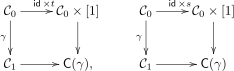
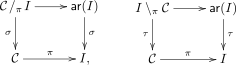


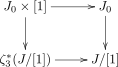

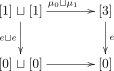


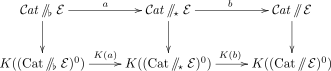

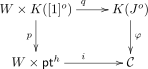


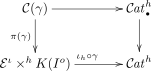


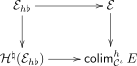


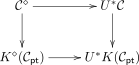





|
 Contact us:
 |
Terms of Use
|
Registration to the website |
Logotypes |
|