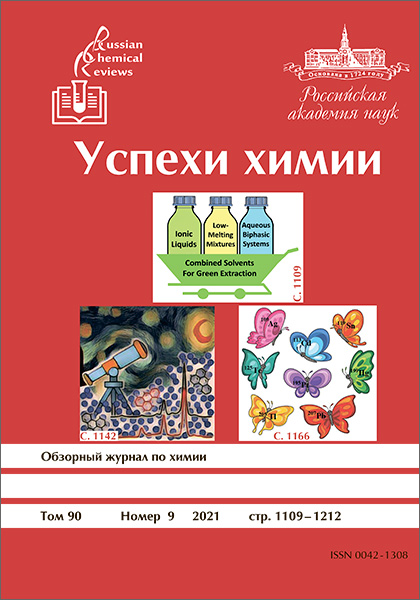
Успехи химии
RUS  ENG    ЖУРНАЛЫ   ПЕРСОНАЛИИ   ОРГАНИЗАЦИИ   КОНФЕРЕНЦИИ   СЕМИНАРЫ   ВИДЕОТЕКА   ПАКЕТ AMSBIB  
Общая информация
Последний выпуск
Архив
Импакт-фактор
Правила для авторов

Поиск публикаций
Поиск ссылок

RSS
Последний выпуск
Текущие выпуски
Архивные выпуски
Что такое RSS


Усп. хим.:
Год:
Том:
Выпуск:
Страница:
Найти


Персональный вход:
Логин:
Пароль:
Запомнить пароль
Войти
Забыли пароль?
Регистрация


Успехи химии, 2021, том 90, выпуск 9, страницы 1142–1165
DOI: https://doi.org/10.1070/RCR4995
(Mi rcr4356)
 

Эта публикация цитируется в 21 научных статьях (всего в 21 статьях)

Matrix isolation in laboratory astrochemistry: state-of-the-art, implications and perspective

Vladimir I. Feldmana, Sergey V. Ryazantsevbac, Svetlana V. Kamenevade

a Department of Chemistry, Lomonosov State University, Moscow
b Skolkovo Institute of Science and Technology, Moscow
c Moscow Institute of Physics and Technology, Dolgoprudny, Moscow Region
d Kurnakov Institute of General and Inorganic Chemistry of the Russian Academy of Sciences, Moscow
e National Research University Higher School of Economics, Moscow
Аннотация: Recent progress in observational astronomy and astrophysics has stimulated intensive laboratory studies aimed at elucidating the mechanisms of evolution of molecular matter in interstellar space and various space objects. One of the most intriguing and rapidly developing areas of these studies is the so-called “cold astrochemistry” devoted to the complex processes occurring in astrophysical ices. In this context, the matrix isolation technique (known for decades) is a very useful approach for both interpreting the results of astrophysical observations and verifying possible mechanisms of key astrochemical processes. This review outlines the most important results of recent studies using the matrix isolation technique. In fact, the results of these studies contribute to “cold” astrochemistry in two main aspects: (i) spectroscopy of astrochemically important molecules, ions and radicals stabilized in cryogenic matrices; (ii) experimental modeling of mechanisms of radiation-induced and “in dark” chemical reactions occurring in “cold” space environments (interstellar, cometary and planetary ices). In the first aspect, special attention is paid to new spectroscopic data obtained using various methods (electronic and vibrational absorption spectroscopy, electron paramagnetic resonance spectroscopy). In the second aspect, we consider the chemical effects resulting from both direct excitation of isolated molecules and the transfer of energy initially absorbed by the medium. Special attention has been paid to recent studies of spectroscopic characteristics and radiation-induced evolution of matrix-isolated weak intermolecular complexes, which can be considered “building blocks” for the cold synthesis of complex molecules in the absence of diffusion mobility. In addition, we consider the use of matrix isolation for the studies of low-temperature chemical reactions “in dark” involving atoms and highly reactive intermediates, which can occur in cold space environments. In the final part, we briefly discuss the applicability of the results of matrix isolation experiments for interpretation of the mechanisms in molecular ices and highlight the prospects of this field. The review can also be useful for specialists in various aspects of chemistry and chemical physics (radiation chemistry, photochemistry, molecular spectroscopy, low-temperature chemistry).
The bibliography includes 379 references.
Ключевые слова: Matrix isolation, Astrochemistry, Low temperatures, Cosmic ices, Spectroscopy, Radiation chemistry, Photochemistry, Reactive intermediates.
Финансовая поддержка Номер гранта
Российский фонд фундаментальных исследований 19-13-50274
This work was supported by the Russian Foundation for Basic Research, Project 19-13-50274.
Поступила в редакцию: 21.08.2020
Англоязычная версия:
Russian Chemical Reviews, 2021, Volume 90, Issue 9, Pages 1142–1165
DOI: https://doi.org/10.1070/RCR4995
Реферативные базы данных:
Тип публикации: Статья
Язык публикации: английский
Образец цитирования: Vladimir I. Feldman, Sergey V. Ryazantsev, Svetlana V. Kameneva, “Matrix isolation in laboratory astrochemistry: state-of-the-art, implications and perspective”, Усп. хим., 90:9 (2021), 1142–1165; Russian Chem. Reviews, 90:9 (2021), 1142–1165
Цитирование в формате AMSBIB
\RBibitem{FelRyaKam21}
\by Vladimir~I.~Feldman, Sergey~V.~Ryazantsev, Svetlana~V.~Kameneva
\paper Matrix isolation in laboratory astrochemistry: state-of-the-art, implications and perspective
\jour Усп. хим.
\yr 2021
\vol 90
\issue 9
\pages 1142--1165
\mathnet{http://mi.mathnet.ru/rcr4356}
\crossref{https://doi.org/10.1070/RCR4995}
\adsnasa{https://adsabs.harvard.edu/cgi-bin/bib_query?2021RuCRv..90.1142F}
\elib{https://elibrary.ru/item.asp?id=47508086}
\transl
\jour Russian Chem. Reviews
\yr 2021
\vol 90
\issue 9
\pages 1142--1165
\crossref{https://doi.org/10.1070/RCR4995}
\isi{https://gateway.webofknowledge.com/gateway/Gateway.cgi?GWVersion=2&SrcApp=Publons&SrcAuth=Publons_CEL&DestLinkType=FullRecord&DestApp=WOS_CPL&KeyUT=000706741900002}
\scopus{https://www.scopus.com/record/display.url?origin=inward&eid=2-s2.0-85114318617}
Образцы ссылок на эту страницу:
  • https://www.mathnet.ru/rus/rcr4356
  • https://www.mathnet.ru/rus/rcr/v90/i9/p1142
  • Эта публикация цитируется в следующих 21 статьяx:
    Citing articles in Google Scholar: Russian citations, English citations
    Related articles in Google Scholar: Russian articles, English articles
    Успехи химии Успехи химии
     
      Обратная связь:
     Пользовательское соглашение  Регистрация посетителей портала  Логотипы © Математический институт им. В. А. Стеклова РАН, 2025