| Izvestiya: Mathematics |
|
|


|
|


|
A sample iterated small cancellation theory for groups of Burnside type I. G. Lysenok Steklov Mathematical Institute of Russian Academy of Sciences, Moscow, Russia
Bibliographic databases:
   § 1. IntroductionThe free $m$-generated Burnside group $B(m,n)$ of exponent $n$ is, by definition, the relatively free group in the variety of groups satisfying the identity $x^n =1$, i.e., $B(m,n) \simeq F_m / F_m^n$, where $F_m$ is the free group of rank $m$ and $F_m^n$ is the subgroup of $F_m$ generated by all $n$th powers. Obtaining a structural information about groups $B(m,n)$ is known to be a difficult problem. The primary question of this sort is whether $B(m,n)$ is finite for given $m, n \geqslant 2$. The question is known as the Burnside problem [1] and it is still not completely answered. The group is shown to be finite for exponents $n=2$, $3$ (see [1]), $n=4$ (see [2]), and $n=6$ (see [3]). A negative solution to the Burnside problem is given by the Novikov–Adian theorem [4], [5] stating that the Burnside group $B(m,n)$ of odd exponent $n \geqslant 665$ with $m \geqslant 2$ generators is infinite. Note that $B(m,r)$ is a homomorphic image of $B(m,n)$ if $n$ is a multiple of $r$, so in this case infiniteness of $B(m,r)$ implies that of $B(m,n)$. The case when the exponent $n$ does not have a large odd divisor was treated in [6], [7]. As for now, infiniteness of $B(m,n)$ is established for exponents of the form $n=557r$ or $n \geqslant 8000$ and any number $m\geqslant 2$ of generators, see [8], [7]. It is strongly believable that non-cyclic free Burnside groups $B(m,n)$ are infinite for considerably lower values of $n$. A principal step in understanding the structure of the group $B(m,n)$ in the infinite case was made in the fundamental work by Novikov and Adian [4] and its improved version [5]. One of the ingredients of the proof was a tightly interweaved version of the small cancellation theory similar to one developed by Tartakovskiĭ[9]. It was also shown in [5] that, for $m \geqslant 2$ and odd $n \geqslant 665$, the group $B(m,n)$ has several properties similar to key properties of small cancellation groups. A basic one is a layered Dehn’s property: a freely reduced non-empty word representing the identity in the group contains a large part of a defining relator modulo relations of the previous layer. This easily implies that any such word should contain a subword of the form $X^t$ for a sufficiently large $t$ which in turn implies that $B(m,n)$ is infinite. Unfortunately, the approach due to Novikov–Adian, even in its polished and improved form in [5], is extremely technical and has a complicated logical structure. Several later works [10]–[13], [8] pursued the goal to find a more conceptually explicit and technically simpler approach to infinite Burnside groups, and more generally, to “infinite quotient of bounded exponent” phenomena in wider classes of groups as in [12]–[14]. As an underlying basic idea, all these approaches utilize a small cancellation theory in a more or less explicit form though based on different implementation techniques. It was eventually realized that iterated small cancellation theory is indeed a relevant framework to present Burnside groups of large exponents as well as many other examples of infinitely presented groups of a “monster” nature. In an explicit form, a relevant version of the theory was formulated by Gromov and Delzant [12] and Coulon [13]. However, both approaches need extremely large exponents to be applied to Burnside groups. (In fact, the both incorporate “non-constructive” tools so that the proof does not provide any explicit lower bound on the exponent $n$.) Two questions naturally arise. What is the lower bound on the exponent $n$ for which the iterated small cancellation approach can be applied to Burnside groups $B(m,n)$? Do we need a sophisticated technical framework to use the approach for reasonably small values of the exponent; for example, for values which are about several hundreds or less? The main goal of the present paper is to develop a sample version of the iterated small cancellation theory specially designed for free Burnside groups $B(m,n)$ with a “moderate” lower bound on the exponent $n$. More precisely, our technique works for odd exponents $n > 2000$. We consider our approach as a first approximation and an introduction to a considerably more technical result on infiniteness of Burnside groups with substantially smaller bounds on the exponent. § 2. The iterated small cancellation condition2.1.We fix a group $G$ given by a graded presentation
$$
\begin{equation}
\biggl\langle\mathcal{A}\biggm| R= 1 \ \biggl(R \in \bigcup_{\alpha\geqslant 1} \mathcal{X}_\alpha\biggr)\biggr\rangle.
\end{equation}
\tag{2.1}
$$
Here, we assume that the set of defining relators is partitioned into the union of subsets $\mathcal{X}_\alpha$ indexed by a positive integer $\alpha$. We call cyclic shifts of words $R \in \mathcal{X}_\alpha^{\pm1}$ relators of rank $\alpha$. Thus, the set of all relators of rank $\alpha$ is symmetrized, i.e., closed under cyclic shifts and taking inverses. With the presentation of $G$, there are naturally associated level groups $G_\alpha$ defined by all relations of rank up to $\alpha$, i.e.,
$$
\begin{equation}
G_\alpha = \biggl\langle \mathcal{A}\biggm| R= 1 \ \biggl(R \in \bigcup_{\beta\leqslant \alpha} \mathcal{X}_\beta\biggr)\biggr\rangle.
\end{equation}
\tag{2.2}
$$
2.2.Our small cancellation condition depends on two positive real-valued parameters $\lambda$ and $\Omega$ satisfying
$$
\begin{equation}
\lambda \leqslant \frac{1}{24}, \qquad \lambda \Omega \geqslant 20.
\end{equation}
\tag{2.3}
$$
We also introduce two other parameters with fixed value: The role of $\lambda$, $\Omega$, $\rho$ and $\zeta$ can be described as follows: $\bullet$ $\lambda$ is an analog of the small cancellation parameter in the classical condition $C'(\lambda)$; $\bullet$ $\Omega$ is the lower bound on the size of a relator $R$ of rank $\alpha$ in terms of the length function $|\,{\cdot}\,|_{\alpha-1}$ associated with $G_{\alpha-1}$ (defined below in 2.7); see condition (S1) in 2.8; $\bullet$ $\rho$ is the reduction threshold used in the definition of a reduced in $G_\alpha$ word; informally, a reduced in $G_\alpha$ word cannot contain more that $\rho$th part of a relator of rank $\alpha$ up to closeness in $G_{\alpha-1}$; $\bullet$ $\zeta$ is the rank scaling factor; it determines how the function $|\,{\cdot}\,|_\alpha$ rescales when incrementing the rank. 2.3.For any $\alpha \geqslant 0$, we introduce the set $\mathcal{H}_\alpha$ of bridge words of rank $\alpha$ recursively by setting
$$
\begin{equation*}
\begin{aligned} \, \mathcal{H}_0 &= \{\text{the empty word}\}, \\ \mathcal{H}_{\alpha} &= \{u S v\mid u,v \in \mathcal{H}_{\alpha-1}, \ S \text{ is a subword of a relator of rank } \alpha\}. \end{aligned}
\end{equation*}
\notag
$$
The definition immediately implies that $\mathcal{H}_{\alpha-1} \subseteq \mathcal{H}_{\alpha}$. Note also that all sets $\mathcal{H}_\alpha$ are closed under taking inverses. 2.4.We call two elements $x,y \in G_\alpha$ close if $x = uyv$ for some $u,v \in \mathcal{H}_\alpha$. This relation will be often used in the case when $x$ and $y$ are represented by words in the generators $\mathcal{A}$. In that case we say that words $X$ and $Y$ are close in rank $\alpha$ if they represent close elements of $G_\alpha$, or, equivalently, $X = uYv$ in $G_\alpha$ for some $u,v \in \mathcal{H}_\alpha$. 2.5.For $\alpha\geqslant0$, the set $\mathcal{R}_\alpha$ of words reduced in $G_\alpha$, the set of fragments of rank $\alpha$ and the length function $|\,{\cdot}\,|_\alpha$ are defined by joint recursion. A word $X$ in the generators $\mathcal{A}$ is reduced in $G_0$ if $X$ is freely reduced. A word $X$ is reduced in $G_\alpha$ for $\alpha\geqslant 1$ if it is reduced in $G_{\alpha-1}$ and the following is true: if a subword $S$ of a relator $R$ of rank $\alpha$ is close in rank $\alpha-1$ to a subword of $X$, then A word $X$ is cyclically reduced in $G_\alpha$ if any cyclic shift of $X$ is reduced in $G_\alpha$.2.6.A non-empty word $F$ is a fragment of rank $\alpha\geqslant 1$ if $F$ is reduced in $G_{\alpha-1}$ and is close in rank $\alpha-1$ to a subword $P$ of a word of the form $R^k$, where $R$ is a relator of rank $\alpha$. (In almost all situations $P$ will be a subword of a cyclic shift of $R$.) A fragment of rank $0$ is a word of length $1$, i.e., a single letter of the alphabet $\mathcal{A}^{\pm1}$. It is convenient to assume that each fragment $F$ of rank $\alpha\geqslant 1$ is considered with fixed associated words $P$, $u$, $v$ and a relator $R$ of rank $\alpha$ such that $F = uPv$ in $G_{\alpha-1}$, $u,v \in \mathcal{H}_{\alpha-1}$ and $P$ is a subword of $R^k$ for some $k > 0$, i.e., a fragment is formally a quintuple $(F,P,u,v,R)$. 2.7.A fragmentation of rank $\alpha$ of a (linear or cyclic) word $X$ is a partition of $X$ into non-empty subwords of fragments of ranks $\beta \leqslant \alpha$. If $\mathcal{F}$ is a fragmentation of rank $\alpha$ of $X$, then by definition, the weight of $\mathcal{F}$ in rank $\alpha$ is defined by
$$
\begin{equation*}
\operatorname{weight}_\alpha(\mathcal{F}) = m_\alpha + \zeta m_{\alpha-1} + \zeta^2 m_{\alpha-2} + \dots + \zeta^\alpha m_0,
\end{equation*}
\notag
$$
where $m_\beta$ is the number of subwords of fragments of rank $\beta$ in $\mathcal{F}$. Here, we assume that each subword in $\mathcal{F}$ is assigned a unique rank $\beta$. We now define a semi-additive length function $|\,{\cdot}\,|_\alpha$ on words in the generators $\mathcal{A}$:
$$
\begin{equation*}
|X|_\alpha = \min\{\operatorname{weight}_\alpha(\mathcal{F})\mid \mathcal{F} \text{ is a fragmentation of rank } \alpha\text{ of }X\}.
\end{equation*}
\notag
$$
Note that $|X|_0$ is the usual length $|X|$ of $X$. 2.8.The iterated small cancellation condition consists of the following three conditions (S0)–(S3) where the quantifier “for all $\alpha\geqslant1$” is assumed. (S0) (“Relators are reduced”) Any relator of rank $\alpha$ is cyclically reduced in $G_{\alpha-1}$. (S1) (“Relators are large”) Any relator $R$ of rank $\alpha$ satisfies (S2) (“Small overlapping”) For $i=1,2$, let $S_i$ be a starting segment of a relator $R_i$ of rank $\alpha$. Assume that $S_1 = u S_2 v$ in $G_{\alpha-1}$ for some $u,v \in \mathcal{H}_{\alpha-1}$ and $|S_1|_{\alpha-1} \geqslant \lambda |R_1|_{\alpha-1}$. Then $R_1 = u R_2 u^{-1}$ in $G_{\alpha-1}$. 2.9.It can be proved that a group $G$ satisfying conditions (S0)–(S2) possesses core properties of small cancellation groups, in particular, a version of Dehn’s property. We will impose, however, an extra condition on the graded presentation of $G$ which implies cyclicity of all finite subgroups of groups $G_\alpha$ and avoids difficulties caused by existence of non-cyclic finite subgroups in the case of Burnside groups $B(m,n)$ of even exponent $n$. (S3) (“No inverse conjugate relators”) No relator of rank $\alpha$ is conjugate in $G_{\alpha-1}$ to its inverse. As we see below, this condition is satisfied if each relator $R$ of rank $\alpha$ has the form $R_0^n$, where the exponent $n$ (which can vary for different $R$) is odd and $R_0$ is a non-power in $G_{\alpha-1}$. See the corollary in 13.11. Starting from § 8, we will use a mild extra assumption on the graded presentation (2.1) by requiring it to be normalized in the following sense. The assumption is not essential and just makes arguments simpler (mainly due to Lemma 8.1) slightly improving bounds on the constants. 2.10.Definition. We call a graded presentation (2.1) normalized if the following assertions hold: (i) every relator $R \in \mathcal{X}_\alpha$ has the form $R \eqcirc R_0^t$, where $R_0$ represents a non-power element of $G_{\alpha-1}$ (i.e., $R_0$ does not represent in $G_{\alpha-1}$ an element of the form $g^k$ for $k \geqslant 2$); we call $R_0$ the root of a relator $R$; (ii) if $R, S \in \mathcal{X}_\alpha$ and $R \ne S$, then $R$ and $S$ are not conjugate in $G_{\alpha-1}$. Note that the condition to be normalized is not restrictive: every graded presentation can be replaced with a normalized one (although formally speaking, this replacement could affect the iterated small cancellation condition; however, in real applications this would hardly be the case). Remark. Checking conditions (S0)–(S3) requires knowledge about groups $G_{\alpha-1}$. Thus presenting a group by relations satisfying the iterated small cancellation condition already requires a proof of properties of groups $G_\alpha$ by induction on the rank. § 3. Main resultsAs in the case of classical small cancellation, the iterated small cancellation condition has strong consequences on the presented group $G$. A basic one is an analog of the Dehn property: every non-empty freely reduced word representing the trivial element of the group “contains a large part” of a relator. In what follows, we assume that a group $G$ is given by a normalized graded presentation satisfying conditions (S0)–(S3) above and, for any $\alpha\geqslant0$, $G_\alpha$ denotes the group defined by all relations of ranks up to $\alpha$. We say that a word $X$ is reduced in $G$ if it is reduced in $G_\alpha$ for all $\alpha \geqslant 0$. The following theorem is an immediate consequence of Proposition 7.6. Theorem 1. Let $X$ be a non-empty word in the generators $\mathcal{A}$. If $X$ reduced in $G_\alpha$, then $X \ne 1$ in $G_\alpha$. If $X$ is reduced in $G$, then $X \ne 1$ in $G$. By expanding the definition of a reduced word in $G$ we get an equivalent formulation which is more in the spirit of the small cancellation theory. Corollary. Let $X$ be a freely reduced non-empty word. If $X = 1$ in $G$, then for some $\alpha\geqslant1$, $X$ has a subword close in $G_{\alpha-1}$ to a subword $P$ of a relator $R$ of rank $\alpha$ with $ |P|_{\alpha-1} \geqslant \rho |R|_{\alpha-1}$. In the classical small cancellation theory, existence of a Dehn reduced representatives for group elements is a simple consequence of the fact that a word containing more than a half of a relator can be shortened by applying the corresponding relation. This approach does not work in our version of the iterated small cancellation and existence of reduced representatives is a nontrivial fact proved below and formulated in Proposition 11.1 and Corollary 14.8. Theorem 2. Every element of $G_\alpha$ can be represented by a word reduced in $G_\alpha$. Every element of $G$ can be represented by a word reduced in $G$. Many other properties of groups $G_\alpha$ and $G$ are established in §§ 5–14. Our principal result shows that our version of the iterated small cancellation theory can be applied to free Burnside groups of odd exponent $n$ with a moderate lower bound on $n$. The following theorem is a consequence of Propositions 16.8 and Corollary 16.10 (see also 15.4). Theorem 3. For odd $n > 2000$ and $m \geqslant 2$, the free Burnside group $B(n,m)$ has a normalized graded presentation satisfying conditions (S0)–(S3) with $\lambda = 80/n$, $\Omega = 0.25 n$. The following theorem is a well known property of Burnside groups of sufficiently large odd exponent. It is direct consequence of Propositions 9.14 and 16.6 (the definition of $\omega$ is given in 15.4). Theorem 4. Let $n > 2000$ be odd. Let $X$ be a non-empty freely reduced word that is equal to $1$ in $B(m,n)$. Then $X$ has a subword of the form $C^{480}$, where $C \in \bigcup_{\alpha\geqslant 1} \mathcal{E}_\alpha$. Note that, with existence of infinite aperiodic words in the 2-letter alphabet (see for example § I.3 in [5]), this implies infiniteness of $B(n,m)$ for odd $n > 2000$ and $m\geqslant 2$. Some remarksThe present approach has much in common with [7]. However, the approach in [7] was based on the assumption that the defining relations of the group under consideration are of the form $x^n=1$ for sufficiently large $n$. Although the general scheme of a large portion of our proofs is the same as in [7], our arguments are in different technical environment. We tried to make the iterated small cancellation condition as simple as possible. In particular, we use a simple version of closeness in groups $G_\alpha$ (see 2.3 and 2.4). However, when presenting the free Burnside group as an iterated small cancellation group, this version is not optimal for the bound on the exponent. A more refined version would significantly lower the bound. Nevertheless, we consider the bound $n > 2000$ on the exponent as a reasonable balance between its optimality and the complexity of definitions and proofs. The whole approach relies essentially on the simultaneous induction on the rank $\alpha$. Since the proof of required statements about groups $G_\alpha$ needs a comprehensive analysis of certain types of relations in groups of previous ranks, the number of assertions that constitute the inductive hypothesis in quite large (several tens). We think that a rather compound inductive hypothesis is an unavoidable feature of any “small cancellation” approach to infinite Burnside groups with a reasonably small lower bound on the exponent. Note that in the “basic” small cancellation theory in §§ 5–7 we use Proposition 7.8 (with its immediate consequence Proposition 7.9) as the only inductive hypothesis. We briefly mention the essential ingredients of our approach. Sections 5–7 are devoted to analysis of van Kampen diagrams over the presentation (2.2) of the group $G_\alpha$. In 5.1, we introduce diagrams with a special marking of the boundary so that the boundary loops of a diagram are divided into sides and bridges. The label of a side is a word reduced in $G_\alpha$ and bridges are “small” sections between sides labeled by bridge words of rank $\alpha$. According to the marking, there are diagrams of bigon, trigon, etc. type. We then analyze a global structure of a diagram with marked boundary using the notion of contiguity subdiagram (see 6.5). For the quantitative analysis, we use a version of discrete connection in the spirit of [15] and the corresponding discrete analog of the Gauss–Bonnet formula (Proposition 7.3). The main outcomes are the bound on the total size of sides of a diagram with no bonds (Propositions 7.9 and 7.12) and the “single layered” structure of diagrams of small complexity (Propositions 7.11 and 7.13). The results of §§ 5–7 serve as a background for further analysis of relations in $G_\alpha$. The most important type of relations under consideration are “closeness” relations in $G_\alpha$ of the form $X = uYv$, where $X,Y \in \mathcal{R}_\alpha$ and $u,v \in \mathcal{H}_\alpha$. The structural description of diagrams over the presentation of $G_\alpha$ transfers naturally to the language of the Cayley graph $\Gamma_\alpha$ of $G_\alpha$, see 9.4. In $\Gamma_\alpha$, words in the generators of the group are represented by paths and relations in $G_\alpha$ are represented by loops. The relation $X = uYv$ becomes a loop $\mathsf X^{-1} \mathsf u \mathsf Y \mathsf v$ in $\Gamma_\alpha$ which can be viewed as a coarse bigon; we also say that paths $\mathsf X$ and $\mathsf Y$ are close. The single layered structure of the filling diagram implies one-to-one correspondence between fragments of rank $\alpha$ in $\mathsf X$ and in $\mathsf Y$ that come from the 2-cells of the diagram, called active fragments of rank $\alpha$ with respect to the coarse bigon $\mathsf X^{-1} \mathsf u \mathsf Y \mathsf v$. To express the correspondence, we use the compatibility relation, defined in 8.6, on the set of fragments of rank $\alpha$ in $\Gamma_\alpha$ (i.e., paths in $\Gamma_\alpha$ labeled by fragments of rank $\alpha$): if $\mathsf K$ and $\mathsf M$ are the corresponding active fragments of rank $\alpha$ in $\mathsf X$ and $\mathsf Y$, respectively, then $\mathsf K$ and $\mathsf M^{-1}$ are compatible (Proposition 9.7). In § 9 we perform this passage from diagrams over the presentation of $G_\alpha$ to the Cayley graph $\Gamma_\alpha$. We establish several properties of coarse bigons, trigons and more generally, coarse polygons in $\Gamma_\alpha$. We consider also conjugacy relations in $G_\alpha$ which are represented by parallel infinite lines in $\Gamma_\alpha$ (see 4.3). A fundamental property of close paths $\mathsf X$ and $\mathsf Y$ in $\Gamma_\alpha$ with $\operatorname{label}(\mathsf X), \operatorname{label}(\mathsf Y) \in \mathcal{R}_\alpha$ is that the correspondence between fragments of rank $\alpha$ in $\mathsf X$ and $\mathsf Y$ extends to non-active ones. If $\mathsf K$ is a fragment in $\mathsf X$ of sufficiently large size, then there exists a fragment of $\mathsf M$ of rank $\alpha$ in $\mathsf Y$ such that $\mathsf K$ is compatible with either $\mathsf M$ or $\mathsf M^{-1}$, with possible exceptions of extreme positions of $\mathsf K$ in $\mathsf X$ (Proposition 10.6). Speaking informally, fragments of rank $\alpha$ play the role of letters when coincidence of words is replaced by closeness in $G_\alpha$. This property of close paths $\mathsf X$ and $\mathsf Y$ in $\Gamma_\alpha$ and its analogs for coarse trigons in $G_\alpha$ (Proposition 10.7) and for conjugacy relations in $G_\alpha$ (Propositions 10.10 and 10.12) provide a technical base to analyze further properties of the groups $G_\alpha$ and $G$. In particular, the correspondence between fragments of rank $\alpha$ in coarse bigons, under an appropriate adaptation, is crucial when we consider in § 13 close in $G_\alpha$ periodic words. In § 11, we prove that any element of $G_\alpha$ can be represented by a reduced word (Proposition 11.1) and is conjugate to an element represented by a cyclically reduced word and, moreover, by a strongly cyclically reduced word if it has infinite order (Definition 4.15, Proposition 11.5). Sections 12 and 13 are preparatory for analysis of periodic relations over $G_\alpha$. In § 12, we introduce the set of coarsely periodic words over $G_\alpha$ which are close (in a stronger sense then defined in 2.4) to periodic words with a strongly reduced in $G_\alpha$ period (Definition 12.4). The main result of § 13, Proposition 13.4, is an analog of a well-known property of periodic words stating that if two periodic words have a sufficiently large overlapping (for example, if they overlap for at least two of each of the periods) then they have a common period. In § 15 and § 16 we define a set of defining relations of the form $C^n = 1$ $\bigl(C \in \bigcup_{\alpha\geqslant 1} \mathcal{E}_\alpha\bigr)$ for the Burnside group $B(m,n)$ and prove that this set satisfies the iterated small cancellation condition (S0)–(S3). More precisely, in Definitions 15.1–15.3 we describe the recursive step to define $\mathcal{E}_{\alpha+1}$ given $\mathcal{E}_\beta$ for $\beta\leqslant\alpha$, i.e., given the presentation of $G_\alpha$. The principal idea underlying the construction of the sets $\mathcal{E}_\alpha$ can be roughly described as “classification of periodic words by depth of periodicity” and is similar to the one used in [4], [5]. Note that other approaches [6], [10]–[14] to groups of “Burnside type” use construction of periodic relations $C^n = 1$, where for the next rank, $C$ are chosen to be “short in size” with respect to the current group. We believe that the “depth of periodicity” approach, allthough more technical in several aspects, gives a more optimal lower bound on the exponent $n$. § 4. PreliminariesStarting from § 5 we assume fixed a value of rank $\alpha \geqslant 0$ and a presentation (2.2) of a group $G_\alpha$ with relators $R \in \mathcal{X}_\beta$ defined for all ranks $\beta \leqslant \alpha$. We assume that the presentation of $G_\alpha$ is normalized and satisfies conditions (S0)–(S3) and inequalities (2.3) for all ranks up to the fixed value $\alpha$. In the proofs we will use forward references to statements for smaller values of rank, as already established. We will use references like “Proposition 2.3$_{\alpha-1}$” or “Lemma 3.4$_{<\alpha}$”, etc., which mean “the statement of Proposition 2.3 for rank $\alpha-1$” or “the statement of Lemma 3.4 for all ranks $\beta < \alpha$”, respectively. With a few exceptions, statements whose formulation includes the case $\alpha=0$ are trivial or follow directly from definitions in that case. 4.1. WordsWe fix a set $\mathcal{A}$ of generators for a group $G$. By a word we always mean a group word over the alphabet $\mathcal{A}^{\pm1} = \mathcal{A} \cup \{a^{-1}\mid a\in \mathcal{A}\}$. We use notation $X \eqcirc Y$ for identical equality of words $X$ and $Y$. By $X^\circ$ we denote the cyclic word represented by a plain word $X$. A subword $Y$ of a word $X$ is always considered with an associated occurrence of $Y$ in $X$ that is clear from the context. To make it formal, we associate with a subword $Y$ of $X$ a pair of words $(U, V)$ such that $UYV \eqcirc X$. If $Y$ is a subword of $X$ with an associated pair $(U, V)$, then writing $Y \eqcirc WZ$ we mean that $W$ and $Z$ are viewed as subwords of $X$ with associated pairs $(U, ZV)$ and $(UW, V)$, respectively. Note that “subword $Y$ of $X_1$” and “subword $Y$ of $X_2$” are formally two distinct objects if $X_1\ne X_2$. It will be always clear from the context which ambient word is assumed for $Y$. A periodic word with period $A$, or an $A$-periodic word for short, is any subword of $A^t$ for $t > 0$. According to the convention about subwords, an $A$-periodic word $P$ is always considered with an associated occurrence of $P$ in a word $A^t$. A partition of a word $X$ is a representation of $X$ as concatenation $X = X_1 \cdot X_2 \cdots X_k$ of some subwords $X_i$. A word $X$ is covered by a collection of words $(Y_i)_i$ if $X$ admits a partition $X = X_1 \cdot X_2 \cdots X_k$ such that $X_i$ is a subword of some $Y_{t_i}$ and $t_i \ne t_j$ for $i \ne j$. 4.2. GraphsWe use the term “graph” as a synonym for “combinatorial 1-complex”. Edges of a graph are considered as having one of the two possible directions, so formally all our graphs are directed. By $\iota(\mathsf e)$ and $\tau(\mathsf e)$ we denote the starting and the ending vertices of an edge $\mathsf e$, respectively, and $\mathsf e^{-1}$ denotes the inverse edge. An $\mathcal{A}$-labeling on a graph $\Gamma$ is a function from the set of edges of $\Gamma$ with values in $\mathcal{A}^{\pm1} \cup \{1\}$ such that $\operatorname{label}(\mathsf e^{-1}) = \operatorname{label}(\mathsf e)^{-1}$ for any $\mathsf e$; here $1$ denotes the empty word. An $\mathcal{A}$-labeling naturally transfers to paths in $\Gamma$, so the label of a path $\mathsf P$ is a word in $\mathcal{A}^{\pm1}$. If $\mathsf P$ is a path in $\Gamma$, then $\iota(\mathsf P)$ and $\tau(\mathsf P)$ denote the starting and the ending vertices of $\mathsf P$, respectively. For any vertex $\mathsf a$ of $\Gamma$, there is the unique empty path at $\mathsf a$. We identify this empty path with vertex $\mathsf a$ itself, so $\iota(\mathsf a) = \tau(\mathsf a) = \mathsf a$ and $\operatorname{label}(\mathsf a) = 1$. A path is simple if it visits no vertex twice. Two paths are disjoint if they have no common and no mutually inverse edges. A line in $\Gamma$ is a bi-infinite path (we do not assume that lines have no loops). If $\mathsf X$ and $\mathsf Y$ are subpaths of a simple path $\mathsf Z$, then we write $\mathsf X \ll \mathsf Y$ if $\mathsf Z = \mathsf Z_1 \mathsf X \mathsf Z_2 \mathsf Y \mathsf Z_3$ for some $\mathsf Z_i$ and $\mathsf X < \mathsf Y$ if $\mathsf Z = \mathsf Z_1 \mathsf X \mathsf u \mathsf Z_2 = \mathsf Z_1 \mathsf v \mathsf Y \mathsf Z_2$ for some $\mathsf Z_i$ and non-empty $\mathsf u$ and $\mathsf v$. Although both relations depend on $\mathsf Z$, it will be always clear from the context which $\mathsf Z$ is assumed. Clearly, if neither $\mathsf X$ and $\mathsf Y$ is contained in the other then either $\mathsf X < \mathsf Y$ or $\mathsf Y < \mathsf X$. The union $\mathsf X \cup \mathsf Y$ of subpaths $\mathsf X$ and $\mathsf Y$ of $\mathsf Z$ is the shortest subpath of $\mathsf Z$ containing both $\mathsf X$ and $\mathsf Y$. The Cayley graph $\Gamma(G,\mathcal{A})$ of a group $G$ with a generating set $\mathcal{A}$ is naturally viewed as an $\mathcal{A}$-labeled graph. We identify vertices of $\Gamma(G,\mathcal{A})$ with elements of $G$, so if $\iota(\mathsf P) = \mathsf a$ and $\tau(\mathsf P) = \mathsf b$, then $\operatorname{label}(\mathsf P)$ is a word representing $\mathsf a^{-1} \mathsf b$. The group $G$ acts on $\Gamma(G,\mathcal{A})$ by left multiplication. A path $\mathsf P$ in $\Gamma(G,\mathcal{A})$ labeled by an $A$-periodic word is an $A$-periodic segment. An $A$-periodic line is a bi-infinite path labeled by $A^\infty$. Since an $A$-periodic word is assumed to have an associated occurrence in some $A^t$, an $A$-periodic segment $\mathsf P$ can be uniquely extended to an $A$-periodic line called the infinite periodic extension of $\mathsf P$. If $\mathsf P$ and $\mathsf Q$ are $A$-periodic segments, $\mathsf P$ is a subpath of $\mathsf Q$ and the both have the same infinite periodic extension then $\mathsf Q$ is a periodic extension of $\mathsf P$. We define also the translation element $s_{A,\mathsf P} \in G$ that shifts the infinite periodic extension $\mathsf L$ of $\mathsf P$ forward by a period $A$. By definition, $s_{A,\mathsf P}$ can be computed as follows. Take any vertex $\mathsf a$ on $\mathsf L$ such that the label of $\mathsf L$ at $\mathsf a$ starts with $A$. Then $s_{A,\mathsf P} = \mathsf a A \mathsf a^{-1}$. If $\mathsf L_1$ and $\mathsf L_2$ are two periodic lines with periods $A_1$ and $A_2$, respectively then $\mathsf L_1$ and $\mathsf L_2$ are parallel if $s_{A_1,\mathsf L_1} = s_{A_2,\mathsf L_2}$. 4.3. Mapping relations in the Cayley graphIt follows from the definition of the Cayley graph that a word $X$ in the generators $\mathcal{A}$ represents the identity of $G$ if and only if some (and therefore, any) path $\mathsf X$ in $\Gamma(G,\mathcal{A})$ with $\operatorname{label}(\mathsf X) \eqcirc X$ is a loop. Thus relations in $G$ are represented by loops in $\Gamma(G,\mathcal{A})$. This representation will be our basic tool to analyze relations in a group using geometric properties of its Cayley graph. We will often use the following notational convention. If $X_1 X_2 \dots X_n = 1$ is a relation in a group $G$, then we represent it by a loop $\mathsf X_1 \mathsf X_2 \dots \mathsf X_n$ in the Cayley graph of $G$ typed with the same letters in sans serif where, by default, $\operatorname{label}(\mathsf X_i) \eqcirc X_i$ for all $i$. We represent also conjugacy relations in $G$ by parallel periodic lines in $\Gamma(G,\mathcal{A})$ as follows. Let $X = Z^{-1} Y Z$ in $G$. Consider a loop $\mathsf X^{-1} \mathsf Z^{-1} \mathsf Y \mathsf Z'$ in $\Gamma(G,\mathcal{A})$ with $\operatorname{label}(\mathsf X) \eqcirc X$, $\operatorname{label}(\mathsf Y) \eqcirc Y$ and $\operatorname{label}(\mathsf Z) \eqcirc \operatorname{label}(\mathsf Z') \eqcirc Z$. We extend $\mathsf X$ to an $X$-periodic line $\mathsf L_1 = \dots \mathsf X_{-1} \mathsf X_0 \mathsf X_1 \dots$ with $\operatorname{label}(\mathsf X_i) \eqcirc X$ and $\mathsf X_0 = \mathsf X$ and, in a similar way, extend $Y$ to a $Y$-periodic line $\mathsf L_2 = \dots \mathsf Y_{-1} \mathsf Y_0 \mathsf Y_1 \dots$ with $\operatorname{label}(\mathsf Y_i) \,{\eqcirc}\, Y$ and $\mathsf Y_0 = \mathsf Y$. Then we get a pair of parallel lines $\mathsf L_1$ and $\mathsf L_2$ that represents conjugacy of $X$ and $Y$ in $G$. We will be freely switch between the language of paths in Cayley graphs and word relations. 4.4. Van Kampen diagramsLet $G$ be a group with a presentation $\mathcal{P} \,{=}\, \langle \mathcal{A}\,|\,\mathcal{R}\rangle$. A diagram $\Delta$ over $\mathcal{P}$ is a finite 2-complex $\Delta$ embedded in $\mathbb R^2$ with a given $\mathcal{A}$-labeling of the 1-skeleton $\Delta^{(1)}$ such that the label of the boundary loop of every 2-cell of $\Delta$ is either empty, has the form $a^{\pm1} a^{\mp1}$ for $a \in \mathcal{A}$ or is a relator in $\mathcal{R}^{\pm1}$. Note that here we use an extended version of the widely used definition by allowing boundary loops of 2-cells labeled with empty word or freely cancelable pair of letters. This allows us to avoid technical issues related to singularities (see § 11.5 in [11] or § 4 in [7]). By default, all diagrams are assumed to be connected. We refer to 2-cells of a diagram $\Delta$ simply as to cells; 1-cells and 0-cells are edges and vertices as usual. By $\delta \mathsf D$ we denote the boundary loop of a cell $\mathsf D$ and by $\delta \Delta$ we denote the unique boundary loop of $\Delta$ in case when $\Delta$ is simply connected. We fix an orientation of $\mathbb R^2$ and assume that boundary loops of cells of $\Delta$ and boundary loops of $\Delta$ are positively oriented with respect to the cell or to the diagram, respectively. This means, for example, that $(\delta \mathsf D)^{-1}$ is a boundary loop of the diagram $\Delta - \mathsf D$ obtained by removal of a cell $\mathsf D$ from $\Delta$. Note that boundary loops of $\Delta$ and of its cells are defined up to cyclic shift. According to van Kampen lemma (Theorem V.1.1 in [16] and Theorem 11.1 in [11]) a word $X$ in the generators $\mathcal{A}$ represents the identity in $G$ if and only if there exists a simply connected diagram $\Delta$ over $\mathcal{P}$ with $\operatorname{label}(\delta\Delta) \eqcirc X$. Words $X$ and $Y$ represent conjugate elements of $G$ if and only if there exists an annular (i.e., homotopy equivalent to an annulus) diagram over $\mathcal{P}$ with boundary loops $\mathsf X$ and $\mathsf Z$ such that $\operatorname{label}(\mathsf X) \eqcirc X$ and $\operatorname{label}(\mathsf Z) \eqcirc Y^{-1}$ (see Lemma V.5.2 in [16] and Theorem 11.2 in [11]). If $\Sigma$ is a subdiagram of $\Delta$, then $\Delta-\Sigma$ denotes the subdiagram of $\Delta$ obtained as the topological closure of the complement $\Delta \setminus \Sigma$. Let $\Delta$ and $\Delta'$ be diagrams over $\mathcal{P}$ such that $\Delta'$ is obtained from $\Delta$ by either
There are several common use cases for refinement. $\bullet$ By refinement any diagram can be made non-singular, i.e., homeomorphic to a punctured disk. In particular, any simply connected diagram can be refined to a non-singular disk. $\bullet$ If $\mathsf C$ is a boundary loop of $\Delta$ represented as a product $\mathsf C = \mathsf X_1 \cdots \mathsf X_k$ of paths $\mathsf X_i$, then, after refinement, the corresponding boundary loop of the new diagram $\Delta'$ becomes $\mathsf X_1' \cdots \mathsf X_k'$, where each $\mathsf X_i$ refines to a non-empty path $\mathsf X_i'$ (see the definition in 4.5). 4.5. Combinatorially continuous maps of graphsWe consider the class of maps between $\mathcal{A}$-labeled graphs which are label preserving and can be realized as continuous maps of topological spaces. More precisely, a map $\phi\colon \Lambda \to \Lambda'$ between $\mathcal{A}$-labeled graphs $\Lambda$ and $\Lambda'$ is combinatorially continuous if: $\bullet$ $\phi$ sends vertices to vertices and edges to edges or vertices; for any edge $\mathsf e$ of $\Lambda$, $\phi(\mathsf e)$ is a vertex only if $e$ has the empty label; if $\phi(\mathsf e)$ is an edge then $\operatorname{label}(\phi(\mathsf e)) = \operatorname{label}(\mathsf e)$; $\bullet$ if $\phi(\mathsf e)$ is an edge, then $\phi$ preserves the starting and the ending vertices of $\mathsf e$; if $\phi(\mathsf e)$ is a vertex, then $\phi(\mathsf e) = \phi(\iota(\mathsf e)) = \phi(\tau(\mathsf e))$. A combinatorially continuous map $\phi\colon \Lambda \to \Lambda'$ extends in a natural way to the map denoted also by $\phi$, from the set of paths in $\Lambda$ to the set of paths in $\Lambda'$. Clearly, $\phi$ preserves path labels. If a diagram $\Delta'$ is obtained from a diagram $\Delta$ by refinement, then we have a combinatorially continuous map $\phi\colon \Delta'^{(1)} \to \Delta^{(1)}$ induced by the sequence of contractions $\Delta' \to \Delta$. If $\mathsf P$ is a path in $\Delta$ and $\mathsf P' = \phi(\mathsf P)$, then $\mathsf P$ refines to $\mathsf P'$. 4.6. Mapping diagrams in Cayley graphsIt is well known that simply connected diagrams can be viewed as combinatorial surfaces in the Cayley complex of a group. Since we do not make use of two-dimensional structure, we adapt this view to the case of Cayley graphs. If $\Delta$ is a simply connected diagram over $\mathcal{P}$, then there exists a combinatorially continuous map $\phi\colon \Delta^{(1)} \to \Gamma(G,\mathcal{A})$. Any two such maps $\phi_1, \phi_2\colon \Delta^{(1)} \to \Gamma(G,\mathcal{A})$ differ by translation by some element $g \in G$, i.e., $\phi_1 = t_g \phi_2$, where $t_g \colon x \mapsto gx$ is the translation. In particular, if $\mathsf X$ is a loop in $\Gamma(G,\mathcal{A})$ and, for the boundary loop $\overline{\mathsf X}$ of $\Delta$, we have $\operatorname{label}(\overline{\mathsf X}) = \operatorname{label}(\mathsf X)$, then there is a map $\phi\colon \Delta^{(1)} \to \Gamma(G,\mathcal{A})$ such that $\phi(\overline{\mathsf X}) \eqcirc \mathsf X$. In this case, we say that $\Delta$ fills $\mathsf X$ via $\phi$. If $\Delta$ is not simply connected, then we can consider a combinatorially continuous map $\phi\colon \widetilde\Delta^{(1)} \to \Gamma(G,\mathcal{A})$, where $\widetilde\Delta$ is the universal cover of $\Delta$. Again, any two such maps $\phi_1, \phi_2\colon \widetilde\Delta^{(1)} \to \Gamma(G,\mathcal{A})$ differ by translation by an element of $G$. The set $\{\mathsf L_i\}_i$ of boundary loops of $\Delta$ lifts to a (possibly infinite) set of bi-infinite boundary lines $\{\widetilde{\mathsf L}_i^j\}_{i,j}$ of $\widetilde\Delta$ and thus produces a set of lines $\{\phi(\widetilde{\mathsf L}_i^j)\}_{i,j}$ in $\Gamma(G,\mathcal{A})$. Each $\phi(\widetilde{\mathsf L}_i^j)$ can be viewed as a $P_i$-periodic line with period $P_i =\operatorname{label}(\mathsf L_i)$. We will be interested mainly in the case when $\Delta$ is an annular diagram, i.e., homotopy equivalent to a circle. In this case, the boundary loops $\mathsf L_1$ and $\mathsf L_2$ of $\Delta$ produce two $P_i$-periodic lines $\phi(\widetilde{\mathsf L}_i)$, $i=1,2$, in $\Gamma(G,\mathcal{A})$ such that $\phi(\widetilde{\mathsf L}_1)$ and $\phi(\widetilde{\mathsf L}_2)^{-1}$ are parallel. 4.7.Definition. Let $\Delta$ and $\Delta'$ be diagrams of the same homotopy type over a presentation of a group $G$. We assume that a label preserving bijection $\mathsf L_i \mapsto \mathsf L_i'$ is given between boundary loops of $\Delta$ and $\Delta'$ (which is usually clear from the context). We say that $\Delta$ and $\Delta'$ have the same frame type if there exist combinatorially continuous maps $\phi\colon \widetilde\Delta^{(1)} \to \Gamma(G,\mathcal{A})$ and $\psi\colon \widetilde{\Delta}'^{(1)} \to \Gamma(G,\mathcal{A})$ such that, for each $i$, we have the same sets of lines (or loops if $\Delta$ and $\Delta'$ are simply connected) $\{\phi(\widetilde{\mathsf L}_i^j)\}_j = \{\psi(\widetilde{\mathsf L}'^j_i)\}_j$. The following two observations follow easily from the definition. 4.8.Lemma. Two simply connected diagrams $\Delta$ and $\Delta'$ have the same frame type if and only if the labels of their boundary loops are equal words. Let $\Delta$ and $\Delta'$ be annular diagrams with boundary loops $\{\mathsf L_1,\mathsf L_2\}$ and $\{\mathsf L_1',\mathsf L_2'\}$. Then $\Delta$ and $\Delta'$ have the same frame type if and only if the following is true. Take any vertices $\mathsf a_i$ on $\mathsf L_i$, $i=1,2$, and let $\mathsf p$ be a path from $\mathsf a_1$ to $\mathsf a_2$ in $\Delta$. Then there exist vertices $\mathsf a_i'$ on $\mathsf L_i'$, $i=1,2$, and a path $\mathsf p'$ from $\mathsf a_1'$ to $\mathsf a_2'$ in $\Delta'$ such that the label of $\mathsf L_i$ read at $\mathsf a_i$ and the label of $\mathsf L_i'$ read at $\mathsf a_i'$ are equal words and $\operatorname{label}(\mathsf p) = \operatorname{label}(\mathsf p')$ in $G$. 4.9.Lemma. Diagrams $\Delta$ and $\Delta'$ have the same frame type in the following two cases: $\bullet$ $\Delta'$ is obtained from $\Delta$ by refinement; $\bullet$ $\Delta'$ is obtained from $\Delta$ by cutting off a simply connected subdiagram and replacing it with another simply connected subdiagram. 4.10. Groups $G_\alpha$Throughout the paper, we will study a fixed family of groups $G_\alpha$ given by a presentation (2.2). Consequently, most of the related terminology will involve rank $\alpha$ as a parameter (though in some cases, it is not mentioned explicitly; for example, the already introduced measure $\mu_{\mathrm f}(F)$ of fragments of rank $\alpha$ formally depends on $\alpha$). Diagrams over the presentation of $G_\alpha$ are referred simply as diagrams over $G_\alpha$. For $1 \leqslant \beta \leqslant \alpha$, a cell of a diagram $\mathsf D$ over $G_\alpha$ with $\operatorname{label}(\delta \mathsf D) \in \mathcal{X}_\beta$ is a cell of rank $\beta$. Cells with trivial boundary labels (i.e., empty or of the form $aa^{-1}$) are cells of rank $0$. The Cayley graph of $G_\alpha$ is denoted by $\Gamma_\alpha$. Note that if $\beta > \alpha$, then we have a natural covering map $\Gamma_\beta \to \Gamma_\alpha$ of labeled graphs. A loop $\mathsf L$ in $\Gamma_\alpha$ lifts to $\Gamma_\beta$ as a loop if and only if $\operatorname{label}(\mathsf L) = 1$ in $G_\beta$. 4.11. PiecesBy a piece of rank $\alpha$ we call any subword (possibly empty) of a relator of rank $\alpha$. If $S$ is a subword of a cyclic shift of a relator $R$, then we say also that $S$ is a piece of $R$. We admit that a piece of rank $\alpha$ be the empty word. Note that our definition differs from the traditional view on a piece in the small cancellation theory as a common starting segment of two distinct relators. We assume that a piece $S$ of rank $\alpha$ always has an associated relator $R$ of rank $\alpha$ such that $S$ is a start of $R$; so formally a piece of rank $\alpha$ should be viewed as a pair of the form $(S,R)$. Associated relators are naturally inherited under taking subwords and inversion: if $S$ is a piece of rank $\alpha$ with associated relator $R = ST$ and $S = S_1 S_2$, then $S_1$ and $S_2$ are viewed as pieces of rank $\alpha$ with associated relators $R$ and $S_2 T S_1$, respectively and $S^{-1}$ is viewed as a piece of rank $\alpha$ with associated relator $S^{-1} T^{-1}$. For pieces of rank $\alpha$ we use a “measure” $\mu(S) \in [0,1]$ defined by $\mu(S) = |S|_{\alpha-1}/|R^\circ|_{\alpha-1}$ as in (8.1) where $R$ is the associated relator. (Recall that $R^\circ$ denotes the cyclic word represented by $R$.) If, for some $\beta$, $\mathsf S$ is a path in $\Gamma_\beta$ or in a diagram over the presentation of $G_\beta$ and $\mathsf S$ is labeled by a piece of a relator of rank $\alpha$ (or by an $R$-periodic word where $R$ is a relator of rank $\alpha$), then we abbreviate $\mu(\operatorname{label}(\mathsf S))$ simply as $\mu(\mathsf S)$. 4.12. Reformulation of conditions (S2) and (S3) in terms of Cayley graphThe following conditions on presentation (2.1) are equivalent to (S2) and (S3), respectively. (S2-Cayley) Let $\mathsf L_i$, $i=1,2$, be an $R_i$-periodic line in $\Gamma_{\alpha-1}$, where $R_i$ is a relator of rank $\alpha$. If $\mathsf L_1$ and $\mathsf L_2$ have close subpaths $\mathsf P_1$ and $\mathsf P_2$ with $|\mathsf P_i| \leqslant |R_i|$ and $\mu(\mathsf P) \geqslant \gamma$, then $\mathsf L_1$ and $\mathsf L_2$ are parallel. (S3-Cayley) There are no parallel $R$-periodic and $R^{-1}$-periodic lines in $\Gamma_{\alpha-1}$, where $R$ is a relator of rank $\alpha$. 4.13. Bridge partitionWe define also a bridge partition of rank $\alpha$ of a word $w \in \mathcal{H}_\alpha$ as follows. A bridge partition of rank $0$ is empty. A bridge partition of rank $\alpha \geqslant 1$ either $\bullet$ has the form $w_1 \cdot S \cdot w_2$, where $w_i \in \mathcal{H}_{\alpha-1}$ and $S$ is a piece of rank $\alpha$ called the central piece of $w$; or $\bullet$ is a single factor $w$ itself in the case $w \in \mathcal{H}_{\alpha-1}$. If $w$ is a bridge word of rank $\alpha$ endowed with a bridge partition $u \cdot S \cdot v$ and $ST$ is the relator of rank $\alpha$ associated with $S$, then $w' = u T^{-1} v$ is a bridge word of rank $\alpha$ equal to $w$ in $G_\alpha$. We say that $w'$ is obtained from $w$ by switching. In this case, we assume also that $w'$ is endowed with the bridge partition $u \cdot T^{-1} \cdot v$. Thus, applying the switching operation twice results in the initial word $w$. We will be considering paths in Cayley graphs $\Gamma_\beta$ labeled by bridge words of rank $\alpha$. We call them bridges of rank $\alpha$ (with a slight abuse of terminology, we will also use this term in § 5 for boundary paths with appropriate label in diagrams over the presentation of $G_\alpha$). If $\mathsf w$ is bridge of rank $\alpha$ in $\Gamma_\beta$, then a bridge partition of rank $\alpha$ of $\mathsf w$ is either a factorization $\mathsf w = \mathsf u \cdot \mathsf S \cdot \mathsf v$, where $\mathsf u$ and $\mathsf v$ are bridges of rank $\alpha-1$ and $\operatorname{label}(\mathsf S)$ is a piece of rank $\alpha$ or a trivial factorization with the single factor $\mathsf w$ if $\mathsf w$ is bridge of rank $\alpha-1$. In the former case, if also $\beta \geqslant \alpha$, we define the switching operation on $\mathsf w$ in a similar way as in the case of words; namely, we take the word $w'$ obtained from $w \eqcirc \operatorname{label}(\mathsf w)$ by switching and consider the path $\mathsf w'$ with $\operatorname{label}(\mathsf w') \eqcirc w'$ starting at the same vertex as $\mathsf w$. Since $w = w'$ in $\Gamma_\beta$, the bridges $\mathsf w$ and $\mathsf w'$ have the same endpoints. 4.14.The following properties of the function $|\,{\cdot}\,|_\alpha$ follow from the definition: (i) $|X|_\alpha + |Y|_\alpha -1 \leqslant |XY|_\alpha \leqslant |X|_\alpha + |Y|_\alpha$; in particular, if $Y$ is a subword of $X$, then $|Y|_\alpha \leqslant |X|_\alpha$; (ii) more generally, if a collection of words $(X_i)_i$ covers a (plain or cyclic) word $X$, then if $(X_i)_{1\leqslant i \leqslant k}$ is a collection $k$ of disjoint subwords of $X$, then(iii) $|X|_\alpha \leqslant \zeta |X|_{\alpha-1}$; (iv) $|X^\circ|_\alpha = \min\{|Y|_\alpha\mid Y \text{ is a cyclic shift of }X\}$. If $\mathsf X$ is a path in $\Gamma_\beta$ or in a diagram over the presentation of $G_\beta$, then we use abbreviation $|\mathsf X|_\alpha = |{\operatorname{label}(\mathsf X)}|_\alpha$. 4.15. Reduced wordsThe set of words reduced in $G_\alpha$ is denoted by $\mathcal{R}_\alpha$. The definition immediately implies that $\mathcal{R}_\alpha$ is closed under taking subwords. A word $X$ is strongly cyclically reduced in $G_\alpha$ if any power $X^t$ is reduced in $G_\alpha$. 4.16. Coarse polygon relationsA relation in $G_\alpha$ of the form where words $X_i$ are reduced in $G_\alpha$ and $u_i$ are bridge words of rank $\alpha$, is called a coarse $m$-gon relation in $G_\alpha$. We can write coarse polygon relations in different forms. For example, a coarse bigon relation can be written as $X = u Y v$, where $X$ and $Y$ are reduced in $G_\alpha$ and $u,v \in \mathcal{H}_\alpha$. In this form, the relation represents closeness of words $X$ and $Y$ in $G_\alpha$.4.17.We transfer some terminology from words to paths in $\Gamma_\alpha$. We call paths in $\Gamma_\alpha$ with label reduced in $G_\alpha$ simply reduced. Note that, according to Proposition 7.6, a reduced path $\mathsf X$ in $\Gamma_\alpha$ is simple. This implies that we can correctly treat the ordering of subpaths of $\mathsf X$, intersections of subpaths, unions etc. Two vertices of $\Gamma_\alpha$ are close if they can be joined by a bridge of rank $\alpha$ (see 4.13). Two paths $\mathsf X$ and $\mathsf Y$ in $\Gamma_\alpha$ are close if their starting vertices and their ending vertices are close. We say that a loop $\mathsf P = \mathsf X_1 \mathsf u_1 \mathsf X_2 \mathsf u_2 ,\dots,\mathsf X_r \mathsf u_r$ in $\Gamma_\alpha$ is a coarse $r$-gon if each $\mathsf X_i$ is reduced and each $\mathsf u_i$ is a bridge of rank $\alpha$. Paths $\mathsf X_i$ are sides of $\mathsf P$. Note that paths $\mathsf X$ and $\mathsf Y$ in $\Gamma_\alpha$ are close if and only if $\mathsf X^{-1} \mathsf u \mathsf Y \mathsf v$ is a coarse bigon for some $\mathsf u$ and $\mathsf v$. 4.18. SymmetryAll concepts (i.e., relations, functions, etc.) and statements involving paths in the Cayley graphs $\Gamma_\alpha$ are invariant under the action of $G_\alpha$ in a natural way. For example, if paths $\mathsf X$ and $\mathsf Y$ in $\Gamma_\alpha$ are close, then the paths $g\mathsf X$ and $g\mathsf Y$ are also close for any $g \in G_\alpha$. We adopt a convention (which is essential for the invariance) that the action of $G_\alpha$ is extended onto extra data associated with paths in $\Gamma_\alpha$: for example, if $\mathsf F$ is a fragment of rank $\beta$ with base $\mathsf P$, then $g \mathsf F$ is considered as a fragment of rank $\beta$ with base $g \mathsf P$ and so on. This implies, for example, that $\mu_{\mathrm f}(\mathsf F) = \mu_{\mathrm f}(g\mathsf F)$ for any $g \in G_\alpha$. We will implicitly use symmetry with respect to inversion. For example, if $\mathsf F$ is a fragment of rank $\beta$ with base $\mathsf P$, then $\mathsf F^{-1}$ is a fragment of rank $\beta$ with base $\mathsf P^{-1}$ and $\mu_{\mathrm f}(\mathsf F^{-1}) = \mu_{\mathrm f}(\mathsf F)$. If a statement admits two symmetric forms then only one of them is formulated (as in case of Lemma 10.15, for instance). 4.19. Numerical parametersIn many cases, it will be notationally more convenient to use instead of $\Omega$ its inverse: Note that by (2.3),
$$
\begin{equation}
\omega \leqslant \frac{1}{480}, \qquad \lambda \geqslant 20\omega.
\end{equation}
\tag{4.1}
$$
We will extensively use $\omega$ as a unit to measure pieces and fragments of rank $\alpha$. Condition (S1) in 2.8 will be often used in the following form: if $P$ is a piece of a relator $R$ of rank $\alpha$ then For reader’s convenience, we list our other global numerical parameters indicating the places where they first appeared:
$$
\begin{equation*}
\begin{gathered} \, \nu = \frac{\zeta}{1 - 2\zeta} = \frac{1}{18}, \qquad \theta = \frac16 (5 - 22\nu) = \frac{17}{27} \quad \text{(Proposition 7.4)}, \\ \eta = \frac{1+2\nu}{\theta} = \frac{30}{17} \quad \text{(Proposition 7.9)}, \\ \xi_0 = 7\lambda - 1.5\omega \quad \text{(Proposition 9.7)}, \\ \xi_1 = \xi_0 - 2.6\omega \quad \text{(Definition 12.2)}, \\ \xi_2 = \xi_1 - 2\lambda - 3.4\omega \quad \text{(Definition 12.4)}. \end{gathered}
\end{equation*}
\notag
$$
§ 5. Diagrams with marked boundary5.1. Boundary marking of rank $\alpha$We start with introducing a class of diagrams over presentation (2.2) of $G_\alpha$ with extra data which, in particular, represent coarse polygon relations in $G_\alpha$. Let $\Delta$ be a non-singular diagram over the presentation (2.2). We say that $\Delta$ has a boundary marking of rank $\alpha$ if, for each boundary loop $\mathsf L$ of $\Delta$, there is a fixed representation as a product $\mathsf L = \mathsf X_1 \mathsf u_1 \cdots \mathsf X_m \mathsf u_m$ of non-empty paths $\mathsf X_i$ and $\mathsf u_i$, where labels of $\mathsf X_i$ are reduced in $G_\alpha$ and the label of each $\mathsf u_i$ belongs to $\mathcal{H}_\alpha$. Paths $\mathsf X_i$ are called sides and paths $\mathsf u_i$ are called bridges of $\Delta$. We allow also that the whole boundary loop $\mathsf L$ of $\Delta$ is viewed a side called a cyclic side. In this case, we require that the label of $\mathsf L$ is cyclically reduced in $G_\alpha$. If $X_1 u_1 \dots X_m u_m = 1$ is a coarse polygon relation in $G_\alpha$, then there exists a disk diagram with boundary label $\mathsf X_1 \mathsf u_1 \dots \mathsf X_m \mathsf u_m$ such that $\operatorname{label}(\mathsf X_i) \eqcirc X_i$ and $\operatorname{label}(\mathsf u_i) \eqcirc u_i$ for all $i$. Refining $\Delta$ if necessary (see 4.4) we can assume that $\Delta$ is non-singular and all paths $\mathsf X_i$ and $\mathsf u_i$ are non-empty, i.e., $\Delta$ satisfies the above definition. In a similar way, we can associate with a conjugacy relation in $G_\alpha$ an annular diagram over the presentation of $G_\alpha$ with an appropriate boundary marking. Unless otherwise stated, “a diagram of rank $\alpha$” will always mean “a non-singular diagram over presentation (2.2) with a fixed boundary marking of rank $\alpha$”. We use terms “diagrams of monogon, bigon, trigon type, etc.” to name disk diagrams of rank $\alpha$ with the appropriate number of sides. 5.2. ComplexityIf $\Delta$ is a diagram of rank $\alpha$, then by $b(\Delta)$ we denote the number of bridges of $\Delta$. We define the complexity $c(\Delta)$ of $\Delta$ by 5.3. Decrementing the rankLet $\Delta$ be a diagram of rank $\alpha\geqslant 1$. By $\Delta_{\alpha-1}$ we denote the diagram over the presentation of $G_{\alpha-1}$ obtained by removing all cells of rank $\alpha$ from $\Delta$. Up to a refinement of $\Delta$, we assume that $\Delta_{\alpha-1}$ is non-singular. We assume that every bridge $\mathsf w$ of $\Delta$ is given a bridge partition of rank $\alpha$, as defined in 4.13, i.e., for some bridges $\mathsf w$, a factorization $\mathsf w = \mathsf u \cdot \mathsf S \cdot \mathsf v$ is fixed, where $\operatorname{label}(\mathsf u), \operatorname{label}(\mathsf v) \in \mathcal{H}_{\alpha-1}$ and $\operatorname{label}(\mathsf S)$ is a piece of rank $\alpha$, and, for all other $\mathsf w$, we have $\operatorname{label}(\mathsf w) \in \mathcal{H}_{\alpha-1}$. In the case when $\mathsf w$ has a nontrivial bridge partition $\mathsf u \cdot \mathsf S \cdot \mathsf v$, we say that $\mathsf w$ has native rank $\alpha$ and call $\mathsf S$ the central arc of $\mathsf u$. We will be always assuming that all factors $\mathsf u$, $\mathsf v$ and $\mathsf S$ are non-empty paths (this can be achieved by refinement). We then define a naturally induced boundary marking of rank $\alpha-1$ of $\Delta_{\alpha-1}$, see Fig. 1. $\bullet$ Sides of $\Delta$ become sides of $\Delta_{\alpha-1}$; we have also extra sides of $\Delta_{\alpha-1}$ defined as follows. $\bullet$ If $\mathsf D$ is a cell of rank $\alpha$ of $\Delta$, then the boundary loop $(\delta \mathsf D)^{-1}$ of $\Delta_{\alpha-1}$ becomes a cyclic side of $\Delta_{\alpha-1}$. $\bullet$ For each bridge $\mathsf w$ of rank $\alpha$ of $\Delta$, we do the following. If the bridge partition of $\mathsf w$ is of the form $\mathsf u = \mathsf v \cdot \mathsf S \cdot \mathsf w$, then we take $\mathsf v$ and $\mathsf w$ as bridges of $\Delta_{\alpha-1}$ and the central arc $\mathsf S$ as a side of $\Delta_{\alpha-1}$. Otherwise we have $\operatorname{label}(\mathsf w) \in \mathcal{H}_{\alpha-1}$ and we take $\mathsf w$ as a bridge of $\Delta_{\alpha-1}$. 5.4. Cell cancellationWe introduce two types of elementary reductions of a diagram $\Delta$ of rank $\alpha \geqslant 1$. In both cases, we reduce the number of cells of rank $\alpha$. As in 5.3, we assume that a bridge partition is fixed for each bridge $\Delta$. Let $\mathsf C$ and $\mathsf D$ be two cells of rank $\alpha$ of $\Delta$. We say that $\mathsf C$ and $\mathsf D$ form a cell–cell cancelable pair if there exists a simple path $\mathsf p$ joining two vertices $\mathsf a$ and $\mathsf b$ in the boundaries of $\mathsf C$ and $\mathsf D$, respectively, so that the label of the path $\mathsf Q \mathsf p \mathsf R \mathsf p^{-1}$ is equal to $1$ in $G_{\alpha-1}$, where $\mathsf Q$ and $\mathsf R$ are boundary loops of $\mathsf C$ and $\mathsf D$ starting at $\mathsf a$ and $\mathsf b$, respectively, see Fig. 2 (a). In this case, we can perform the procedure of cell–cell cancellation as follows. We remove the cells $\mathsf C$ and $\mathsf D$ from $\Delta$, cut the remaining diagram along $\mathsf p$, and fill in the resulting region by a diagram $\Theta$ over the presentation of $G_{\alpha-1}$, see Fig. 2 (b). The boundary marking of the new diagram naturally inherits the boundary marking of $\Delta$ and the labels of sides and bridges are not changed. Now let $\mathsf u$ be a bridge of native rank $\alpha$ of $\Delta$ with bridge partition $\mathsf u = \mathsf v \cdot \mathsf S \cdot \mathsf w$. The label $S$ of $\mathsf S$ has an associated relator $R$ of rank $\alpha$ such that $R \eqcirc ST$ for some $T$ (according to the convention in 4.11). We attach a cell $\mathsf C$ of rank $\alpha$ to $\Delta$ along $\mathsf S$ so that $(ST)^{-1}$ becomes the label of the boundary loop $(\mathsf S \mathsf T)^{-1}$ of $\mathsf C$, see Fig. 2 (c). For the new diagram $\Delta \cup \mathsf C$ we define the boundary marking of rank $\alpha$ with a new bridge $\mathsf v \mathsf T^{-1} \mathsf w$ instead of $\mathsf u$. We call this operation switching of $\mathsf u$. If $\mathsf C$ and another cell $\mathsf D$ of rank $\alpha$ of $\Delta$ form a cell–cell cancellation pair in $\Delta \cup \mathsf C$, then we say that $\mathsf u$ and $\mathsf D$ form a bridge–cell cancelable pair. In this case, after performing a cell–cell cancellation in $\Delta \cup \mathsf C$ we obtain a diagram $\Delta'$ having one cell of rank $\alpha$ less than $\Delta$. We will refer to this reduction step as a bridge–cell cancellation. 5.5.Definition (reduced diagram). Let $\Delta$ be a diagram of rank $\alpha\geqslant1$ with fixed bridge partitions for all bridges of $\Delta$. We say that $\Delta$ is reduced if it has no cancelable pairs after any refinement. 5.6.Remark. In what follows, we will be assuming that a diagram $\Delta$ of rank $\alpha\geqslant 1$ has fixed bridge partitions of all bridges of $\Delta$ if it is required by context. In particular, this applies when we consider the subdiagram $\Delta_{\alpha-1}$ and the property of $\Delta$ to be reduced. 5.7. Reduction processIf a diagram $\Delta$ of rank $\alpha$ is not reduced, then, after possible refinement, we obtain a cancelable pair which can be removed by performing the reduction procedure described above. Thus, any diagram of rank $\alpha\geqslant 1$ can be transformed to a reduced one. Note that we use a sequence of transformations of the following two types in the reduction process: Thus, after reduction, the new diagram $\overline\Delta$ has the same frame type as $\Delta$ up to bridge switching.The following observation follows from Definitions 5.4 and 5.5 and will be used without explicit reference. 5.8.Proposition. Let $\Sigma$ be a subdiagram of a reduced diagram $\Delta$ of rank $\alpha\geqslant 1$ such that the central arc of any bridge of $\Sigma$ is either a subpath of the central arc of a bridge of $\Delta$ or a subpath of $(\delta \mathsf D)^{-1}$, where $\mathsf D$ is a cell of rank $\alpha$ of $\Delta$. Then $\Sigma$ is reduced as well. § 6. Reduction to the previous rank6.1.Definition. Let $\Delta$ be a diagram of rank $\alpha$. A bond in $\Delta$ is a simple path $\mathsf u$ satisfying the following conditions: (i) $\mathsf u$ joins two vertices on sides of $\Delta$ and intersects the boundary of $\Delta$ only at the endpoints of $\mathsf u$; (ii) $\operatorname{label}(\mathsf u)$ is equal in $G_\alpha$ to a word in $\mathcal{H}_{\alpha}$; (iii) $\mathsf u$ is not homotopic in $\Delta$ (rel endpoints) to a subpath of a side of $\Delta$; (iv) $\mathsf u$ does not cut off from $\Delta$ a simply connected subdiagram with boundary loop $\mathsf u^{\pm1} \mathsf p \mathsf v \mathsf q$, where $\mathsf p$ is an end of a side of $\Delta$, $\mathsf v$ is a bridge of $\Delta$, $\mathsf q$ is a start of a side of $\Delta$ and labels of $\mathsf p$ and $\mathsf q$ are empty words, see Fig. 3. 6.2.In most cases, we will assume that the label of a bond $\mathsf u$ already belongs to $\mathcal{H}_\alpha$. Note that this condition can always be achieved by cutting $\Delta$ along $\mathsf u$ and attaching a subdiagram with boundary loop $\mathsf u^{\pm1} \mathsf v$, where $\operatorname{label}(\mathsf v) \in \mathcal{H}_\alpha$ and its mirror copy, see Fig. 4. 6.3.Definition. A diagram of rank $\alpha$ is small if it has no bonds after any refinement. The following observation is straightforward. 6.4.Proposition. (i) The property of a diagram $\Delta$ of rank $\alpha$ to be small depends only on the frame type of $\Delta$. (ii) The property of a diagram of rank $\alpha$ to be small is preserved under switching of bridges. (iii) If $\Delta$ is a small diagram of rank 0 with $c(\Delta) > 0$, then labels of all sides of $\Delta$ are empty words. 6.5.Definition. Let $\Delta$ be a diagram of rank $\alpha\geqslant 1$. A disk subdiagram $\Pi$ of $\Delta_{\alpha-1}$ is a contiguity subdiagram of $\Delta$ if the boundary loop of $\Pi$ has the form $\mathsf P\mathsf u_1 \mathsf Q \mathsf u_2$, where $\mathsf P^{-1}$ and $\mathsf Q^{-1}$ are non-empty subpaths of sides of $\Delta_{\alpha-1}$ and each of the two paths $\mathsf u_i$ is either a bond in $\Delta_{\alpha-1}$ with $\operatorname{label}(\mathsf u_i) \in \mathcal{H}_{\alpha-1}$ or a bridge of $\Delta_{\alpha-1}$. Note that here we use Definition 6.1 with rank $\alpha-1$ instead of $\alpha$. The paths $\mathsf P^{\pm1}$ and $\mathsf Q^{\pm1}$ are contiguity arcs of $\Pi$. If $\mathsf P^{-1}$ and $\mathsf Q^{-1}$ occur, respectively, in sides $\mathsf S$ and $\mathsf T$ of $\Delta_{\alpha-1}$, then we say that $\Pi$ is a contiguity subdiagram of $\mathsf S$ to $\mathsf T$ (or between $\mathsf S$ and $\mathsf T$). According to Definition 2.4, if $\mathsf P$ and $\mathsf Q$ are contiguity arcs of a contiguity subdiagram with boundary loop $\mathsf P\mathsf u_1 \mathsf Q \mathsf u_2$, then the labels of $\mathsf P^{-1}$ and $\mathsf Q$ are close in $G_{\alpha-1}$. 6.6.Lemma (small cancellation in reduced diagrams). Let $\Delta$ be a reduced diagram of rank $\alpha$. Let $\Pi$ be a contiguity subdiagram of $\Delta$ with boundary loop $\delta \Pi = \mathsf P \mathsf u \mathsf Q \mathsf v$, where $\mathsf P$ and $\mathsf Q$ are the contiguity arcs of $\Pi$. Assume that $\mathsf P^{-1}$ occurs in the boundary loop of a cell $\mathsf D$ of rank $\alpha$ and $\mathsf Q^{-1}$ occurs in a side $\mathsf S$ of $\Delta_{\alpha-1}$. Then: (i) if $\mathsf S$ is a side of $\Delta$, then $\mu(\mathsf P) < \rho$; (ii) if $\mathsf S$ is the boundary loop of a cell $\mathsf D'$ distinct from $\mathsf D$, then $\mu(\mathsf P) < \lambda$; (iii) if $\mathsf S$ is the central arc of a bridge of $\Delta$, then $\mu(\mathsf P) < \lambda$. Proof. If $\mathsf S$ is a side of $\Delta$, then the label of $\mathsf S$ is reduced in $G_\alpha$ (or cyclically reduced in $G_\alpha$ if $\mathsf S$ is a cyclic side), as defined in 5.1. Then $\mu(\mathsf P) < \rho$ by the definition of a reduced word in 2.5.
Assume that $\mu(\mathsf P) \geqslant \gamma$ and $\mathsf S = \delta \mathsf D'$, where $\mathsf D'$ is a cell distinct from $\mathsf D$. Let $\mathsf R$ and $\mathsf R'$ be boundary loops of $\mathsf D$ and $\mathsf D'$ starting at the initial and terminal vertices of $\mathsf u$, respectively. By the small cancellation condition (S2), we have $\operatorname{label}(\mathsf R) = \operatorname{label}(\mathsf u \mathsf R' \mathsf u^{-1})$ in $G_{\alpha-1}$, hence $\mathsf D$ and $\mathsf D'$ form a cell–cell cancelable pair contrary to the hypothesis that $\Delta$ is reduced. If $\mu(\operatorname{label}(\mathsf P)) \geqslant \lambda$ and $\mathsf S$ is the central arc of a bridge of $\Delta$, then in a similar way we see that $\mathsf D$ and $\mathsf S$ form a cell–bridge cancelable pair. $\Box$ Note that the lemma leaves uncovered a possibility when $\mathsf S = \delta \mathsf D$, i.e., when $\Pi$ is a contiguity subdiagram of $\mathsf D$ to itself. This case needs a special consideration. 6.7.Definition. A cell $\mathsf D$ of rank $\alpha$ in a diagram $\Delta$ of rank $\alpha\geqslant 1$ is folded if there exists a simple path $\mathsf u$ joining two vertices $\mathsf a$ and $\mathsf b$ in the boundary of $\mathsf D$ so that $\operatorname{label}(\mathsf P\mathsf Q \mathsf u \mathsf Q\mathsf P\mathsf u^{-1}) = 1$ in $G_{\alpha-1}$, where $\mathsf P$ and $\mathsf Q$ are subpaths of $\delta \mathsf D$ from $\mathsf a$ to $\mathsf b$ and from $\mathsf b$ to $\mathsf a$, respectively, see Fig. 5. 6.8.Lemma (no folded cells). Assume that no relator of rank $\alpha$ is conjugate in $G_{\alpha-1}$ to its inverse. Then folded cells do not exist. Consequently, if $\Pi$ is a contiguity subdiagram of a cell of rank $\alpha$ to itself then $\mu(\operatorname{label}(\mathsf P)) < \lambda$ for a contiguity arc $\mathsf P$ of $\Pi$. Proof. The first statement is an immediate consequence of Definition 6.7. If $\Pi$ is a contiguity subdiagram of a cell $\mathsf D$ of rank $\alpha$ to itself and $\mathsf P$ is a contiguity arc of $\Pi$ with $\mu(\operatorname{label}(\mathsf P)) \geqslant \lambda$, then, as in the proof of Lemma 6.6, we conclude that $\mathsf D$ is a folded cell. $\Box$ 6.9.We will be considering finite sets of disjoint contiguity subdiagrams of a diagram $\Delta$ of rank $\alpha\geqslant1$. Our goal is to produce a maximal, in an appropriate sense, such a set. Let $\{\Pi_i\}$ be a finite set of pairwise disjoint contiguity subdiagrams of $\Delta$. Each connected component $\Theta$ of the complement $\Delta_{\alpha-1} - \bigcup \Pi_i$ is a diagram of rank ${\alpha-1}$ with a naturally induced boundary marking of rank $\alpha-1$ defined as follows: $\bullet$ bridges of $\Delta_{\alpha-1}$ occurring in the boundary of $\Theta$ become bridges of $\Theta$; $\bullet$ if $\mathsf u$ is a bond of $\Delta_{\alpha-1}$ occurring in the boundary of some contiguity subdiagram $\Pi_i$ and $\mathsf u^{-1}$ occurs in the boundary of $\Theta$, then $\mathsf u^{-1}$ becomes a bridge of $\Theta$; $\bullet$ the rest of the boundary of $\Theta$ consists of subpaths of sides of $\Delta_{\alpha-1}$, or possibly cyclic sides of $\Delta_{\alpha-1}$, which are viewed as sides of $\Theta$. The next observation follows easily by induction on the number of contiguity subdiagrams in a set $\{\Pi_i\}$. 6.10.Lemma. Let $\{\Pi_i\}$ be a set of $r$ pairwise disjoint contiguity subdiagrams of a diagram $\Delta$ of rank $\alpha\geqslant1$. Let $\{\Theta_j\}$ be the set of all connected components of the complement $\Delta_{\alpha-1} - \bigcup_i \Pi_i$. Then
$$
\begin{equation*}
\begin{gathered} \, \sum_j c(\Theta_j) = c(\Delta_{\alpha-1}), \\ \sum_j \chi(\Theta_j) = \chi(\Delta_{\alpha-1}) + r. \end{gathered}
\end{equation*}
\notag
$$
6.11.Proposition. Let $\Delta$ be a diagram of rank $\alpha\geqslant1$. Then there exists another diagram $\Delta'$ of rank $\alpha$ and a finite set $\{\Pi_i\}$ of pairwise disjoint contiguity subdiagrams of $\Delta'$ such that: (i) $\Delta'$ is obtained from $\Delta$ by replacing its subdiagram $\Delta_{\alpha-1}$ with another subdiagram over the presentation of $G_{\alpha-1}$ of the same frame type; in particular, $\Delta$ and $\Delta'$ have the same boundary marking and the same frame type; (ii) any connected component $\Theta$ of $\Delta'_{\alpha-1} - \bigcup_i \Pi_i$ is a small diagram of rank ${\alpha-1}$; (iii) if $c(\Delta_{\alpha-1}) > 0$, then $c(\Theta) >0$ for each connected component $\Theta$ of $\Delta'_{\alpha-1} - \bigcup_i \Pi_i$. Proof. Let $\Delta$ be a diagram of rank $\alpha$ and let $\{\Pi_i\}$ be a finite set of pairwise disjoint contiguity subdiagrams of $\Delta$. Assume that a connected component $\Theta$ of $\Delta_{\alpha-1} - \bigcup_i \Pi_i$ has a bond, possibly after refinement. We describe how to obtain from $\{\Pi_i\}$ a new set of disjoint contiguity subdiagrams by either increasing the set or increasing the part of $\Delta$ covered by $\{\Pi_i\}$. We track on two inductive parameters: the number $N$ of connected components of $\Delta_{\alpha-1} - \bigcup_i \Pi_i$ and the total length $L$ of sides of these components.
Refining $\Theta$ inside $\Delta$ we may assume that $\Theta$ has a bond $\mathsf u$. An easy analysis shows that any bond in $\Theta$ is also a bond in $\Delta_{\alpha-1}$. Performing surgery as described in 6.2 we may assume that the label of $\mathsf u$ belongs to $\mathcal{H}_{\alpha-1}$. Observe that $\mathsf u$ cuts $\Theta$ into a subdiagram $\Theta_1$ or two subdiagrams $\Theta_1$ and $\Theta_2$ which inherit the boundary marking of rank $\alpha-1$. From the definition of complexity $c(*)$ we immediately see that $c(\Theta) = \sum_i c(\Theta_i)$ in either of the two cases. Since $\mathsf u$ is not homotopic to a subpath of a side of $\Theta$ we have $c(\Theta_i) \geqslant 0$ for each $\Theta_i$. We change the set $\{\Pi_i\}$ depending on the following two cases. Case 1: $\mathsf u$ cuts $\Theta$ into two subdiagrams $\Theta_1$ and $\Theta_2$ and at least one of them, say $\Theta_1$, satisfies $c(\Theta_1) = 0$. Then $\Theta_1$ is a simply connected subdiagram with two bridges, and hence a contiguity subdiagram of $\Delta$. Note that if for both $\Theta_1$ and $\Theta_2$ we have $c(\Theta_1) = c(\Theta_2) = 0$, then $\Delta$ has no cells of rank $\alpha$ and is itself a contiguity subdiagram. We then can take $\{\Pi_i\} = \{\Delta\}$. We assume that this is not the case. Let $\mathsf v$ be the other bridge of $\Theta_1$. If $\mathsf u$ is a bridge of $\Delta_{\alpha-1}$, then we simply add $\Theta_1$ to the set $\{\Pi_i\}$. Otherwise $\mathsf v^{-1}$ is a bond of $\Delta_{\alpha-1}$ occurring in the boundary loop of some $\Pi_i$; then we attach $\Theta_1$ to $\Pi_i$, see Fig. 6. Note that the label of at least one side of $\Theta_1$ is non-empty (by condition (iv) of Definition 6.1 applied to $\Theta$ and $\mathsf u$). Hence after performing this operation, $L$ is strictly decreased and $N$ is not changed. Case 2: Case 1 does not hold. We refine $\Delta$ so that $\mathsf u$ “bifurcates” into two paths $\mathsf u'$ and $\mathsf u''$, see Fig. 7, and obtain a “degenerate” contiguity subdiagram $\Pi$ of $\Delta$ between $\mathsf u'$ and $\mathsf u''$. We then add $\Pi$ to the set $\{\Pi_i\}$. The operation strictly increases $N$ not changing $L$. Starting from the empty set of contiguity subdiagrams $\Pi_i$, we perform recursively the procedure described above. Each step we either decrease $L$ not changing $N$ or increase $N$ not changing $L$. Furthermore, each time there is at most one connected component $\Theta$ of $\Delta_{\alpha-1} - \bigcup_i \Pi_i$ with $c(\Theta) \leqslant 0$ and it exists only if $c(\Delta_{\alpha-1}) \leqslant 0$ for the initial diagram $\Delta$. By Lemma 6.10, $N$ is bounded from above, so the procedure terminates after finitely many steps. Upon termination, all connected components of $\Delta_{\alpha-1} - \bigcup_i \Pi_i$ become small by construction. $\Box$ 6.12.Definition. We say that a set $\{\Pi_i\}$ satisfying the conclusion of Proposition 6.11 is a tight set of contiguity subdiagrams of $\Delta'$. § 7. Global bounds on diagrams7.1.Let $\Delta$ be a diagram of rank $\alpha\geqslant1$ and $\{\Pi_j\}$ a set of disjoint contiguity subdiagrams of $\Delta$. We have a tiling of $\Delta$ by subdiagrams of three types: cells of rank $\alpha$, contiguity subdiagrams $\Pi_i$ and connected components of the complement $\Delta_{\alpha-1} - \bigcup \Pi_i$. We name these subdiagrams tiles of index $2$, $1$ and $0$, respectively, and refer to them also as internal tiles. We also consider external 2-cells of $\Delta$ as tiles of index $2$, so with these extra tiles we obtain a tiling of the 2-sphere. Boundary loops of all tiles carry naturally induced partitions into subpaths (allowed to be whole loops) called tiling sides, defined precisely as follows, see Fig. 8. $\bullet$ The boundary loop $\delta \Pi_i$ of each contiguity subdiagram $\Pi_i$ is partitioned as $\mathsf P \cdot \mathsf u \cdot \mathsf Q \cdot \mathsf v$, where $\mathsf P$ and $\mathsf Q$ are the contiguity arcs; thus $\delta \Pi_i$ consists of four tiling sides. $\bullet$ A component $\Theta$ of $\Delta_{\alpha-1} - \bigcup_i \Pi_i$ has the induced boundary marking of rank $\alpha-1$ (in this case, a tiling side can be a cyclic side of $\Theta$). $\bullet$ The boundary loop of a cell of rank $\alpha$ either has no nontrivial partition (in this case it is considered as a cyclic tiling side) or is partitioned as an alternating product of contiguity arcs of subdiagrams $\Pi_i$ and paths $\mathsf S$, where $\mathsf S^{-1}$ is a side of a component of $\Delta_{\alpha-1} - \bigcup_i \Pi_i$. $\bullet$ The partition of the boundary loop $\mathsf L$ of an external cell is defined as follows: we take the partition of $\mathsf L$ induced by the boundary marking of rank $\alpha-1$ of $\Delta_{\alpha-1}$ and additionally subdivide sides of rank $\alpha-1$ into alternating products of contiguity arcs of subdiagrams $\Pi_i$ and paths $\mathsf S$, where $\mathsf S^{-1}$ is a side of a component of $\Delta_{\alpha-1} - \bigcup_i \Pi_i$. Note that we view on tiling sides as paths, i.e., they are considered with direction. By construction, the set of all tiling sides is closed under inversion, and each tiling side occurs in a unique way in a boundary loop of a tile. 7.2.Definition. Let $\mathcal{S}$ be the set of tiling sides associated with $\{\Pi_i\}$. For every tile $T$, we denote by $\mathcal{S}(T)$ the set of tiling sides occurring in the boundary loops of $T$. A discrete connection on a pair $(\Delta,\{\Pi_i\})$ is a function $w\colon \mathcal{S} \to \mathbb R$ such that $w(\mathsf s^{-1}) = -w(\mathsf s)$ for any $\mathsf s$. Given $w$, the curvature $\kappa(T)$ of each internal tile $T$ is defined by
$$
\begin{equation*}
\kappa(T) = (-1)^{\text{index}(T)} \chi(T) + \sum_{\mathsf s \in \mathcal{S}(T)} w(\mathsf s).
\end{equation*}
\notag
$$
(Note that the inequality $\chi(T) \ne 1$ is possible only if $T$ has index $0$.) For an external tile $T$, by definition,
$$
\begin{equation*}
\kappa(T) = \sum_{\mathsf s \in \mathcal{S}(T)} w(\mathsf s).
\end{equation*}
\notag
$$
By definition, the total curvature $\kappa(\Delta)$ of $\Delta$ is the sum of curvatures of all internal tiles of $\Delta$. The total curvature of external tiles of $\Delta$ is the curvature along the boundary of $\Delta$, denoted $\kappa(\partial\Delta)$. 7.3.Proposition (a discrete version of the Gauss–Bonnet theorem). For any diagram $\Delta$ of rank $\alpha\geqslant1$ and any set $\{\Pi_i\}$ of disjoint contiguity subdiagrams of $\Delta$,
$$
\begin{equation*}
\kappa(\Delta) + \kappa(\partial\Delta) = \chi(\Delta).
\end{equation*}
\notag
$$
In particular, if $\kappa(T)$ is non-positive for any internal tile $T$, then $\kappa(\partial\Delta) \geqslant \chi(\Delta)$. Proof. Let $t$ be the number of cells of rank $\alpha$ of $\Delta$. It follows from the second equality of Lemma 6.10 that where the sum is taken over all internal tiles $T$ of the diagram $\Delta$. In the expansion of $\kappa(\Delta) + \kappa(\partial\Delta)$ all summands $w(\mathsf s)$ are canceled because of the assumption $w(\mathsf s^{-1}) = -w(\mathsf s)$. $\Box$ 7.4.Proposition (bounding the number of cells). Let $\Delta$ be a reduced diagram of rank $\alpha\geqslant1$ with $c(\Delta_{\alpha-1}) > 0$. Denote
$$
\begin{equation}
\nu = \frac{\zeta}{1 - 2\zeta} = \frac{1}{18}, \qquad \theta = \frac16 (5 - 22\nu) = \frac{17}{27}.
\end{equation}
\tag{7.1}
$$
Let $\mathcal{T}$ be a tight set of contiguity subdiagrams of $\Delta$. We assume that the following extra condition is satisfied: Let $M$ be the number of cells of rank $\alpha$ of $\Delta$. Then
$$
\begin{equation}
\theta M \leqslant \frac23 (1+\nu) b(\Delta) - \chi(\Delta).
\end{equation}
\tag{7.2}
$$
Proof. For the proof, we define a discrete connection $w$ on the pair $(\Delta, \{\Pi_i\})$. Note that $w(\mathsf S^{-1}) = -w(\mathsf S)$ by Definition 7.2 and thus defining $w(\mathsf S)$ automatically defines $w(\mathsf S^{-1})$.
Recall that the sides of $\Delta_{\alpha-1}$ are divided into three types: sides of $\Delta$, central arcs of bridges of native rank $\alpha$, and the boundary loops of cells of rank $\alpha$. If $\mathsf S$ is a side of $\Delta_{\alpha-1}$ or a subpath of a side of $\Delta_{\alpha-1}$, then we assign to $\mathsf S$ type I, II or III respectively. Before defining $w$, we perform on $\Delta$ the following “cleaning” procedure: if a bridge of $\Delta_{\alpha-1}$ occurs in the boundary of some contiguity subdiagram $\Pi_i$, then we cut off $\Pi_i$ from $\Delta$ taking the bond in the boundary of $\Pi_i$ as a new bridge of the resulting $\Delta_{\alpha-1}$. Thus we may assume that We define $w$ as follows. (i) Let $\Theta$ be a connected component of $\Delta_{\alpha-1} - \bigcup_{\Pi \in \mathcal{T}} \Pi$. For each bond or bridge $\mathsf u$ of rank $\alpha-1$ occurring in the boundary of $\Theta$, define For each side $\mathsf S$ of $\Theta$,(ii) Let $\Pi \in \mathcal{T}$ and let $\delta\Pi = \mathsf P \mathsf u_1 \mathsf Q \mathsf u_2$ as in Definition 6.5. By $(**)$, for each $i=1,2$, the tiling side $\mathsf u_i^{-1}$ occurs in the boundary of a connected component of $\Delta_{\alpha-1} - \bigcup_{\Pi\in\mathcal{T}} \Pi$. By (i), we already have
$$
\begin{equation*}
w(\mathsf u_i) = - w(\mathsf u_i^{-1}) = \frac13 (1 + \nu).
\end{equation*}
\notag
$$
We define $w(\mathsf P)$ (the definition of $w(\mathsf Q)$ is similar):
$$
\begin{equation}
w(\mathsf P) = \begin{cases} 0 &\text{if $\mathsf P$ has type I or II}, \\ \dfrac13 (1 - 2\nu) &\text{if $\mathsf P$ has type III and $\mathsf Q$ has type I}, \\ \dfrac16 (1 - 2\nu) &\text{if $\mathsf P$ has type III and $\mathsf Q$ has type II or III}. \end{cases}
\end{equation}
\tag{7.3}
$$
(iii) Let $\mathsf D$ be a cell of rank $\alpha$ of $\Delta$ and $\mathsf S$ be a tiling side occurring in $\delta\mathsf D$. The value of $w(\mathsf S)$ is already defined by (i) and (ii). We have: $\bullet$ if $\mathsf S^{-1}$ is the contiguity arc of a contiguity subdiagram $\Pi \in \mathcal{T}$ of $\mathsf D$ to a side of $\Delta_{\alpha-1}$ of type I or II then $w(\mathsf S) = -\frac13 (1 - 2\nu)$; $\bullet$ if $\mathsf S^{-1}$ is the contiguity arc of a contiguity subdiagram $\Pi \in \mathcal{T}$ of $\mathsf D$ to a side of $\Delta_{\alpha-1}$ of type III then $w(\mathsf S) = -\frac16 (1 - 2\nu)$; $\bullet$ if $\mathsf S^{-1}$ occurs in the boundary of a connected component of $\Delta_{\alpha-1} - \bigcup_{\Pi\in\mathcal{T}} \Pi$, then $w(\mathsf S) = -\zeta\theta |\mathsf S|_{\alpha-1}$. We provide an upper bound for the curvature of any internal tile. For contiguity subdiagrams $\Pi \in \mathcal{T}$, we immediately have $\kappa(\Pi) \leqslant 0$ by (ii). Let $\Theta$ be a connected component of $\Delta_{\alpha-1} - \bigcup_{\Pi \in \mathcal{T}} \Pi$. We have
$$
\begin{equation*}
\kappa(\Theta) = \chi(\Theta) - \frac13(1+\nu) b(\Theta) + \zeta\theta \sum_{\mathsf S} |\mathsf S|_{\alpha-1},
\end{equation*}
\notag
$$
where the sum is taken over the sides $\mathsf S$ of $\Theta$.
If $\alpha = 1$, then $\sum |\mathsf S|_{\alpha-1} = 0$ (Proposition 6.4 (iii)). If $\alpha \geqslant 2$, then by Proposition 7.8$_{\alpha-1}$,
$$
\begin{equation*}
\theta \sum |\mathsf S|_{\alpha-1} \leqslant \frac23 (1+\nu) b(\Theta) - \chi(\Theta).
\end{equation*}
\notag
$$
Using the fact that $c(\Theta)>0$ it is easy to check that $\kappa(\Theta) \leqslant 0$ in both cases $\alpha=1$ and $\alpha \geqslant 2$. (The critical case is when $b(\Theta) = 3$ and $\chi(\Theta) = 1$; in this case we have $\kappa(\Theta) = -\nu$ if $\alpha=1$ and $\kappa(\Theta) = 0$ if $\alpha \geqslant 2$ by definition (7.1) of $\nu$.)
Finally, let $\mathsf D$ be a cell of rank $\alpha$ of $\Delta$. We prove that $\kappa(\mathsf D) \leqslant - \theta$. By $(*)$, $\mathsf D$ has at most one contiguity subdiagram to sides of $\Delta_{\alpha-1}$ of type I. We consider first the case when $\mathsf D$ has one. Let $r$ be the number of contiguity subdiagrams of $\mathsf D$ to sides of types II and III. The remaining $r+1$ subpaths $\mathsf S_1, \mathsf S_2, \dots, \mathsf S_{r+1}$ of $\delta \mathsf D$ are tiling sides such that $\mathsf S_i^{-1}$ belong to boundary loops of connected components of $\Delta_{\alpha-1} - \bigcup_{\Pi \in \mathcal{T}} \Pi$; so we have
$$
\begin{equation*}
\kappa(\mathsf D) \leqslant 1 - \frac13 (1 - 2\nu) - r \biggl( \frac16 (1 - 2\nu) \biggr) - \zeta\theta \sum_{i=1}^{r+1} |\mathsf S_i|_{\alpha-1}.
\end{equation*}
\notag
$$
By condition (S1) in 2.8 and Lemmas 6.6, 6.8,
$$
\begin{equation*}
\sum_{i=1}^{r+1} |\mathsf S_i|_{\alpha-1} \geqslant (1 - \rho - r \lambda) \Omega = (9-r) \lambda\Omega .
\end{equation*}
\notag
$$
Hence
$$
\begin{equation}
\kappa(\mathsf D) \leqslant \frac23(1+\nu) - r \biggl( \frac16 (1 - 2\nu) \biggr) - \zeta\theta \lambda\Omega \max (0,\ 9 - r).
\end{equation}
\tag{7.4}
$$
If $r \geqslant 9$, then the coefficient before $r$ in the right-hand side of (7.4) is negative. If $r \leqslant 9$, then the coefficient is which is positive since by the second inequality (2.3) we have $\zeta\theta \lambda \Omega \geqslant 20\zeta \theta = \theta > 1/6$. Hence the maximal value of the expression in (7.4) is when $r = 9$. Substituting $r=9$ into the right-hand side of (7.4) we obtain the expression which is equal to $-\theta$ by (7.1). This shows that $\kappa(\mathsf D) \leqslant -\theta$.
Assume that $\mathsf D$ has no contiguity subdiagrams to sides of type I. Let, as above, $r$ be the number of contiguity subdiagrams of $\mathsf D$ to sides of types II and III and $\mathsf S_1, \mathsf S_2, \dots, \mathsf S_{r}$ be the remaining $r$ tiling sides occurring in $\delta \mathsf D$ such that $\mathsf S_i^{-1}$ belong to boundary loops of connected components of $\Delta_{\alpha-1} - \bigcup_{\Pi \in \mathcal{T}} \Pi$. Instead of (7.4) we have
$$
\begin{equation}
\kappa(\mathsf D) \leqslant 1 - r \biggl( \frac16 (1 - 2\nu) \biggr) - \zeta\theta N \max (0,\ 1 - r \lambda) .
\end{equation}
\tag{7.5}
$$
If we allow $r$ to be a non-negative real, then the maximal value of the right-hand side is when Substituting $r = 1/\lambda$ into the left-hand side of (7.5) we obtain the expression which is less then $-\theta$ since $\lambda \leqslant 1/24$.
Finally, we compute an upper bound for $\kappa(\partial \Delta)$. For a tiling side $\mathsf S$ occurring in the boundary loop of an external cell of $\Delta$ (the loop has the form $\mathsf L^{-1}$, where $\mathsf L$ is a boundary loop of $\Delta$) we have three possibilities: either $\mathsf S^{-1}$ is a contiguity arc of a subdiagram $\Pi \in \mathcal{T}$, $\mathsf S^{-1}$ is a side of a component of $\Delta_{\alpha-1} - \bigcup_{\Pi\in\mathcal{T}} \Pi$, or $\mathsf S^{-1}$ is a bridge of $\Delta_{\alpha-1}$. In the first two cases we have $w(\mathsf S) \leqslant 0$ according to (ii) or (i) respectively. If $\mathsf S^{-1}$ is a bridge of $\Delta_{\alpha-1}$, then by $(**)$, $\mathsf S^{-1}$ is also a bridge of some component of $\Delta_{\alpha-1} - \bigcup_{\Pi\in\mathcal{T}} \Pi$ and by (i), Note that each bridge of $\Delta$ produces at most two bridges of $\Delta_{\alpha-1}$. As a result, $b(\Delta_{\alpha-1}) \leqslant 2 b(\Delta)$, and hence
$$
\begin{equation}
\kappa(\partial \Delta) \leqslant \frac13 (1+\nu) b(\Delta_{\alpha-1}) \leqslant \frac23 (1+\nu) b(\Delta).
\end{equation}
\tag{7.6}
$$
An application of Proposition 7.3 gives
$$
\begin{equation*}
\frac23 (1+\nu) b(\Delta) - \theta M \geqslant \chi(\Delta)
\end{equation*}
\notag
$$
as required. This completes the proof of Proposition 7.4. $\Box$ 7.5.Lemma. Let $\Delta$ be a reduced disk diagram of rank $\alpha\geqslant1$. If $\Delta$ has a single (cyclic or non-cyclic) side, then $\Delta$ has no cells of rank $\alpha$. Proof. Let $\Delta$ be a reduced disk diagram of rank $\alpha$ with a single side, i.e., $\Delta$ is of monogon or nullgon type. Assume that $\Delta$ has a cell of rank $\alpha$. We choose such $\Delta$ with minimal possible non-zero number $M$ of cells of rank $\alpha$. We then have $\chi(\Delta_{\alpha-1}) \leqslant 0$ and hence $c(\Delta_{\alpha-1}) > 0$. We can assume that $\Delta$ is given a tight set $\mathcal{T}$ of contiguity subdiagrams. If each cell of rank $\alpha$ of $\Delta$ has at most one contiguity subdiagram $\Pi \in \mathcal{T}$ to the side of $\Delta$, then an application of Proposition 7.4 would give Therefore, $\Delta$ has a cell $\mathsf D$ of rank $\alpha$ having two contiguity subdiagram $\Pi_1,\Pi_2 \in \mathcal{T}$ to the side of $\Delta$. The union $\mathsf D \cup \Pi_1 \cup \Pi_2$ cuts off from $\Delta$ a disk diagram $\Delta'$ of rank $\alpha$ with a single side and a single bridge, see Fig. 9.
The assumption that $\Delta$ is reduced implies that so is $\Delta'$. By the choice of $\Delta$, $\Delta'$ has no cells of rank $\alpha$. Then, for some component $\Theta$ of $\Delta_{\alpha-1} - \bigcup_{\Pi\in\mathcal{T}} \Pi$, we have $c(\Theta) = 0$, contrary to the choice of a tight set $\mathcal{T}$ of contiguity subdiagrams of $\Delta$ (Definition 6.12). $\Box$ 7.6.Proposition. If a non-empty word $X$ is reduced in $G_\alpha$, then $X \ne 1$ in $G_\alpha$. Proof. Let $\alpha\geqslant1$. Let $X$ be reduced in $G_\alpha$ and $X = 1$ in $G_\alpha$. Consider a reduced disk diagram $\Delta$ of rank $\alpha$ with one side labeled $X$ and one bridge labeled by the empty word. Lemma 7.5 says that $\Delta$ has no cells of rank $\alpha$ and hence we have $X = 1$ in $G_{\alpha-1}$. Since $\mathcal{R}_\alpha \subseteq \mathcal{R}_{\alpha-1}$, arguing by induction we conclude that $X = 1$ in the free group $G_0$. Since $X$ is freely reduced (Definition 2.5) we conclude that $X$ is empty. $\Box$ 7.7.Lemma. Let $\Delta$ be a reduced diagram of rank $\alpha\geqslant1$ and let $\mathsf u$ be a simple path in $\Delta$ homotopic rel endpoints to a subpath $\mathsf S$ of a side of $\Delta$. Assume, moreover, that the label of $\mathsf u$ is equal in $G_{\alpha-1}$ to a word in $\mathcal{H}_{\alpha-1}$. Then the subdiagram of $\Delta$ with boundary loop $\mathsf S \mathsf u^{-1}$ has no cells of rank $\alpha$. Proof. Let $\Delta'$ be the subdiagram of $\Delta$ with boundary loop $\mathsf S \mathsf u^{-1}$ and let $w \in \mathcal{H}_{\alpha-1}$ be a word such that $\operatorname{label}(\mathsf u) = w$ in $G_{\alpha-1}$. We attach to $\Delta'$ a diagram $\Theta$ over the presentation of $G_{\alpha-1}$ with boundary loop $\mathsf u \mathsf w^{-1}$, where $\operatorname{label}(\mathsf w) = w$. We consider $\Delta' \cup \Theta$ as a diagram of rank $\alpha$ with one side $\mathsf S$ and one bridge $\mathsf w^{-1}$. Note that any simple path in $\Delta' \cup \Theta$ with endpoints in $\Delta'$ is homotopic rel endpoints to a simple path in $\Delta'$. Moreover, this holds also if $\Delta' \cup \Theta$ is refined to a diagram $\Sigma$ and we take a refinement of $\Delta'$ in $\Sigma$ instead of $\Delta'$. This implies that $\Delta' \cup \Theta$ is a reduced diagram of rank $\alpha$. Then by Lemma 7.5, $\Delta' \cup \Theta$ has no cells of rank $\alpha$. $\Box$ 7.8.Proposition (bounding sides of a small diagram, raw form). Let $\Delta$ be a small diagram of rank $\alpha\,{\geqslant}\,1$. Assume that $\Delta$ is not of bigon type and $c(\Delta_{\alpha-1})\,{>}\, 0$. Then
$$
\begin{equation}
\theta \sum_{\mathsf S} |\mathsf S|_\alpha \leqslant \frac23 (1+\nu) b(\Delta) - \chi(\Delta),
\end{equation}
\tag{7.7}
$$
where the sum is taken over all sides $\mathsf S$ of $\Delta$. Proof. We make $\Delta$ reduced and endow it with a tight set $\mathcal{T}$ of contiguity subdiagrams. We assign to subpaths of sides of $\Delta_{\alpha-1}$ type I, II and III as in the proof of Proposition 7.4 and make several observations about $\mathcal{T}$.
Claim 1. There are no contiguity subdiagrams $\Pi \in \mathcal{T}$ between two (not necessarily distinct) sides of type I of $\Delta_{\alpha-1}$. Proof. Assume $\Pi$ is such a contiguity subdiagram. Let $\delta\Pi = \mathsf P \mathsf u_1 \mathsf Q \mathsf u_2$, where $\mathsf P$ and $\mathsf Q$ are the contiguity arcs of $\Pi$. According to Definition 6.5 at least one of $\mathsf u_i$’s, say $\mathsf u_1$, is a bond in $\Delta_{\alpha-1}$ (otherwise $\Pi = \Delta_{\alpha-1}$, contrary to the assumption $c(\Delta_{\alpha-1}) > 0$). Checking with Definition 6.1 we see that $\mathsf u_1$ is also a bond in $\Delta$ (condition (iii) of Definition 6.1 holds due to Lemma 7.7). This contradicts to the assumption that $\Delta$ is small. $\Box$ Claim 2. Up to inessential change of $\Delta$ we may assume that condition $(*)$ of Proposition 7.4 is satisfied, i.e., each cell of rank $\alpha$ of $\Delta$ has at most one contiguity subdiagram $\Pi \in \mathcal{T}$ to sides of type I of $\Delta_{\alpha-1}$. Proof. Assume that a cell $\mathsf D$ of rank $\alpha$ has two contiguity subdiagrams $\Pi_i \in \mathcal{T}$, $i=1,2$, to sides $\mathsf S_i$ of type I. Let $\mathsf P_i$ be the contiguity arc of $\Pi_i$ that occurs in $\mathsf S_i$. The boundary loop of $\mathsf D \cup \Pi_1 \cup \Pi_2$ has the form $\mathsf P_1 \mathsf u_1 \mathsf P_2 \mathsf u_2$, where labels of $\mathsf u_i$ are in $\mathcal{H}_\alpha$. Since $\Delta$ is small, at least one of the conditions (iii) or (iv) of Definition 6.1 should be violated for each of the paths $\mathsf u_i$. If $\mathsf S_1 = \mathsf S_2$ and some $\mathsf u_i$ (and hence both $\mathsf u_1$ and $\mathsf u_2$) are homotopic rel endpoints to a subpath of $\mathsf S_1$, then $\mathsf D \cup \Pi_1 \cup \Pi_2$ cuts off a reduced disk subdiagram $\Delta'$ of $\Delta$ with one bridge $\mathsf u_1^{-1}$ or $\mathsf u_2^{-1}$. By Lemma 7.5, $\Delta'$ has no cells of rank $\alpha$. Then either $\Delta'$ is a component of $\Delta_{\alpha-1} - \bigcup_{\Pi\in\mathcal{T}} \Pi$ or $\Delta'$ contains a component $\Theta$ of $\Delta_{\alpha-1} - \bigcup_{\Pi\in\mathcal{T}} \Pi$ with $c(\Theta) = 0$. We come to a contradiction with the choice of a tight set $\mathcal{T}$ of contiguity subdiagrams of $\Delta$.
Assume that condition (iv) of Definition 6.1 fails for both $\mathsf u_1$ and $\mathsf u_2$. Then, up to renumeration of $\Pi_1$ and $\Pi_2$, $\mathsf D \cup \Pi_1 \cup \Pi_2$ cuts off a simply connected subdiagram $\Delta'$ with boundary loop $\mathsf u_1^{-1} \mathsf T_1 \mathsf v \mathsf T_2$, where $\mathsf P_1 \mathsf T_1$ is an ending subpath of $\mathsf S_1$, $\mathsf v$ is a bridge of $\Delta$, $\mathsf T_2 \mathsf P_2$ is a starting subpath of $\mathsf S_2$ and labels of $\mathsf P_1 \mathsf T_1$ and $\mathsf T_2 \mathsf P_2$ are empty, see Fig. 10 (a). In this case, we cut off the subdiagram $\mathsf D \cup \Pi_1 \cup \Pi_2 \cup \Delta'$ from $\Delta$. The operation does not change the values of $\sum |\mathsf S|_\alpha$, $b(\Delta)$ and $\chi(\Delta)$ in (7.7) and preserves the assumption that $\Delta$ is small. We also have $c(\Delta_{\alpha-1}) > 0$ for the modified $\Delta$ (otherwise $\Delta$ would be a monogon type contradicting Lemma 7.5). $\Box$ Claim 3. Up to inessential change of $\Delta$, we may assume that there are no contiguity subdiagrams $\Pi \in \mathcal{T}$ between sides of type I and II of $\Delta_{\alpha-1}$. Proof. Assume that $\Pi \in \mathcal{T}$ is a contiguity subdiagram between sides of type I and II. Let $\delta\Pi = \mathsf P \mathsf u_1 \mathsf Q \mathsf u_2$, where $\mathsf P$ occurs in a side $\mathsf S$ of $\Delta$ and $\mathsf Q$ occurs in the central arc $\mathsf R$ of a bridge $\mathsf v = \mathsf v_1 \mathsf R \mathsf v_2$. Observe that any of the endpoints of $\mathsf P$ can be joined with any of the endpoints of $\mathsf v$ by a path labeled with a word in $\mathcal{H}_\alpha$ in a graph composed from paths $\mathsf u_1$, $\mathsf u_2$ and $\mathsf v$, see Fig. 10 (b). Since $\Delta$ is small, this easily implies that $\mathsf v$ and $\mathsf S$ are adjacent in the boundary of $\Delta$. Up to symmetry, assume that $\mathsf v \mathsf S$ occurs in a boundary loop of $\Delta$. So $\mathsf R = \mathsf R_1 \mathsf Q \mathsf R_2$ and $\mathsf S = \mathsf S_1 \mathsf P \mathsf S_2$. Note that $\operatorname{label}(\mathsf S_1\mathsf P)$ is empty (otherwise $\mathsf v_1 \mathsf R_1 \mathsf u_1^{-1}$ would give a bond in $\Delta$ after refinement) and $\operatorname{label}(\mathsf Q \mathsf R_2)$ is non-empty (because $\mathsf u_1$ is a bond in $\Delta_{\alpha-1}$). We cut off the subdiagram of $\Delta$ bounded by $\mathsf Q \mathsf R_2 \mathsf v_2 \mathsf S_1 \mathsf P \mathsf u_1$. As in the proof of the previous claim, the operation does not change the values of terms in (7.7), the value of $c(\Delta_{\alpha-1})$ and keeps the assumption that $\Delta$ is small. On the other hand, we decrease the total length of labels of sides $\Delta_{\alpha-1}$. The claim is proved. $\Box$ We now define a discrete connection $w^*$ on $(\Delta,\mathcal{T})$ by changing the function $w$ defined in the proof of Proposition 7.4. The new function $w^*$ differs from $w$ only on contiguity arcs of contiguity subdiagrams $\Pi \in \mathcal{T}$ as follows. Let $\delta\Pi = \mathsf P \mathsf u_1 \mathsf Q \mathsf u_2$, where $\mathsf P$ and $\mathsf Q$ are the contiguity arcs of $\Pi$. By Claims 1 and 3, if $\mathsf P$ has type I then $\mathsf Q$ has necessarily type III. Instead of (7.3) we define
$$
\begin{equation*}
w^*(\mathsf P) = \begin{cases} \theta &\text{if $\mathsf P$ has type I}, \\ \dfrac13 (1 - 2\nu) - \theta &\text{if $\mathsf P$ has type III and $\mathsf Q$ has type I}, \\ \dfrac16 (1 - 2\nu) &\text{in all other cases}. \end{cases}
\end{equation*}
\notag
$$
For contiguity subdiagrams $\Pi \in \mathcal{T}$ we immediately have $\kappa^*(\Pi) \leqslant 0$, where $\kappa^*$ denotes the curvature function defined from $w^*$. If $\Theta$ is a connected component of $\Delta_{\alpha-1} - \bigcup_{\Pi\in\mathcal{T}} \Pi$, then $\kappa^*(\Theta) = \kappa(\Theta) \leqslant 0$. Let $\mathsf D$ be a cell of rank $\alpha$ of $\Delta$. In view of Claim 2,
$$
\begin{equation*}
\kappa^*(\mathsf D) \leqslant \kappa(\mathsf D) + \theta \leqslant 0.
\end{equation*}
\notag
$$
We provide a bound for $\kappa^*(\partial \Delta)$. Let $t$ be the number of all contiguity subdiagrams $\Pi \in \mathcal{T}$ between sides of type I and sides of type III. Then
$$
\begin{equation*}
\begin{aligned} \, \kappa^*(\partial \Delta) &\leqslant \frac13 (1+\nu) b(\Delta_{\alpha-1}) - \theta t - \zeta \theta \sum_{\mathsf S\in\operatorname{sides}(\Theta)} |\mathsf S|_{\alpha-1} \\ &\leqslant \frac23 (1+\nu) b(\Delta) - \theta \sum_{\mathsf S\in\operatorname{sides}(\Delta)} |\mathsf S|_\alpha, \end{aligned}
\end{equation*}
\notag
$$
where $\Theta$ runs over all connected components of $\Delta_{\alpha-1} - \bigcup_{\Pi\in\mathcal{T}} \Pi$. Applying Proposition 7.3 we obtain
$$
\begin{equation*}
\frac23 (1+\nu) b(\Delta) - \theta \sum_{\mathsf S\in\operatorname{sides}(\Delta)} |\mathsf S|_\alpha \geqslant \chi(\Delta)
\end{equation*}
\notag
$$
as required. $\Box$ Below we will often use Proposition 7.8 in a slightly simplified form. We introduce yet another numerical parameter 7.9.Proposition (bounding sides of a small diagram, simplified form). If $\Delta$ is a small diagram of rank $\alpha$ of positive complexity, then
$$
\begin{equation}
\sum_{\mathsf S \in \operatorname{sides}(\Delta)} |\mathsf S|_\alpha \leqslant \eta \, c(\Delta).
\end{equation}
\tag{7.8}
$$
Proof. By Proposition 6.4 we may assume that $\alpha\geqslant1$. It remains to notice that if $c(\Delta) \geqslant 1$, then (The critical case is when $b(\Delta) = 3$ and $\chi(\Delta) = 1$. In this case, we have the equality.) $\Box$ 7.10.Lemma. Let $\Delta$ be a reduced diagram of rank $\alpha\geqslant1$ and let $\mathcal{T}$ be a tight set of contiguity subdiagrams of $\Delta$. Let $\mathsf D$ be a cell of rank $\alpha$ of $\Delta$. Then the following is true. (i) Let $\Pi_1$ and $\Pi_2$ be two contiguity subdiagrams of $\mathsf D$ to a side $\mathsf S$ of $\Delta_{\alpha-1}$. Then a subdiagram $\Theta$ of $\Delta$ bounded by $\delta \mathsf D$, $\Pi_1$, $\Pi_2$ and $\mathsf S$ (there are two of them if $\mathsf S$ is a cyclic side) is not simply connected, see Fig. 11 (a). (ii) Let $\Pi$ be a contiguity subdiagram of $\mathsf D$ to itself. Then the subdiagram $\Theta'$ of $\Delta$ bounded by $\delta \mathsf D$ and $\Pi$, see Fig. 11 (b), is not simply connected. (iii) If $\Delta$ is simply connected, then any cell of rank $\alpha$ has at most one contiguity subdiagram to each side of $\Delta_{\alpha-1}$ and has no contiguity subdiagrams to itself. Proof. (i) Assume that $\Theta$ is simply connected. We consider $\Theta$ as a diagram of rank $\alpha$ with a single side that is a subpath of $\mathsf S$. The assumption that $\Delta$ is reduced implies that $\Theta$ is reduced. By Lemma 7.5, $\Theta$ has no cells of rank $\alpha$. Then we obtain a contradiction with the choice of a tight set $\mathcal{T}$ of contiguity subdiagrams of $\Delta$.
(ii) Assume that $\Theta'$ is simply connected. Let $\partial \Theta' = \mathsf R \mathsf u$, where $\mathsf R^{-1}$ occurs in the boundary loop of $\mathsf D$ and $\mathsf u^{-1}$ is the bond in $\Delta_{\alpha-1}$ that occurs in $\partial \Pi$. We consider $\Theta'$ as a diagram of rank $\alpha$ with one side $\mathsf S$ labeled by the empty word and one bridge $\mathsf R \mathsf u$ (formally, to fit the definition in 5.1 we have to take a copy of $\Theta'$ and perform a refinement to make $\mathsf S$ a non-empty path). By Lemma 7.5 $\Theta'$ has no cells of rank $\alpha$ and we come to a contradiction since in this case $\mathsf u^{-1}$ cannot be a bond in $\Delta_{\alpha-1}$ due to condition (iii) of Definition 6.1. (iii) follows from (i) and (ii). $\Box$ 7.11.Proposition (diagrams of small complexity are single layered). Let $\Delta$ be a reduced diagram of rank $\alpha\geqslant1$ and let $\mathcal{T}$ be a tight set of contiguity subdiagrams of $\Delta$. (i) If $\Delta$ is a disk diagram of bigon type, then every cell of rank $\alpha$ of $\Delta$ has a contiguity subdiagram $\Pi \in \mathcal{T}$ to each of the two sides of $\Delta$. (ii) If $\Delta$ is a disk diagram of trigon or tetragon type, then every cell of rank $\alpha$ of $\Delta$ has contiguity subdiagrams $\Pi\in \mathcal{T}$ to at least two sides of $\Delta$. (iii) If $\Delta$ is an annular diagram with two cyclic sides, then every cell of rank $\alpha$ of $\Delta$ has a contiguity subdiagram $\Pi \in \mathcal{T}$ to each of the sides of $\Delta$. (iv) If $\Delta$ is an annular diagram with one cyclic side and one non-cyclic side, then every cell $\mathsf D$ of rank $\alpha$ of $\Delta$ has at least two contiguity subdiagrams $\Pi, \Pi' \in \mathcal{T}$ to sides of $\Delta$. Here, we admit the possibility that both $\Pi$ and $\Pi'$ are contiguity subdiagrams between $\mathsf D$ and the non-cyclic side of $\Delta$. Proof. Let $\Delta$ be a reduced diagram of rank $\alpha$ of a type listed in (i)–(iv). We call a cell $\mathsf D$ of rank $\alpha$ of $\Delta$ regular if it satisfies the conclusion of the corresponding statement (i)–(iv) and exceptional otherwise. We need to prove that $\Delta$ has no exceptional cells. Observe that by Lemma 7.10, an exceptional cell has at most one contiguity subdiagram to sides of $\Delta$, i.e., such a cell satisfies condition $(*)$ of Proposition 7.4. We use induction on the number $M$ of cells of rank $\alpha$ of $\Delta$.
(i) Let $\Delta$ be of bigon type, i.e., a disk diagram with two sides. If $\Delta$ has no regular cells of rank $\alpha$ but has at least one exceptional cell, then an application of Proposition 7.4 gives a contradiction. Assume that $\mathsf D$ is a regular cell of $\Delta$. Let $\Pi_i$, $i=1,2$, be the contiguity subdiagram of $\mathsf D$ to $\mathsf X_i$. The complement of $\mathsf D \cup \Pi_1 \cup \Pi_2$ in $\Delta$ consists of two components $\Delta_1$ and $\Delta_2$ of bigon type with the induced boundary marking of rank $\alpha$, see Fig. 12 (a). The set of subdiagrams $\Pi \in \mathcal{T}$ contained in $\Delta_i$ is a tight set of contiguity subdiagrams of $\Delta_i$. Each of the subdiagrams $\Delta_i$ has a smaller number of cells of rank $\alpha$, so the statement follows by induction. (ii) Let $\Delta$ be of trigon or tetragon type. Assume that $\Delta$ has a regular cell $\mathsf D$. Let $\Pi_i$, $i=1,2$, be contiguity subdiagrams of $\mathsf D$ to sides of $\Delta$. The complement of $\Delta - \mathsf D \cup \Pi_1 \cup \Pi_2$ consists of two components $\Delta_1$ and $\Delta_2$ with the induced boundary marking of rank $\alpha$, see Fig. 12 (b), making them diagrams of rank $\alpha$. If $\Delta$ is of trigon type, then $\Delta_1$ and $\Delta_2$ are of trigon and bigon types. If $\Delta$ is of tetragon type, then either $\Delta_1$ and $\Delta_2$ are of tetragon and bigon types, or both $\Delta_i$ are of trigon type. Then we can refer to (i) and the inductive hypothesis. Assume that all cells of rank $\alpha$ of $\Delta$ are exceptional. Then by Proposition 7.4, which implies $M \leqslant 2$. Following the proof of Proposition 7.4, we compute a better bound for $M$ and conclude that $M=0$.Assume that $M \geqslant 1$ and let $\mathsf D$ be a cell of rank $\alpha$ of $\Delta$. Consider the discrete connection $w$ on $(\Delta,\mathcal{T})$ defined in the proof of Proposition 7.4. An upper bound for $\kappa(\mathsf D)$ is given by (7.4). The right-hand side of (7.4) is a linear expression on $r$ and, as we have seen in the proof of Proposition 7.4, in the case $r \leqslant 9$ the coefficient before $r$ is positive. To get a value for the upper bound, we compute the maximal possible value of $r$. Observe that, by Lemma 7.10, $\mathsf D$ has no contiguity subdiagrams to itself, has at most one contiguity subdiagram to another cell of rank $\alpha$ of $\Delta$ (if such a cell exists) and the number of contiguity subdiagrams of $\mathsf D$ to sides of type II is at most 4; so $r \leqslant 5$. Then the maximal value of the right-hand side of (7.4) is achieved when $r=5$. Substituting $r=5$ into (7.4) and using (2.3) we obtain
$$
\begin{equation*}
\kappa(\mathsf D) \leqslant \frac23(1+\nu) - \frac56 (1 - 2\nu) - 4 \zeta\theta \lambda\Omega \leqslant -\frac16 + \frac73 \nu - 4\theta = - \frac{138}{54}.
\end{equation*}
\notag
$$
By (7.6),
$$
\begin{equation*}
\kappa(\partial \Delta) \leqslant \frac83 (1+\nu) = \frac{152}{54}.
\end{equation*}
\notag
$$
Proposition 7.3 gives
$$
\begin{equation*}
1 = \kappa(\Delta) + \kappa(\partial\Delta) \leqslant \frac{14}{54}.
\end{equation*}
\notag
$$
The contradiction shows that the assumption $M \geqslant 1$ is impossible. (iii) Similarly to the proof of (ii), assume first that $\Delta$ has a regular cell $\mathsf D$ of rank $\alpha$ with two contiguity subdiagrams $\Pi_1$ and $\Pi_2$ to sides of $\Delta$. In view of Lemma 7.10 (i), these are contiguity subdiagrams to distinct sides of $\Delta$. Hence the complement $\Delta - (\mathsf D \cup \Pi_1 \cup \Pi_2)$ is a diagram of bigon type and the statement follows directly from (i). If all cells of rank $\alpha$ of $\Delta$ are exceptional and there is at least one cell of rank $\alpha$, then an application of Proposition 7.4 gives an immediate contradiction. (iv) Assume that $\Delta$ has a regular cell $\mathsf D$ of rank $\alpha$ with two contiguity subdiagrams $\Pi_i$, $i=1,2$, to sides of $\Delta$. There are two cases depending on whether or not $\Pi_1$ and $\mathsf \Pi_2$ are contiguity subdiagrams to distinct sides of $\Delta$, see Fig. 13. In the first case, the complement $\Delta - (\mathsf D \cup \Pi_1 \cup \Pi_2)$ is a diagram of trigon type and the statement follows from the already proved part (ii). In the second case, $\Delta - (\mathsf D \cup \Pi_1 \cup \Pi_2)$ consists of a simply connected component $\Delta_1$ and an annular component $\Delta_2$ with one non-cyclic side. For cells of rank $\alpha$ in $\Delta_1$, the statement follows by (i) and for cells of rank $\alpha$ in $\Delta_2$ we can apply induction, since $\Delta_2$ has a strictly smaller number of cells of rank $\alpha$ than $\Delta$. If all cells of rank $\alpha$ of $\Delta$ are exceptional, then an application of Proposition 7.4 gives $M = 0$. $\Box$ 7.12.Proposition (small diagrams of trigon or tetragon type). Let $\Delta$ be a small diagram of rank $\alpha$ of trigon or tetragon type with sides $\mathsf S_i$, $1 \leqslant i \leqslant k$, $k = 3$ or $k = 4$. Then
$$
\begin{equation*}
\sum_{i=1}^3 |\mathsf S_i|_\alpha \leqslant 4 \zeta \eta \quad \text{or} \quad \sum_{i=1}^4 |\mathsf S_i|_\alpha \leqslant 6 \zeta \eta
\end{equation*}
\notag
$$
in the trigon and tetragon cases, respectively. Proof. By Proposition 6.4 we may assume that $\alpha\geqslant1$.
We assume that $\Delta$ is reduced and is given a tight set $\mathcal{T}$ of contiguity subdiagrams. Following the arguments from the proof of Proposition 7.8 we can assume that Claims 1–3 from that proof hold in our case. By Claim 2 and Proposition 7.11 (ii), $\Delta$ has no cells of rank $\alpha$. By Claims 1 and 3, $\mathcal{T}$ has only contiguity subdiagrams between sides of $\Delta_{\alpha-1}$ of type II. Hence any side of $\Delta$ occurs entirely in a boundary loop of a connected component $\Theta$ of $\Delta_{\alpha-1} - \bigcup_{\Pi\in\mathcal{T}} \Pi$. By Lemma 6.10, $\sum_{\Theta} c(\Theta) = c(\Delta_{\alpha-1})$. Applying Proposition 7.9$_{\alpha-1}$ to components $\Theta$ of $\Delta_{\alpha-1} - \bigcup_{\Pi\in\mathcal{T}} \Pi$, we obtain
$$
\begin{equation*}
\sum_i |\mathsf S_i|_{\alpha-1} \leqslant \eta c(\Delta_{\alpha-1}) \leqslant (b(\Delta_{\alpha-1}) -2) \eta,
\end{equation*}
\notag
$$
which gives the required inequality by (iii) in § 4.14. $\Box$ 7.13.Proposition (cell in a diagram of small complexity). Let $\Delta$ be a reduced diagram of rank $\alpha\geqslant1$ of one of the types listed in Proposition 7.11. Let $\mathcal{T}$ be a tight set of contiguity subdiagrams on $\Delta$ and let $\mathsf D$ be a cell of rank $\alpha$ of $\Delta$. Let $\mathsf P_i$, $i=1,2,\dots,r$, be the contiguity arcs of contiguity subdiagrams of $\mathsf D$ to sides of $\Delta$ that occur in $\delta \mathsf D$. Then: (i) if $\Delta$ has bigon type or is an annular diagram with two cyclic sides, then $r=2$ and
$$
\begin{equation*}
\mu(\mathsf P_1) + \mu(\mathsf P_2) \geqslant 1 - 2\lambda - 16\zeta\eta\omega;
\end{equation*}
\notag
$$
(ii) if $\Delta$ has trigon type, then $2 \leqslant k \leqslant 3$ and
$$
\begin{equation*}
\sum_{i=1}^k \mu(\mathsf P_i) \geqslant 1 - 3\lambda - 24\zeta\eta\omega;
\end{equation*}
\notag
$$
(iii) if $\Delta$ is an annular diagram with one cyclic side and one non-cyclic side, then $2 \leqslant k \leqslant 3$ and
$$
\begin{equation*}
\sum_{i=1}^k \mu(\mathsf P_i) \geqslant 1 - 4\lambda - 24\zeta\eta\omega.
\end{equation*}
\notag
$$
Proof. Assume that $\mathsf C$ is another cell of rank $\alpha$ of $\Delta$. By Proposition 7.11, $\mathsf C$ has at least two contiguity subdiagrams $\Pi_1$, $\Pi_2$ to sides of $\Delta$. Let $\Delta'$ be the connected component of $\Delta - \mathsf C - \Pi_1 - \Pi_2 $ containing $\mathsf D$. Then $\Delta'$ inherits from $\Delta$ the boundary marking of rank $\alpha$ and the tight set of contiguity subdiagrams. Observe also that $\Delta'$ is also a diagram of rank $\alpha$ of one of the types in cases (i)–(iii); moreover, it is of the same type (i)—(iii) or has a smaller complexity. In this case, the statement is reduced by induction to the case of a diagram with a smaller number of cells of rank $\alpha$.
It remains to consider the case when $\mathsf D$ is a single cell of rank $\alpha$ of $\Delta$. The equality $r=2$ in (i) and the bound $2 \leqslant r \leqslant 3$ in (ii) and (iii) follow from Lemma 7.10. With bounds from Lemmas 6.6, 6.8, Propositions 7.9, 7.12 for $\alpha := \alpha-1$ and inequality (4.2), an easy analysis shows that the worst cases for the lower bound on $\sum_i \mu(\mathsf P_i)$ are as shown in Fig. 14. We then get the corresponding inequality in (i)–(iii). $\Box$ § 8. FragmentsIn this section, we establish several properties of fragments of rank $\alpha\geqslant1$. Most of them are proved using facts about relations in $G_{\alpha-1}$. Starting from this point we use extensively statements from subsequent §§ 9–13 for values of rank $\beta<\alpha$. We also switch our main action scene to Cayley graphs $\Gamma_{\alpha-1}$ and $\Gamma_\alpha$. All statements in this section are formulated and proved under assumption $\alpha\geqslant1$. The following observation is a consequence of the assumption that the graded presentation of $G_\alpha$ is normalized, condition (S3) and the fact that centralizers of non-torsion elements of $G_{\alpha-1}$ are cyclic (Proposition 13.8$_{\alpha-1}$). Recall that two periodic lines $\mathsf L_1$ and $\mathsf L_2$ in $\Gamma_{\alpha-1}$ are called parallel if $s_{P_1,\mathsf L_1} = s_{P_2,\mathsf L_2}$, where $P_i$ is the period of $\mathsf L_i$ (see 4.2). 8.1.Lemma. If $\mathsf L_1$ and $\mathsf L_2$ are two parallel periodic lines in $\Gamma_{\alpha-1}$ whose periods are relators of rank $\alpha$, then $\mathsf L_1 = \mathsf L_2$. Proof. Let $\mathsf L_i$, $i=1,2$, be two parallel periodic lines in $\Gamma_{\alpha-1}$ whose periods $R_i$ are relators of rank $\alpha$. Up to cyclic shift of $R_i$, we can assume that $R_i \in \mathcal{X}_\alpha^{\pm1}$, where $\mathcal{X}_\alpha$ is the set of defining relators of rank $\alpha$ in presentation (2.1). Let $\mathsf v_i$ be a vertex on $\mathsf L_i$ such that the label of $\mathsf L_i$ starts at $\mathsf v_i$ with $R_i$. Let $g = \mathsf v_1^{-1} \mathsf v_2 \,{\in}\, G_\alpha$ (recall that we identify the vertices of $\Gamma_\alpha$ with elements of $G_\alpha$). Since $\mathsf L_1$ and $\mathsf L_2$ are parallel we have $g R_2 g^{-1} = R_1$. By (S3) we have either $R_1,R_2 \in \mathcal{X}_\alpha$ or $R_1^{-1},R_2^{-1} \,{\in}\, \mathcal{X}_\alpha$, so according to Definition 2.10, we get $R_1 \eqcirc R_2$ and $R_1 \eqcirc R_0^t$, where $R_0$ it the root of $R_1$. Since the centralizer of $R_1$ is cyclic, we have $g = R_0^k$ for some integer $k$. This implies $\mathsf L_1 = \mathsf L_2$. $\Box$ 8.2.Corollary (small cancellation in the Cayley graph). Let $\mathsf L_1$ and $\mathsf L_2$ be periodic lines in $\Gamma_{\alpha-1}$ with periods $R_1$ and $R_2$, respectively, where both $R_i$ are relators of rank $\alpha$. Assume that $\mathsf L_1$ and $\mathsf L_2$ have close subpaths $\mathsf S_1$ and $\mathsf S_2$ such that $|\mathsf S_1|_{\alpha-1} \geqslant \lambda |R_1|_{\alpha-1}$. Then $\mathsf L_1 = \mathsf L_2$. Proof. If $|\mathsf S_i| \leqslant |R_i|$ for $i=1,2$, then the statement follows directly from condition (S2-Cayley) in 4.12. Let $|\mathsf S_1| > |R_1|$ or $|\mathsf S_2| > |R_2|$. Using Proposition 9.21$_{\alpha-1}$ and condition (S1) we find close subpaths $\mathsf S_1'$ and $\mathsf S_2'$ of $\mathsf S_1$ and $\mathsf S_2$ with $|\mathsf S_i| \leqslant |R_i|$, $i=1,2$, and $|\mathsf S_j|_{\alpha-1} \geqslant \lambda |R_j|_{\alpha-1}$ for $j=1$ or $j=2$. This reduces the statement to the previous case. $\Box$ 8.3.Proposition. A relator of rank $\alpha$ is strongly cyclically reduced in $G_{\alpha-1}$. Proof. Let $R$ be a relator of rank $\alpha$. Assume that some power $R^t$ is not reduced in $G_{\alpha-1}$. According to Definition 2.5, for some $1 \leqslant \beta \leqslant \alpha-1$, there exists a subword $S$ of $R^t$ which is close in $G_{\beta-1}$ to a piece $P$ of rank $\beta$ with $\mu(P) > \rho$. Since $R$ is cyclically reduced in $G_{\alpha-1}$, we have $|S| > |R|$. Now according to the definition in 2.6, we have $|R^\circ|_\beta \leqslant 1$ and hence
$$
\begin{equation*}
|R^\circ|_{\alpha-1} \leqslant \zeta^{\alpha-\beta-1} |R^\circ|_\beta \leqslant 1
\end{equation*}
\notag
$$
contradicting (S1) and (2.3). $\Box$ 8.4.A fragment path of rank $\alpha$ in $\Gamma_{\alpha-1}$ is a path $\mathsf F$ labeled by a fragment of rank $\alpha$. We assume that $\mathsf F$ has an associated $R$-periodic segment $\mathsf P$ with $R \in \mathcal{X}_\alpha$ which is close to $\mathsf F$. We call $\mathsf P$ the base for $\mathsf F$. Note that this agrees with the definition in 2.6. If $F$ is a fragment of rank $\alpha$ with associated triple $(P,u,v)$ and $\mathsf F$ is a path in $\Gamma_{\alpha-1}$ with $\operatorname{label}(\mathsf F) \eqcirc F$, then the loop $\mathsf F^{-1} \mathsf u \mathsf P \mathsf v$ with $\operatorname{label}(\mathsf u\mathsf P\mathsf v) \eqcirc uPv$ gives a base $\mathsf P$ for $\mathsf F$. Conversely, if $\mathsf F$ is a fragment of rank $\alpha$ in $\Gamma_{\alpha-1}$ with base $\mathsf P$, then choosing a loop $\mathsf F^{-1} \mathsf u \mathsf P \mathsf v$ with $\operatorname{label}(\mathsf u), \operatorname{label}(\mathsf v) \in \mathcal{H}_{\alpha-1}$ and denoting $F$, $P$, $u$ and $v$ the corresponding labels, we obtain a fragment $F$ of rank $\alpha$ with associated triple $(P,u,v)$. If $\beta \geqslant \alpha$ and paths $\mathsf F$ and $\mathsf P$ in $\Gamma_\beta$ are obtained by mapping a fragment $\overline{\mathsf F}$ of rank $\alpha$ with base $\overline{\mathsf P}$ in $\Gamma_{\alpha-1}$, then, by definition, we consider $\mathsf F$ as a fragment of rank $\alpha$ with base $\mathsf P$ in $\Gamma_\beta$. Abusing the language we will use the term “fragment” for both fragment words and fragment paths in $\Gamma_\beta$. Recall that by a convention in 4.2, a base $\mathsf P$ for a fragment $\mathsf F$ of rank $\alpha$ in $\Gamma_\beta$ has an associated relator $R$ of rank $\alpha$ and the unique infinite $R$-periodic extension $\mathsf L$. If $\beta=\alpha-1$, then $\mathsf L$ is a bi-infinite path (which is simple by Proposition 8.3) that we call the base axis for $\mathsf F$. If $\beta > \alpha$, then $\mathsf L$ is winding over a relator loop labeled $R$ that we call the base relator loop for $\mathsf F$. 8.5.We describe a way to measure fragments of rank $\alpha$. If $P$ is a subword of a word $R^k$, where $R$ is a relator of rank $\alpha$, then we define
$$
\begin{equation}
\mu(P) = \frac{|P|_{\alpha-1}}{|R^\circ|_{\alpha-1}}.
\end{equation}
\tag{8.1}
$$
Note that this agrees with the definition in 4.11 of the function $\mu(S)$ on the set of pieces $S$ of rank $\alpha$. If $F$ is a fragment of rank $\alpha\geqslant 1$, then the size $\mu_{\mathrm f}(F)$ of $F$ is defined to be equal to $\mu(P)$, where $P$ is the associated subword of $R^k$ and $R$ is the associated relator of rank $\alpha$. Thus, for example, $\mu_{\mathrm f}(F) = 1/2$ means approximately that $F$ is close in rank $\alpha-1$ to a “half” of its associated relator of rank $\alpha$. If $\mathsf F$ is a fragment of rank $\alpha$ in $\Gamma_\beta$, then we set $\mu_{\mathrm f}(\mathsf F) = \mu_{\mathrm f}(\operatorname{label}(\mathsf F))$. This means that $\mu_{\mathrm f}(\mathsf F)$ is given by the formula
$$
\begin{equation*}
\mu_{\mathrm f}(\mathsf F) = \frac{|\mathsf P|_{\alpha-1}}{|R^\circ|_{\alpha-1}},
\end{equation*}
\notag
$$
where $\mathsf P$ is the base for $\mathsf F$ and $R$ is the relator associated with $\mathsf P$. Using Proposition 9.21$_{<\alpha}$ we can easily reformulate the definition of a reduced in $G_\alpha$ word in 2.5 in the following way: a word $X$ is reduced in $G_\alpha$ if and only if $X$ is freely reduced and contains no fragments $F$ of rank $1\leqslant \beta \leqslant \alpha$ with $\mu_{\mathrm f}(F) > \rho$. 8.6.Definition. Two fragments $\mathsf F$ and $\mathsf G$ of rank $\alpha$ in $\Gamma_{\alpha-1}$ are compatible if their base axes are parallel. Note that by Lemma 8.1, the base axes of fragments of rank $\alpha$ are parallel if and only if they coincide. In the case $\beta \geqslant \alpha$, two fragments $\mathsf F$ and $\mathsf G$ of rank $\alpha$ in $\Gamma_\beta$ are defined to be compatible if they have compatible lifts in $\Gamma_{\alpha-1}$, or, equivalently, $\mathsf F$ and $\mathsf G$ have the same base relator loop. It will be convenient to extend compatibility relation to fragments of rank $0$. Recall that according to the definition in 2.6 fragments of rank 0 are letters in $\mathcal{A}^{\pm1}$. Thus, fragments of rank $0$ in $\Gamma_\beta$ are paths of length 1. By definition, fragments $\mathsf F$ and $\mathsf G$ of rank $0$ in $\Gamma_\beta$ are compatible if and only if $\mathsf F = \mathsf G$. We write compatibility of fragments as $\mathsf F \sim \mathsf G$. Note that we have in fact a family of relations with two parameters $\alpha \geqslant 0$ and $\beta \geqslant \max(0,\alpha-1) $: compatibility of fragments of rank $\alpha$ in $\Gamma_\beta$. The values of $\beta$ and $\alpha$ will be always clear from the context. Below we will use also “compatibility up to invertion” relation on the set of fragments of rank $\alpha$ in $\Gamma_\beta$, denoted $\mathsf F \sim \mathsf G^{\pm1}$ and meaning that $\mathsf F \sim \mathsf G$ or $\mathsf F \sim \mathsf G^{-1}$. Both are obviously equivalence relations. 8.7.Proposition (fragment stability in bigon of the previous rank). Let $\alpha\geqslant1$. Let $\mathsf X$ and $\mathsf Y$ be reduced close paths in $\Gamma_{\alpha-1}$. Let $\mathsf K$ be a fragment of rank $\alpha$ in $\mathsf X$ with $\mu_{\mathrm f}(\mathsf K) \geqslant 2.3 \omega$. Then there exists a fragment $\mathsf M$ of rank $\alpha$ in $\mathsf Y$ such that $\mathsf M \sim \mathsf K$ and
$$
\begin{equation*}
\mu_{\mathrm f}(\mathsf M) > \mu_{\mathrm f}(\mathsf K) - 2.6\omega.
\end{equation*}
\notag
$$
Proof. Let $\mathsf P$ be the base for $\mathsf K$. By (4.2) and Proposition 10.16$_{\alpha-1}$ we have $\mathsf P = \mathsf z_1 \mathsf P' \mathsf z_2$, where $\mathsf P'$ is close to a subpath $\mathsf M$ of $\mathsf Y$ and $|\mathsf z_i|_{\alpha-1} < 1.3$, $i=1,2$. Then $\mathsf M$ is a fragment of rank $\alpha$ with base $\mathsf P'$, so $\mu_{\mathrm f}(\mathsf M) = \mu(\mathsf P')$. By (4.2) and hence $\Box$ 8.8.Proposition (fragment stability in trigon of the previous rank). Let $\mathsf X^{-1} * \mathsf Y_1 * \mathsf Y_2 *$ be a coarse trigon in $\Gamma_{\alpha-1}$. Let $\mathsf K$ be a fragment of rank $\alpha$ in $\mathsf X$ such that $\mu_{\mathrm f}(\mathsf K) \geqslant 2.5 \omega$. Then at least one of the following statements holds: $\bullet$ for $i=1$ or $i=2$, there is a fragment $\mathsf M_i$ of rank $\alpha$ in $\mathsf Y_i$ such that $\mathsf M_i \sim \mathsf K$ and
$$
\begin{equation*}
\mu_{\mathrm f}(\mathsf M_i) > \mu_{\mathrm f}(\mathsf K) - 2.8 \omega;
\end{equation*}
\notag
$$
$\bullet$ for each $i=1,2$, there is a fragments $\mathsf M_i$ of rank $\alpha$ in $\mathsf Y_i$ such that $\mathsf M_i \sim \mathsf K$ and
$$
\begin{equation*}
\mu_{\mathrm f}(\mathsf M_1) + \mu_{\mathrm f}(\mathsf M_2) > \mu_{\mathrm f}(\mathsf K) - 3\omega.
\end{equation*}
\notag
$$
Proof. This follows from Proposition 10.18$_{\alpha-1}$ in a similar way as in the proof of Proposition 8.7. $\Box$ 8.9.Proposition (fragment stability in conjugacy relations of the previous rank). Let $X$ be a word cyclically reduced in $G_{\alpha-1}$. Let $Y$ be a word reduced in $G_{\alpha-1}$, $u \in \mathcal{H}_{\alpha-1}$ and $Yu = z^{-1} X z$ in $G_{\alpha-1}$ for some $z$. We represent the conjugacy relation by two lines $\dots \mathsf Y_{-1} \mathsf u_{-1} \mathsf Y_{0} \mathsf u_{0} \mathsf Y_{1} \mathsf u_{1} \dots$ and $\overline{\mathsf X} = \dots \mathsf X_{-1} \mathsf X_{0} \mathsf X_{1} \dots$ in $\Gamma_{\alpha-1}$, where $\operatorname{label}(\mathsf X_i) \eqcirc X$, $\operatorname{label}(\mathsf Y_i) \eqcirc Y$ and $\operatorname{label}(\mathsf u_i) \eqcirc u$ (see 4.3). Let $\mathsf K$ be a fragment of rank $\alpha$ in $\overline{\mathsf X}$ with $|\mathsf K| \leqslant |X|$ and $\mu_{\mathrm f}(\mathsf K) \geqslant 2.5\omega$. Then at least one of the following statements is true: $\bullet$ for some $i$, there is a fragment $\mathsf M$ of rank $\alpha$ in $\mathsf Y_{i}$ such that $\mathsf M \sim \mathsf K$ and
$$
\begin{equation*}
\mu_{\mathrm f}(\mathsf M) > \mu_{\mathrm f}(\mathsf K) - 2.9\omega;
\end{equation*}
\notag
$$
$\bullet$ for some $i$, there are fragments $\mathsf M_1$ and $\mathsf M_2$ of rank $\alpha$ in $\mathsf Y_{i}$ and $\mathsf Y_{i+1}$, respectively, such that $\mathsf M_i \sim \mathsf K$, $i=1,2$, and
$$
\begin{equation*}
\mu_{\mathrm f}(\mathsf M_1) + \mu_{\mathrm f}(\mathsf M_2) > \mu_{\mathrm f}(\mathsf K) - 3\omega.
\end{equation*}
\notag
$$
8.10.Proposition (inclusion implies compatibility). Let $\mathsf K$ and $\mathsf M$ be fragments of rank $\alpha$ in $\Gamma_\beta$, $\beta \geqslant \alpha-1$. Assume that $\mathsf K$ is contained in $\mathsf M$ and $\mu_{\mathrm f}(\mathsf K) \geqslant \lambda + 2.6\omega$. Then $\mathsf K \sim \mathsf M$. Proof. We first consider the case $\beta = \alpha-1$. Let $\mathsf P$ and $\mathsf Q$ be bases for $\mathsf K$ and $\mathsf M$, respectively. By Proposition 10.16$_{\alpha-1}$, there are close subpaths $\mathsf P'$ of $\mathsf P$ and $\mathsf Q'$ of $\mathsf Q$ such that $\mu(\mathsf P') \geqslant \lambda$. Then by Corollary 8.2 $\mathsf P$ and $\mathsf Q$ have the same infinite periodic extension and we conclude that $\mathsf K$ and $\mathsf M$ are compatible.
If $\beta \geqslant \alpha$, then we consider lifts $\widetilde{\mathsf K}$ and $\widetilde{\mathsf M}$ of $\mathsf K$ and $\mathsf M$ in $\Gamma_{\alpha-1}$ such that $\widetilde{\mathsf K}$ is contained in $\widetilde{\mathsf M}$ and apply the already proved part. $\Box$ 8.11.Proposition (dividing a fragment). Let $\mathsf K$ be a fragment of rank $\alpha$ in $\Gamma_\beta$, $\beta \geqslant \alpha-1$. If $\mathsf K = \mathsf K_1 \mathsf K_2$, then either $\mathsf K_1$ or $\mathsf K_2$ contains a fragment $\mathsf F$ of rank $\alpha$ with $\mathsf F \sim \mathsf K$ and $\mu_{\mathrm f}(\mathsf F) > \mu_{\mathrm f}(\mathsf K) - \zeta\omega$, or $\mathsf K$ can be represented as $\mathsf K = \mathsf F_1 \mathsf u \mathsf F_2$, where $\mathsf F_i$ are fragments of rank $\alpha$, $\mathsf F_1$ is a start of $\mathsf K_1$, $\mathsf F_2$ is an end of $\mathsf K_2$, $\mathsf F_1 \sim \mathsf F_2 \sim \mathsf K$ and
$$
\begin{equation*}
\mu_{\mathrm f}(\mathsf F_1) + \mu_{\mathrm f}(\mathsf F_2) > \mu_{\mathrm f}(\mathsf K) - \zeta\omega.
\end{equation*}
\notag
$$
Proof. If $\alpha=1$, then $\mathsf u$ can be taken empty and the statement is trivial. If $\beta = \alpha-1 \geqslant 1$, then the statement follows from Proposition 9.21$_{\alpha-1}$. The case $\beta > \alpha-1$ follows from the case $\beta = \alpha-1$. $\Box$ The following result is immediate from Propositions 8.10 and 8.11. 8.12.Proposition (overlapping fragments). Let $\mathsf X$ be a reduced path in $\Gamma_\beta$, $\beta \geqslant \alpha-1$. Let $\mathsf K$ and $\mathsf M$ be non-compatible fragments of rank $\alpha$ in $\mathsf X$. Assume that $\mathsf K \leqslant \mathsf M$ and $\mu_{\mathrm f}(\mathsf K), \mu_{\mathrm f}(\mathsf M) \geqslant \lambda + 2.7\omega$. Then there are a start $\mathsf K_1$ of $\mathsf K$ disjoint from $\mathsf M$ and an end $\mathsf M_1$ of $\mathsf M$ disjoint from $\mathsf K$ such that $\mathsf K_1$ and $\mathsf M_1$ are fragments of rank $\alpha$, $\mathsf K_1 \sim \mathsf K$, $\mathsf M_1 \sim \mathsf M$, $\mu_{\mathrm f}(\mathsf K) - \mu_{\mathrm f}(\mathsf K_1) < \lambda + 2.7\omega$ and $\mu_{\mathrm f}(\mathsf M) - \mu_{\mathrm f}(\mathsf M_1) < \lambda + 2.7\omega$. 8.13.Proposition (union of fragments). Let $\mathsf X$ be a reduced path in $\Gamma_{\alpha-1}$ and let $\mathsf K_i$, $i=1,2$, be compatible fragments of rank $\alpha$ in $\mathsf X$. Assume that $\mu_{\mathrm f}(\mathsf K_i) \geqslant 5.7\omega$ for $i=1$ or $i=2$. Then the union of $\mathsf K_1$ and $\mathsf K_2$ is a fragment of rank $\alpha$ with the same base axis. Moreover, if $\mathsf K_1$ and $\mathsf K_2$ are disjoint, then $\mu_{\mathrm f}(\mathsf K_1 \cup \mathsf K_2) \geqslant \mu_{\mathrm f}(\mathsf K_1) + \mu_{\mathrm f}(\mathsf K_2) - 5.7\omega$. Proof. By Lemma 8.1, $\mathsf K_1$ and $\mathsf K_2$ have a common base axis. If some of the $\mathsf K_i$’s is contained in the other, then there is nothing to prove. Otherwise the statement easily follows from Proposition 10.21$_{\alpha-1}$. $\Box$ 8.14.Corollary (compatibility preserves order). Let $\mathsf X$ be a reduced path in $\Gamma_{\alpha-1}$, let $\mathsf K_i, \mathsf M_i$, $i=1,2$, be fragments of rank $\alpha$ in $\mathsf X$ and let $\mu_{\mathrm f}(\mathsf K_i), \mu_{\mathrm f}(\mathsf M_i) \geqslant \lambda + 2.6\omega$. Assume that $\mathsf K_1 \sim \mathsf K_2$, $\mathsf M_1 \sim \mathsf M_2$ and $\mathsf K_1 \not\sim \mathsf M_1$. Then $\mathsf K_1 < \mathsf M_1$ if and only if $\mathsf K_2 < \mathsf M_2$. Proof. By Proposition 8.10, for each $i=1,2$ neither of $\mathsf K_i$ or $\mathsf M_i$ can be contained in the other, so we have either $\mathsf K_i < \mathsf M_i$ or $\mathsf M_i < \mathsf K_i$. It is enough to prove the statement in the case $\mathsf K_1 = \mathsf K_2$. Assume, for example, that $\mathsf M_1 < \mathsf K_1 < \mathsf M_2$. Then by Proposition 8.13 $\mathsf M_1 \cup \mathsf M_2$ is a fragment of rank $\alpha$ with $\mathsf M_1 \cup \mathsf M_2 \not\sim \mathsf K_1$ and we get a contradiction with Proposition 8.10. $\Box$ 8.15.Proposition (no inverse compatibility). Let $\mathsf K$ and $\mathsf M$ be fragments of rank $\alpha$ in a reduced path $\mathsf X$ in $\Gamma_{\alpha-1}$. Let $\mu_{\mathrm f}(\mathsf K), \mu_{\mathrm f}(\mathsf M) \geqslant 5.7\omega$. Then $\mathsf K \not\sim \mathsf M^{-1}$. 8.16.Proposition. Let $\mathsf K$ be a fragment of rank $\beta$ in $\Gamma_\alpha$, where $1 \leqslant \beta \leqslant \alpha$. (i) Let $\mathsf R$ be the base loop for $\mathsf K$ labeled by a relator $R$ of rank $\beta$ and let $R_0$ be the root of $R$. Then the subgroup $\{g \in G_\alpha\mid g \mathsf K \sim \mathsf K\}$ is finite cyclic and conjugate to $\langle R_0\rangle$. (ii) Let $X$ be a word representing an element of $G_\alpha$ which is not conjugate to a power of $R_0$. Let $\overline{\mathsf X}$ be an $X$-periodic line in $\Gamma_\alpha$ labeled $X^\infty$. Then $s_{X,\overline{X}} \mathsf K \not \sim \mathsf K$. (iii) Under hypothesis of (ii), if $\mathsf K$ is a subpath of $\overline{\mathsf X}$ and $\mu_{\mathrm f}(\mathsf K) \geqslant 2\lambda +5.3\omega$, then $|\mathsf K| < 2 |X|$. Proof. (i) It follows from Lemma 8.1$_\beta$ that $g \mathsf K \sim \mathsf K$ if and only if $g \mathsf R = \mathsf R$. Since $\operatorname{label}(\mathsf R) \eqcirc R_0^t$ and $R_0$ is a non-power, the stabilizer of $\mathsf K$ in $G_\alpha$ is a subgroup conjugate to $\langle R_0\rangle$.
Assertion (ii) follows immediately from (i). (iii) If $\mathsf K$ is a subpath of $\overline{\mathsf X}$, $\mu_{\mathrm f}(\mathsf K) \geqslant 2\lambda +5.3\omega$ and $|\mathsf K| \geqslant 2 |X|$, then using Propositions 8.11$_\beta$ and 8.10$_\beta$ we conclude that either $s^{-1}_{X,\overline{\mathsf X}} \mathsf K \sim \mathsf K$ or $s_{X,\overline{\mathsf X}} \mathsf K \sim \mathsf K$, a contradiction with (ii). $\Box$ § 9. Consequences of diagram analysisFollowing the terminology introduced in 4.16, a coarse $r$-gon in $\Gamma_\alpha$ is a loop of the form
$$
\begin{equation*}
\mathsf P = \mathsf X_1 \mathsf u_1 \mathsf X_2 \mathsf u_2 ,\dots,\mathsf X_r \mathsf u_r,
\end{equation*}
\notag
$$
where paths $\mathsf X_i$ are reduced and $\mathsf u_i$ are bridges of rank $\alpha$. Let us assume that each bridge $\mathsf u_i$ of $\mathsf P$ is given an associate bridge partition of rank $\alpha$ (see 4.13) and consider a filling $\phi\colon \Delta^{(1)} \to \Gamma_\alpha$ of $\mathsf P$ by a disk diagram $\Delta$ over the presentation of $G_\alpha$, i.e., $\Delta$ has boundary loop $\widetilde{\mathsf X}_1 \widetilde{\mathsf u}_1 \widetilde{\mathsf X}_2 \widetilde{\mathsf u}_2 ,\dots, \widetilde{\mathsf X}_r \widetilde{\mathsf u}_r$, where $\phi(\widetilde{\mathsf X}_i) \eqcirc \mathsf X_i$ and $\phi(\widetilde{\mathsf u}_i) \eqcirc \mathsf u_i$. We can assume that $\Delta$ has a boundary marking of rank $\alpha$ with sides $\widetilde{\mathsf X}_i$ and bridges $\widetilde{\mathsf u}_i$ (see 5.1) and that each $\widetilde{\mathsf u}_i$ has an induced bridge partition of rank $\alpha$. Applying to $\Delta$ the reduction process described in 5.4 we get a reduced diagram. Note that during the process, bridges $\widetilde{\mathsf u}_i$ of $\Delta$ can be changed by switching. To keep the equality $\phi(\widetilde{\mathsf u}_i) \eqcirc \mathsf u_i$ we have to perform an appropriate switching of bridges $\mathsf u_i$ (see 4.13). We thus reach the following result. 9.1.Proposition (filling coarse polygons by diagrams). Let $\alpha\geqslant 1$ and $\mathsf P = \mathsf X_1 \mathsf u_1 \mathsf X_2 \mathsf u_2 ,\dots,\mathsf X_r \mathsf u_r$ be a coarse $r$-gon in $\Gamma_\alpha$ with fixed bridge partitions of all bridges $\mathsf u_i$. Then, after possible switching of bridges $\mathsf u_i$, there exists a reduced disk diagram $\Delta$ of rank $\alpha$ which fills $\mathsf P$. 9.2.Definition. The $\alpha$-area of $\mathsf P$, denoted $\operatorname{Area}_\alpha(\mathsf P)$, is the number of cells of rank $\alpha$ of a filling diagram $\Delta$ as in Proposition 9.1. To avoid correctness issues, we assume formally that $\operatorname{Area}_\alpha(\mathsf P)$ is defined with respect to a particular choice of $\Delta$. The image $\phi(\delta \mathsf D)$ in $\Gamma_\alpha$ of the boundary loop of a cell of rank $\alpha$ of $\Delta$ is an active relator loop for $\mathsf P$ for a particular choice $\Delta$. Thus $\operatorname{Area}_\alpha(\mathsf P)$ is the number of active relator loops for $\mathsf P$. Abusing the language, we call the inverse loop $\phi(\delta \mathsf D)^{-1}$ an active relator loop for $\mathsf P$ as well. 9.3.Remark. Equality $\operatorname{Area}_\alpha(\mathsf X_1 \mathsf u_1 \mathsf X_2 \mathsf u_2, \dots,\mathsf X_r \mathsf u_r)=0$ is equivalent to the assertion that $\mathsf X_1 \mathsf u_1 \mathsf X_2 \mathsf u_2 ,\dots,\mathsf X_r \mathsf u_r$ lifts to $\Gamma_{\alpha-1}$ after a possible switching of bridges $\mathsf u_i$. 9.4.As a special case of a coarse polygon, consider a coarse bigon $\mathsf X^{-1} \mathsf u \mathsf Y \mathsf v$ in $\Gamma_\alpha$, $\alpha\geqslant 1$. Up to switching of bridges $\mathsf u$ and $\mathsf v$ we can assume that there is a reduced diagram $\Delta$ of rank $\alpha$ which fills $\mathsf X^{-1} \mathsf u \mathsf Y \mathsf v$ via a map $\phi\colon \Delta^{(1)} \to \Gamma_\alpha$. We can assume also that $\Delta$ is given a tight set $\mathcal{T}$ of contiguity subdiagrams. The boundary loop of $\Delta$ has the form $\widetilde{\mathsf X}^{-1} \widetilde{\mathsf u} \widetilde{\mathsf Y} \widetilde{\mathsf v}$ with sides $\widetilde{\mathsf X}^{-1}$ and $\widetilde{\mathsf Y}$, which are mapped onto $\mathsf X^{-1}$ and $\mathsf Y$, respectively. By Proposition 7.11 (i), each cell of rank $\alpha$ of $\Delta$ has a contiguity subdiagram to each of the sides $\widetilde{\mathsf X}^{-1}$ and $\widetilde{\mathsf Y}$. The boundary loops of cells of rank $\alpha$ and the bridges of these contiguity subdiagrams form a graph mapped in $\Gamma_\alpha$ as in Fig. 15. Let $\mathsf R_i$ be images in $\Gamma_\alpha$ of boundary loops of cells of rank $\alpha$ of $\Delta$ and let $\mathsf K_i$, $\mathsf M_i$, $\mathsf Q_i$ and $\mathsf S_i$ be subpaths of $\mathsf X$, $\mathsf Y$ and $\mathsf R_i$, respectively, that are images of the corresponding contiguity arcs of contiguity subdiagrams of cells of rank $\alpha$ to $\widetilde{\mathsf X}^{-1}$ and $\widetilde{\mathsf Y}$, as shown in the figure. According to the definition in 8.4, $\mathsf K_i$ and $\mathsf M_i$ are fragments of rank $\alpha$ with bases $\mathsf Q_i^{-1}$ and $\mathsf S_i$ and base relator loops $\mathsf R_i^{-1}$ and $\mathsf R_i$, respectively. We call $\mathsf K_i$ and $\mathsf M_i$ active fragments of rank $\alpha$ of the coarse bigon $\mathsf X^{-1} \mathsf u \mathsf Y \mathsf v$. Thus, if $\operatorname{Area}_\alpha(\mathsf X^{-1} \mathsf u \mathsf Y \mathsf v)=t$, then there are precisely $t$ disjoint active fragments of rank $\alpha$ in each of the paths $\mathsf X$ and $\mathsf Y$. Note again that the set of active relator loops and the set of active fragments formally depend on the choice of particular $\Delta$ and $\mathcal{T}$. 9.5.Let, as above, $\mathsf P = \mathsf X^{-1} \mathsf u \mathsf Y \mathsf v$ be a coarse bigon in $\Gamma_\alpha$ and $\Delta$ a reduced diagram of rank $\alpha$ with $\delta \Delta = \widetilde{\mathsf X}^{-1} \widetilde{\mathsf u} \widetilde{\mathsf Y} \widetilde{\mathsf v}$ filling $\mathsf P$ via a map $\phi\colon \Delta^{(1)} \to \Gamma_\alpha$ (we assume that the switching operation is already applied to $\mathsf u$ and $\mathsf v$ if needed). We assume that $\Delta$ has a tight set $\mathcal{T}$ of contiguity subdiagrams. Let $\mathsf R = \phi(\delta \mathsf D)$ be an active relator loop of $\mathsf P$ and let $\mathsf Q^{-1} \mathsf w_1 \mathsf K^{-1} \mathsf w_2$ and $\mathsf S^{-1} \mathsf w_3 \mathsf M \mathsf w_4$ be images of boundary loop of contiguity subdiagrams in $\mathcal{T}$ of the cell $\mathsf D$ to sides $\widetilde{\mathsf X}^{-1}$ and $\widetilde{\mathsf Y}$, respectively as in Fig. 16. Then two loops $\mathsf P_1$ and $\mathsf P_2$, as shown in the figure, can be considered as coarse bigons in $\Gamma_\alpha$ with sides that are subpaths of $\mathsf X$ and $\mathsf Y$. They are filled by reduced subdiagrams of $\Delta$, so we have $\operatorname{Area}_\alpha(\mathsf P_1) + \operatorname{Area}_\alpha(\mathsf P_2) = \operatorname{Area}_\alpha(\mathsf P) - 1$. We will use this simple observation in inductive arguments. 9.6.In a similar way, let $\mathsf P = \mathsf X_1 \mathsf u_1 \mathsf X_2 \mathsf u_2 \mathsf X_3 \mathsf u_3$ be a coarse trigon in $\Gamma_\alpha$. After a possible switching of bridges $\mathsf u_i$, we can find a reduced diagram $\Delta$ of rank $\alpha$ with boundary loop $\widetilde{\mathsf X}_1 \widetilde{\mathsf u}_1 \widetilde{\mathsf X}_2 \widetilde{\mathsf u}_2 \widetilde{\mathsf X}_3 \widetilde{\mathsf u}_3$ which fills $\mathsf P$ via a map $\phi\colon \Delta^{(1)} \to \Gamma_\alpha$ of $\mathsf P$, where $\phi(\widetilde{\mathsf X}_i) = \mathsf X_i$ and $\phi(\widetilde{\mathsf u}_i) = \mathsf u_i$. We can also assume that $\Delta$ has a tight set $\mathcal{T}$ of contiguity subdiagrams. By Proposition 7.11 (ii), each cell of rank $\alpha$ of $\Delta$ has contiguity subdiagrams in $\mathcal{T}$ to at least two sides $\widetilde{\mathsf X}_i$. This implies that, for any active relator loop $\mathsf R$ of $\mathsf P$, there are two or three fragments $\mathsf K_i$, $i = 1,2$ or $i=1,2,3$, of rank $\alpha$ with base loop $\mathsf R$ that occur in distinct paths $\mathsf X_j$. Similarly to the bigon case, we call them active fragments of rank $\alpha$ of $\mathsf P$. As in the bigon case, for any active relator loop $\mathsf R$ of $\mathsf P$ we can consider a coarse bigon $\mathsf P_1$ and a coarse trigon $\mathsf P_2$, respectively, as shown in Fig. 17, with $\operatorname{Area}_\alpha(\mathsf P_1) + \operatorname{Area}_\alpha(\mathsf P_2) = \operatorname{Area}_\alpha(\mathsf P) - 1$. 9.7.Proposition (active fragments in bigon). Let $\mathsf P = \mathsf X^{-1} \mathsf u \mathsf Y \mathsf v$ be a coarse bigon in $\Gamma_\alpha$, $\alpha\geqslant 1$. (i) Let $\mathsf K$ and $\mathsf M$ be active fragments of rank $\alpha$ of $\mathsf P$ in $\mathsf X$ and $\mathsf Y$, respectively, with mutually inverse base active relator loops. Then $\mathsf K \sim \mathsf M^{-1}$,
$$
\begin{equation*}
\mu_{\mathrm f}(\mathsf K) + \mu_{\mathrm f}(\mathsf M) > 1 - 2\lambda - 1.5\omega
\end{equation*}
\notag
$$
and
$$
\begin{equation*}
\mu_{\mathrm f}(\mathsf K), \mu_{\mathrm f}(\mathsf M) > 7\lambda - 1.5\omega.
\end{equation*}
\notag
$$
(ii) Let $\mathsf K$ and $\mathsf K'$ be two distinct active fragments of rank $\alpha$ in $\mathsf X$. Then $\mathsf K \not\sim \mathsf K'$. Proof. (i) It follows directly from the construction that $\mathsf K \sim \mathsf M^{-1}$. The first inequality follows from Proposition 7.13 (i). Since $\mathsf X$ and $\mathsf Y$ are reduced, we have $\mu_{\mathrm f}(\mathsf K) \leqslant \rho$ and $\mu_{\mathrm f}(\mathsf M) \leqslant \rho$, which implies the lower bound on $\mu_{\mathrm f}(\mathsf K)$ and $\mu_{\mathrm f}(\mathsf M)$.
(ii) Assume that $\mathsf K \sim \mathsf K'$. Let $\mathsf M$ and $\mathsf M'$ be the corresponding active fragments of rank $\alpha$ in $\mathsf Y$. By (i), we have $\mathsf M \sim \mathsf M'$. Then by Proposition 8.13 and the first inequality of (i), which contradicts the hypothesis that $\mathsf X$ and $\mathsf Y$ are reduced. $\Box$We introduce the notation for the lower bound on the size of active fragments in (i): 9.8.Definition. We say that paths $\mathsf X$ and $\mathsf Y$ in $\Gamma_\alpha$ are close in rank $\beta \leqslant \alpha$ if there exist bridges $\mathsf u$ and $\mathsf v$ of rank $\beta$ such that $\mathsf X^{-1} \mathsf u \mathsf Y \mathsf v$ is a loop that can be lifted to $\Gamma_\beta$. (So “being close” for paths in $\Gamma_\alpha$ means the same as “being close in rank $\alpha$”.) 9.9.Remark. If $\mathsf X$ and $\mathsf Y$ are labeled with freely reduced words, then $\mathsf X$ and $\mathsf Y$ are close in rank $0$ if and only if $\mathsf X=\mathsf Y$. 9.10.Proposition (lifting bigon). Let $0 \leqslant \beta < \alpha$ and $\mathsf X^{-1} \mathsf u \mathsf Y \mathsf v$ be a coarse bigon in $\Gamma_\alpha$, where $\mathsf u$ and $\mathsf v$ are bridges of rank $\beta$. Assume that,, for each $\gamma$ in the interval $\beta+1 \leqslant \gamma \leqslant \alpha$, either $\mathsf X$ or $\mathsf Y$ has no fragments $\mathsf K$ of rank $\gamma$ with $\mu_{\mathrm f}(\mathsf K) \geqslant \xi_0$. Then $\mathsf X^{-1} \mathsf u \mathsf Y \mathsf v$ can be lifted to $\Gamma_\beta$ and, consequently, $\mathsf X$ and $\mathsf Y$ are close in rank $\beta$. 9.11.Proposition (no active relators). Let $\alpha\geqslant 1$, $\mathsf X^{-1} \mathsf u \mathsf Y \mathsf v$ be a coarse bigon in $\Gamma_\alpha$ and $\operatorname{Area}_\alpha(\mathsf X^{-1} \mathsf u \mathsf Y \mathsf v) =0$. Assume that $|\mathsf X|_\alpha > 2+6\zeta^2\eta$. Then $\mathsf X$ and $\mathsf Y$ can be represented as $\mathsf X = \mathsf w_1 \mathsf X_1 \mathsf w_2$ and $\mathsf Y =\mathsf z_1 \mathsf Y_1 \mathsf z_2$, where $\mathsf X_1$ and $\mathsf Y_1$ are close in rank $\alpha-1$ and $|\mathsf w_i|_\alpha, |\mathsf z_i|_\alpha \leqslant 1+4\zeta^2\eta$, $i=1,2$. Proof. By Remark 9.3 we can assume that $\mathsf X^{-1} \mathsf u \mathsf Y \mathsf v$ lifts to $\Gamma_{\alpha-1}$. To simplify the notation, we assume that $\mathsf X^{-1} \mathsf u \mathsf Y \mathsf v$ is already in $\Gamma_{\alpha-1}$. Let $\mathsf u = \mathsf u_1 \mathsf P \mathsf u_2$ and $\mathsf v = \mathsf v_1 \mathsf Q \mathsf v_2$, where $\mathsf u_i$, $\mathsf v_i$ are bridges of rank $\alpha-1$ and $\mathsf P$, $\mathsf Q$ are paths labeled by pieces of rank $\alpha$. We apply Proposition 9.19$_{\alpha-1}$ to the coarse tetragon $\mathsf X^{-1} \mathsf u_1 \mathsf P \mathsf u_2 \mathsf Y \mathsf v_1 \mathsf Q \mathsf v_2$. Observe that if a subpath of $\mathsf P$ or $\mathsf Q$ is close (in $\Gamma_{\alpha-1}$) to a subpath $\mathsf S$ of $\mathsf X$, then $|\mathsf S|_\alpha \leqslant 1$. Since $|\mathsf X|_\alpha > 2+6\zeta^2\eta$ we cannot get the first case of the conclusion of Proposition 9.19$_{\alpha-1}$. Therefore, the second case holds: we have $\mathsf X = \mathsf X_1 \mathsf z_1 \mathsf X_2 \mathsf z_2 \mathsf X_3$, where $\mathsf X_1$ is close to a start of $\mathsf P$, $\mathsf X_2$ is close to a subpath of $\mathsf Y$, $\mathsf X_3$ is close to an end of $\mathsf Q$ and $|\mathsf z_i|_{\alpha-1} \leqslant 4 \zeta\eta$, $i=1,2$. So, $|\mathsf X_1 \mathsf z_1|_\alpha \leqslant 1 + 4\zeta^2 \eta$, $|\mathsf z_2 \mathsf X_3|_\alpha \leqslant 1 + 4\zeta^2 \eta$, and we get the required bound. $\Box$ 9.12.Corollary (no active fragments). Let $\mathsf X$ and $\mathsf Y$ be close reduced paths in $\Gamma_\alpha$, $\alpha\geqslant 1$. Assume that either $\mathsf X$ or $\mathsf Y$ has no fragments $\mathsf K$ of rank $\alpha$ with $\mu_{\mathrm f}(\mathsf K) \geqslant \xi_0$. Assume also that $|\mathsf X|_\alpha > 2+6\zeta^2\eta$. Then $\mathsf X$ and $\mathsf Y$ can be represented as $\mathsf X = \mathsf w_1 \mathsf X_1 \mathsf w_2$ and $\mathsf Y =\mathsf z_1 \mathsf Y_1 \mathsf z_2$, where $\mathsf X_1$ and $\mathsf Y_1$ are close in rank $\alpha-1$ and $|\mathsf w_i|_\alpha, |\mathsf z_i|_\alpha \leqslant 1+4\zeta^2\eta$, $i=1,2$. 9.13.Corollary (no active fragments, iterated). Let $\mathsf X$ and $\mathsf Y$ be close reduced paths in $\Gamma_\alpha$. Let $0 \leqslant \beta < \alpha$ and assume that, for all $\gamma$ in the interval $\beta+1 \leqslant \gamma \leqslant \alpha$, either $\mathsf X$ or $\mathsf Y$ has no fragments $\mathsf K$ of rank $\gamma$ with $\mu_{\mathrm f}(\mathsf K) \geqslant \xi_0$. Let $|\mathsf X|_\alpha \geqslant 2 + 3\zeta$. Then $\mathsf X$ and $\mathsf Y$ can be represented as $\mathsf X = \mathsf w_1 \mathsf X_1 \mathsf w_2$ and $\mathsf Y =\mathsf z_1 \mathsf Y_1 \mathsf z_2$, where $\mathsf X_1$ and $\mathsf Y_1$ are close in rank $\beta$ and $ |\mathsf w_i|_\alpha < 1 + 5\zeta^2 \eta$, $i=1,2$. 9.14.Proposition. Let $X$ be a non-empty freely reduced word equal $1$ in $G_\alpha$. Then $X$ has a subword $P$ which is a piece of rank $\beta$, where $1 \leqslant \beta \leqslant \alpha$ and $\mu(P) > 136\omega$. Proof. By Proposition 7.6, $X$ is not reduced in $G_\alpha$ and therefore contains a fragment $K$ of rank $\beta$, where $1 \leqslant \beta \leqslant \alpha$ and $\mu_{\mathrm f}(K) \geqslant \rho$. Let $\beta\geqslant1$ be the minimal rank such that $X$ contains a fragment $K$ of rank $\beta$ with $\mu_{\mathrm f}(K) \geqslant \xi_0$. If $\beta = 1$, then $K$ is already a piece of rank 1 with $\mu(K) \geqslant \xi_0 > 138\omega$ by (4.1). Let $\beta > 1$. Let $\mathsf K$ be a fragment in $\Gamma_{\beta-1}$ with $\operatorname{label}(\mathsf K) \eqcirc K$ and $\mathsf S$ a base for $\mathsf K$. By Corollary 9.13$_{\beta-1}$, we have $\mathsf S = \mathsf w_1 \mathsf P \mathsf w_2$, where $|\mathsf w_i|_{\beta-1} < 1.03$, $i=1,2$, and $P = \operatorname{label}(\mathsf P)$ occurs in $K$. By (4.1), $\mu(P) \geqslant \xi_0 - 2.06\omega = 7\lambda - 3.56\omega > 136\omega$. $\Box$ 9.15.Proposition (active fragments in trigon). Let $\mathsf P = \mathsf X_1 \mathsf u_1 \mathsf X_2 \mathsf u_2 \mathsf X_3 \mathsf u_3$ be a coarse trigon in $\Gamma_\alpha$, let $\mathsf R$ be an active relator loop for $\mathsf P$ and let $\mathsf K_i$, $i = 1,2$ or $i=1,2,3$, be active fragments of rank $\alpha$ with base loop $\mathsf R$. Then $\mathsf K_i \sim \mathsf K_j$ for all $i$, $j$,
$$
\begin{equation*}
\sum_i \mu_{\mathrm f}(\mathsf K_i) > 1 - 3\lambda - 2.2\omega
\end{equation*}
\notag
$$
and for at least two indices $i$. Proof. We have $\mathsf K_i \sim \mathsf K_j$ by construction. The first inequality follows from Proposition 7.13 (ii). Since $\mathsf X_i$ is reduced in $G_\alpha$ we have $\mu(\mathsf K_i) \leqslant \rho = 1 - 9\lambda$. This implies the second inequality. $\Box$ 9.16.Proposition (no active fragments in conjugacy relations). Let $X$ and $Y$ be words cyclically reduced in $G_\alpha$, $\alpha\geqslant1$. Let $X = Z^{-1} Y Z$ in $G_\alpha$ for some $Z$. Assume that no cyclic shift of $X$ contains a fragment $K$ of rank $\alpha$ with $\mu_{\mathrm f}(K) \geqslant \xi_0$. Then there exists a word $Z_1$ such that $Z_1 = Z$ in $G_\alpha$ and $X = Z_1^{-1} Y Z_1$ in $G_{\alpha-1}$. Proof. Let $\Delta_0$ be a disk diagram of rank $\alpha$ with boundary label $X^{-1} Z^{-1} Y Z$. We produce an annular diagram $\Delta_1$ by gluing two boundary segments of $\Delta_0$ labeled $Z^{-1}$ and $Z$. The diagram $\Delta_1$ can be assigned a boundary marking of rank $\alpha$ with two cyclic sides $\mathsf X^{-1}$ and $\mathsf Y$. We denote $\mathsf Z$ the path in $\Delta$ with $\operatorname{label}(\mathsf Z) \eqcirc Z$ that joins the starting vertices of $\mathsf Y$ and $\mathsf X$. Let $\Delta_2$ be a reduced diagram of rank $\alpha$ obtained from $\Delta_1$ by reduction process. According to the remark in 5.7, $\Delta_1$ and $\Delta_2$ have the same frame type. It follows from Lemma 4.8 that there exists a path $\mathsf Z_1$ in $\Delta_2$ joining starting vertices of boundary loops $\mathsf Y_1$ and $\mathsf X_1^{-1}$ such that $\operatorname{label}(\mathsf X_1) \eqcirc X$, $\operatorname{label}(\mathsf Y_1) \eqcirc Y$ and $Z_1 = Z$ in $G_\alpha$, where $Z_1 \eqcirc \operatorname{label}(\mathsf Z_1)$. By Proposition 7.13 (i), $\Delta_2$ has no cells of rank $\alpha$. Then $X = Z_1^{-1} Y Z_1$ in $G_{\alpha-1}$. $\Box$ 9.17.Proposition (no active fragments in conjugacy relations, iterated). Let $X$ and $Y$ be cyclically reduced in $G_\alpha$ words which represent conjugate elements of $G_\alpha$, $\alpha\geqslant 1$. Let $\beta \leqslant \alpha$. Assume that at least one of the words $X$ or $Y$ has the property that no its cyclic shift contains a fragment $K$ of rank $\gamma$ with $\mu_{\mathrm f}(K) \geqslant \xi_0$ and $\beta < \gamma\leqslant \alpha$. Let $\overline{\mathsf X} = \dots \mathsf X_{-1} \mathsf X_0 \mathsf X_1 \dots$ and $\overline{\mathsf Y} = \dots \mathsf Y_{-1} \mathsf Y_0 \mathsf Y_1 \dots$ be parallel periodic lines in $\Gamma_\alpha$ with $\operatorname{label}(\mathsf X_i) \eqcirc X$ and $\operatorname{label}(\mathsf Y_i) \eqcirc Y$ representing the conjugacy relation. Then some vertices on $\overline{\mathsf X}$ and $\overline{\mathsf Y}$ are joined by a bridge of rank $\beta$. Moreover, for any subpath $\mathsf Z$ of $\overline{\mathsf X}$, there exists a loop $\mathsf S^{-1} \mathsf u \mathsf T \mathsf v$ which can lifted to $\Gamma_\beta$ such that $\mathsf S$ and $\mathsf T$ are subpaths of $\overline{\mathsf X}$ and $\overline{\mathsf Y}$, respectively, $\mathsf u$ and $\mathsf v$ are bridges of rank $\beta$ and $\mathsf Z$ is contained in $\mathsf S$. Proof. Since $\overline{\mathsf X}$ and $\overline{\mathsf Y}$ are parallel, if vertices $\mathsf a$ on $\overline{\mathsf X}$ and $\mathsf b$ on $\overline{\mathsf Y}$ are joined by a path labeled $Z$, then the same is true for all their translates $s_{X,\overline{\mathsf X}}^k \mathsf a$ and $s_{Y,\overline{\mathsf Y}}^k \mathsf b$. Now the second statement follows from the first one.
Let $\Delta$ be an annular diagram of rank $\alpha$ with boundary loops $\widehat{\mathsf X}^{-1}$ and $\widehat{\mathsf Y}$ and $\phi\colon \widetilde{\Delta}^{(1)} \to \Gamma_\alpha$ a combinatorially continuous map of the 1-skeleton of the universal cover $\widetilde\Delta$ of $\Delta$ to $\Gamma_\alpha$ sending lifts $\widetilde{\mathsf X}$ of $\widehat{\mathsf X}$ and $\widetilde{\mathsf Y}$ of $\widehat{\mathsf Y}$ to $\overline{\mathsf X}$ and $\overline{\mathsf Y}$, respectively. We can assume that $\Delta$ is reduced and has a tight set of contiguity subdiagrams. If $\beta = \alpha$ and $\Delta$ has a cell of rank $\alpha$, then the statement follows from Proposition 7.11 (iii). If $\Delta$ has no cells of rank $\alpha$, then we can lift $\overline{\mathsf X}$ and $\overline{\mathsf Y}$ to $\Gamma_{\alpha-1}$ and use induction on $\alpha$. If $\beta < \alpha$ and at least one of the words $X$ or $Y$ has no cyclic shift containing a fragment $K$ of rank $\alpha$ with $\mu_{\mathrm f}(K) > \xi_0$, then by Proposition 7.13 (i), $\Delta$ has no cells of rank $\alpha$ and, again, the statement follows by induction. $\Box$ 9.18.Proposition (small coarse polygons). Let $\mathsf P = \mathsf X_1*\mathsf X_2*\cdots *\mathsf X_r*$ be a coarse $r$-gon in $\Gamma_\alpha$, where $r \geqslant 3$ and $\mathsf X_i$ are sides of $\mathsf P$. Assume that there are no pairs of close vertices lying on distinct paths $\mathsf X_i$ and $\mathsf X_j$ except pairs $\{\tau(\mathsf X_i),\iota(\mathsf X_{i+1})\}$ and $\{\tau(\mathsf X_r),\iota(\mathsf X_1)\}$. Then If $r = 3$ or $r = 4$, then we have the stronger bound
$$
\begin{equation*}
\sum_i |\mathsf X_i|_\alpha \leqslant 2(r-1)\zeta\eta.
\end{equation*}
\notag
$$
Proof. Consider a filling $\phi\colon \Delta^{(1)} \to \Gamma_\alpha$ of $\mathsf P$ by a reduced disk diagram $\Delta$ of rank $\alpha$. Let $\delta\Delta = \overline{\mathsf X}_1 \mathsf u_1 \overline{\mathsf X}_2 \mathsf u_2 \dots \overline{\mathsf X}_r \mathsf u_r$, where $\mathsf u_i$ are bridges and $\mathsf X_i$ are sides of $\Delta$ with $\phi(\overline{\mathsf X}_i) = \mathsf X_i$. The hypothesis of the proposition implies that $\Delta$ is small. Now the result follows from Propositions 7.9 and 7.12. $\Box$ 9.19.Proposition (trigons and tetragons are thin). (i) Let $\mathsf X^{-1} * \mathsf Y_1 * \mathsf Y_2 *$ be a coarse trigon in $\Gamma_\alpha$. Then $\mathsf X$ can be represented as $\mathsf X = \mathsf X_1 \mathsf z \mathsf X_2$, where $\mathsf X_1$ is close to a start of $\mathsf Y_1$, $\mathsf X_2$ is close to an end of $\mathsf Y_2$ and $|\mathsf z|_\alpha \leqslant 4 \zeta\eta$. (ii) Let $\mathsf X^{-1} * \mathsf Y_1 * \mathsf Y_2 * \mathsf Y_3 *$ be a coarse tetragon in $\Gamma_\alpha$. Then at least one of the following possibilities holds:
Proof. (i) We can represent $\mathsf X_1 = \mathsf X_1 \mathsf z \mathsf X_2$, $\mathsf Y_i = \mathsf Y_{i1} \mathsf w_i \mathsf Y_{i2}$, $i=1,2$, with close pairs $(\mathsf X_1,\mathsf Y_{11})$, $(\mathsf Y_{12},\mathsf Y_{21}^{-1})$ and $(\mathsf Y_{22},\mathsf X_2)$, where no vertices lying on distinct paths $\mathsf z$, $\mathsf w_1$ and $\mathsf w_2$ are close except appropriate endpoints (Fig. 18 (a)). Now the result follows by an application of Proposition 9.18 to $\mathsf z^{-1} * \mathsf w_1 * \mathsf w_2 *$.
(ii) If there is a pair of close vertices on $\mathsf Y_1$ and $\mathsf Y_3$, then the statement follows from (i) giving the first alternative. If there is a pair of close vertices on $\mathsf X$ and on $\mathsf Y_2$, then we represent $\mathsf X$ and $\mathsf Y_2$ as $\mathsf X = \mathsf X_1 \mathsf X_2$, $\mathsf Y_2= \mathsf Y_{21} \mathsf Y_{22}$, where $\tau(\mathsf X_1)$ and $\tau(\mathsf Y_{21})$ are close, and apply (i) to $\mathsf X_1^{-1} * \mathsf Y_1 * \mathsf Y_{21} *$ and $\mathsf X_2^{-1} * \mathsf Y_{22} * \mathsf Y_3 *$ (Fig. 18 (b)). We then come to the second alternative to the statement. Otherwise we use an argument similar to the proof of (i) coming to the first alternative. $\Box$ 9.20.Proposition (small cyclic monogon). Let $X$ be a word cyclically reduced in $G_\alpha$ and let $X$ be conjugate in $G_\alpha$ to a word $Yu$, where $Y$ is reduced in $G_\alpha$ and $u$ is a bridge of rank $\alpha$. Let $\overline{\mathsf X} = \prod_{i \in \mathbb{Z}} \mathsf X_i$ and $\prod_{i \in \mathbb{Z}} \mathsf Y_i \mathsf u_i$ be lines in $\Gamma_\alpha$ representing the conjugacy relation. Assume that no vertex on $\mathsf X_0$ is close to a vertex on $\mathsf Y_i$. Then $|X|_\alpha \leqslant \eta$. Proof. Let $\Delta$ be an annular diagram of rank $\alpha$ with boundary loops $\widehat{\mathsf X}$ and $\widehat{\mathsf Y}^{-1} \widehat{\mathsf u}^{-1}$ representing the conjugacy relation. We consider $\Delta$ as having a cyclic side $\widehat{\mathsf X}$, a non-cyclic side $\widehat{\mathsf Y}^{-1}$ and a bridge $\widehat{\mathsf u}^{-1}$. Up to switching of $\widehat{\mathsf u}^{-1}$ we can assume that $\Delta$ is reduced. The hypothesis implies that $\Delta$ cannot have a bond between $\widehat{\mathsf X}$ and $\widehat{\mathsf Y}^{-1}$ after any refinement. Assume that $\Delta$ has a bond $\mathsf v$ (possibly after refinement) joining two vertices on the same side $\widehat{\mathsf Y}^{-1}$. Then $\mathsf v$ cuts off from $\Delta$ a simply connected subdiagram $\Sigma$ with boundary loop $\mathsf Z_1 \widehat{\mathsf u}^{-1} \mathsf Z_2 \mathsf v^{\pm1}$, where $\widehat{\mathsf Y}^{-1}= \mathsf Z_2 \mathsf W \mathsf Z_1$ for some $\mathsf W$. According to Definition 6.1, at least one of the words $\operatorname{label}(\mathsf Z_i)$, $i=1,2$, is non-empty. Removing $\Sigma$ from $\Delta$ we obtain a diagram $\Delta'$ with a shorter total label of its two sides. Hence, by induction, we can assume that $\Delta'$ is small. Then $|X|_\alpha = |\widehat{\mathsf X}|_\alpha \leqslant \eta$ by Proposition 7.9. $\Box$ 9.21.Proposition (closeness fellow traveling). Let $\mathsf X$ and $\mathsf Y$ be close reduced paths in $\Gamma_\alpha$, $\alpha\geqslant1$. Then $\mathsf X$ and $\mathsf Y$ can be represented as $\mathsf X = \mathsf U_1 \mathsf U_2 \dots \mathsf U_k$ and $\mathsf Y = \mathsf V_1 \mathsf V_2 \dots \mathsf V_k$ ($\mathsf U_i$ and $\mathsf V_i$ can be empty) where the starting vertex of each $\mathsf U_i$ is close to the starting vertex of $\mathsf V_i$ and $ |\mathsf U_i|_\alpha, |\mathsf V_i|_\alpha \leqslant \zeta$ for all $i$. Proof. Observe that the statement of the lemma holds in the case $\alpha=0$ with $|\mathsf U_i|_0, |\mathsf V_i|_0 = 1$. Thus we may refer to the statement of the lemma in rank $\alpha-1$ with bounds $|\mathsf U_i|_{\alpha-1}, |\mathsf V_i|_{\alpha-1} \leqslant 1$ which imply $|\mathsf U_i|_{\alpha}, |\mathsf V_i|_{\alpha} \leqslant \zeta$. Observe also that if $\mathsf X = \mathsf X_1 \mathsf X_2 \dots \mathsf X_r$ and $\mathsf Y = \mathsf Y_1 \mathsf Y_2 \dots \mathsf Y_r$, where for each $i$, $\mathsf X_i$ and $\mathsf Y_i$ are close, then the statement of the lemma for each pair $(\mathsf X_i,\mathsf Y_i)$ implies the statement of the lemma for $\mathsf X$ and $\mathsf Y$. By 9.5 we represent $\mathsf X$ and $\mathsf Y$ as $\mathsf X = \mathsf X_1 \mathsf X_2 \dots \mathsf X_r$ and $\mathsf Y = \mathsf Y_1 \mathsf Y_2 \dots \mathsf Y_r$, where pairs $(\mathsf X_i,\mathsf Y_i)$ satisfy the following conditions (1) or (2) in the alternate way: (1) for some bridges $\mathsf u_i$ and $\mathsf v_i$ of rank $\alpha$ the loop $\mathsf X_i^{-1} \mathsf u_i \mathsf Y_i \mathsf v_i$ lifts to $\Gamma_{\alpha-1}$ or (2) there are loops $\mathsf X_i^{-1} \mathsf w_{i1} \mathsf R_i \mathsf w_{i2}$ and $\mathsf Y_i \mathsf w_{i3} \mathsf S_i \mathsf w_{i4}$ which can be lifted to $\Gamma_{\alpha-1}$ such that $\mathsf S_i$ and $\mathsf R_i$ occur in one relation loop of rank $\alpha$ and $\mathsf w_{ij}$ are bridges of rank $\alpha-1$ (see Fig. 19). We can assume that pairs $(\mathsf X_1,\mathsf Y_1)$ and $(\mathsf X_r,\mathsf Y_r)$ satisfy (2) and that in the case of (2), subpaths $\mathsf X_i$, $\mathsf Y_i$ of $\mathsf X$, $\mathsf Y$ and $\mathsf S_i$, $\mathsf R_i$ of the appropriate relation loop cannot be extended. We prove the statement for each of the pair $(\mathsf X_i,\mathsf Y_i)$.
Case of (1). Omitting the index $i$ for $\mathsf X_i$ and $\mathsf Y_i$, we can assume that the loop $\mathsf X^{-1} \mathsf w_1 \mathsf P \mathsf w_2 \mathsf Y \mathsf w_3 \mathsf Q \mathsf w_4$ lifts to $\Gamma_{\alpha-1}$, where $\mathsf w_i$ are bridges of rank $\alpha-1$ and $\mathsf P$ and $\mathsf Q$ are labeled by pieces of rank $\alpha$. Without changing notation, we assume that $\mathsf X^{-1} \mathsf w_1 \mathsf P \mathsf w_2 \mathsf Y \mathsf w_3 \mathsf Q \mathsf w_4$ is already in $\Gamma_{\alpha-1}$. By the maximal choice of $\mathsf X_i$, $\mathsf Y_i$, $\mathsf S_i$ and $\mathsf R_i$ in the case of (2), there are no close vertices on pairs $(\mathsf X,\mathsf P)$, $(\mathsf X,\mathsf Q)$, $(\mathsf Y,\mathsf P)$ and $(\mathsf Y,\mathsf Q)$ except appropriate endpoints (i.e., except $\iota(\mathsf X)$ and $\iota(\mathsf P)$ for $(\mathsf X,\mathsf P)$, etc.). Depending on existence of close vertices on pairs $(\mathsf P,\mathsf Q)$ and $(\mathsf X,\mathsf Y)$ we consider three cases (a)–(c) as in Fig. 20. In case (a) we have $|\mathsf X|_\alpha, |\mathsf Y|_\alpha \leqslant 6\zeta^2\eta < \zeta$ by Proposition 9.18$_{\alpha-1}$. In case (b) taking the maximal pair of close subpaths of $\mathsf P$ and $\mathsf Q$ we get $|\mathsf X|_\alpha, |\mathsf Y|_\alpha \leqslant 4\zeta^2\eta < \zeta$ again by Proposition 9.18$_{\alpha-1}$. In case (c) we have $\mathsf X = \mathsf X_1 \mathsf X_2 \mathsf X_3$ and $\mathsf Y = \mathsf Y_1 \mathsf Y_2 \mathsf Y_3$, where $\mathsf X_2$ and $\mathsf Y_2$ are close. Taking $\mathsf X_2$ and $\mathsf Y_2$ maximal possible we get $|\mathsf X_i|_\alpha, |\mathsf Y_i|_\alpha \leqslant 4\zeta^2\eta $ for $i=1,3$ by Proposition 9.18$_{\alpha-1}$. For $\mathsf X_2$ and $\mathsf Y_2$ we can apply the statement for $\alpha := \alpha-1$. Case of (2). In the second case by the statement of the lemma for $\alpha := \alpha-1$ we have $\mathsf X = \mathsf U_1 \mathsf U_2 \dots \mathsf U_k$ and $\mathsf Y = \mathsf W_1 \mathsf W_2 \dots \mathsf W_l$, where $|\mathsf U_i|_\alpha, |\mathsf W_i|_\alpha \leqslant \zeta$, the starting vertex of each $\mathsf U_i$ can be joined by a bridge of rank $\alpha-1$ with a vertex on $\mathsf R$ and the starting vertex of each $\mathsf W_i$ can be joined by a bridge of rank $\alpha-1$ with a vertex on $\mathsf S$. Now each $\iota(\mathsf U_i)$ is close to $\iota(\mathsf Y)$ and each $\iota(\mathsf W_i)$ is close to $\tau(\mathsf X)$. We take $\mathsf X = \mathsf U_1 \mathsf U_2 \dots \mathsf U_{k+l}$ and $\mathsf Y = \mathsf V_1 \mathsf V_2 \dots \mathsf V_{k+l}$, where $\mathsf U_{k+1}, \dots, \mathsf U_{k+l}, \mathsf V_1, \dots, \mathsf V_k$ are empty and $\mathsf V_j = \mathsf W_{j-k}$ for $k +1 \leqslant j \leqslant k+l$. $\Box$ 9.22.Lemma. Let $\mathsf X$ be a reduced path and $\mathsf R$ a relation loop of rank $\alpha$ in $\Gamma_\alpha$, $\alpha\geqslant 1$. Let $\mathsf u_i$, $i=1,2$, be a path labeled by a word in $\mathcal{H}_{\alpha-1}$ and joining vertices $\mathsf a_i$ on $\mathsf X$ and $\mathsf b_i$ on $\mathsf R$. Let $\mathsf Y$ be the subpath of $\mathsf X^{\pm1}$ that starts at $\mathsf a_1$ and ends at $\mathsf a_2$, and let $\mathsf R = \mathsf R_1 \mathsf R_2$, where $\mathsf R_i$ starts at $\mathsf b_i$ (Fig. 21). Then one of the two loops $\mathsf Y \mathsf u_2 \mathsf R_1^{-1} \mathsf u_1^{-1}$ or $\mathsf Y \mathsf u_2 \mathsf R_2 \mathsf u_1^{-1}$ lifts to $\Gamma_{\alpha-1}$. Proof. We fill the loop $\mathsf Y \mathsf u_2 \mathsf R_1^{-1} \mathsf u_1^{-1}$ by a disk diagram $\Delta$ of rank $\alpha$ with boundary loop $\overline{\mathsf Y} \overline{\mathsf u}_2 \mathsf S \overline{\mathsf u}_1^{-1}$, where $\operatorname{label}(\mathsf S) \eqcirc \operatorname{label}(\mathsf R_1^{-1})$. We take $\overline{\mathsf Y}$ as a side and $\overline{\mathsf u}_2 \mathsf S \overline{\mathsf u}_1^{-1}$ as a bridge of $\Delta$ with bridge partition $\overline{\mathsf u}_2 \cdot \mathsf S \cdot \overline{\mathsf u}_1^{-1}$. Then we apply the reduction process making $\Delta$ reduced. After a reduction, we either have $\operatorname{label}(\mathsf S) \eqcirc \operatorname{label}(\mathsf R_1^{-1})$ or $\operatorname{label}(\mathsf S) \eqcirc \operatorname{label}(\mathsf R_2)$. By Lemma 7.5, $\Delta$ has no cells of rank $\alpha$. Depending on the case, this implies that either $\mathsf Y \mathsf u_2 \mathsf R_1^{-1} \mathsf u_1^{-1}$ or $\mathsf Y \mathsf u_2 \mathsf R_2 \mathsf u_1^{-1}$ lifts to $\Gamma_{\alpha-1}$. $\Box$ 9.23.Proposition (compatibility lifting). Let $1 \leqslant \beta \leqslant \alpha$. Let $\mathsf K$ and $\mathsf M$ be fragments of rank $\beta$ which occur in a reduced path $\mathsf X$ in $\Gamma_{\alpha}$. Let $\widehat{\mathsf X}$ be a lift of $\mathsf X$ in $\Gamma_{\beta-1}$ and $\widehat{\mathsf K}$ and $\widehat{\mathsf M}$ be the subpaths of $\widehat{\mathsf X}$ projected onto $\mathsf K$ and $\mathsf M$, respectively. Then $\mathsf K \sim \mathsf M$ implies $\widehat{\mathsf K} \sim \widehat{\mathsf M}$ and $\mathsf K \sim \mathsf M^{-1}$ implies $\widehat{\mathsf K} \sim \widehat{\mathsf M}^{-1}$. Proof. Assume that $\mathsf K \sim \mathsf M^\varepsilon$, where $\varepsilon =\pm1$. Let $\mathsf R$ be the common base loop for $\mathsf K$ and $\mathsf M^\varepsilon$. Lemma 9.22 implies that $\mathsf R$ can be lifted to a line $\widehat{\mathsf R}$ which is the common base axis for both $\widehat{\mathsf K}$ and $\widehat{\mathsf M}^\varepsilon$. This implies $\widehat{\mathsf K} \sim \widehat{\mathsf M}^\varepsilon$. $\Box$ 9.24.Corollary. Let $1 \leqslant \beta \leqslant \alpha$. Then the statements of Proposition 8.13, Corollary 8.14 and Proposition 8.15 hold for fragments of rank $\beta$ in a reduced path $\mathsf X$ in $G_\alpha$. More precisely, let $\mathsf X$ be a reduced path in $\Gamma_{\alpha}$. Then the following is true. (i) Let $\mathsf K_i$, $i=1,2$, be fragments of rank $\beta$ in $\mathsf X$, $\mathsf K_1 \sim \mathsf K_2$ and $\mu_{\mathrm f}(\mathsf K_i) \geqslant 5.7\omega$ for $i=1$ or $i=2$. Then $\mathsf K_1 \cup \mathsf K_2$ is a fragment of rank $\beta$ with $\mathsf K_1 \cup \mathsf K_2 \sim \mathsf K_1$. If $\mathsf K_1$ and $\mathsf K_2$ are disjoint then $\mu_{\mathrm f}(\mathsf K_1 \cup \mathsf K_2) \geqslant \mu_{\mathrm f}(\mathsf K_1) + \mu_{\mathrm f}(\mathsf K_2) - 5.7\omega$. (ii) Let $\mathsf K_i$, $\mathsf M_i$, $i=1,2$, be fragments of rank $\beta$ in $\mathsf X$ with $\mu_{\mathrm f}(\mathsf K_i), \mu_{\mathrm f}(\mathsf M_i) \geqslant \gamma+2.6\omega$. Assume that $\mathsf K_1 \sim \mathsf K_2$, $\mathsf M_1 \sim \mathsf M_2$ and $\mathsf K_1 \not\sim \mathsf M_1$. Then $\mathsf K_1 < \mathsf M_1$ if and only if $\mathsf K_2 < \mathsf M_2$. (iii) If $\mathsf K$ and $\mathsf M$ are fragments of rank $\beta$ in $\mathsf X$ and $\mu_{\mathrm f}(\mathsf K), \mu_{\mathrm f}(\mathsf M) \geqslant 5.7\omega$, then $\mathsf K \not\sim \mathsf M^{-1}$. § 10. StabilityLet $F_A$ be a free group with basis $A$ and let $X^{-1} Y_1 Y_2 \dots Y_{k+1} = 1$ be a relation in $F_A$, where $X, Y_1, \dots, Y_k$ are freely reduced words in the generators $A$. Then, for any occurrence of a letter $a^\varepsilon \in A^{\pm1}$ in $X$ there is a unique occurrence of the same letter $a^\varepsilon$ in some $Y_i$ which cancels with $a^{-\varepsilon}$ in $X^{-1} Y_1 Y_2 \dots Y_{k+1}$. The main goal of this section is to establish an analog of this statement for relations in $G_\alpha$. The role of letters $a^\varepsilon$ will be played by fragments of rank $\alpha$ and instead of relation $X^{-1} Y_1 Y_2 \dots Y_{k+1} = 1$ we consider coarse polygons $\mathsf X^{-1} * \mathsf Y_1 * \dots \mathsf Y_k *$ in $\Gamma_{\alpha}$ (for our considerations, it is enough to consider cases $k=1,2,3$). The role of correspondence of canceled letters will be played by the equivalence relation “$\mathsf K \sim \mathsf L^{\pm1}$”. There are two essential differences of the case of groups $G_\alpha$ from the case of a free group $F_A$. One is a “fading effect”: a fragment in $\mathsf Y_i$ can be of a “smaller size” than an initial fragment in $\mathsf X$. Another difference is that bridges of the coarse polygon can produce exceptions for stability (to describe such situations we introduce a special relation between fragments and bridges of the same rank $\beta$, see Definition 10.4). We start with a statement which shows how closeness is propagated in coarse tetragons in $\Gamma_{\alpha-1}$. This is essentially a consequence of the inductive hypotheses. 10.1.Definition (uniformly close). For $\alpha\geqslant 1$, we say that vertices $\mathsf a_1, \mathsf a_2, \dots, \mathsf a_r$ of $\Gamma_\alpha$ are uniformly close if at least one of the following is true:
Note that uniformly close vertices are pairwise close. If $r=2$, then being uniformly close and being close is equivalent. 10.2.Lemma. Let $\alpha\geqslant1$, $\mathsf X$ and $\mathsf Y$ be close reduced paths in $\Gamma_{\alpha-1}$, and let $\mathsf S^{-1} * \mathsf T_1 * \mathsf T_2 * \mathsf T_3 *$ be a coarse tetragon in $\Gamma_{\alpha-1}$ such that $\mathsf Y$ is a subpath of $\mathsf S$. Assume that $|\mathsf X|_{\alpha-1} \geqslant 5.2$. Then $\mathsf X$ can be represented as $\mathsf z_0 \mathsf X_1 \mathsf z_1 \dots \mathsf X_r \mathsf z_r$, $1 \leqslant r \leqslant 3$, where $\mathsf X_i$ is close to a subpath $\mathsf W_i$ of some $\mathsf T_{j_i}$, $j_1 < \dots < j_r$, and
$$
\begin{equation}
\sum_i |\mathsf X_i|_{\alpha-1} > |\mathsf X|_{\alpha-1} - 5.8.
\end{equation}
\tag{10.1}
$$
Moreover: (i) if $r=3$, then we have a stronger bound
$$
\begin{equation*}
\sum_i |\mathsf X_i|_{\alpha-1} > |\mathsf X|_{\alpha-1} - 3.4,
\end{equation*}
\notag
$$
(ii) there is a subpath $\mathsf Y_1$ of $\mathsf Y$ such that the starting vertices $\iota(\mathsf X_1)$, $\iota(\mathsf Y_1)$ and $\iota(\mathsf W_1)$ are uniformly close and the same is true for the ending vertices $\iota(\mathsf X_r)$, $\iota(\mathsf Y_1)$ and $\iota(\mathsf W_r)$. Proof. If $\alpha = 1$ the statement is obvious (see Remark 10.3 below). Let $\alpha > 1$. Let $\mathsf Z$ be a reduced path joining $\iota(\mathsf S)$ and $\tau(\mathsf T_2)$ which exists by Proposition 11.1$_{\alpha-1}$ (see Fig. 22). We apply Proposition 10.18$_{\alpha-1}$ first to the coarse trigon $\mathsf S^{-1} * \mathsf Z * \mathsf T_3*$ and then, possibly, to the coarse trigon $\mathsf Z^{-1} * \mathsf T_1 * \mathsf T_2$. Since $|\mathsf X|_{\alpha-1} \geqslant 5.2$, after the first application of Proposition 10.18$_{\alpha-1}$, we find either a subpath $\mathsf X_3$ of $\mathsf X$ that is close to a subpath of $\mathsf T_3$ or a subpath $\mathsf X'$ of $\mathsf X$ that is close to a subpath of $\mathsf Z$ with $|\mathsf X'|_{\alpha-1} > |\mathsf X|_{\alpha-1} - 2.75 > 2.45$. In the latter case, the second application of 10.18$_{\alpha-1}$ gives the remaining $\mathsf X_1$ and/or $\mathsf X_2$. If $r < 3$, then for the bound (10.1), the worst cases are when we get two $\mathsf X_i$’s after double application of 10.18$_{\alpha-1}$. In those cases we have once case (iii) of 10.18$_{\alpha-1}$ and another time case (i) or (ii). Hence $\sum_i |\mathsf X_i|_{\alpha-1} > |\mathsf X|_{\alpha-1} - 3 - 2.75$. Statement (ii) follows from the appropriate part of Proposition 10.18$_{\alpha-1}$.
Assume that $r=3$ and therefore $\mathsf X = \mathsf z_0 \mathsf X_1 \mathsf z_1 \mathsf X_2 \mathsf z_2 \mathsf X_3 \mathsf z_3$, where each $\mathsf X_i$ is close to a subpath of $\mathsf T_i$. An application of Proposition 10.18$_{\alpha-1}$ shows that
$$
\begin{equation*}
|\mathsf z_0|_{\alpha-1}, |\mathsf z_3|_{\alpha-1} < 1.3.
\end{equation*}
\notag
$$
Now using Proposition 9.19 (i)$_{\alpha-1}$ we extend all $\mathsf X_i$ to get
$$
\begin{equation*}
|\mathsf z_1|_{\alpha-1}, |\mathsf z_2|_{\alpha-1} \leqslant 4\zeta\eta < 0.4.
\end{equation*}
\notag
$$
This proves (i). $\Box$ 10.3.Remark. If $\alpha=1$, then the hypotheses of Lemma 10.2 say that $\mathsf X = \mathsf Y$ and $\mathsf S^{-1} \mathsf T_1 \mathsf T_2 \mathsf T_3$ is a loop in the Cayley graph $\Gamma_0$ of the free group $G_0$. Now the statement of the lemma holds without the assumption $|\mathsf X|_{\alpha-1} \geqslant 5.2$. Furthermore, in the conclusion we have $\sum_i |\mathsf X_i|_{\alpha-1} = |\mathsf X|_{\alpha-1}$. 10.4.Definition (independence). Let $1 \leqslant \beta \leqslant \alpha$, $\mathsf K$ be a fragment of rank $\beta$ in $\Gamma_\alpha$ and $\mathsf u$ be a bridge of rank $\beta$ in $\Gamma_\alpha$. Recall that $\mathsf K$ is considered with the associated base loop $\mathsf R$ of rank $\beta$. We say that $\mathsf K$ is independent of $\mathsf u$ if either $\operatorname{label}(\mathsf u) \in \mathcal{H}_{\beta-1}$ or $\mathsf u$ possesses a bridge partition $\mathsf u = \mathsf v \cdot \mathsf S \cdot \mathsf w$ of rank $\beta$, where $\mathsf S$ occurs in a relator loop $\mathsf L$ of rank $\beta$ such that $\mathsf L \ne \mathsf R^{\pm1}$. It follows from the definition that if $\mathsf K$ is independent of $\mathsf u$ and $\mathsf M \sim \mathsf K^{\pm1}$, then $\mathsf M$ is also independent of $\mathsf u$. 10.5.Proposition (non-active fragment in bigon). Let $\alpha\geqslant 1$, $\mathsf X^{-1} \mathsf u \mathsf Y \mathsf v$ be a coarse bigon in $\Gamma_\alpha$ and let $\mathsf X = \mathsf F_0 \mathsf K_1 \mathsf F_1 \dots \mathsf K_r \mathsf F_r$, where $\mathsf K_i$ are the associated active fragments of rank $\alpha$. Let $\mathsf K$ be a fragment of rank $\alpha$ in $\mathsf X$ with $\mu_{\mathrm f}(\mathsf K) \geqslant 2\lambda +5.8\omega$. Assume that $\mathsf K \not\sim \mathsf K_i$ for all $i$ and that $\mathsf K$ is independent of $\mathsf u$ and $\mathsf v$. Then there exists a fragment of rank $\alpha$ in $\mathsf Y$ such that $\mathsf M \sim \mathsf K$ and
$$
\begin{equation*}
\mu_{\mathrm f}(\mathsf M) \geqslant \mu_{\mathrm f}(\mathsf K) - 2 \lambda - 3.4\omega.
\end{equation*}
\notag
$$
Proof. By Proposition 8.10 $\mathsf K$ is a subpath of one of the paths $\mathsf F_0 \mathsf K_1, \mathsf K_1 \mathsf F_1 \mathsf K_2,\dots, \mathsf K_r \mathsf F_r$. We consider the case when $\mathsf K$ is a subpath of some $\mathsf K_i \mathsf F_i \mathsf K_{i+1}$ (the cases when $\mathsf K$ is a subpath of $\mathsf F_0 \mathsf K_1$ or $\mathsf K_r \mathsf F_r$ are similar; see also the remark at the end of the proof). Let $\mathsf Y = \mathsf H_0 \mathsf M_0 \mathsf H_1 \dots \mathsf M_r \mathsf H_r$, where $\mathsf M_i$ are the corresponding active fragments of rank $\alpha$ in $\mathsf Y$.
As we can see from 9.4, there is a loop $\mathsf T = (\mathsf K_i \mathsf F_i \mathsf K_{i+1})^{-1} \mathsf w_1 \mathsf S_1 \mathsf w_2 \mathsf H_i \mathsf w_3 \mathsf S_2 \mathsf w_4$ which can be lifted to $\Gamma_{\alpha-1}$ and where $\mathsf w_j$ are bridges of rank $\alpha-1$ and $\mathsf S_1$ and $\mathsf S_2$ occur in base loops for $\mathsf K_i$ and $\mathsf K_{i+1}$, respectively (see Fig. 23). Abusing notation we assume that $\mathsf T$ is already in $\Gamma_{\alpha-1}$. Then, instead of base loops, $\mathsf S_1$ and $\mathsf S_2$ occur in base axes $\mathsf L_1$ and $\mathsf L_2$ for $\mathsf K_i$ and $\mathsf K_{i+1}$, respectively. Let $\mathsf L$ be the base axis for $\mathsf K$ and $\mathsf S$ the base for $\mathsf K$ (which is contained in $\mathsf L$ by definition). Assumptions $\mathsf K \not\sim \mathsf K_i$ and $\mathsf K \not\sim \mathsf K_{i+1}$ imply $\mathsf L \ne \mathsf L_i$, $i = 1,2$. By Corollary 8.2, if a subpath $\mathsf P$ of $\mathsf S$ is close to a subpath of $\mathsf S_i$, then $\mu(\mathsf P) < \lambda$. Now by Lemma 10.2 we find a subpath $\mathsf Q$ of $\mathsf S$ which is close to a subpath $\mathsf M$ of $\mathsf H_i$ and satisfies
$$
\begin{equation*}
\mu(\mathsf Q) > \mu(\mathsf S) - 2\lambda - 3.4\omega.
\end{equation*}
\notag
$$
Hence $\mathsf M$ is a fragment of rank $\alpha$ with base $\mathsf Q$. Clearly, $\mathsf M$ satisfies the conclusion of the proposition. If $\mathsf K$ is a subpath of $\mathsf F_0 \mathsf K_1$ or $\mathsf K_r \mathsf F_r$, a similar argument applies. For example, assume that $\mathsf K$ is a subpath of $\mathsf F_0 \mathsf K_1$. As above, we assume that all paths are in $\Gamma_{\alpha-1}$ not changing their notation. Let $\mathsf L$ be a base axis for $\mathsf K$. By hypothesis, either $\operatorname{label}(\mathsf u) \in \mathcal{H}_{\alpha-1}$ or $\mathsf u = \mathsf u_1 \mathsf V \mathsf u_2$, where $\mathsf V$ occurs in a line $\mathsf L_1$ labeled by the infinite power $R^\infty$ of a relator $R$ of rank $\alpha$ and $\mathsf L_1$ is distinct from $\mathsf L$. In the case $\operatorname{label}(\mathsf u) \in \mathcal{H}_{\alpha-1}$ we apply Proposition 10.18$_{\alpha-1}$. Otherwise, the argument is the same as in the case when $\mathsf K$ is a subpath of $\mathsf K_i \mathsf F_i \mathsf K_{i+1}$. The case when $\mathsf K$ is a subpath of $\mathsf K_r \mathsf F_r$ is similar. Finally, there is a “degenerate” case when $\operatorname{Area}_\alpha(\mathsf X^{-1} \mathsf u \mathsf Y \mathsf v) = 0$ and both $\mathsf u$ and $\mathsf v$ are bridges of rank $\alpha-1$. In this case, the statement follows directly from Proposition 8.7. $\Box$ 10.6.Proposition (fragment stability in bigon). Let $\alpha\geqslant 1$, $\mathsf X^{-1} \mathsf u \mathsf Y \mathsf v$ be a coarse bigon in $\Gamma_\alpha$ and let $\mathsf K$ be a fragment of rank $\alpha$ in $\mathsf X$ with $\mu_{\mathrm f}(\mathsf K) \geqslant 2\lambda +5.8\omega$. Assume that $\mathsf K$ is independent of $\mathsf u$ and $\mathsf v$. Then there exists a fragment $\mathsf M$ of rank $\alpha$ in $\mathsf Y$ such that $\mathsf M \sim \mathsf K^{\pm1}$ and
$$
\begin{equation*}
\mu_{\mathrm f}(\mathsf M) \geqslant \min\{\mu_{\mathrm f}(\mathsf K) - 2 \lambda - 3.4\omega, \ \xi_0\}.
\end{equation*}
\notag
$$
Proof. Let $\mathsf X = \mathsf F_0 \mathsf K_1 \mathsf F_1 \dots \mathsf K_r \mathsf F_r$ and $\mathsf Y = \mathsf H_0 \mathsf M_0 \mathsf H_1 \dots \mathsf M_r \mathsf H_r$, where $\mathsf K_i$ and $\mathsf M_i$ are the associated active fragments of rank $\alpha$. If $\mathsf K \sim \mathsf K_i$ for some $i$, then we can take $\mathsf M = \mathsf M_i$ due to Proposition 9.7. Otherwise we apply Proposition 10.5. $\Box$ 10.7.Proposition (fragment stability in trigon). Let $\alpha\geqslant 1$, $\mathsf X^{-1} \mathsf u_1 \mathsf Y_1 \mathsf u_2 \mathsf Y_2 \mathsf u_3$ be a coarse trigon in $\Gamma_\alpha$ and let $\mathsf K$ be a fragment of rank $\alpha$ in $\mathsf X$ with $\mu_{\mathrm f}(\mathsf K) \geqslant 3\lambda +10\omega$. Assume that $\mathsf K$ is independent of any of $\mathsf u_i$. Then there is a fragment $\mathsf M$ of rank $\alpha$ in $\mathsf Y_1$ or $\mathsf Y_2$ such that $\mathsf M \sim \mathsf K^{\pm1}$ and
$$
\begin{equation*}
\mu_{\mathrm f}(\mathsf M) > \min\biggl\{3\lambda - 1.1\omega, \ \frac12 (\mu_{\mathrm f}(\mathsf K) - 3\lambda - 6.8\omega)\biggr\}.
\end{equation*}
\notag
$$
Proof. The idea of the proof is similar to that of Proposition 10.5. To avoid complicated notation, we proceed by induction on the $\alpha$-area of $\mathsf P = \mathsf X^{-1} \mathsf u_1 \mathsf Y_1 \mathsf u_2 \mathsf Y_2 \mathsf u_3$, as described in 9.6. Assume that $\mathsf R$ is an active relator loop of rank $\alpha$ of $\mathsf P$. As observed in 9.6, there are two or three fragments $\mathsf N_i$, $i=1,2$ or $i=1,2,3$, of rank $\alpha$ with base loop $\mathsf R$ that occur in distinct paths $\mathsf X^{-1}$, $\mathsf Y_1$ or $\mathsf Y_2$. By Proposition 9.15, we can assume that $\mu_{\mathrm f}(\mathsf N_i) \geqslant 3\lambda - 1.1\omega$ for $i=1,2$. If $\mathsf K \sim \mathsf N_1^{\pm1}$, then we for the required $\mathsf M$ we take that $\mathsf N_i$ which occurs in $\mathsf Y_1$ or $\mathsf Y_2$. Let $\mathsf K \not\sim \mathsf N_1^{\pm1}$.
If $\mathsf N_1$ and $\mathsf N_2$ occur in $\mathsf Y_1$ and $\mathsf Y_2$, then we can replace $\mathsf P$ by a coarse trigon with smaller $\alpha$-area and use induction, see Fig. 24 (a). (In this case, $\mathsf u_2$ is replaced by a new bridge $\mathsf u_2'$ and the assumption $\mathsf K \not\sim \mathsf N_1^{\pm1}$ implies that $\mathsf K$ is independent of $\mathsf u_2'$.) Otherwise, assume that $\mathsf N_1$ occurs in $\mathsf X^{-1}$ and $\mathsf N_2$ occurs in $\mathsf Y_1$ (the case when $\mathsf N_2$ occurs in $\mathsf Y_2$ is symmetric). Since $\mathsf K \not\sim \mathsf N_1^{-1}$ we have either $\mathsf K < \mathsf N_1^{-1}$ or $\mathsf K > \mathsf N_1^{-1}$. In the first case, we reduce the statement to the case of a coarse bigon as in Fig. 24 (b) and apply Proposition 10.5. In the second case, the statement follows by inductive hypothesis. It remains to consider the case $\operatorname{Area}_\alpha(\mathsf P) = 0$. Then the loop $\mathsf P$ can be lifted to $\Gamma_{\alpha-1}$ and we assume that $\mathsf P$ is already in $\Gamma_{\alpha-1}$. Let $\mathsf L$ be the base axis for $\mathsf K$ and $\mathsf S$ the base for $\mathsf K$. Since $\mathsf K$ is independent of $\mathsf u_i$ (when viewed in $\Gamma_\alpha$), we have either $\operatorname{label}(\mathsf u_i) \in \mathcal{H}_{\alpha-1}$ or $\mathsf u_i = \mathsf v_i \mathsf Q_i \mathsf w_i$, where $\operatorname{label}(\mathsf v_i), \operatorname{label}(\mathsf w_i) \in \mathcal{H}_{\alpha-1}$ and $\mathsf Q_i$ occurs in a line $\mathsf L_i$ labeled by the infinite power $R_i^\infty$ of a relator $R_i$ of rank $\alpha$ such that $\mathsf L_i \ne \mathsf L$. We obtain a coarse $r$-gon with sides $\mathsf X^{-1}$, $\mathsf Y_1$, $\mathsf Y_2$ and $\mathsf Q_i$, where $3 \leqslant r \leqslant 6$, see Fig. 25. We consider the “worst” case $r=6$ (the other cases are similar, with application of Propositions 10.18$_{\alpha-1}$ or 8.7$_{\alpha-1}$, where needed). Let $\mathsf Z$ be a reduced path joining $\tau(\mathsf u_1)$ and $\iota(\mathsf u_3)$ existing by Proposition 11.1$_{\alpha-1}$. By Corollary 8.2, if a subpath $\mathsf P$ of $\mathsf S$ is close to a subpath of $\mathsf Q_i$, then $\mu(\mathsf P) < \lambda$. Now the statement easily follows by applying Lemma 10.2 twice to coarse tetragons $\mathsf X^{-1} \mathsf v_1 \mathsf Q_1 \mathsf w_1 \mathsf Z \mathsf v_3 \mathsf Q_3 \mathsf w_3$ and $\mathsf Z^{-1} \mathsf Y_1 \mathsf v_2 \mathsf Q_2 \mathsf w_2 \mathsf Y_2 $. $\Box$ 10.8.Lemma. Let $\alpha\geqslant1$, $X$ be a piece of rank $1 \leqslant \beta < \alpha$ or a fragment of rank $\beta<\alpha$. Then $X$ contains no fragment $K$ of rank $\alpha$ with $\mu_{\mathrm f}(K) \geqslant 3.2\omega$. In particular, any fragment $K$ of rank $\alpha$ with $\mu_{\mathrm f}(K) \geqslant 3.2\omega$ is a non-empty word (since otherwise it would occur in a fragment of rank 0). Proof. We consider the case when $X$ is a fragment of rank $\beta<\alpha$. We represent $X$ by a path $\mathsf X$ in $\Gamma_{\alpha-1}$. Assume that $\mathsf X$ contains a fragment $\mathsf K$ of rank $\alpha$ with $\mu_{\mathrm f}(\mathsf K) \geqslant 3.2\omega$. Let $\mathsf S$ be a base for $\mathsf K$ with $|\mathsf S|_{\alpha-1} \geqslant 3.2$. By Lemma 10.8$_{\leqslant\alpha-1}$ and Corollary 9.13 we have $\mathsf S = \mathsf w_1 \mathsf S_1 \mathsf w_2$ and $\mathsf K = \mathsf z_1 \mathsf K_1 \mathsf z_2$, where $\mathsf S_1$ and $\mathsf K_1$ are close in rank $\max(0,\beta-1)$ and $|\mathsf S_1|_{\alpha-1} > |\mathsf S|_{\alpha-1}- 2-10\zeta^2\eta > 1.15$. If $\beta=0$ we already get a contradiction since in this case $|\mathsf K_1|\leqslant 1$ but $|\mathsf S_1| \geqslant |\mathsf S_1|_{\alpha-1} > 1$. Let $\beta\geqslant 1$. Up to change of notation, we assume that $\mathsf X$, $\mathsf K_1$ and $\mathsf S_1$ are lifted to $\Gamma_{\beta-1}$. Let $\mathsf T$ be a base for $\mathsf X$. By Proposition 10.16$_{\beta-1}$ a subpath $\mathsf T_1$ of $\mathsf T$ is close to a subpath $\mathsf S_2$ of $\mathsf S$ with $|\mathsf S_2|_{\alpha-1} > |\mathsf S_1|_{\alpha-1} - 2.6\zeta > 1$. Now $\mathsf S_2$ is a fragment of rank $\beta$ with base $\mathsf T_1$ and we should have $|\mathsf S_2|_{\alpha-1} \leqslant 1$, a contradiction.
In the case when $X$ is a piece of rank $\alpha$ a similar argument works with skipping application of Proposition 10.16$_{\beta-1}$. $\Box$ 10.9.Lemma. Let $\alpha\geqslant 1$ and $X$ be a word cyclically reduced in $G_{\alpha-1}$. Assume that a cyclic shift of $X$ contains a fragment $K$ of rank $\alpha$ with $\mu_{\mathrm f}(K) \geqslant 6.5\omega$. Then $X$ is strongly cyclically reduced in $G_{\alpha-1}$. Proof. Let $F$ be a fragment of rank $1 \leqslant \beta \leqslant \alpha-1$ in a word $X^t$. Assume that $|F| > |X|$. Using Proposition 8.11, we represent $K$ as $K \eqcirc K_1 u K_2$, where $\mu_{\mathrm f}(K_1), \mu_{\mathrm f}(K_2) > 3.2\omega$. Since $|K| \leqslant |X|$, $F$ should contain a translate of $K_1$ or $K_2$. But this is impossible by Lemma 10.8. Hence $|F| \leqslant |X|$ and now $\mu_{\mathrm f}(F) \leqslant \rho$, since $X$ is cyclically reduced in $G_{\alpha-1}$. This shows that any power $X^t$ is reduced in $G_{\alpha-1}$, i.e., $X$ is strongly cyclically reduced in $G_{\alpha-1}$. $\Box$ 10.10.Proposition (fragment stability in conjugacy relations with cyclic sides). Let $\alpha\geqslant 1$ and $X$ and $Y$ be words which are cyclically reduced in $G_\alpha$ and represent conjugate elements of $G_\alpha$. Let $\overline{\mathsf X} = \prod_{i \in \mathbb{Z}} \mathsf X_i$ and $\overline{\mathsf Y} = \prod_{i \in \mathbb{Z}} \mathsf Y_i$ be parallel lines in $\Gamma_\alpha$ representing the conjugacy relation. Let $\mathsf K$ be a fragment of rank $\alpha$ in $\overline{\mathsf X}$ with $\mu_{\mathrm f}(\mathsf K) \geqslant 2\lambda +5.8\omega$ and $|\mathsf K| \leqslant |X|$. Then there is a fragment $\mathsf M$ of rank $\alpha$ in $\overline{\mathsf Y}$ such that $\mathsf M \sim \mathsf K^{\pm1}$ and
$$
\begin{equation*}
\mu_{\mathrm f}(\mathsf M) \geqslant \min\{\mu_{\mathrm f}(\mathsf K) - 2 \lambda - 3.4\omega, \ \xi_0\}.
\end{equation*}
\notag
$$
Proof. By Lemma 10.9, $X$ is strongly cyclically reduced in $G_{\alpha-1}$. We claim that a cyclic shift of $Y$ also contains a fragment $F$ of rank $\alpha$ with $\mu_{\mathrm f}(F) \geqslant 6.5$ and thus $Y$ is strongly cyclically reduced in $G_{\alpha-1}$ as well. Indeed, by Proposition 9.17 with $\beta :=\alpha-1$ we may assume that, for some cyclic shifts $X'$ and $Y'$ of $X$ and $Y$, we have $Y' = w^{-1} X' w$ in $G_{\alpha-1}$, where $w \in \mathcal{H}_{\alpha-1}$. Now the existence of $F$ easily follows from Propositions 8.11 and 8.7.
Consider a reduced annular diagram $\Delta$ of rank $\alpha$ with boundary loops $\widehat{\mathsf X}$ and $\widehat{\mathsf Y}^{-1}$ representing the conjugacy relation given in the proposition. Let $\widetilde\Delta$ be the universal cover of $\Delta$ and let $\phi\colon \widetilde\Delta^{(1)} \to \Gamma_\alpha$ be a combinatorially continuous map which sends lifts of $\widehat{\mathsf X}$ and $\widehat{\mathsf Y}$ to $\overline{\mathsf X}$ and $\overline{\mathsf Y}$, respectively. Assume that $\Delta$ has a cell of rank $\alpha$. Let $\mathsf D$ be some lift of this cell in $\widetilde\Delta$. By Proposition 7.13 (i), $\phi(\delta \mathsf D)$ and $\phi(\delta \mathsf D)^{-1}$ are base loops for fragments $\mathsf N_i$, $i=1,2$, of rank $\alpha$ in $\overline{\mathsf X}$ and $\overline{\mathsf Y}$, respectively, such that $\mu_{\mathrm f}(\mathsf N_1) + \mu_{\mathrm f}(\mathsf N_2) \geqslant 1 - 2\lambda - 1.5\omega$. Since $X$ and $Y$ are cyclically reduced in $G_\alpha$ we have $\mu_{\mathrm f}(\mathsf N_i) \leqslant \rho$ and hence $\mu_{\mathrm f}(\mathsf N_i) \geqslant 1 - \rho - 2\lambda - 1.5\omega = \xi_0$. By construction, $\mathsf N_1 \sim \mathsf N_2^{-1}$. Since $\overline{\mathsf X}$ and $\overline{\mathsf Y}$ are parallel, we have $s^k_{X,\overline{\mathsf X}} \mathsf N_1 \sim s^k_{Y,\overline{\mathsf Y}} \mathsf N_2^{-1}$ for any $k \in \mathbb{Z}$. If $\mathsf K \sim s^k_{X,\overline{\mathsf X}} \mathsf N_1$ for some $k$, then we can take $s^k_{Y,\overline{\mathsf Y}} \mathsf N_2$ for $\mathsf M$. Otherwise we have $s^k_{X,\overline{\mathsf X},} \mathsf N_1 < \mathsf K < s^{k+1}_{X,\overline{\mathsf X}} \mathsf N_1$ for some $k$ and the rest of the argument is the same as in the proof of Proposition 10.5. Now we assume that $\Delta$ has no cells of rank $\alpha$. We can assume that $\Delta$ is a reduced diagram of rank ${\beta}$ for some $\beta \leqslant \alpha-1$ and in case $\beta \geqslant 1$, $\Delta$ has at least one cell of rank $\beta$. If $\beta = 0$, then $\overline{\mathsf X} = \overline{\mathsf Y}$ and there is nothing to prove. Let $\beta \,{\geqslant}\, 1$. Up to change of notation, we assume that $\mathsf K$, $\overline{\mathsf X}$ and $\overline{\mathsf Y}$ are lifted to $\Gamma_{\alpha-1}$. Proposition 7.13 (i)$_\beta$ implies that some vertices $\mathsf a$ on $\overline{\mathsf X}$ and $\mathsf b$ on $\overline{\mathsf Y}$ are joined by a bridge of rank $\beta$. This is true also for any translates $s^i_{X,\overline{\mathsf X}} \mathsf a$ and $s^i_{Y,\overline{\mathsf Y}} \mathsf b$. Now the statement follows by Proposition 8.7 (here we use that $X$ and $Y$ are strongly cyclically reduced in $G_{\alpha-1}$). $\Box$ 10.11.Lemma. Let $\alpha\geqslant 1$ and $S$ be a word cyclically reduced in $G_{\alpha-1}$. Assume that $S$ is conjugate in $G_{\alpha-1}$ to a word $T_1v_1T_2v_2$, where $T_i$ are reduced in $G_{\alpha-1}$ and $v_i$ are bridges of rank $\alpha$. Let $\overline{\mathsf S} = \prod_{i \in \mathbb{Z}} \mathsf S_i$ and $\prod_{i \in \mathbb{Z}} \mathsf T_1^{(i)} \mathsf v_1^{(i)} \mathsf T_2^{(i)} \mathsf v_2^{(i)}$ be parallel lines in $\Gamma_{\alpha-1}$ representing the conjugacy relation. We set $\mathsf U_{2i} = \mathsf T_1^{(i)}$ and $\mathsf U_{2i+1} = \mathsf T_2^{(i)}$. Assume that a reduced path $\mathsf X$ in $\Gamma_{\alpha-1}$ is close to a subpath $\mathsf Y$ of $\overline{\mathsf S}$ with $|\mathsf Y| \leqslant |S|$. Let $|\mathsf X|_{\alpha-1} \geqslant 8$. Then $\mathsf X$ can be represented as $\mathsf z_0 \mathsf X_1 \mathsf z_1 \dots \mathsf X_r \mathsf z_r$, $1 \leqslant r \leqslant 4$, where each $\mathsf X_i$ is close to a subpath of some $\mathsf U_{j_i}$, $j_1 < \dots < j_r$, $j_r - j_1 \leqslant 3$, and
$$
\begin{equation*}
\sum_i |\mathsf X_i|_{\alpha-1} \geqslant |\mathsf X|_{\alpha-1} - 9.
\end{equation*}
\notag
$$
Proof. Let $Z$ be a word reduced in $G_{\alpha-1}$ such that $Z = T_1 v_1 T_2$ in $G_{\alpha-1}$. We join $\iota(\mathsf T_1^{(i)})$ and $\tau(\mathsf T_2^{(i)})$ with the path $\mathsf Z_i$ labeled $Z$. Since $|\mathsf X|_{\alpha-1} \geqslant 8$, an application of Propositions 10.19$_{\alpha-1}$ gives $\mathsf X = \mathsf w_1 \mathsf X' \mathsf w_2$ or $\mathsf X = \mathsf w_1 \mathsf X' \mathsf w_2 \mathsf X'' \mathsf w_3$, where, respectively, $\mathsf X'$ is close to a subpath of some $\mathsf Z_i$ and $|\mathsf X'|_{\alpha-1} \geqslant |\mathsf X|_{\alpha-1} - 2.9$ or for some $i$, $\mathsf X'$ is close to a subpath of $\mathsf Z_i$, $\mathsf X''$ is close to a subpath of $\mathsf Z_{i+1}$ and $|\mathsf X'|_{\alpha-1} + |\mathsf X''|_{\alpha-1} \geqslant |\mathsf X|_{\alpha-1} - 3$. Then a single or double application of Proposition 10.18$_{\alpha-1}$ gives the required $\mathsf X_i$’s. $\Box$ 10.12.Proposition (fragment stability in conjugacy relations with non-cyclic side). Let $\alpha\geqslant 1$ and $X$ be a word cyclically reduced in $G_\alpha$. Assume that $X$ is conjugate in $G_\alpha$ to a word $Yu$, where $Y$ is reduced in $G_\alpha$ and $u$ is a bridge of rank $\alpha$. Let $\overline{\mathsf X} = \prod_{i\in\mathbb{Z}} \mathsf X_i$ and $\prod_{i\in\mathbb{Z}} \mathsf Y_i \mathsf u_i$ be parallel lines in $\Gamma_\alpha$ representing the conjugacy relation. Let $\mathsf K$ be a fragment of rank $\alpha$ in $\overline{\mathsf X}$ with $\mu_{\mathrm f}(\mathsf K) \geqslant 3\lambda +9\omega$ and $|\mathsf K| \leqslant |X|$. Assume that $\mathsf K$ is independent of any of the bridges $\mathsf u_i$. Then there is a fragment $\mathsf M$ of rank $\alpha$ in some $\mathsf Y_k$ such that $\mathsf M \sim \mathsf K^{\pm1}$ and
$$
\begin{equation*}
\mu_{\mathrm f}(\mathsf M) > \min\biggl\{\frac52 \lambda - 1.1\omega, \ \frac12 (\mu_{\mathrm f}(\mathsf K) - 3\lambda - 6.8\omega)\biggr\}.
\end{equation*}
\notag
$$
Proof. Let $\Delta$ be an annular diagram of rank $\alpha$ with boundary loops $\widehat{\mathsf X}^{-1}$ and $\widehat{\mathsf Y} \widehat{\mathsf u}$ representing the conjugacy relation. Let $\widetilde{\Delta}$ be the universal cover of $\Delta$ and $\phi\colon \widetilde{\Delta}^{(1)} \to \Gamma_\alpha$ a combinatorially continuous map sending lifts $\widetilde{\mathsf X}_i$, $\widetilde{\mathsf Y}_i$ and $\widetilde{\mathsf u}_i$ of $\widehat{\mathsf X}$, $\widehat{\mathsf Y}$ and $\widehat{\mathsf u}$ to $\mathsf X_i$, $\mathsf Y_i$ and $\mathsf u_i$, respectively. Up to switching of $\widehat{\mathsf u}$, we assume that $\Delta$ is reduced and has a tight set $\mathcal{T}$ of contiguity subdiagrams.
Case 1: $\Delta$ has no cells of rank $\alpha$. Then the parallel lines $\overline{\mathsf X} = \prod_{i\in\mathbb{Z}} \mathsf X_i$ and $\prod_{i\in\mathbb{Z}} \mathsf Y_i \mathsf u_i$ can be lifted to $\Gamma_{\alpha-1}$; we assume that they and the subpath $\mathsf K$ of $\overline{\mathsf X}$ are already lifted to $\Gamma_{\alpha-1}$. If $u \in \mathcal{H}_{\alpha-1}$, then the statement follows by Proposition 10.19$_{\alpha-1}$, so we assume that $u \notin \mathcal{H}_{\alpha-1}$. Let $\mathsf L$ be the base axis for $\mathsf K$ and $\mathsf S$ the base for $\mathsf K$. Since $\mathsf K$ is independent of $\mathsf u_i$ (when viewed in $\Gamma_\alpha$) we have $\mathsf u_i = \mathsf w_1^{(i)} \mathsf Q_i \mathsf w_2^{(i)}$, where $\operatorname{label}(\mathsf w_j^{(i)}) \in \mathcal{H}_{\alpha-1}$ and $\mathsf Q_i$ occurs in a line $\mathsf L_i$ labeled by the infinite power $R_i^\infty$ of a relator $R_i$ of rank $\alpha$ such that $\mathsf L_i \ne \mathsf L$. By Corollary 8.2, if a subpath $\mathsf P$ of $\mathsf S$ is close to a subpath of $\mathsf Q_i$, then $\mu(\mathsf P) < \lambda$. Applying Lemma 10.11, we conclude that either there exists a fragment $\mathsf M$ of rank $\alpha$ in some $\mathsf Y_k$ such that $\mathsf M \sim \overline{\mathsf K}$ and $\mu_{\mathrm f}(\mathsf M) > \mu_{\mathrm f}(\mathsf K) - 2\lambda - 9\omega$ or there exist fragments $\mathsf M_1$ and $\mathsf M_2$ of rank $\alpha$ in some $\mathsf Y_k$ and $\mathsf Y_{k+1}$, respectively, such that $\mathsf M_1 \sim \mathsf M_2 \sim \mathsf K$ and
$$
\begin{equation*}
\mu_{\mathrm f}(\mathsf M_1) + \mu_{\mathrm f}(\mathsf M_2) > \mu_{\mathrm f}(\mathsf K) - 2\lambda - 9\omega.
\end{equation*}
\notag
$$
In the latter case, for at least one $\mathsf M_i$ we have $\mu_{\mathrm f}(\mathsf M_i) > \frac12 (\mu_{\mathrm f}(\mathsf K) - 2\lambda - 9\omega)$ and we can take its image in $\Gamma_\alpha$ for the required $\mathsf M$.
Case 2: $\Delta$ has at least one cell of rank $\alpha$. Let $\mathsf D$ be such a cell and let $\widetilde{\mathsf D}$ be a lift of $\mathsf D$ in $\widetilde{\Delta}$. By Proposition 7.11 (iv) and Lemma 7.10 (i), $\mathsf D$ has two or three contiguity subdiagrams $\Pi_i \in \mathcal{T}$ to sides of $\Delta$, at most two to $\widehat{\mathsf Y}$ and at most one to $\widehat{\mathsf X}^{-1}$. By Proposition 7.13 (iii), $\phi(\delta \widetilde{\mathsf D})$ is the base loop for two or three fragments $\mathsf N_i$, $i=1,2$ or $i=1,2,3$, of rank $\alpha$ in two or three of the paths $\overline{\mathsf X}^{-1}$, $\mathsf Y_j$ and $\mathsf Y_{j+1}$ for some $j$, respectively, with
$$
\begin{equation}
\sum_i \mu_{\mathrm f}(\mathsf N_i) > 1 - 4\lambda - 2.2\omega.
\end{equation}
\tag{10.2}
$$
Since $\mu_{\mathrm f}(\mathsf N_i) \leqslant \rho$ for each $i$, for at least two indices $i$ we have
$$
\begin{equation*}
\mu_{\mathrm f}(\mathsf N_i) > \frac12 (1 - 4\lambda - 2.2\omega - \rho) = \frac52 \lambda - 1.1\rho.
\end{equation*}
\notag
$$
Note that all $\mathsf N_i$ are pairwise compatible. If $\mathsf K \sim \mathsf N_1^{\pm1}$, then for the required $\mathsf M$ we can take that $\mathsf N_i$ which occurs in $\mathsf Y_i$ or in $\mathsf Y_{j+1}$ and has a larger $\mu_{\mathrm f}(\mathsf N_i)$. Hence we can assume that $\mathsf K \not\sim \mathsf N_i^{\pm1}$ for all $\mathsf N_i$ produced by all lifts $\widetilde{\mathsf D}$ of all cells $\mathsf D$ of rank $\alpha$ of $\Delta$.
Assume that $\mathsf D$ has two contiguity subdiagrams $\Pi_i \in \mathcal{T}$, $i=1,2$, to $\widehat{\mathsf Y}$, i.e., the corresponding fragments $\mathsf N_1$ and $\mathsf N_2$ of rank $\alpha$ occur in $\mathsf Y_{k}$ and $\mathsf Y_{k+1}$, respectively. Then we cut off from $\Delta$ the subdiagram $\Delta \cup \Pi_1 \cup \Pi_2$ and the remaining simply connected component. This replaces $\Delta$ with a new diagram $\Delta'$ with a smaller number of cells of rank $\alpha$, $\mathsf Y_i$ with a subpath of $\mathsf Y_i$, bridges $\mathsf u_i$ with another bridges $\mathsf u_i'$ and the assumption that $\mathsf K \not\sim \mathsf N_i^{\pm1}$ for $\mathsf N_i$ produced by all lifts $\widetilde{\mathsf D}$ of $\mathsf D$ implies that $\mathsf K$ is independent of all new bridges $\mathsf u_i'$. In this case, we can apply induction on the number of the cells of rank $\alpha$ of $\Delta$. We may assume now that each cell $\mathsf D$ of rank $\alpha$ of $\Delta$ has precisely two contiguity subdiagrams $\Pi_i \in\mathcal{T}$ to sides of $\Delta$, one to $\widehat{\mathsf X}^{-1}$ and another one to $\widehat{\mathsf Y}$. This implies that each lift of $\mathsf D$ produces two fragments $\mathsf N_i$, one in $\overline{\mathsf X}^{-1}$ and one in some $\mathsf Y_j$. Let $\{\mathsf D_1,\mathsf D_2,\dots,\mathsf D_k\}$ be the set of all cells of rank $\alpha$ of $\Delta$. For each lift $\widetilde{\mathsf D}_i^{(j)}$, $t \in \mathbb{Z}$, of $\mathsf D_i$, denote $\mathsf N_{i,1}^{(j)}$ and $\mathsf N_{i,2}^{(j)}$ the corresponding fragments of rank $\alpha$ that occurs in $\overline{\mathsf X}^{-1}$ and $\mathsf Y_j$, respectively (the requirement that $\mathsf N_{i,2}^{(j)}$ occurs in $\mathsf Y_j$ determines uniquely the lift $\widetilde{\mathsf D}_i^{(j)}$ and the fragment $\mathsf N_{i,1}^{(j)}$). Note that (10.2) implies
$$
\begin{equation*}
\mu_{\mathrm f}(\mathsf N_{i,k}^{(j)}) > 1 - 4\lambda - 2.2\omega - \rho = 5\lambda - 2.2\omega.
\end{equation*}
\notag
$$
We order the cells $\mathsf D_i$ to get $\mathsf N_{i,2}^{(j)}$ ordered in $\mathsf Y_j$ as $\mathsf N_{1,2}^{(j)} \ll \dots \ll \mathsf N_{k,2}^{(j)}$. Consequently, in $\overline{\mathsf X}$ we have $\cdots {\mathsf N_{1,1}^{(j)}}^{-1} \ll \dots \ll {\mathsf N_{k,1}^{(j)}}^{-1} \ll {\mathsf N_{1,1}^{(j+1)}}^{-1} \ll \dots \ll {\mathsf N_{k,1}^{(j+1)}}^{-1} \cdots$, see Fig. 26. By the above assumption, $\mathsf K \not\sim {\mathsf N_{i,1}^{(j)}}^{-1}$ for all $i$, $j$. Then by Proposition 8.10 we have either ${\mathsf N_{i,1}^{(j)}}^{-1} < \mathsf K < {\mathsf N_{i+1,1}^{(j)}}^{-1}$ for some $i$, $j$ or ${\mathsf N_{k,1}^{(j)}}^{-1} < \mathsf K < {\mathsf N_{1,1}^{(j+1)}}^{-1}$ for some $i$. In each of these cases, we find the required $\mathsf M$ by applying an appropriate part of the proof of Proposition 10.5 or Proposition 10.7. $\Box$ We will use the following observation. 10.13.Lemma. (i) Let $\mathsf K$ be a fragment of rank $1 \leqslant \beta \leqslant \alpha$ in $\Gamma_\alpha$. Let $\mathsf M$ be either another fragment of rank $\beta$ in $\Gamma_\alpha$ such that $\mathsf K \sim \mathsf M^{\pm1}$ or a bridge of rank $\beta$ such that $\mathsf K$ is not independent of $\mathsf M$. Then any of the endpoints of $\mathsf K$ can be joined with any of the endpoints of $\mathsf M$ by a bridge $\mathsf w$ of rank $\beta$. Moreover, $\mathsf w$ can be chosen with the following property. If $\mathsf N$ is any other fragment of rank $\beta$ such that $\mathsf N \not\sim \mathsf M^{\pm1}$, then $\mathsf N$ is independent of $\mathsf w$. (ii) Let $\mathsf K_1, \mathsf K_2, \dots, \mathsf K_r$ be fragments of rank $\beta \leqslant \alpha$ in $\Gamma_\alpha$ such that $\mathsf K_1 \sim \mathsf K_i^{\pm1}$ for all $i$. Then all endpoints of all $\mathsf K_i$ are uniformly close. The proof follows from the definitions in 8.4 and Definition 10.4. 10.14.Lemma. Let $(\mathsf X_i, \mathsf Y_i)$, $i=1,2$, be two pairs of close reduced paths in $\Gamma_\alpha$, where $\mathsf X_1$ and $\mathsf X_2$ are subpaths of a reduced path $\overline{\mathsf X}$. Assume that, for the common subpath $\mathsf Z$ of $\mathsf X_1$ and $\mathsf X_2$, we have $|\mathsf Z|_\alpha \geqslant 2.2$. Then there exists a triple $\mathsf a_i$, $i=1,2,3$, of uniformly close vertices on $\mathsf Z$, $\mathsf Y_1$ and $\mathsf Y_2$, respectively. Proof. If $\alpha=0$ there is nothing to prove. Let $\alpha\geqslant 1$. Let $\mathsf X_i^{-1} \mathsf u_i \mathsf Y_i \mathsf v_i$, $i=1,2$, be a coarse bigon where $\mathsf u_i$ and $\mathsf v_i$ are bridges of rank $\alpha$.
Case 1: $\operatorname{Area}_\alpha(\mathsf X_i^{-1} \mathsf u_i \mathsf Y_i \mathsf v_i) = 0$ for both $i=1,2$. We apply Proposition 9.11 and find loops $\mathsf X_i'^{-1} \mathsf u_i' \mathsf Y_i' \mathsf v_i'$ that can be lifted to $\Gamma_{\alpha-1}$, where $\mathsf X_i'$ and $\mathsf Y_i'$ are subpaths of $\mathsf X_i$ and $\mathsf Y_i$, respectively. For the common part $\mathsf Z'$ of $\mathsf X_1'$ and $\mathsf Z_2'$ we have $|\mathsf Z'|_\alpha \geqslant |\mathsf Z|_\alpha - 2.04 \geqslant 0.16$ and hence $|\mathsf Z'|_{\alpha-1} \geqslant 3.2$. Now the statement follows by induction. Case 2: $\operatorname{Area}_\alpha(\mathsf X_i^{-1} \mathsf u_i \mathsf Y_i \mathsf v_i) > 0$ for $i=1$ or $i=2$. Without loss of generality, assume that $\mathsf K$ and $\mathsf M$ are active fragments of rank $\alpha$ in $\mathsf X_1$ and in $\mathsf Y_1$, respectively, such that $\mathsf K \sim \mathsf M^{-1}$. Let $\mathsf X_1 = \mathsf S_1 \mathsf K \mathsf S_2$ and $\mathsf Y_1 = \mathsf T_1 \mathsf M \mathsf T_2$. If $\mathsf S_1 \mathsf K$ contains $\mathsf Z$, then we shorten $\mathsf X_1$ and $\mathsf Y_1$ replacing them with $\mathsf S_1 \mathsf K$ and $\mathsf T_1$ thereby decreasing $\operatorname{Area}_\alpha(\mathsf X_1^{-1} \mathsf u_1 \mathsf Y_1 \mathsf v_1)$, as described in 9.5. Similarly, if $\mathsf K \mathsf S_2$ contains $\mathsf Z$, then we can replace $\mathsf X_1$ and $\mathsf Y_1$ with $\mathsf K \mathsf S_2$ and $\mathsf T_2$. Therefore, we can assume that $\mathsf K$ is contained in $\mathsf Z$. We take $\mathsf a_1 = \iota(\mathsf K)$ and $\mathsf a_2 = \iota(\mathsf M)$. If $\mathsf K$ is not independent of $\mathsf u_2$ or from $\mathsf v_2$, then for $\mathsf a_3$ we can take $\iota(\mathsf Y_2)$ or $\tau(\mathsf Y_2)$, respectively. Otherwise, by Proposition 10.6 there exists a fragment $\mathsf N$ of rank $\alpha$ in $\mathsf Y_2$ such that $\mathsf N \sim \mathsf K^{\pm1}$ and we can take $\mathsf a_3 = \iota(\mathsf N)$. $\Box$ 10.15.Lemma. Let $(\mathsf S,\mathsf T)$ and $(\mathsf X,\mathsf Y)$ be pairs of close reduced paths in $\Gamma_\alpha$, where $\mathsf Y$ is an end of $\mathsf S$ and the ending vertices $\tau(\mathsf X)$, $\tau(\mathsf Y)=\tau(\mathsf S)$ and $\tau(\mathsf T)$ are uniformly close. Then there exists a triple $\mathsf a_i$, $i=1,2,3$, of uniformly close vertices on $\mathsf X$, $\mathsf Y$ and $\mathsf T$, respectively, such that $\mathsf a_1$ cuts off a start $\mathsf X_1$ of $\mathsf X$ with $|\mathsf X_1|_\alpha < 1.3$ and $\mathsf a_2$ cuts off a start $\mathsf Y_1$ of $\mathsf Y$ with $|\mathsf Y_1|_\alpha < 1.15$. Proof. We can assume $\alpha\geqslant1$. We use induction on $|\mathsf X| + |\mathsf Y| + |\mathsf T|$. If $|\mathsf X|_\alpha < 1.3$ and $|\mathsf Y|_\alpha < 1.2$ there is nothing to prove. We assume that $|\mathsf X|_\alpha \geqslant 1.3$ or $|\mathsf Y|_\alpha \geqslant 1.15$. It is enough to find a triple $\mathsf a_i$, $i=1,2,3$, of uniformly close vertices on $\mathsf X$, $\mathsf Y$ and $\mathsf T$, respectively, such that at least one $\mathsf a_i$ cuts off a proper start of appropriate path $\mathsf X$, $\mathsf Y$ or $\mathsf T$.
Let $\mathsf X^{-1} \mathsf u_1 \mathsf Y \mathsf u_2$ and $\mathsf S^{-1} \mathsf v_1 \mathsf T \mathsf v_2$ be coarse bigons in $\Gamma_\alpha$, where $\mathsf u_i$ and $\mathsf v_i$ are bridges of rank $\alpha$. Case 1: $\operatorname{Area}_\alpha(\mathsf X^{-1} \mathsf u_1 \mathsf Y \mathsf u_2) = \operatorname{Area}_\alpha(\mathsf S^{-1} \mathsf v_1 \mathsf T \mathsf v_2) = 0$. We assume that $\mathsf u_2$ and $\mathsf v_2$ are defined from the condition that $\tau(\mathsf X)$, $\tau(\mathsf Y)$ and $\tau(\mathsf T)$ are uniformly close; that is, either $\mathsf u_2$ and $\mathsf v_2$ are bridges of rank $\alpha-1$ or have the form $\mathsf u_2 = \mathsf w_1 \mathsf P_1 \mathsf w_2$ and $\mathsf v_2 = \mathsf w_3 \mathsf P_2 \mathsf w_4$, where $\mathsf w_i$ are bridges of rank $\alpha-1$ and $\mathsf P_i^{\pm1}$ are subpaths of a relator loop $\mathsf R$ of rank $\alpha$. We consider the second case (the case when $\mathsf u_2$ and $\mathsf v_2$ are bridges of rank $\alpha-1$ is treated in a similar manner). Without changing notation, we assume that the loops $\mathsf X^{-1} \mathsf u_1 \mathsf Y \mathsf u_2$ and $\mathsf S^{-1} \mathsf v_1 \mathsf T \mathsf v_2$ are lifted to $\Gamma_{\alpha-1}$ and, consequently, all paths introduced are in $\Gamma_{\alpha-1}$ (the only change is that $\mathsf P_i^{\pm1}$ become subpaths of an $R$-periodic line $\widetilde{\mathsf R}$, where $R$ is a relator of rank $\alpha$). After choosing $\mathsf a_i$, $i=1,2,3$, in $\Gamma_{\alpha-1}$ we pass on to their images in $\Gamma_\alpha$. Case 1a: $|\mathsf X|_\alpha \geqslant 1.3$. If a vertex $\mathsf b_1 \ne \tau(\mathsf X)$ on $\mathsf X$ is close in rank $\alpha-1$ to a vertex $\mathsf b_2$ on $\mathsf P_1$, then we can take $\mathsf a_1 := \mathsf b_1$, $\mathsf a_2 := \tau(\mathsf Y)$ and $\mathsf a_3 := \tau(\mathsf T)$. We assume that no such $\mathsf b_1$ and $\mathsf b_2$ exist. Now an application of Proposition 9.19 (ii)$_{\alpha-1}$ shows that $\mathsf X = \mathsf z_1 \mathsf X' \mathsf z_2$, where $\mathsf X'$ is close to a subpath $\mathsf Y'$ of $\mathsf Y$, $|\mathsf z_1|_\alpha \leqslant 1 + 4\zeta^2\eta$, $|\mathsf z_2|_\alpha \leqslant 4\zeta^2\eta$ and hence $|\mathsf X'|_\alpha \geqslant 0.3 - 8\zeta^2\eta $. Assume first that $\alpha\geqslant 2$. Then shortening $\mathsf X'$ from the end by Proposition 9.21$_{\alpha-1}$ we can assume that $\mathsf z_1 \mathsf X'$ is a proper start of $\mathsf X$ (and that $\mathsf X'$ is still close to a subpath $\mathsf Y'$ of $\mathsf Y$). For the shortened $\mathsf X'$, we have $ |\mathsf X'|_{\alpha} > 0.3 - 8\zeta^2\eta - \zeta^2 > 0.26$ which implies $|\mathsf X'|_{\alpha-1} \geqslant (1/\zeta) |\mathsf X'|_{\alpha} > 5.2$. Let $\mathsf v_1 = \mathsf w_5 \mathsf Q \mathsf w_6$, where $\mathsf w_5, \mathsf w_6$ are bridges of rank $\alpha-1$ and $\mathsf Q$ is labeled by a piece of rank $\alpha$. An application of Lemma 10.2 gives a triple of uniformly close vertices $\mathsf a_i$, $i=1,2,3$, where $\mathsf a_1$ lies on $\mathsf X'$, $\mathsf a_2$ lies on $\mathsf Y'$ and $\mathsf a_3$ lies either on $\mathsf Q$ or $\mathsf T$. If $\mathsf a_3$ lies on $\mathsf Q$, then we replace it with $\iota(\mathsf T)$. In the case $\alpha=1$ we shorten $\mathsf X'$ by one edge and for the new $\mathsf X'$ we have $ |\mathsf X'|_{\alpha} > 0.3 - 8\zeta^2\eta - \zeta > 0$. We can still apply Lemma 10.2 due to Remark 10.3, so the argument remains the same. Case 1b: $|\mathsf Y|_\alpha \geqslant 1.15$. Similarly to Case 1, we can assume that there is no vertex $\mathsf b \ne \tau(\mathsf Y)$ on $\mathsf Y$ (and hence on $\mathsf S$ since $|\mathsf Y|_{\alpha-1} \geqslant 1.15/\zeta = 23$) close in rank $\alpha-1$ to a vertex on $\mathsf P_1$ or on $\mathsf P_2$. Applying Proposition 9.19 (ii)$_{\alpha-1}$ we represent $\mathsf Y$ and $\mathsf S$ as $\mathsf Y = \mathsf z_1 \mathsf Y' \mathsf z_2$, $\mathsf S = \mathsf z_3 \mathsf S' \mathsf z_4$, where $\mathsf Y'$ is close (in rank $\alpha-1$) to a subpath $\mathsf X'$ of $\mathsf X$, $\mathsf S'$ is close to a subpath $\mathsf T'$ of $\mathsf T$ and $|\mathsf z_1|_\alpha, |\mathsf z_3|_\alpha < 1 + 4\zeta^2\eta$, $|\mathsf z_2|_\alpha, |\mathsf z_4|_\alpha < 4\zeta^2\eta$. In the case $\alpha=1$ there is a common subpath $\mathsf Z$ of $\mathsf X'$, $\mathsf Y'$, $\mathsf S'$ and $\mathsf T'$ of size $|\mathsf Z|_\alpha \geqslant |\mathsf Y|_\alpha - 1 - 8\zeta^2\eta > 0$ and we can take $\iota(\mathsf Z)$ for all $\mathsf a_i$. In the case $\alpha \geqslant 2$, shortening $\mathsf Y'$ from the end by Proposition 9.21$_{\alpha-1}$ we can assume that $\mathsf z_1 \mathsf Y'$ is a proper start of $\mathsf Y$. Let $\mathsf Z$ be the common subpath of $\mathsf Y'$ and $\mathsf S'$. We have $|\mathsf Z|_\alpha > |\mathsf Y|_\alpha - 1 - 8\zeta^2\eta - \zeta^2 > 0.11$ and hence $|\mathsf Z|_{\alpha-1} > 2.2$. Now the statement follows by Lemma 10.14$_{\alpha-1}$. Case 2: $\operatorname{Area}_\alpha(\mathsf S^{-1} \mathsf v_1 \mathsf T \mathsf v_2) > 0$. Let $\mathsf K$ and $\mathsf M$ be active fragments of rank $\alpha$ in $\mathsf S$ and in $\mathsf T$, respectively, such that $\mathsf K \sim \mathsf M^{-1}$. Let $\mathsf S = \mathsf G_1 \mathsf K \mathsf G_2$ and $\mathsf T = \mathsf H_1 \mathsf M \mathsf H_2$. Note that $|\mathsf K|,|\mathsf M| > 0$ by Lemma 10.8. If $\mathsf K$ is not contained in $\mathsf Y$, then we replace $\mathsf S$ and $\mathsf T$ with $\mathsf K \mathsf G_2$ and $\mathsf H_2$, respectively and use induction. Assume that $\mathsf K$ is contained in $\mathsf Y$. We first take $\mathsf a_2 := \iota(\mathsf K)$, $\mathsf a_3 := \iota(\mathsf M)$. If $\mathsf M$ is not independent of $\mathsf u_1$ or of $\mathsf u_2$, then we take $\mathsf a_1 := \iota(\mathsf X)$ or $\mathsf a_1 := \tau(\mathsf X)$, respectively. Otherwise, by Proposition 10.6 there exits a fragment $\mathsf N$ of rank $\alpha$ in $\mathsf X$ such that $\mathsf N \sim \mathsf M^{\pm1}$. In this case, we take $\mathsf a_1 := \iota(\mathsf N)$ by Lemma 10.13 (ii). Case 3: $\operatorname{Area}_\alpha(\mathsf X^{-1} \mathsf u_1 \mathsf Y \mathsf u_2) > 0$. Let $\mathsf K$ and $\mathsf M$ be active fragments of rank $\alpha$ in $\mathsf X$ and $\mathsf Y$, respectively such that $\mathsf K \sim \mathsf M^{-1}$. We then take $\mathsf a_1 := \iota(\mathsf K)$, $\mathsf a_2 := \iota(\mathsf M)$. Depending on whether $\mathsf M$ is not independent of $\mathsf v_1$ or $\mathsf v_2$, we find $\mathsf a_3$ similarly to the case 2 using Proposition 10.6 and Lemma 10.13 (ii). $\Box$ 10.16.Proposition (closeness transition in bigon). Let $(\mathsf X,\mathsf Y)$ and $(\mathsf S,\mathsf T)$ be pairs of close reduced paths in $\Gamma_\alpha$, where $\mathsf Y$ is a subpath of $\mathsf S$. Assume that $|\mathsf X|_\alpha \,{\geqslant}\, 2.3$. Then $\mathsf X = \mathsf z_1 \mathsf X' \mathsf z_2$, where $\mathsf X'$ is close to a subpath $\mathsf W$ of $\mathsf T$ and $|\mathsf z_i|_\alpha < 1.3$, $i=1,2$. Moreover, $\mathsf Y = \mathsf t_1 \mathsf Y' \mathsf t_2$, where $|\mathsf t_1|_\alpha, |\mathsf t_2|_\alpha < 1.15$ and triples $(\iota(\mathsf X'), \iota(\mathsf Y'),\iota(\mathsf W))$ and $(\tau(\mathsf X'), \tau(\mathsf Y'), \tau(\mathsf W))$ are uniformly close. Proof. We can assume that $\alpha\geqslant 1$. Let $\mathsf X^{-1} \mathsf u_1 \mathsf Y \mathsf u_2$ and $\mathsf S^{-1} \mathsf v_1 \mathsf T \mathsf v_2$ be coarse bigons in $\Gamma_\alpha$, where $\mathsf u_i$ and $\mathsf v_i$ are bridges of rank $\alpha$. By Lemma 10.15 it is enough to find a triple $\mathsf a_i$, $i=1,2,3$, of uniformly close vertices on $\mathsf X$, $\mathsf Y$ and $\mathsf T$, respectively. An easy analysis involving Proposition 10.6 shows how to do this in the case when $\operatorname{Area}_\alpha(\mathsf X^{-1} \mathsf u_1 \mathsf Y \mathsf u_2) > 0$ or $\operatorname{Area}_\alpha(\mathsf S^{-1} \mathsf v_1 \mathsf T \mathsf v_2)> 0$. It remains to consider the case when $\operatorname{Area}_\alpha(\mathsf X^{-1} \mathsf u_1 \mathsf Y \mathsf u_2) = \operatorname{Area}_\alpha(\mathsf S^{-1} \mathsf v_1 \mathsf T \mathsf v_2) = 0$. Let $\mathsf v_i = \mathsf v_{i1} \mathsf R_i \mathsf v_{i2}$, $i=1,2$, where $\mathsf v_{ij}$ is a bridge of rank $\alpha-1$ and $\mathsf R_i$ is labeled by a piece of rank $\alpha$. By Proposition 9.11 we have $\mathsf X = \mathsf w_1 \mathsf X_1 \mathsf w_2$, where endpoints of $\mathsf X_1$ and a subpath $\mathsf Y_1$ of $\mathsf Y$ can be joined by bridges $\mathsf u_1'$ and $\mathsf u_2'$ of rank $\alpha-1$, so that the loop $\mathsf X_1^{-1} \mathsf u_1' \mathsf Y_1 \mathsf u_2'$ can be lifted to $\Gamma_{\alpha-1}$ and $|\mathsf w_i|_\alpha \leqslant 1 + 4\zeta^2\eta$, $i=1,2$. Without changing notation, we assume that the loops $\mathsf X_1^{-1} \mathsf u_1' \mathsf Y_1 \mathsf u_2'$ and $\mathsf S^{-1} \mathsf v_1 \mathsf T \mathsf v_2$ are already lifted to $\Gamma_{\alpha-1}$ (and $\mathsf Y_1$ is still a subpath of $\mathsf S$). We have
$$
\begin{equation*}
|\mathsf X_1|_\alpha \geqslant |\mathsf X|_\alpha - |\mathsf w_1|_\alpha - |\mathsf w_2|_\alpha > 0.3 - 8 \zeta^2\eta > 0.26
\end{equation*}
\notag
$$
and, consequently, $|\mathsf X_1|_{\alpha-1} > 5.2$. By Lemma 10.2, there is a triple of uniformly close vertices $\mathsf b_1$ on $\mathsf X$, $\mathsf b_2$ on $\mathsf Y$ and $\mathsf b_3$ on one of the paths $\mathsf R_1$, $\mathsf T$ or $\mathsf R_2$. For $\mathsf a_1$ and $\mathsf a_2$ we take images of $\mathsf b_1$ and $\mathsf b_2$ in $\Gamma_\alpha$. Depending on the location of $\mathsf b_3$ we take for $\mathsf a_3$ the image of either $\iota(\mathsf T)$, $\mathsf b_3$ or $\tau(\mathsf T)$ as shown in Fig. 27. $\Box$ 10.17.Lemma. Let $(\mathsf X,\mathsf Y)$ be a pair of close reduced paths in $\Gamma_\alpha$, and let $\mathsf S^{-1} * \mathsf T_1 * \mathsf T_2 *$ be a coarse trigon in $\Gamma_\alpha$, where $\mathsf Y$ is an end of $\mathsf S$ and ending vertices $\tau(\mathsf X)$, $\tau(\mathsf Y)$ and $\tau(\mathsf T_2)$ are uniformly close. Then either: (i) there exists a triple $\mathsf a_i$, $i=1,2,3$, of uniformly close vertices on $\mathsf X$, $\mathsf Y$ and $\mathsf T_1$, respectively, such that $\mathsf a_1$ cuts off a start $\mathsf X_1$ of $\mathsf X$ with $|\mathsf X_1|_\alpha < 1.3$; (ii) there exists a triple $\mathsf a_i$, $i=1,2,3$, of uniformly close vertices on $\mathsf X$, $\mathsf Y$ and $\mathsf T_2$, respectively, such that $\mathsf a_1$ cuts off a start $\mathsf X_1$ of $\mathsf X$ with $|\mathsf X_1|_\alpha \leqslant 1.45$. Proof. We can assume that $\alpha\geqslant 1$. We use the same strategy as in the proof of Lemma 10.15 and proceed by induction on $|\mathsf X| + |\mathsf Y| + |\mathsf T_2|$. In view of Lemma 10.15, it is enough to prove that if $|\mathsf X| \geqslant 1.45$, then there exists a triple $\mathsf a_i$ of uniformly close vertices on $\mathsf X$, $\mathsf Y$ and some $\mathsf T_i$, respectively, such that $\mathsf a_1$ or $\mathsf a_2$ cuts off a proper start of the appropriate path $\mathsf X$ or $\mathsf Y$.
Let $\mathsf u_i$, $i=1,2$, and $\mathsf v_j$, $j=1,2,3$, be bridges of rank $\alpha$ in $\Gamma_\alpha$ such that $\mathsf u_1 \mathsf X \mathsf u_2 \mathsf Y^{-1}$ is a coarse bigon and $\mathsf S^{-1} \mathsf v_1 \mathsf T_1 \mathsf v_2 \mathsf T_2 \mathsf v_3$ is a coarse trigon. Case 1: $\operatorname{Area}_\alpha(\mathsf X^{-1} \mathsf u_1 \mathsf Y \mathsf u_2) = \operatorname{Area}_\alpha(\mathsf S^{-1} \mathsf v_1 \mathsf T_1 \mathsf v_2 \mathsf T_2 \mathsf v_3) = 0$. We assume that $\mathsf u_2$ and $\mathsf v_3$ are defined from the condition that $\tau(\mathsf X)$, $\tau(\mathsf Y)$ and $\tau(\mathsf T_2)$ are uniformly close; that is, either $\mathsf u_2$ and $\mathsf v_3$ are bridges of rank $\alpha-1$ or have the form $\mathsf u_2 = \mathsf u_{21} \mathsf Q \mathsf u_{22}$ and $\mathsf v_3 = \mathsf v_{31} \mathsf P_3 \mathsf v_{32}$, where $\mathsf u_{2i}$, $\mathsf v_{3i}$ are bridges of rank $\alpha-1$ and $\mathsf Q^{\pm1}$, $\mathsf P_3^{\pm1}$ are subpaths of a relator loop $\mathsf R$ of rank $\alpha$. We consider the second case (the argument in the first case is similar). Let $\mathsf v_i = \mathsf v_{i1} \mathsf P_i \mathsf v_{i2}$, $i=1,2$, where $\mathsf v_{ij}$ is a bridge of rank $\alpha-1$ and $\operatorname{label}(\mathsf P_i)$ is a piece of rank $\alpha$. We can assume that there is no vertex on $\mathsf X$ other than $\tau(\mathsf X)$ which is close in rank $\alpha-1$ to a vertex on $\mathsf R$ (otherwise we can take those for $\mathsf a_1$ and $\mathsf a_2$ as in the proof of Lemma 10.15). By Remark 9.3, we can assume that the loops $\mathsf X^{-1} \mathsf u_1 \mathsf Y \mathsf u_2$ and $\mathsf S^{-1} \mathsf v_1 \mathsf T_1 \mathsf v_2 \mathsf T_2 \mathsf v_3$ can be lifted to $\Gamma_{\alpha-1}$. Abusing notation, we assume that they are already in $\Gamma_{\alpha-1}$. An application of Proposition 9.19 (ii)$_{\alpha-1}$ shows that $\mathsf X = \mathsf w_1 \mathsf X' \mathsf w_2$, where $\mathsf X'$ is close to a subpath $\mathsf Y'$ of $\mathsf Y$, $|\mathsf w_1|_\alpha \leqslant 1 + 4\eta\zeta^2$, $|\mathsf w_2|_\alpha \leqslant 4\eta\zeta^2$ and hence $ |\mathsf X'|_\alpha \geqslant 0.45 - 8\eta\zeta^2$. As in the proof of Lemma 10.15, our argument slightly differs in the cases $\alpha\geqslant2$ and $\alpha\geqslant1$. In the case $\alpha\geqslant2$, shortening $\mathsf X'$ from the end by Proposition 9.21$_{\alpha-1}$ we can assume that $\mathsf w_1 \mathsf X'$ is a proper start of $\mathsf X$, with a new bound $|\mathsf X'|_{\alpha} > 0.45 - 8\eta\zeta^2 - \zeta^2 > 0.41$, which implies $|\mathsf X'|_{\alpha-1} > 8.2$. If there is a triple of uniformly close vertices on $\mathsf X'$, $\mathsf Y'$ and some $\mathsf P_i$, then we are done. We assume that no such triple exists. Let $\mathsf S_1$ be a reduced path joining $\iota(\mathsf T_1)$ and $\tau(\mathsf T_2)$, see Fig. 28. By Lemma 10.2, we have $\mathsf X' = \mathsf z_1 \mathsf X'' \mathsf z_2$, where $\mathsf X''$ is close to a subpath of $\mathsf S_1$. Moreover, the lemma says that there exists a triple of uniformly close vertices on $\mathsf X'$, $\mathsf Y'$ and $\mathsf S_1$ and then applying Lemma 10.17$_{\alpha-1}$ we may assume that $|z_i|_{\alpha-1} < 1.45$. Then
$$
\begin{equation*}
|\mathsf X''|_{\alpha-1} \geqslant |\mathsf X'|_{\alpha-1} - |\mathsf z_1|_{\alpha-1} - |\mathsf z_2|_{\alpha-1} > 5.3.
\end{equation*}
\notag
$$
Another application of Lemma 10.2 gives a triple of uniformly close vertices $\mathsf b_i$, $i=1,2,3$, where $\mathsf b_1$ lies on $\mathsf X'$, $\mathsf b_2$ lies on $\mathsf Y'$ and $\mathsf b_3$ lies either on $\mathsf T_1$ or on $\mathsf T_2$. For $\mathsf a_i$, we take the images of $\mathsf b_i$ in $\Gamma_\alpha$.
If $\alpha=1$ then the argument is similar (see Case 1a in the proof of Lemma 10.15) with no need for a lower bound on $|\mathsf X''|_{\alpha-1}$ for an application of Lemma 10.2. Case 2: $r = \operatorname{Area}_\alpha(\mathsf S^{-1} \mathsf v_1 \mathsf T_1 \mathsf v_2 \mathsf T_2 \mathsf v_3) > 0$. Let $\mathsf L$ be an active relator loop for $\mathsf S^{-1} \mathsf v_1 \mathsf T_1 \mathsf v_2 \mathsf T_2 \mathsf v_3$ and $\mathsf K_i$, $i=1,2$ or $i=1,2,3$, be the associated active fragments of rank $\alpha$ occurring in $\mathsf S$, $\mathsf T_1$ or $\mathsf T_2$. If some $\mathsf K_i$ occurs in $\mathsf T_1$ and some $\mathsf K_j$ occur in $\mathsf T_2$, then we can shorten $\mathsf T_1$ and $\mathsf T_2$ decreasing $r$, as described in 9.6. A similar inductive argument works in the case when some $\mathsf K_i$ occurs in $\mathsf S$ and is not contained in $\mathsf Y$. Thus we may assume that there are only $\mathsf K_1$ and $\mathsf K_2$, $\mathsf K_1$ is contained in $\mathsf Y$ and $\mathsf K_2$ occurs in $\mathsf T_1$ or $\mathsf T_2$. By Proposition 9.15, $\mu_{\mathrm f}(\mathsf K_i) \geqslant 3\lambda - 1.1\omega$. The rest of the argument is the same as in the Case 2 of the proof of Lemma 10.15. Case 3: $\operatorname{Area}_\alpha(\mathsf X^{-1} \mathsf u_1 \mathsf Y \mathsf u_2) > 0$. Let $\mathsf K$ and $\mathsf M$ be active fragments of rank $\alpha$ in $\mathsf X$ and in $\mathsf Y$, respectively such that $\mathsf K \sim \mathsf M^{-1}$. We take $\mathsf a_1 := \iota(\mathsf K)$, $\mathsf a_2 := \iota(\mathsf M)$ and define $\mathsf a_3$ according to the following cases:
10.18.Proposition (closeness transition in trigon). Let $(\mathsf X,\mathsf Y)$ be a pair of close reduced paths in $\Gamma_\alpha$, and let $\mathsf S^{-1} * \mathsf T_1 * \mathsf T_2 *$ be a coarse trigon in $\Gamma_\alpha$, where $\mathsf Y$ is a subpath of $\mathsf S$. Assume that $|\mathsf X|_\alpha \geqslant 2.45$. Then $\mathsf X$ can be represented as in one of the following three cases: (i) $\mathsf X = \mathsf z_1 \mathsf X_1 \mathsf z_2$, where $\mathsf X_1$ is close to a subpath $\mathsf W_1$ of $\mathsf T_1$ and $|\mathsf z_1|_\alpha < 1.3$, $|\mathsf z_2|_\alpha < 1.45$; (ii) $\mathsf X = \mathsf z_1 \mathsf X_2 \mathsf z_2$, where $\mathsf X_2$ is close to a subpath $\mathsf W_2$ of $\mathsf T_2$ and $|\mathsf z_1|_\alpha < 1.45$, $|\mathsf z_2|_\alpha < 1.3$; (iii) $\mathsf X = \mathsf z_1 \mathsf X_1 \mathsf z_3 \mathsf X_2 \mathsf z_2$, where $\mathsf X_i$ is close to a subpath $\mathsf W_i$ of $\mathsf T_i$, $i=1,2$, $|\mathsf z_1|_\alpha,|\mathsf z_2|_\alpha < 1.3$ and $|\mathsf z_3|_\alpha < 0.4$. Moreover, we can assume that there exists a subpath $\mathsf Y'$ of $\mathsf Y$ such that triples $(\iota(\mathsf X_p), \iota(\mathsf Y'), \iota(\mathsf W_p))$ and $(\tau(\mathsf X_q), \tau(\mathsf Y'), \tau(\mathsf W_q))$ are uniformly close where $p$ and $q$ are the smallest and the greatest indices of $\mathsf X_i$ in (i)–(iii), i.e., $p=q=1$ in (i), $p=q=2$ in (ii) and $p=1$, $q=2$ in (iii). Proof. Let $\mathsf u_i$, $i=1,2$, and $\mathsf v_j$, $j=1,2,3$, be bridges of rank $\alpha$ such that $\mathsf u_1 \mathsf X \mathsf u_2 \mathsf Y^{-1}$ is a coarse bigon and $\mathsf S^{-1} \mathsf v_1 \mathsf T_1 \mathsf v_2 \mathsf T_2 \mathsf v_3$ is a coarse trigon. In view of Lemmas 10.15 and 10.17, finding a triple $\mathsf a_i$, $i=1,2,3$, of uniformly close vertices on $\mathsf X$, $\mathsf Y$ and some $\mathsf T_i$ implies the conclusion of the proposition except the bound $|\mathsf z_3|_\alpha < 0.4$ in (iii). The latter follows from Proposition 9.19 (i). An easy analysis as in Cases 2 and 3 of the proof of Lemma 10.17 shows how to find the vertices $\mathsf a_i$ in the case when $\operatorname{Area}_\alpha(\mathsf X^{-1} \mathsf u_1 \mathsf Y \mathsf u_2) > 0$ or $\operatorname{Area}_\alpha(\mathsf S^{-1} \mathsf v_1 \mathsf T \mathsf v_2 \mathsf T_2 \mathsf v_3)> 0$. It remains to consider the case when $\operatorname{Area}_\alpha(\mathsf X^{-1} \mathsf u_1 \mathsf Y \mathsf u_2) = \operatorname{Area}_\alpha(\mathsf S^{-1} \mathsf v_1 \mathsf T \mathsf v_2 \mathsf T_2 \mathsf v_3) = 0$. Let $\mathsf v_i = \mathsf w_{i1} \mathsf R_i \mathsf w_{i2}$, $i=1,2,3$, where $\operatorname{label}(\mathsf w_{ij}) \in \mathcal{H}_{\alpha-1}$ and the label of $\mathsf R_i$ is a piece of rank $\alpha$. By Proposition 9.11 we have $\mathsf X = \mathsf w_1 \mathsf X_1 \mathsf w_2$, where endpoints of $\mathsf X_1$ and a subpath $\mathsf Y_1$ of $\mathsf Y$ can be joined by bridges $\mathsf u_1'$ and $\mathsf u_2'$ of rank $\alpha-1$ and the loop $\mathsf X_1 \mathsf u_1' \mathsf Y_1^{-1} \mathsf u_2'^{-1}$ can be lifted to $\Gamma_{\alpha-1}$ and $|\mathsf w_i|_\alpha \leqslant 1 + 4\zeta^2\eta$, $i=1,2$. Without changing notation, we assume that loops $\mathsf X_1^{-1} \mathsf u_1' \mathsf Y_1 \mathsf u_2'$ and $\mathsf S^{-1} \mathsf v_1 \mathsf T \mathsf v_2$ are already in $\Gamma_{\alpha-1}$ (and $\mathsf Y_1$ is still a subpath of $\mathsf S$). We have
$$
\begin{equation*}
|\mathsf X_1|_\alpha \geqslant |\mathsf X|_\alpha - |\mathsf w_1|_\alpha - |\mathsf w_2|_\alpha > 0.41
\end{equation*}
\notag
$$
and, consequently, $|\mathsf X_1|_{\alpha-1} > 8.2$. Then applying Lemmas 10.17$_{\alpha-1}$ and 10.2 as in the proof of Lemma 10.17 we find $\mathsf a_i$. $\Box$ 10.19.Proposition (closeness transition in conjugacy relations). Let $S$ be a word cyclically reduced in $G_\alpha$. Assume that $S$ is conjugate in $G_\alpha$ to a word $Tv$, where $T \in \mathcal{R}_\alpha$ and $v \in \mathcal{H}_\alpha$. Let $\overline{\mathsf S} = \prod_{i \in \mathbb{Z}} \mathsf S_i$ and $\prod_{i \in \mathbb{Z}} \mathsf T_i \mathsf v_i$ be lines in $\Gamma_\alpha$ representing the conjugacy relation. Assume that a reduced path $\mathsf X$ in $\Gamma_\alpha$ is close to a subpath $\mathsf Y$ of $\overline{\mathsf S}$ with $|\mathsf Y| \leqslant |S|$. Let $|\mathsf X|_\alpha \geqslant 2.45$. Then either: (i) $\mathsf X$ can be represented as $\mathsf X = \mathsf z_1 \mathsf X_1 \mathsf z_2$, where $\mathsf X_1$ is close to a subpath $\mathsf W_1$ of $\mathsf T_i$ for some $i$ and $|\mathsf z_1|_\alpha,|\mathsf z_2|_\alpha < 1.45$; (ii) $\mathsf X$ can be represented as $\mathsf X = \mathsf z_1 \mathsf X_1 \mathsf z_3 \mathsf X_2 \mathsf z_2$, where, for some $i$, $\mathsf X_1$ is close to a subpath $\mathsf W_1$ of $\mathsf T_i$, $\mathsf X_2$ is close to a subpath $\mathsf W_2$ of $\mathsf T_{i+1}$, $|\mathsf z_1|_\alpha,|\mathsf z_2|_\alpha < 1.3$ and $|\mathsf z_3|_\alpha \leqslant 0.4$. Moreover, we can assume that there exists a subpath $\mathsf Y'$ of $\mathsf Y$ such that triples $(\iota(\mathsf X_1), \iota(\mathsf Y'), \iota(\mathsf W_1))$ and $(\tau(\mathsf X_q), \tau(\mathsf Y'), \tau(\mathsf W_q))$ are uniformly close where $q=1$ in (i) and $q=2$ in (ii). Proof. It is enough to find a uniformly close triple of vertices $\mathsf a_i$, $i=1,2,3$, on $\mathsf X$, $\mathsf Y$ and some $\mathsf T_i$ and then use Lemmas 10.17 or 10.15. Let $\mathsf X^{-1} \mathsf u_1 \mathsf Y \mathsf u_2$ be a coarse bigon where $\mathsf u_1$ and $\mathsf u_2$ are bridges of rank $\alpha$. If $\operatorname{Area}_\alpha(\mathsf X^{-1} \mathsf u_1 \mathsf Y \mathsf u_2) > 0$, then we reach the goal using Proposition 10.12 and Lemma 10.13 (ii). Assume that $\operatorname{Area}_\alpha(\mathsf X^{-1} \mathsf u_1 \mathsf Y \mathsf u_2) = 0$.
Let $\Delta$ be an annular diagram of rank $\alpha$ with boundary loops $\widehat{\mathsf S}^{-1}$ and $\widehat{\mathsf T} \widehat{\mathsf v}$ representing the conjugacy relation. Let $\widetilde{\Delta}$ be the universal cover of $\Delta$ and $\phi\colon \widetilde{\Delta}^{(1)} \to \Gamma_\alpha$ the combinatorially continuous map sending lifts $\widetilde{\mathsf S}_i$, $\widetilde{\mathsf T}_i$ and $\widetilde{\mathsf v}_i$ to $\mathsf S_i$, $\mathsf T_i$ and $\mathsf v_i$, respectively. We assume that $\Delta$ is reduced and has a tight set of contiguity subdiagrams. Let $r$ be the number of cells of rank $\alpha$ of $\Delta$. Assume that $r > 0$ and let $\mathsf D$ be a cell of rank $\alpha$ of $\Delta$. By Proposition 7.11 (iv) and Lemma 7.10 (i), $\mathsf D$ has two or three contiguity subdiagrams $\Pi_i \in \mathcal{T}$ to sides of $\Delta$, at most two to $\widehat{\mathsf T}$ and at most one to $\widehat{\mathsf S}^{-1}$. If there are two contiguity subdiagrams $\Pi_i$, $i=1,2$, of $\mathsf D$ to $\widehat{\mathsf T}$, then we consider a new annular diagram $\Delta'$ obtained by cutting off $\mathsf D \cup \Pi_1 \cup \Pi_2$ and the remaining simply connected component from $\Delta$, and new words $T'$ and $v'$, where $T'$ is a subword of $T$. In this case, the statement follows by induction on $r$. We can assume now that $\mathsf D$ has one contiguity subdiagram to $\widehat{\mathsf S}^{-1}$ and one to $\widehat{\mathsf T}$. Let $\widetilde{\mathsf D}_i$, $i \in \mathbb{Z}$, be the lifts of $\mathsf D$ in $\widetilde\Delta$. With an appropriate numeration of $\widetilde{\mathsf D}_i$’s, each relation loop $\phi(\delta\widetilde{\mathsf D}_i)$ is a base loop for a fragment $\mathsf K_i$ in $\overline{\mathsf S}^{-1}$ and a fragment $\mathsf M_i$ in $\mathsf T_i$. By Proposition 7.13 (iii),
$$
\begin{equation*}
\mu_{\mathrm f}(\mathsf K_i^{-1}) + \mu_{\mathrm f}(\mathsf M_i) > 1 - 4\lambda - 2.2\omega.
\end{equation*}
\notag
$$
Since $T$ is reduced in $G_\alpha$, we have $\mu_{\mathrm f}(\mathsf M_i) \leqslant \rho$ and hence
$$
\begin{equation*}
\mu_{\mathrm f}(\mathsf K_i^{-1}) > 5 \lambda - 2.2\omega.
\end{equation*}
\notag
$$
If none of $\mathsf K_i^{-1}$’s is contained in $\mathsf Y$, then we can apply Proposition 10.18. Otherwise we use an argument similar to one in Case 2 of the proof of Lemma 10.15.
Now assume that $\Delta$ has no cells of rank $\alpha$. Without changing notation, we assume that the parallel lines $\overline{\mathsf S} = \prod_{i \in \mathbb{Z}} \mathsf S_i$, $\prod_{i \in \mathbb{Z}} \mathsf T_i \mathsf v_i$ and the paths $\mathsf X$ and $\mathsf Y$ are lifted to $\Gamma_{\alpha-1}$ so that $\mathsf Y$ is still a subpath of $\overline{\mathsf S}$. Let $v \eqcirc w_1 R w_2$, where $w_i \in \mathcal{H}_{\alpha-1}$ and $R$ is a piece of rank $\alpha$. We represent $\mathsf v_i$ accordingly as $\mathsf v_i = \mathsf w_1^{(i)} \mathsf R_i \mathsf w_2^{(i)}$. Let $Z$ be a word reduced in $G_{\alpha-1}$ such that $Z = T w_1 R$ and let $\mathsf Z_i$, $i \in \mathbb{Z}$, be appropriate paths in $\Gamma_{\alpha-1}$ with $\operatorname{label}(\mathsf Z_i) \eqcirc Z$, see Fig. 29. Since $|\mathsf X|_\alpha \geqslant 2.45$ we have $|\mathsf X|_{\alpha-1} \geqslant (1/\zeta) |\mathsf X|_\alpha \geqslant 49$. By Proposition 10.19$_{\alpha-1}$, a subpath $\mathsf X'$ of $\mathsf X$ with $|\mathsf X'|_{\alpha-1} > 23$ is close to a subpath of some $\mathsf Z_i$. Now using Proposition 10.18$_{\alpha-1}$ we find a triple $\mathsf b_i$ of uniformly close vertices on $\mathsf X'$, $\mathsf Y$ and $\mathsf T_i$ or $\mathsf R_i$, respectively. If $\mathsf b_3$ lies on $\mathsf T_i$, then for the desired $\mathsf a_i$ we take images of $\mathsf b_i$ in $\Gamma_\alpha$. If $\mathsf b_3$ lies on $\mathsf R_i$, then for $\mathsf a_i$, $i=1,2,3$, we take images of $\mathsf b_1$, $\mathsf b_2$ and $\tau(\mathsf T_i)$, respectively. 10.20.Lemma. Let $1 \leqslant \beta \leqslant \alpha$ and $\mathsf X$ be a reduced path in $\Gamma_\alpha$. Let $\mathsf K_1$ and $\mathsf K_2$ be fragments of rank $\beta$ in $\mathsf X$ such that $\mu_{\mathrm f}(\mathsf K_i) \geqslant \lambda + 2.6\omega$, $i=1,2$, $\mathsf K_1 < \mathsf K_2$ and $\mathsf K_1 \not\sim \mathsf K_2$. If a bridge of rank $\beta$ starts or ends at $\iota(\mathsf X)$, then $\mathsf K_2$ is independent of $\mathsf u$. Similarly, if a bridge of rank $\beta$ starts or ends at $\tau(\mathsf X)$, then $\mathsf K_1$ is independent of $\mathsf u$. Proof. We consider the case when $\iota(\mathsf u) = \iota(\mathsf X)$ (all other cases are similar). Assume that $\mathsf K_2$ is not independent of $\mathsf u$. By Definition 10.4, $\mathsf u = \mathsf v \mathsf S \mathsf w$, where $\mathsf S$ occurs in a relation loop $\mathsf R$ of rank $\beta$, $\mathsf v$ and $\mathsf w$ are bridges of rank $\beta-1$ and $\mathsf R^{\pm1}$ is the base relation loop for $\mathsf K$. Let $\widetilde{\mathsf R}$ and $\widetilde{\mathsf X}$ be lifts of $\mathsf R$ and $\mathsf X$ in $\Gamma_{\beta-1}$ so that $\widetilde{\mathsf R}^{\pm1}$ is the base axis for $\widetilde{\mathsf K}_2$. Lemma 9.22 implies that the starting vertex of $\widetilde{\mathsf X}$ is close to a vertex on $\widetilde{\mathsf R}$. Now using Proposition 10.21$_{\alpha-1}$ we conclude that the starting segment $\widetilde{\mathsf X}_1 \widetilde{\mathsf K}_2$ of $\widetilde{\mathsf X}$ is a fragment of rank $\alpha$ with base axis $\widetilde{\mathsf R}$. Since $\mathsf K_1$ is contained in $\widetilde{\mathsf X}_1 \widetilde{\mathsf K}_2$, Proposition 8.10 gives $\mathsf K_1 \sim \mathsf K_2$, a contradiction. $\Box$ 10.21.Proposition (closeness preserves order). Let $\mathsf X_1 \mathsf X_2$ and $\mathsf Y_1 \mathsf Y_2$ be reduced paths in $\Gamma_\alpha$ such that endpoints of $\mathsf X_i$ and $\mathsf Y_i$ are close in the order as in Fig. 30. Then $|\mathsf X_1|_\alpha, |\mathsf Y_2|_\alpha < 5.7$. Proof. We can assume that $\alpha\geqslant1$. Due to symmetry, it is enough to show that $|\mathsf X_1|_\alpha < 5.7$. Let $\mathsf u_i$ $(i=1,2,3)$ be bridges of rank $\alpha$ joining endpoints of $\mathsf X_i$ and $\mathsf Y_i$ as shown in Fig. 30.
Claim 4. $\operatorname{Area}_\alpha(\mathsf X_1^{-1} \mathsf u_1 \mathsf Y_2 \mathsf u_2^{-1}) \leqslant 1$. Proof. Assume that $\operatorname{Area}_\alpha (\mathsf X_1^{-1} \mathsf u_1 \mathsf Y_2 \mathsf u_2^{-1}) \geqslant 2$. Let $\mathsf K_i$ and $\mathsf M_i$, $i=1,2$, be active fragments of rank $\alpha$ in $\mathsf X_1$ and $\mathsf Y_2$, respectively, such that $\mathsf K_1 < \mathsf K_2$ and $\mathsf K_i \sim \mathsf M_i^{-1}$. By Proposition 9.7 (ii) and Lemma 10.20, $\mathsf K_2$ is independent of $\mathsf u_1$. Similarly, $\mathsf M_2$ and hence $\mathsf K_2$, are independent of $\mathsf u_3$. By Propositions 9.7 and 10.5 applied to $(\mathsf X_1 \mathsf X_2)^{-1} \mathsf u_1 \mathsf Y_1^{-1} \mathsf u_3^{-1}$, there is a fragment $\mathsf N$ of rank $\alpha$ in $\mathsf Y_1$ such that $\mathsf N \sim \mathsf K_2^{\pm 1}$ and $\mu_{\mathrm f}(\mathsf N) \geqslant 5\lambda - 4.9\omega$. We obtain a contradiction with Corollary 9.24 (ii), (iii). $\Box$ Claim 5. If $\operatorname{Area}_\alpha(\mathsf X_1^{-1} \mathsf u_1 \mathsf Y_2 \mathsf u_2^{-1}) = 0$ and if $\operatorname{label}(\mathsf u_1), \operatorname{label}(\mathsf u_2) \in \mathcal{H}_{\alpha-1}$, then $|\mathsf X_1|_\alpha < 1 + 6.1\zeta$. Proof. If $r = \operatorname{Area}_\alpha(\mathsf X_2 \mathsf u_3 \mathsf Y_1 \mathsf Y_2 \mathsf u_2^{-1}) >0$, we can reduce the statement to the case of a smaller $r$ explained in 9.4. So, we can assume that $\operatorname{Area}_\alpha(\mathsf X_2 \mathsf u_3 \mathsf Y_1 \mathsf Y_2 \mathsf u_2^{-1}) =0$. Then loops $\mathsf X_1^{-1} \mathsf u_1 \mathsf Y_2 \mathsf u_2^{-1}$ and $\mathsf X_2 \mathsf u_3 \mathsf Y_1 \mathsf Y_2 \mathsf u_2^{-1}$ can be lifted to $\Gamma_{\alpha-1}$ (up to a possible switching of $\mathsf u_3$). To simplify notation, we assume that these loops are already in $\Gamma_{\alpha-1}$. Let $\mathsf u_3 = \mathsf v_1 \mathsf Q \mathsf v_2$, where $\operatorname{label}(\mathsf v_i) \in \mathcal{H}_{\alpha-1}$ and $\operatorname{label}(\mathsf Q)$ is a piece of rank $\alpha$. We obtain a coarse trigon in $\Gamma_{\alpha-1}$ with sides $\mathsf X_1 \mathsf X_2$, $\mathsf Q$ and $\mathsf Y_1$, see Fig. 31. Applying Propositions 9.19 (i)$_{\alpha-1}$ and 10.21$_{\alpha-1}$ we obtain $\Box$ If $\operatorname{Area}_\alpha(\mathsf X_1^{-1} \mathsf u_1 \mathsf Y_2 \mathsf u_2^{-1}) = 0$, then the statement follows from Claim 5 and Proposition 9.11. By Claim 4, it remains to consider the case $\operatorname{Area}_\alpha(\mathsf X_1^{-1} \mathsf u_1 \mathsf Y_2 \mathsf u_2^{-1}) = 1$. Then $\mathsf X_1$ can be represented as $\mathsf R_1 \mathsf S_1 \mathsf R_2 \mathsf S_2 \mathsf R_3$, see Fig. 32, where each $\mathsf R_i$ is a fragment of rank $\alpha$ and by Claim 5 and Proposition 9.19 (ii)$_{\alpha-1}$ each $\mathsf S_i$ satisfies $|\mathsf S_i|_\alpha < 1 + 6.1\zeta + 8\zeta^2\eta$. We obtain
$$
\begin{equation*}
|\mathsf X_1|_\alpha < 3 + 2(1+6.1\zeta + 8\zeta^2\eta) < 5.7.
\end{equation*}
\notag
$$
The proof of Proposition 10.21 is completed. $\Box$ At the end of the section we formulate several statements about stability of fragments in a more general setup when fragments have arbitrary rank $\beta$ in the interval $0 \leqslant \beta \leqslant \alpha$. 10.22.Proposition. Let $\mathsf S$ and $\mathsf T$ be close reduced paths in $\Gamma_\alpha$. Let $0 \leqslant \beta < \alpha$ and let $\mathsf X$ and $\mathsf Y$ be close in rank $\beta$ reduced paths in $\Gamma_\alpha$ such that $\mathsf Y$ is a subpath of $\mathsf S$. Assume that $|\mathsf X|_\alpha \geqslant 2.3$ and $\mathsf Y$ contains no fragments $\mathsf K$ of rank $\gamma$ with $\beta < \gamma \leqslant \alpha$ and $\mu_{\mathrm f}(\mathsf K) \geqslant \xi_0$. Then $\mathsf X$ can be represented as $\mathsf X = \mathsf w_1 \mathsf X' \mathsf w_2$, where $\mathsf X'$ is close in rank $\beta$ to a subpath of $\mathsf T$ and $|\mathsf w_i|_\alpha < 1.2$, $i=1,2$. Proof. Let $\mathsf S^{-1} \mathsf u_1 \mathsf T \mathsf u_2$ and $\mathsf X^{-1} \mathsf v_1 \mathsf Y \mathsf v_2$ be corresponding coarse bigons. Assume that $\operatorname{Area}_\alpha(\mathsf S^{-1} \mathsf u_1 \mathsf T \mathsf u_2) > 0$. Then by the argument from 9.5 we reduce the statement to a new pair $(\mathsf S,\mathsf T)$ and a coarse bigon $\mathsf S^{-1} \mathsf u_1 \mathsf T \mathsf u_2$ with a smaller value of $\operatorname{Area}_\alpha(\mathsf S^{-1} \mathsf u_1 \mathsf T \mathsf u_2)$. Hence we can assume that $\operatorname{Area}_\alpha(\mathsf S^{-1} \mathsf u_1 \mathsf T \mathsf u_2) = 0$. Without changing notation, we assume that both loops $\mathsf S^{-1} \mathsf u_1 \mathsf T \mathsf u_2$ and $\mathsf X^{-1} \mathsf v_1 \mathsf Y \mathsf v_2$ are in $\Gamma_{\alpha-1}$. Let $\mathsf u_i = \mathsf u_{i1} \mathsf P_i \mathsf u_{i2}$, where $\operatorname{label}(\mathsf u_{ij}) \in \mathcal{H}_{\alpha-1}$ and $\operatorname{label}(\mathsf P_i)$ is a piece of rank $\alpha$. Observe that if a subpath $\mathsf X'$ is close to a subpath of $\mathsf P_1$ or $\mathsf P_2$, then $|\mathsf X'|_\alpha \leqslant 1$. Since $|\mathsf X|_\alpha \geqslant 2.3$ applying Lemma 10.2 we find a subpath of $\mathsf X$ close to a subpath of $\mathsf T$. We consider the case when $\mathsf X = \mathsf z_0 \mathsf X_1 \mathsf z_1 \mathsf X_2 \mathsf z_2 \mathsf X_3 \mathsf z_3$, where $\mathsf X_i$, $i=1,2,3$, are close to subpaths of $\mathsf P_1$, $\mathsf T$ and $\mathsf P_2$, respectively (the other cases from Lemma 10.2 give a better lower bound on $|\mathsf X_2|_{\alpha}$). By Lemma 10.15 we can assume that $|\mathsf z_0|_{\alpha-1}, |\mathsf z_3|_{\alpha-1} < 1.3$ and by Proposition 9.19 (i)$_{\alpha-1}$ we can assume that $|\mathsf z_1|_{\alpha-1}, |\mathsf z_2|_{\alpha-1} < 0.4$. We have $|\mathsf X_1|_\alpha, |\mathsf X_3|_\alpha \leqslant 1$, so $|\mathsf X_2|_{\alpha} > 2.3 - 2 - 3\zeta = 0.15$ and hence $|\mathsf X_2|_{\alpha-1} > 3$. Then by Corollary 9.13$_{\alpha-1}$ we have $\mathsf X_2 = \mathsf t_1 \mathsf X' \mathsf t_2$, where $\mathsf X'$ is close in rank $\beta$ to a subpath of $\mathsf T$ and $|\mathsf t_i|_{\alpha-1} < 1.03$. We have $\mathsf X = \mathsf z_1 \mathsf X_1 \mathsf z_2 \mathsf t_1 \mathsf X' \mathsf t_2 \mathsf z_3 \mathsf X_3 \mathsf z_4$, where $|\mathsf z_1 \mathsf X_1 \mathsf z_2 \mathsf t_1|_\alpha < 1 + 2.73\zeta < 1.2$ and a similar bound holds for $|\mathsf t_2 \mathsf z_3 \mathsf X_3 \mathsf z_4|_\alpha$. $\Box$ 10.23.Proposition. Let $\mathsf X$ and $\mathsf Y$ be reduced paths in $\Gamma_\alpha$. Let $1 \leqslant \beta \leqslant \alpha$ and assume that either $\mathsf X$ or $\mathsf Y$ contains no fragments $\mathsf N$ of rank $\gamma$ with $\beta < \gamma \leqslant \alpha$ and $\mu_{\mathrm f}(\mathsf N) \geqslant \xi_0$. Let $\mathsf K_i$, $i=1,2$, be fragments of rank $\beta$ in $\mathsf X$ such that $\mathsf K_1 \not\sim \mathsf K_2$ and $\mathsf K_1 < \mathsf K_2$. Assume that at least one of the following conditions holds: $(*)$ there exist fragments $\mathsf M_i$ $(i=1,2)$ of rank $\beta$ in $\mathsf Y$ such that $\mu_{\mathrm f}(\mathsf M_i) \geqslant \lambda + 2.7\omega$, $\mathsf K_i \sim \mathsf M_i^{\pm1}$ and $\mathsf M_1 < \mathsf M_2$; or $(**)$ $\mathsf X$ and $\mathsf Y$ are close in rank $\beta$. Then the following is true. (i) Let $\mathsf N$ be a fragment of rank $\beta$ in $\mathsf X$ with $\mu_{\mathrm f}(\mathsf N) \geqslant 2\lambda + 9.1\omega$ such that $\mathsf K_1 < \mathsf N < \mathsf K_2$ and $\mathsf N \not\sim \mathsf K_i$ for $i=1,2$. Then there exists a fragment $\mathsf N'$ of rank $\beta$ in $\mathsf Y$ such that $\mathsf N' \sim \mathsf N^{\pm1}$, $\mathsf M_1 < \mathsf N' < \mathsf M_2$ in case $(*)$ and
$$
\begin{equation}
\mu_{\mathrm f}(\mathsf N') \geqslant \min\{\mu_{\mathrm f}(\mathsf N_i) - 2 \lambda - 3.4\omega, \ \xi_0\}.
\end{equation}
\tag{10.3}
$$
In case $(*)$, if $\mathsf M_1$ and $\mathsf M_2$ are disjoint, then we can assume that $\mathsf M_1 \ll \mathsf N' \ll \mathsf M_2$. This is the case (that is, $\mathsf M_1$ and $\mathsf M_2$ are necessarily disjoint) if $\mu_{\mathrm f}(\mathsf N) \geqslant 4\lambda + 9\omega$. (ii) Assume that $\mu_{\mathrm f}(\mathsf K_i) \geqslant 2\lambda + 9.1\omega$ and in case $(*)$, $\mu_{\mathrm f}(\mathsf M_i) \geqslant 2\lambda + 9.1\omega$. Let $\mathsf K_i'$, $i=1,2$, be a pair of another fragments of rank $\beta$ in $\mathsf X$ and $\mathsf M_i'$, $i=1,2$, a pair of another fragments of rank $\beta$ in $\mathsf Y$ such that $\mu_{\mathrm f}(\mathsf K_i'), \mu_{\mathrm f}(\mathsf M_i') \geqslant 2\lambda+9.1\omega$, $\mathsf K_i' \sim \mathsf M_i'^{\pm1}$, $i=1,2$, and $\mathsf K_1' \not\sim \mathsf K_2'$. Then $\mathsf K_1' < \mathsf K_2'$ if and only if $\mathsf M_1' < \mathsf M_2'$. Furthermore, the statement of the proposition is true also in the case $\beta=0$ if we drop all conditions of the form $\mu_{\mathrm f}(\,{\cdot}\,) \geqslant \cdots$ for fragments of rank $\beta$. Proof. If $\beta=0$, then by Proposition 9.10 we have $\mathsf M_i = \mathsf K_i$, $i=1,2$, $\mathsf M_1 \cup \mathsf M_2 = \mathsf K_1\cup \mathsf K_2$ in case (*) and $\mathsf X = \mathsf Y$ in case $(**)$. Now the statement is trivial. We assume that $\beta\geqslant 1$.
(i) Assume that $(*)$ holds. We first assume that $\mathsf M_1$ and $\mathsf M_2$ are disjoint. Let $\mathsf X_1 = \mathsf K_1 \cup \mathsf K_2$ and $\mathsf Y_1$ be the subpath of $\mathsf Y$ between $\mathsf M_1$ and $\mathsf M_2$, i.e., $\mathsf Y = * \mathsf M_1 \mathsf Y_1 \mathsf M_2 *$. By Lemma 10.13 (i) and Proposition 9.10 we have a loop $\mathsf X_1^{-1} \mathsf u \mathsf Y_1 \mathsf v$ that can be lifted to $\Gamma_\beta$, where $\mathsf u$ and $\mathsf v$ are bridges of rank $\beta$. Up to change of notation, we assume that $\mathsf X_1^{-1} \mathsf u \mathsf Y_1 \mathsf v$ is already in $\Gamma_\beta$. Again by Lemma 10.13 (i)$_\beta$, $\mathsf N$ is independent of $\mathsf u$ and $\mathsf v$. By Proposition 10.6$_\beta$, there exists $\mathsf N'$ in $\mathsf Y_1$ satisfying (10.3) such that $\mathsf N' \sim \mathsf N^{\pm1}$, i.e., we have $\mathsf M_1 \ll \mathsf N' \ll \mathsf M_2$ as required. Assume that $\mathsf M_1$ and $\mathsf M_2$ have a non-empty intersection. By Proposition 8.12$_\beta$ there exist fragments $\mathsf M_1'$ and $\mathsf M_2'$ of rank $\beta$ such that $\mathsf M_i' \sim \mathsf M_i$, $\mathsf M_1'$ is a start of $\mathsf M_1$ disjoint from $\mathsf M_2$ and $\mathsf M_2'$ is an end of $\mathsf M_2$ disjoint from $\mathsf M_1$. Let $\mathsf Y_2 = \mathsf M_1 \cup \mathsf M_2$. Using the argument above with $\mathsf Y_2$ instead of $\mathsf Y_1$ and $\mathsf M_1'$ instead of $\mathsf M_1$ we find $\mathsf N_1$ in $\mathsf Y_2$ disjoint from $\mathsf M_2$ such that $\mu_{\mathrm f}(\mathsf N_1) > 5.7\omega$ and $\mathsf N_1 \sim \mathsf N^{\pm1}$. Similarly, using $\mathsf Y_2$ instead of $\mathsf Y_1$ and $\mathsf M_2'$ instead of $\mathsf M_2$ we find $\mathsf N_2$ in $\mathsf Y_2$ disjoint from $\mathsf M_1$ such that $\mu_{\mathrm f}(\mathsf N_2) > 5.7\omega$ and $\mathsf N_2 \sim \mathsf N^{\pm1}$. Then we can take $\mathsf N' = \mathsf N_1 \cup \mathsf N_2$ by Corollary 9.24 (i), (iii). If $\mu_{\mathrm f}(\mathsf N) \geqslant 4\lambda + 9\omega$, then $\mu_{\mathrm f}(\mathsf N') > 2\lambda + 5.6\omega$ and using Propositions 8.11$_\beta$ and 8.10$_\beta$ we conclude that $\mathsf M_1$ and $\mathsf M_2$ cannot cover $\mathsf N'$ together, i.e., $\mathsf M_1 \ll \mathsf M_2$. In case $(**)$ we already have a loop $\mathsf X^{-1} \mathsf u \mathsf Y \mathsf v$ with bridges $\mathsf u$ and $\mathsf v$ of rank $\beta$. We lift it to $\Gamma_\beta$ and then apply Lemma 10.20$_\beta$ to see that the lift of $\mathsf N$ is independent of the lifts of $\mathsf u$ and $\mathsf v$. Now an application of Proposition 10.6$_\beta$ gives us the required $\mathsf N'$. (ii) An easy analysis with the help of Propositions 9.24 (ii) and 8.10$_\beta$ shows that it is enough to prove the following. Let $\mathsf X$ and $\mathsf Y$ be reduced paths in $\Gamma_\alpha$. Let $\mathsf K_i$, $i=1,2,3$, be fragments of rank $\beta$ in $\mathsf X$, $\mathsf M_i$, $i=1,2,3$, be fragments of rank $\beta$ in $\mathsf Y$, $\mu_{\mathrm f}(\mathsf K_i), \mu_{\mathrm f}(\mathsf M_i) \geqslant \lambda + 9.1\omega$, $\mathsf K_i \sim \mathsf M_i^{\pm1}$ for all $i$ and $\mathsf K_i \not\sim \mathsf K_j$ for $i \ne j$. If $\mathsf K_1 < \mathsf K_2 < \mathsf K_3$ and $\mathsf M_1 < \mathsf M_3$, then $\mathsf M_1 < \mathsf M_2 < \mathsf M_3$. Assume that this is not the case, that is, we have $\mathsf K_1 < \mathsf K_2 < \mathsf K_3$, $\mathsf M_1 < \mathsf M_3$ and either $\mathsf M_2 < \mathsf M_1$ or $\mathsf M_3 < \mathsf M_2$. By (i), there exists a fragment $\mathsf N$ of rank $\alpha$ in $\mathsf Y$ such that $\mathsf K_2 \sim \mathsf N^{\pm1}$ and $\mathsf M_1 < \mathsf N < \mathsf M_3$. Now by Propositions 9.24 (i) and 8.10$_\beta$ we obtain $\mathsf M_1 \sim \mathsf N$ or $\mathsf M_3 \sim \mathsf N$, a contradiction. $\Box$ 10.24.Proposition. Let $X$ and $Y$ be words strongly cyclically reduced in $G_\alpha$, representing conjugate elements of $G_\alpha$. Let $\overline{\mathsf X}$ and $\overline{\mathsf Y}$ be lines in $\Gamma_\alpha$ representing the conjugacy relation. Let $1 \leqslant \beta \leqslant \alpha$. Assume that at least one of the words $X$ or $Y$ has the property that no its cyclic shift contains a fragment $K$ of rank $\gamma$ with $\mu_{\mathrm f}(K) > \xi_0$ and $\beta < \gamma\leqslant \alpha$. Let $\overline{\mathsf X} = \dots \mathsf X_{-1} \mathsf X_0 \mathsf X_1 \dots$ and $\overline{\mathsf Y} = \dots \mathsf Y_{-1} \mathsf Y_0 \mathsf Y_1 \dots$ be lines in $\Gamma_\alpha$ representing the conjugacy relation. (i) Then, for any fragment $\mathsf K$ of rank $\beta$ in $\overline{\mathsf X}$ with $\mu_{\mathrm f}(\mathsf K) \geqslant 2\lambda+9.1\omega$, there exists a fragment $\mathsf M$ of rank $\beta$ in $\overline{\mathsf Y}$ such that $\mathsf M \sim \mathsf K^{\pm1}$ and
$$
\begin{equation*}
\mu_{\mathrm f}(\mathsf M) \geqslant \min\{\mu_{\mathrm f}(\mathsf K) - 2 \lambda - 3.4\omega, \ \xi_0\}.
\end{equation*}
\notag
$$
(ii) If $X$ and $Y$ are strongly cyclically reduced in $G_\alpha$, then the correspondence between fragments of rank $\beta$ in $\overline{\mathsf X}$ and in $\overline{\mathsf Y}$ preserves the ordering in the following sense: if $\mathsf K_i$, $i=1,2$, are fragments of rank $\beta$ in $\overline{\mathsf X}$, $\mathsf M_i$, $i=1,2$, are fragments of rank $\beta$ in $\overline{\mathsf Y}$, $\mu_{\mathrm f}(\mathsf K_i), \mu_{\mathrm f}(\mathsf M_i) \geqslant 2\lambda+9.1\omega$, $\mathsf K_i \sim \mathsf M_i^{\pm1}$, $i=1,2$, and $\mathsf K_1 \not\sim \mathsf K_2$. Then $\mathsf K_1 < \mathsf K_2$ if and only if $\mathsf M_1 < \mathsf M_2$. Furthermore, the statement of the proposition is true also in the case $\beta=0$ if we drop all conditions of the form $\mu_{\mathrm f}(\,{\cdot}\,) \geqslant \cdots$ for fragments of rank $\beta$. Proof. By Proposition 9.17, every subpath of $\overline{\mathsf X}$ can be extended to be close in rank $\beta$ to a subpath of $\overline{\mathsf Y}$. Now (i) follows from Proposition 8.16 (ii) and Proposition 10.23 (i) with $\mathsf K_1 = s_{X,\overline{\mathsf X}}^{-1} \mathsf K$ and $\mathsf K_2 = s_{X,\overline{\mathsf X}} \mathsf K$. Statement (ii) is secured by Proposition 10.23 (ii). In the case $\beta=0$, the statement becomes trivial after an application of Proposition 9.17. $\Box$
§ 11. Reduced representativesThe main goal of this section is to prove that any element of $G_\alpha$ can be represented by a reduced word and to verify a cyclic analog of this statement (Proposition 11.5). 11.1.Proposition (reduced representative). Every element of $G_\alpha$ can be represented by a reduced in $G_\alpha$ word which contains no fragments $F$ of rank $1\leqslant \beta\leqslant \alpha$ with $\mu_{\mathrm f}(\mathsf F) \geqslant \frac12 + 2\lambda + 15\omega$. 11.2.Lemma. Let $m \geqslant 3$ and $\mathsf X^{-1} * \mathsf Y_1 * \mathsf Y_2* \dots * \mathsf Y_m * $ be a coarse $(m+1)$-gon in $\Gamma_{\alpha-1}$. Assume that there are indices $1 \leqslant t_1 < t_2 < \dots < t_k \leqslant m$, $k \geqslant 1$, such that
$$
\begin{equation*}
t_1 \leqslant 3, \qquad t_k \geqslant m-2, \qquad t_j - t_{j-1} \leqslant 2 \quad \text{for all }\ j
\end{equation*}
\notag
$$
and
$$
\begin{equation*}
|\mathsf Y_{t_j}|_{\alpha-1} > 4\eta \quad \text{for all }\ j.
\end{equation*}
\notag
$$
Assume further that there are no close vertices in each of the pairs $(\mathsf Y_i,\mathsf Y_{i+1})$, $(\mathsf Y_1,\mathsf Y_{t_1})$, $(\mathsf Y_{t_j}, \mathsf Y_{t_j+1})$, $(\mathsf Y_{t_k}, \mathsf Y_m)$ except appropriate endpoints (i.e., except $\tau(\mathsf Y_i)$ and $\iota(\mathsf Y_{i+1})$). Then each of the paths $\mathsf Y_{t_j}$ has a vertex close to a vertex $\mathsf a_j$ on $\mathsf X$ and these vertices $\mathsf a_j$ are in $\mathsf X$ in the (non-strict) order from start to end. Proof. We first claim that there are no close vertices in pairs $(\mathsf Y_i,\mathsf Y_j)$ for $j\,{-}\,i \,{>}\, 1$. Assume on the contrary that such vertices exist. We choose such a pair with minimal possible $j-i$. Then an ending segment $\mathsf Y_i'$ of $\mathsf Y_i$, paths $\mathsf Y_{i+1}$, $\dots$, $\mathsf Y_{j-1}$ and a starting segment $\mathsf Y_j'$ of $\mathsf Y_j$ form a coarse $r$-gon with $r = j-i+1 \geqslant 3$. Applying Proposition 9.18$_{\alpha-1}$ we get On the other hand, it follows from the hypothesis of the lemma that there are at least $\min\bigl(1,\frac12 (r-3)\bigr)$ paths $\mathsf Y_{t_k}$ among $\mathsf Y_{i+1}, \dots, \mathsf Y_{j-1}$ and hence We get a contradiction since the right-hand side of the inequality is at least $(r-2)\eta$. This proves the claim.
Shortening if necessary $\mathsf Y_1$ and $\mathsf X$ we can assume that there is no pair of close vertices on $\mathsf Y_1$ and $\mathsf X$ other that $(\iota(\mathsf Y_1),\iota(\mathsf X))$. Similarly, we can assume that there is no pair of close vertices on $\mathsf Y_m$ and $\mathsf X$ other than $(\tau(\mathsf Y_m),\tau(\mathsf X))$. Now we claim that there is a pair of close vertices on $\mathsf Y_i$ and $\mathsf X$ for some $2 \leqslant i \leqslant m-1$. Indeed, otherwise we can apply Proposition 9.18$_{\alpha-1}$ to the whole coarse $(m+1)$-gon $\mathsf X^{-1} * \mathsf Y_1 * \mathsf Y_2* \dots * \mathsf Y_m *$ and obtain a contradiction since $4k\eta \geqslant (m-1)\eta$. Let $(\mathsf b,\mathsf c)$ be a pair of close vertices on $\mathsf X$ and $\mathsf Y_{i_0}$, where $2 \leqslant i_0 \leqslant m-1$. Let $\mathsf b$ divide $\mathsf X$ as $\mathsf X_1 \mathsf X_2$ and $\mathsf c$ divide $\mathsf Y_{i_0}$ as $\mathsf Z_1 \mathsf Z_2$. If there is at least one index $t_j$ in the interval $2 \leqslant t_j \leqslant i_0-1$, then the conditions of the lemma are satisfied for the coarse $(i_0+1)$-gon $\mathsf X_1^{-1} * \mathsf Y_1 * \dots * \mathsf Y_{i_0-1} * \mathsf Z_1 *$ and we conclude by induction that every $\mathsf Y_{t_j}$ with $t_j < i_0$ has a vertex close to a vertex $\mathsf a_j$ on $\mathsf X$ and the vertices $\mathsf a_j$ occur in $\mathsf X$ in the appropriate order. Similarly, we conclude the same for every path $\mathsf Y_{t_j}$ with $t_j > i_0$. This implies the statement for all $\mathsf Y_{t_j}$. $\Box$ 11.3.Lemma. Let $X$ be a word reduced in $G_{\alpha-1}$. Assume that, for any fragment $K$ of rank $\alpha$ in $X$, Then there exists a word $Y$ equal to $X$ in $G_\alpha$ which is reduced in $G_{\alpha-1}$ and such that, for any fragment $M$ of rank $\alpha$ in $Y$, In particular, $Y$ is reduced in $G_\alpha$ (note that $\frac12 + 2 \lambda + 15\omega < \rho = 1 - 9\lambda$ by (2.3) and (4.1)). Proof. We represent $X$ by a reduced path $\mathsf X$ in $\Gamma_{\alpha-1}$. We set Let $\mathsf K_1,\dots,\mathsf K_r$ be a maximal set of pairwise non-compatible fragments of rank $\alpha$ in $\mathsf X$ with $\mu_{\mathrm f}(\mathsf K_i) \geqslant t$. We assume that each $\mathsf K_i$ has maximal size $\mu_{\mathrm f}(\mathsf K_i)$ in its equivalence class of compatible fragments of rank $\alpha$ occurring in $\mathsf X$. Using Proposition 8.12 we shorten each $\mathsf K_i$ from the start obtaining a fragment $\overline{\mathsf K}_i$ of rank $\alpha$ so that $\overline{\mathsf K}_i$ do not intersect pairwise; we have $\mu_{\mathrm f}(\overline{\mathsf K}_i) > \mu_{\mathrm f}(\mathsf K_i) - \lambda - 2.7\omega$. Let Let $\mathsf P_i$ be a base for $\overline{\mathsf K}_i$; for each $i$, we have a coarse bigon $\overline{\mathsf K}_i^{-1} \mathsf u_i \mathsf P_i \mathsf v_i$ with bridges $\mathsf u_i$ and $\mathsf v_i$. Let $P_i \eqcirc \operatorname{label}(\mathsf P_i)$ and $P_iQ_i^{-1}$ be the associated relator of rank $\alpha$. We consider a path in $\Gamma_{\alpha-1}$ where labels of $\mathsf S_i^*$, $\mathsf u_i^*$ and $\mathsf v_i^*$ are equal to corresponding labels of $\mathsf S_i$, $\mathsf u_i$ and $\mathsf v_i$ and $\operatorname{label}(\mathsf Q_i) \eqcirc Q_i$. Note that $\operatorname{label}(\mathsf Z) = X$ in $G_\alpha$. We perform the following procedure:
(i) if a pair of vertices on $\mathsf Q_i$ and $\mathsf S_i^*$ are close and is distinct from $(\tau(\mathsf Q_i), \iota(\mathsf S_i^*))$, then we choose a bridge $\mathsf w$ of rank $\alpha-1$ joining these vertices, replace $\mathsf v_i^*$ with $\mathsf w$ and shorten $\mathsf Q_i$ from the end and $\mathsf S_i^*$ from the start; similarly, if a pair of vertices on $\mathsf Q_i$ and $\mathsf S_{i-1}^*$ are close and is distinct from $(\iota(\mathsf Q_i), \tau(\mathsf S_{i-1}^*))$, then we choose a bridge $\mathsf w$ of rank $\alpha-1$ joining them and replace $\mathsf u_i^*$ with $\mathsf w$ shortening $\mathsf Q_i$ from the start and $\mathsf S_{i-1}^*$ from the end; we apply recursively the operation until possible; (ii) if a vertex on $\mathsf Q_i$ is close to a vertex on $\mathsf Q_{i+1}^*$, then we choose a bridge $\mathsf w$ of rank $\alpha-1$ joining these vertices, shorten $\mathsf Q_i$ from the end and $\mathsf Q_{i+1}$ from the end and join then by $\mathsf w$ (so $\mathsf S_i^*$ is eliminated and $\mathsf v_i^* \mathsf S_i^* \mathsf u_i^*$ is replaced with a bridge $\mathsf w$ of rank $\alpha-1$); we apply recursively the operation until possible. After the procedure, we obtain a path
$$
\begin{equation*}
\mathsf Z_1 = \mathsf T_0 \mathsf U_0 \mathsf R_1 \mathsf U_1 \dots \mathsf R_r \mathsf U_r \mathsf T_r,
\end{equation*}
\notag
$$
where for each $i$, $\mathsf R_i$ is a subpath of $\mathsf Q_i$ and $\mathsf U_i$ either is a bridge of rank $\alpha-1$ or has the form $\mathsf w_i \mathsf T_i \mathsf z_i$, where $\mathsf T_i$ is a subpath of $\mathsf S_i^*$ and $\mathsf w_i$ and $\mathsf z_i$ are bridges of rank $\alpha-1$. Let $\mathsf Y$ be a reduced path with the same endpoints as $\mathsf Z_1$. Our goal is to prove that the label $Y$ of $\mathsf Y$ satisfies the requirement of the lemma, that is, for any fragment $\mathsf N$ of rank $\alpha$ in $\mathsf Y$ we have $\mu_{\mathrm f}(\mathsf N) < \frac12 + 2\lambda + 15\omega$.
We compute a lower bound for $\mu(\mathsf R_i)$. Fix $i$ and let $\mathsf Q_i = \mathsf Q' \mathsf R_i \mathsf Q''$. At step (i) of the procedure, we do not shorten $\mathsf Q_i$ more than this would give a fragment of rank $\alpha$ in $\mathsf X$ with a base that is a proper extension of $\mathsf P_i$, so we get $\mu(\mathsf Q_i) \geqslant 1 - \mu_{\mathrm f}(\mathsf K_i) \geqslant 3\lambda + 5\omega$. At step (ii) we shorten $\mathsf Q_i$ from each side by less than $\lambda + 0.4\omega$ (this follows from Proposition 9.19 (i)$_{\alpha-1}$, Proposition 8.15 and Corollary 8.2). This implies $\mu(\mathsf R_i) > \lambda + 4\omega$ and, in particular, $|\mathsf R_i|_{\alpha-1} > 4 \eta$. We apply Lemma 11.2 with $\mathsf X :=\mathsf Y$, where $\mathsf R_i$ and $\mathsf T_i$ play the role of $\mathsf Y_i$’s and $\mathsf R_i$ are taken as $\mathsf Y_{t_i}$. The lemma says that each path $\mathsf R_i$ has a vertex close to a vertex on $\mathsf Y$ and these vertices on $\mathsf Y$ are appropriately ordered. We can write
$$
\begin{equation*}
\mathsf Y = \mathsf V_0 \mathsf M_1 \mathsf V_1 \dots \mathsf M_r \mathsf V_r,
\end{equation*}
\notag
$$
where each $\mathsf M_i$ is close to a subpath of $\mathsf Q_i$ (at the moment each $\mathsf M_i$ is empty because it is represented by a vertex on $\mathsf Y$). Extending $\mathsf M_i$’s we make them maximal so that no vertex on $\mathsf W_i$ except $\iota(\mathsf V_i)$ is close to a vertex on $\mathsf Q_i$ and no vertex on $\mathsf V_i$ except $\tau(\mathsf V_i)$ is close to a vertex on $\mathsf Q_{i+1}$. Up to location of $\mathsf Z$ in $\Gamma_{\alpha-1}$ we can assume that it starts at $\iota(\mathsf X)$. Combining the two graphs shown in Fig. 33 (a) and mapping them to $\Gamma_\alpha$ we obtain a graph as shown in Fig. 33 (b).
This graph is similar to the one obtained from a single-layer diagram (as in Fig. 15). An easy analysis with use of Proposition 9.19$_{\alpha-1}$, Proposition 8.15 and Corollary 8.2 shows that $\mathsf M_i$ and some extension $\widetilde{\mathsf K}_i$ of $\overline{\mathsf K}_i$ satisfy the bound as in Proposition 9.7, i.e.,
$$
\begin{equation*}
\mu_{\mathrm f}(\mathsf M_i) + \mu_{\mathrm f}(\widetilde{\mathsf K}_i) > 1 - 2\lambda - 1.5\omega.
\end{equation*}
\notag
$$
Since $\mu_{\mathrm f}(\widetilde{\mathsf K}_i) \leqslant \mu_{\mathrm f}(\mathsf K_i) \leqslant 1 - 3\lambda - 5\omega$, we have, for each $i$, Let $\mathsf N$ be a fragment of rank $\alpha$ in $\mathsf Y$. By Proposition 8.10, we have either $\mathsf N \sim \mathsf M_i$ or $\mathsf N \subseteq \mathsf M_i \cup \mathsf M_{i+1}$ for some $i$. In the case when $\mathsf N \subseteq \mathsf M_i \cup \mathsf M_{i+1}$, $\mathsf N \not\sim \mathsf M_i$ and $\mathsf N \not\sim \mathsf M_{i+1}$ we can apply the argument from the proof of Proposition 10.5 and find a fragment $\mathsf N'$ in $\mathsf X$ such that
$$
\begin{equation*}
\mu_{\mathrm f}(\mathsf N') > \mu_{\mathrm f}(\mathsf N) - 2 \lambda - 3.4\omega.
\end{equation*}
\notag
$$
We have also $\mathsf N' \not\sim \mathsf K_i, \mathsf K_{i+1}$ and hence $\mathsf N' \not\sim \mathsf K_j$ for all $j$. By the choice of the $\mathsf K_i$’s, we have $\mu_{\mathrm f}(\mathsf K') < t$ and hence
$$
\begin{equation*}
\mu_{\mathrm f}(\mathsf N) < t + 2\lambda + 3.4\omega < \frac12 + 2\lambda + 15\omega.
\end{equation*}
\notag
$$
Assume that $\mathsf N \sim \mathsf M_i$ for some $i$. Let $\overline{\mathsf Q}$ and $\overline{\mathsf P}$ be bases for $\mathsf N$ and $\mathsf K_i$, respectively. The images of $\overline{\mathsf Q}^{-1}$ and $\overline{\mathsf P}$ in $\Gamma_\alpha$ are subpaths of a relator loop and have at most two overlapping parts. We give an upper bound for $\mu(\overline{\mathsf Q}) + \mu(\overline{\mathsf P})$ by finding an upper bound for the size of each overlapping part. Assume, for example, that an end of the image of $\overline{\mathsf P}$ in $\Gamma_\alpha$ overlaps with a start of the image of $\overline{\mathsf Q}^{-1}$. Changing the location of $\mathsf Z$ in $\Gamma_{\alpha-1}$ we can assume that $\overline{\mathsf P}$ and $\overline{\mathsf Q}^{-1}$ overlap on a subpath $\mathsf W$ of the same size already in $\Gamma_{\alpha-1}$. We consider the case $i < r$ (see Fig. 34; the case $i=r$ is similar with a better upper bound on $\mu(\mathsf W)$). We apply Proposition 9.19 (ii)$_{\alpha-1}$ to a coarse tetragon with one side $\mathsf W$ and other sides which are an end $\mathsf S$ of $\mathsf S_{i} \overline{\mathsf K}_{i+1}$, a start $\mathsf V$ of $\mathsf M_{i+1}^{-1} \mathsf V_{i}^{-1}$ and a subpath of a common base axis $\mathsf L$ for $\mathsf K_{i+1}^{-1}$ and $\mathsf N_{i+1}$. In the worst case we have $\mathsf W = \mathsf W_1 \mathsf z_1 \mathsf W_2 \mathsf z_2 \mathsf W_3$, where $\mathsf W_1$ is close to a subpath of $\mathsf V^{-1}$, $\mathsf W_2$ is close to a subpath of $\mathsf L^{-1}$, $\mathsf W_3$ is close to a subpath of $\mathsf S^{-1}$ and $|\mathsf z_i|_{\alpha-1} \leqslant 4\eta\zeta$. Proposition 10.21$_{\alpha-1}$ implies $|\mathsf W_1|_{\alpha-1} < 5.7$ and $|\mathsf W_3|_{\alpha-1} < 5.7$. Since $\mathsf K_i \not\sim \mathsf K_{i+1}$ we obtain $\mu(\mathsf W_2) < \lambda$. Hence
$$
\begin{equation*}
\mu(\mathsf W) < \lambda + 2\omega(5.7+4\eta\zeta) < \lambda + 13\omega.
\end{equation*}
\notag
$$
We obtain
$$
\begin{equation*}
\mu_{\mathrm f}(\mathsf N) + \mu_{\mathrm f}(\mathsf K_i) < 1 + 2\lambda + 26\omega.
\end{equation*}
\notag
$$
Since $\mu_{\mathrm f}(\mathsf K_i) \geqslant t$ this implies the required bound $\mu_{\mathrm f}(\mathsf N) < \frac12 + 2\lambda + 15\omega$. $\Box$ 11.4.Lemma. Let $\alpha\geqslant1$ and $X$ be a word reduced in $G_\alpha$ and $a \in\mathcal{A}^{\pm1}$ a letter in the generators of $G_\alpha$. Let $Y$ be a word reduced in $G_{\alpha-1}$ such that $Y = Xa$ in $G_{\alpha-1}$. Then $Y$ has no fragments $K$ of rank $\alpha$ with $\mu_{\mathrm f}(K) \geqslant \rho + 6.2\omega$. This result follows from Lemma 10.8 and Proposition 8.8. Proof of Proposition 11.1. It is trivial if $\alpha=0$. In the case $\alpha\geqslant 1$, Proposition 11.1 follows by induction from Lemmas 11.3 and 11.4 since $\rho + 6.2\omega < 1 - 3\lambda -5\omega$. $\Box$ We turn to the cyclic analogue of Proposition 11.1. 11.5.Proposition (cyclically reduced representative). Every element of $G_\alpha$ of finite order is conjugate to a cyclically reduced word of the form $R_0^k$, where $R_0$ is the root of a relator of rank $\beta$, $1 \leqslant \beta \leqslant \alpha$. Every element of $G_\alpha$ of infinite order is conjugate to a strongly cyclically reduced word in $G_\alpha$. 11.6.Lemma (a cyclic version of Lemma 11.2). Let $X$ be a word cyclically reduced in $G_{\alpha-1}$ representing an element of $G_{\alpha-1}$ of infinite order. Let $m \geqslant 2$, $Y_1, \dots, Y_m$ be words reduced in $G_{\alpha-1}$, $u_1,\dots,u_m$ be bridges of rank $\alpha-1$ and let $X$ be conjugate to $Y_1 u_1 \dots Y_m u_m$ in $G_{\alpha-1}$. Let $\prod_{i \in \mathbb{Z}} \mathsf Y_1^{(i)} \mathsf u_1^{(i)} \dots \mathsf Y_m^{(i)} \mathsf u_m^{(i)}$ and $\overline{\mathsf X} = \prod_{i \in \mathbb{Z}} \mathsf X^{(i)}$ be lines in $\Gamma_{\alpha-1}$ labeled $(Y_1 u_1 \dots Y_m u_m)^\infty$ and $X^\infty$, respectively representing the conjugacy relation. Assume that there are indices $1 \leqslant t_1 < t_2 < \dots < t_k \leqslant m$, $k \geqslant 1$, such that
$$
\begin{equation*}
m+ t_1 - t_m \leqslant 2, \qquad t_j - t_{j-1} \leqslant 2 \quad\text{ for all }\ j,
\end{equation*}
\notag
$$
and
$$
\begin{equation*}
|Y_{t_j}|_{\alpha-1} > 4\eta \quad \text{for all }\ j.
\end{equation*}
\notag
$$
Assume that there are no close vertices in each of the pairs $(\mathsf Y_i^{(0)},\mathsf Y_{i+1}^{(0)})$, $(\mathsf Y_m^{(0)}, \mathsf Y_1^{(1)})$, $(\mathsf Y_{t_j}^{(0)}, \mathsf Y_{t_j+1}^{(0)})$, $(\mathsf Y_{t_k}^{(0)}, \mathsf Y_{t_1}^{(1)})$ except appropriate endpoints (i.e., except pairs $(\tau(\mathsf Y_i^{(0)}), \iota(\mathsf Y_{i+1}^{(0)}))$ and $(\tau(\mathsf Y_m^{(0)}), \iota(\mathsf Y_{1}^{(1)}))$). Then each of the paths $\mathsf Y_{t_j}^{(0)}$, $j=1,\dots,k$, has a vertex close to a vertex $\mathsf a_j$ on $\overline{\mathsf X}$ and these vertices $\mathsf a_j$ are in the (non-strict) order corresponding to the order of the $\mathsf Y_j^{(0)}$’s (and $\mathsf a_k$ is located non-strictly before $s_{X,\overline{\mathsf X} }\mathsf a_0$). Claim 6. There are no close vertices in pairs $(\mathsf Y_i^{(0)},\mathsf Y_j^{(0)})$ with $j-i > 1$ and $(\mathsf Y_i^{(0)},\mathsf Y_j^{(1)})$ with $j+m -i > 1$. The proof repeats the argument from the proof of Lemma 11.2. Claim 7. For some $i$, there are close vertices in the pair $(\mathsf Y_i^{(0)}, \overline{\mathsf X})$. Assume this is not true. Consider an annular diagram $\Delta$ of rank ${\alpha-1}$ with boundary loops $\widehat{\mathsf X}^{-1}$ and $\widehat{\mathsf Y}_1 \widehat{\mathsf u}_1 \dots \widehat{\mathsf Y}_m \widehat{\mathsf u}_m$ and a combinatorially continuous map $\phi\colon \widetilde{\Delta} \,{\to}\, \Gamma_{\alpha-1}$ such that $\phi$ maps the boundary of $\widetilde\Delta$ to $\overline{\mathsf X}^{-1}$ and $\prod_i \mathsf Y_1^{(i)} \mathsf u_1^{(i)} \dots \mathsf Y_m^{(i)} \mathsf u_m^{(i)}$. The assumption, Claim 6 and the hypothesis of the lemma imply that $\Delta$ is small. An application of Proposition 7.9$_{\alpha-1}$ gives On the other hand, from the hypothesis of the lemma we have $\sum_i |Y_i|_{\alpha-1} \geqslant 4k \eta > \eta m$, a contradiction. This proves the claim.By Claim 7, assume without loss of generality that there is a vertex $\mathsf b$ on $\mathsf Y_1^{(0)}$ which is close to a vertex $\mathsf c$ on $\overline{\mathsf X}$. Let $\mathsf b$ divide $\mathsf Y_1^{(0)}$ as $\mathsf Y_1^{(0)} = \mathsf Z_1 \mathsf Z_2$ and up to cyclic shift of $X$, assume that $\mathsf X^{(0)}$ starts at $\mathsf c$. Now we can directly apply Lemma 11.2 to the coarse $(m+2)$-gon
$$
\begin{equation*}
(\mathsf X^{(0)})^{-1} * \mathsf Z_2 \mathsf u_1^{(0)} \mathsf Y_2^{(0)} \dots \mathsf u_{m-1}^{(0)} \mathsf Y_m^{(0)} \mathsf u_m^{(0)} \mathsf Z_1 *
\end{equation*}
\notag
$$
and get the required conclusion. $\Box$ 11.7.Lemma (a cyclic version of Lemma 11.3). Let $X$ be a word strongly cyclically reduced in $G_{\alpha-1}$. Assume that $X$ is not conjugate in $G_{\alpha}$ to a power of the root of a relator of rank $\beta\leqslant\alpha$. Next, assume that, for any fragment $K$ of rank $\alpha$ in a cyclic shift of $X$, Then there exists a word $Z$ conjugate to $X$ in $G_\alpha$ which is strongly cyclically reduced in $G_{\alpha-1}$ and such that no power $Z^k$ contains a fragment $L$ of rank $\alpha$ with In particular, $Z$ is strongly cyclically reduced in $G_\alpha$. Proof. The general scheme is the same as in the proof of Lemma 11.3. Let $\overline{\mathsf X} = \prod_{i\in \mathbb{Z}} \mathsf X_i$ be a line in $\Gamma_{\alpha-1}$ labeled $X^\infty$. First, we note that, for any fragment $\mathsf K$ of rank $\alpha$ in $\overline{\mathsf X}$, we have $s_{X,\overline{\mathsf X}} \mathsf K \not \sim \mathsf K$ by Proposition 8.16 (ii). By Propositions 8.10 and 8.11 there exists a starting segment $\mathsf K'$ of $\mathsf K$ that is a fragment of rank $\alpha$ with $\mu_{\mathrm f}(\mathsf K') > \mu_{\mathrm f}(\mathsf K) - \lambda - 3\omega$ and $|\mathsf K'| \leqslant |X|$, i.e., $\operatorname{label}(\mathsf K')$ occurs in a cyclic shift of $X$. Then the hypothesis of the lemma implies that $\overline{\mathsf X}$ contains no fragments $\mathsf K$ of rank $\alpha$ with $\mu_{\mathrm f}(\mathsf K) \geqslant 1 - 3\lambda - 5\omega$.
We set $t = 1/2 + 11\omega$. We can assume that there is at least one fragment $\mathsf K$ of rank $\alpha$ in $\overline{\mathsf X}$ with $\mu_{\mathrm f}(\mathsf K) \geqslant t$ (otherwise we can take $Z := X$). We choose a maximal set $\mathsf K_1, \dots, \mathsf K_r$ of pairwise non-compatible fragments of rank $\alpha$ in $\overline{\mathsf X}$ with $\mu_{\mathrm f}(\mathsf K_i) \geqslant t$ such that $\mathsf K_1 < \dots < \mathsf K_r < s_{X,\overline{\mathsf X}} \mathsf K_1$ and $\mathsf K_r \not\sim s_{X,\overline{\mathsf X}} \mathsf K_1$ (after choosing $\mathsf K_1$ we use Proposition 8.16 (ii) to get $s_{X,\overline{\mathsf X}} \mathsf K_1 \not \sim \mathsf K_1$). We assume that each $\mathsf K_i$ has maximal size $\mu_{\mathrm f}(\mathsf K_i)$ in its class of compatible fragments of rank $\alpha$ in $\overline{\mathsf X}$. Using Proposition 8.12 we shorten each $\mathsf K_i$ from its start obtaining a fragment $\overline{\mathsf K}_i$ of rank $\alpha$ so that all $\overline{\mathsf K}_i$ do not intersect pairwise and $|\mathsf K_1 \cup \mathsf K_r| \leqslant |X|$; we have $\mu_{\mathrm f}(\overline{\mathsf K}_i) > \mu_{\mathrm f}(\mathsf K_i) - \lambda - 2.7\omega$. Passing to a cyclic shift of $X$ (and changing all $\mathsf X_i$ accordingly), we may assume also that
$$
\begin{equation*}
\mathsf X_0 = \overline{\mathsf K}_1 \mathsf S_1 \dots \overline{\mathsf K}_r \mathsf S_r.
\end{equation*}
\notag
$$
Let $\mathsf P_i$ be the base for $\overline{\mathsf K}_i$ and $\overline{\mathsf K}_i^{-1} \mathsf u_i \mathsf P_i \mathsf v_i$ a loop in $\Gamma_{\alpha-1}$ with bridges $\mathsf u_i$ and $\mathsf v_i$. We set $S_i \eqcirc \operatorname{label}(\mathsf S_i)$, $P_i \eqcirc \operatorname{label}(\mathsf P_i)$, $u_i \eqcirc \operatorname{label}(\mathsf u_i)$, $v_i \eqcirc \operatorname{label}(\mathsf v_i)$ and let $P_i Q_i^{-1}$ be the associated relator of rank $\alpha$. Let
$$
\begin{equation*}
Z = u_1 Q_1 v_1 S_1 u_2 Q_1 v_2 S_2 \dots u_r Q_r v_r S_r.
\end{equation*}
\notag
$$
Let $Y$ be a word strongly cyclically reduced in $G_{\alpha-1}$ that is conjugate to $Z$ in $G_{\alpha-1}$. We prove that $Y$ satisfies the requirements of the lemma. Note that $Y$ and hence $Z$ are conjugate to $X$ in $G_\alpha$.
We transform $Z$ using a procedure analogous to the procedure described in the proof of Lemma 11.3. At any moment, we will have a word $Z_1$ of the form conjugate to $Z$ in $G_{\alpha-1}$, where each $R_i$ is a subword of $Q_i$ and each $U_i$ either is a bridge of rank $\alpha-1$ or has the form $w_i T_i z_i$, where $w_i$, $z_i$ are bridges of rank $\alpha-1$ and $T_i$ is a subword of $S_i$. At the start, we have $R_i = Q_i$ and $U_i = v_i S_i u_{i+1}$ (here and below, $i+1$ is taken modulo $r$). The transformation procedure consists of the following steps applied recursively until possible.(i) Suppose that $U_i$ has the form $w_i T_i z_i$ above. If $R_i = R' R''$, $T_i = T' T''$, where $|R''| + |T'| > 0$ and $R'' w_i T'$ is equal in $G_{\alpha-1}$ to a bridge $w$ of rank $\alpha-1$, then we replace $R_i$, $w_i$ and $T_i$ with $R'$, $w$ and $T''$, respectively; similarly, if $T_i = T' T''$, $R_{i+1} = R' R''$, where $|T''| + |R'| >0$ and $T'' z_i R'$ is equal in $G_{\alpha-1}$ to a bridge $w$ of rank $\alpha-1$, then we replace $T_i$, $z_i$ and $R_{i+1}$ with $T'$, $w$ and $R''$, respectively. (ii) If $R_i = R'R''$ and $R_{i+1} = R^* R^{**}$, where $|R''| + |R^*| >0$ and $R'' U_i R^*$ is equal in $G_{\alpha-1}$ to a bridge $w$ of rank $\alpha-1$, then we replace $R_i$, $U_i$ and $R_{i+1}$ with $R'$, $w$ and $R^{**}$, respectively. Similar to the proof of Lemma 11.3, after performing the procedure we obtain $|R_i|_{\alpha-1} > 4\eta$ for all $i$. Let $\overline{\mathsf Z} = \prod_{i \in \mathbb{Z}} \mathsf Z^{(i)}$ be a line in $G_{\alpha-1}$ labeled $Z^\infty$ and let $\mathsf Q_j^{(i)}$ denote the appropriate subpath of $\mathsf Z^{(i)}$ labeled $Q_j$. We can implement the procedure above on the line $\overline{\mathsf Z}$ instead of a word $Z$ by changing appropriate paths instead of words (to each change of words in (i) or (ii), there corresponds infinitely many changes of paths translated by $s_{X,\overline{\mathsf X}}$). As a result, we get a line $\prod_{i \in \mathbb{Z}} \mathsf Z_1^{(i)}$ so that the corresponding subpath $\mathsf R_j^{(i)}$ of $\mathsf Z_1^{(i)}$ is also a subpath of $\mathsf Q_j^{(i)}$. We denote also by $\mathsf T_j^{(i)}$ the appropriate subpath of $\mathsf Z_1^{(i)}$ labeled $T_j$. Let $\overline{\mathsf Y} = \prod_{i \in \mathbb{Z}} \mathsf Y^{(i)}$ be the line in $G_{\alpha-1}$ such that $\overline{\mathsf Z}$ and $\overline{\mathsf Y}$ are associated with conjugate words $Z$ and $Y$. We apply Lemma 11.6 with $\overline{\mathsf X} :=\overline{\mathsf Y}$, where $\mathsf R_j^{(i)}$ and $\mathsf T_j^{(i)}$ play the role of $\mathsf Y_j^{(i)}$’s and $\mathsf R_j^{(i)}$ are taken as $\mathsf Y_{t_j}^{(i)}$. According to the lemma, each path $\mathsf R_j^{(0)}$ has a vertex close to a vertex on $\overline{\mathsf Y}$, these vertices on $\overline{\mathsf Y}$ are ordered along $\overline{\mathsf Y}$ in the increasing order of the index $j$, and the length of the segment of $\overline{\mathsf Y}$ between the first and the last one is not more that $|Y|$. Up to cyclic shift of $Y$, we can write
$$
\begin{equation*}
\mathsf Y^{(0)} = \mathsf W_0 \mathsf M_1 \mathsf W_1 \dots \mathsf M_r \mathsf W_r,
\end{equation*}
\notag
$$
where each $\mathsf M_j$ is close to a subpath of $\mathsf Q_j^{(0)}$. Taking $\mathsf M_j$ maximal with these properties we obtain, as in the proof of Lemma 11.3,
$$
\begin{equation*}
\mu_{\mathrm f}(\mathsf M_i) > \lambda + 3.5\omega \quad\text{for all } \ j.
\end{equation*}
\notag
$$
The rest of the proof is similar to the proof of Lemma 11.3. $\Box$ 11.8.Lemma. If $\mathsf X$ is a reduced path in $\Gamma_\alpha$ and the endpoints of $\mathsf X$ are close, then $|\mathsf X|_\alpha \leqslant 1$. 11.9.Lemma. If $P$ is a piece of rank $\alpha$, then $\mu_{\mathrm f}(K) \leqslant \max\{\lambda, \mu(P) + 2\omega\}$ for any fragment $K$ of rank $\alpha$ in $P$. Proof. Let $\mathsf P$ be a path in $\Gamma_{\alpha-1}$ with $\operatorname{label}(\mathsf P) \eqcirc P$, let $R$ be the associated relator of rank $\alpha$ and let $\mathsf L$ be the line labeled $R^\infty$ extending $\mathsf P$. Assume that $\mathsf K$ is a fragment of rank $\alpha$ contained in $\mathsf P$. If the base axis for $\mathsf K$ is distinct from $\mathsf L$, then $\mu_{\mathrm f}(\mathsf K) < \lambda$ by Corollary 8.2. Otherwise, the base $\mathsf Q$ for $\mathsf K$ is contained in $\mathsf L$ and Lemma 11.8$_{\alpha-1}$ implies $\Box$ 11.10.Proposition. Let $P$ be a piece of rank $1\leqslant \beta \leqslant \alpha$ with $\mu(P) \leqslant \rho - 2\omega$. Then $P$ is reduced in $G_\alpha$. If $R\eqcirc QS$, where $R$ is a relator of rank $\beta$, then either $Q$ or $S$ is reduced in $G_\alpha$. Proof. The first statement follows from Lemmas 10.8 and 11.9. If $R$ is a relator of rank $\beta$ and $R\eqcirc QS$, then by (ii) in § 4.14, we have either $\mu(Q) \leqslant 1/2 + \omega$ or $\mu(S) \leqslant 1/2 + \omega$. It remains to note that $1/2 + \omega < \rho - 2\omega$. $\Box$ Proof of Proposition 11.5. Let $X$ be a word representing an element of $G_\alpha$. We may assume that $X$ is reduced in $G_\alpha$ as a non-cyclic word. We perform a “coarse cyclic cancellation” in $X$: we represent $X$ as $U X_1 V$, where $V U$ is equal in $G_\alpha$ to a bridge $u$ of rank $\alpha$ and $X_1$ has the minimal possible length. Let $u \eqcirc v_1 P v_2$, where $P$ is a piece of rank $\alpha$. We can assume that $\mu(P) \leqslant 1/2 + \omega$. Let $Y$ be a word cyclically reduced in $G_{\alpha-1}$ and conjugate to $X_1 u$ in $G_{\alpha-1}$. Note that $X_1 u$ and hence $Y$ are conjugate to $X$ in $G_\alpha$. We show that either $Y$ is conjugate in $G_{\alpha-1}$ to a power $R_0^t$ of the root $R_0$ of a relator of rank $\beta\leqslant\alpha$ or no cyclic shift of $Y$ contains a fragment $K$ of rank $\alpha$ with $\mu_{\mathrm f}(\mathsf K) \geqslant \rho + 2\lambda + 16\omega$. In the first case, by Proposition 11.10 we can assume that $R_0^k$ is cyclically reduced in $G_\alpha$ and we come to the first alternative of Proposition 11.5. Otherwise, according to Proposition 11.5$_{\alpha-1}$ we can assume that $Y$ is strongly cyclically reduced in $G_{\alpha-1}$. Then we apply Lemma 11.7 to find a strongly cyclically reduced in $G_\alpha$ word $Z$ conjugate to $Y$ in $G_\alpha$ (note that $\rho + 2\lambda + 16\omega < 1 - 4\lambda - 8\omega$), coming to the second alternative.
Let $\overline{\mathsf Y} = \prod_{i \in \mathbb{Z}} \mathsf Y_i$ and $\prod_{i \in \mathbb{Z}} \mathsf X_1^{(i)} \mathsf v_1^{(i)} \mathsf P_i \mathsf v_2^{(i)}$ be lines in $\Gamma_{\alpha-1}$ representing the conjugacy relation. The following result holds. (i) The base axis of any fragment $\mathsf N$ of rank $\alpha$ in $\mathsf P_i$ with $\mu_{\mathrm f}(\mathsf N) \geqslant \lambda$ is the infinite periodic extension of $\mathsf P_i$. In particular, if $\mathsf N_1$ and $\mathsf N_2$ are fragments of rank $\alpha$ in $\mathsf P_i$ with $\mu_{\mathrm f}(\mathsf N_j) \geqslant \lambda$, then $\mathsf N_1 \sim \mathsf N_2$. (This follows from Corollary 8.2.) Now we formulate some consequences of the choice of $X_1$ of minimal possible length. (ii) There exist no fragments $\mathsf N_1$ and $\mathsf N_2$ of rank $\alpha$ in $\mathsf X_1^{(i)}$ and in $\mathsf X_1^{(i+1)}$, respectively, such that $\mathsf N_1 \sim \mathsf N_2$ and $\mu_{\mathrm f}(\mathsf N_i) \geqslant 3.2\omega$. Indeed, assume that such $\mathsf N_1$ and $\mathsf N_2$ do exist. Note that both $\mathsf N_1$ and $\mathsf N_2$ are non-empty by Lemma 10.8. By Lemma 10.13 (i), any two of the endpoints of the images of $\mathsf N_1$ and $\mathsf N_2$ in $\Gamma_\alpha$ are close. Then we can shorten $X_1$ to its subword $X_2$ so that $X_2 u'$ is conjugate to $X$ in $G_\alpha$ for some $u' \in \mathcal{H}_\alpha$ contrary to the choice of $X_1$ (see Fig. 35 (a); in the figure we have $\mathsf N_2 \ll s_{Y,\overline{\mathsf Y}} \mathsf N_1$ in $\mathsf X_1^{(i+1)}$ but in all other cases we can easily find an appropriate path $\mathsf X_2$ with $|\mathsf X_2| < \mathsf X_1$ and take $X_2 := \operatorname{label}(\mathsf X_2)$). (iii) There exist no fragments $\mathsf N_1$ and $\mathsf N_2$ of rank $\alpha$ in $\mathsf X_1^{(i)}$ and in $\mathsf P_i$ or $\mathsf P_{i-1}$, respectively, such that $\mathsf N_1 \sim \mathsf N_2$, $\mu_{\mathrm f}(\mathsf N_1) \geqslant 3.2\omega$ and $\mu_{\mathrm f}(\mathsf N_2) \geqslant \lambda$. (Otherwise, using (i) we can shorten $X_1$ to $X_2 := \operatorname{label}(\mathsf X_2)$ as shown in Figure 35 (b).) Let $Q$ be a word reduced in $G_{\alpha-1}$ which is equal to $X_1 v_1 P$ in $G_{\alpha-1}$. Let $\mathsf Q_i$ be the corresponding path in $\Gamma_{\alpha-1}$ joining $\iota(\mathsf X_1^{(i)})$ with $\tau(\mathsf P_i)$. Using (iii), Proposition 8.8 and Lemma 11.9, we have the following result. (iv) There are no fragments $\mathsf M$ of rank $\alpha$ in $\mathsf Q_i$ with $\mu_{\mathrm f}(\mathsf M) \geqslant \rho + \lambda + 6.2\omega$. Assume that $\mathsf K$ is a fragment of rank $\alpha$ in $\overline{\mathsf Y}$ with $\mu_{\mathrm f}(\mathsf K) \geqslant \rho + 2\lambda + 16\omega$ and $|\mathsf K| \leqslant |Y|$. By (iv) and Proposition 8.9, for some $i$, there are fragments $\mathsf M_1$ and $\mathsf M_2$ of rank $\alpha$ in $\mathsf Q_i$ and $\mathsf Q_{i+1}$, respectively, such that $\mathsf M_j \sim \mathsf K$, $i=1,2$, and $\mu_{\mathrm f}(\mathsf M_j) > \lambda +6.8\omega$. By Proposition 8.8, there is a fragment $\mathsf N_1$ of rank $\alpha$ such that $\mathsf M_1 \sim \mathsf N_1$ and either $\mathsf N_1$ occurs in $\mathsf X_1^{(i)}$ and $\mu_{\mathrm f}(\mathsf N_1) > 3.2\omega$ or $\mathsf N_1$ occurs in $\mathsf P_i$ and $\mu_{\mathrm f}(\mathsf N_1) > \lambda$. Similarly, there is a fragment $\mathsf N_2$ of rank $\alpha$ such that $\mathsf M_2 \sim \mathsf N_2$ and either $\mathsf N_2$ occurs in $\mathsf X_1^{(i+1)}$ and $\mu_{\mathrm f}(\mathsf N_2) > 3.2\omega$ or $\mathsf N_2$ occurs in $\mathsf P_{i+1}$ and $\mu_{\mathrm f}(\mathsf N_2) > \lambda$. If $\mathsf N_1$ occurs in $\mathsf X_1^{(i)}$ and $\mathsf N_2$ occurs in $\mathsf X_1^{(i+1)}$, we get a contradiction with (ii). If $\mathsf N_1$ occurs in $\mathsf P_i$ and $\mathsf N_2$ occurs in $\mathsf X_1^{(i+1)}$ or $\mathsf N_1$ occurs in $\mathsf X_1^{(i)}$ and $\mathsf N_2$ occurs in $\mathsf P_{i+1}$ we get a contradiction with (iii). Finally, if $\mathsf N_1$ occurs in $\mathsf P_i$ and $\mathsf N_2$ occurs in $\mathsf P_{i+1}$, then by (i), we have $s_{Y,\overline{\mathsf Y}} \mathsf N_1 \sim \mathsf N_2$ and hence $\mathsf K \sim s_{Y,\overline{\mathsf Y}} \mathsf K$. By Proposition 8.16 (i)$_{\alpha-1}$ this implies that $Y$ is conjugate in $G_{\alpha-1}$ to a power of the root of a relator of rank $\alpha$. This completes the proof. $\Box$ 11.11.Proposition. Let $R$ be a relator of rank $\beta \leqslant \alpha$ and let $R \eqcirc R_0^n$, where $R_0$ is the root of $R$. Then $R_0$ has order $n$ in $G_\alpha$. Proof. Let $k$ be a proper divisor of $n$. By Lemma 10.8, $R_0^k$ contains no fragments $K$ of rank $\gamma$ with $\mu_{\mathrm f}(K) \geqslant 3.2\omega$, for all $\gamma=\beta+1,\dots,\alpha$. By Proposition 11.10$_\beta$, $R_0^k$ is cyclically reduced in $G_\beta$ and hence also in rank $\alpha$. Hence $R_0^k \ne 1$ in $G_\alpha$. $\Box$ 11.12.Proposition (conjugate powers of relator roots). Let $R$ be a relator of rank $1\leqslant \beta \leqslant \alpha$ and let $R \eqcirc R_0^n$, where $R_0$ is the root of $R$. If $R_0^k = g^{-1} R_0^l g$ in $G_\alpha$ for some $k,l \not\equiv 0 \pmod n$, then $g \in \langle R_0\rangle$ and $k \equiv l \pmod n$. Proof. By Proposition 11.11, if $R_0^k = g^{-1} R_0^l g$ in $G_\alpha$ and $g \in \langle R_0\rangle$, then $k \equiv l \pmod n$. It remains to prove that the equality $R_0^k = g^{-1} R_0^l g$ for $k,l \not\equiv 0 \pmod n$ implies $g \in \langle R_0\rangle$.
By Proposition 11.10, we can assume that $R_0^k$ and $R_0^l$ are cyclically reduced in $G_\alpha$. We represent $g$ by a word $Z$ and consider an annular diagram $\Delta$ of rank $\alpha$ with two cyclic sides $\mathsf X_1$ and $\mathsf X_2$ labeled $R_0^{-k}$ and $R_0^{l}$ which is obtained from a disk diagram with boundary label $R_0^{-k} Z^{-1} R_0^l Z$ by gluing two boundary segments labeled $Z^{-1}$ and $Z$. Let $\mathsf Z$ be the path in $\Delta$ with $\operatorname{label}(\mathsf Z) \eqcirc Z$ that joins the starting vertices of $\mathsf X_2$ and $\mathsf X_1$. We apply to $\Delta$ the reduction process 5.7. By Lemma 4.8, we can replace $\mathsf Z$ by a new path $\mathsf Z_1$ with the same endpoints such that $\operatorname{label}(Z_1) = Z$ in $G_\alpha$ (so $\operatorname{label}(Z_1)$ represents $g$ in $G_\alpha$). We can assume also that $\Delta$ has a tight set $\mathcal{T}$ of contiguity subdiagrams. Case 1: $\Delta$ has a cell $\mathsf D$ of rank $\alpha$. By Proposition 7.13 (i), $\mathsf D$ has a contiguity subdiagram $\Pi_i \in \mathcal{T}$ to each of the sides $\mathsf X_i$ of $\Delta$. Moreover, if $\delta\Pi_i = \mathsf S_i \mathsf u_i \mathsf Q_i \mathsf v_i$, where $\mathsf S_i^{-1}$ is a contiguity arc occurring in $\delta\mathsf D$, then $\mu(\mathsf S_i) > \lambda$. By Lemma 10.8, this implies $\beta=\alpha$. Let $\operatorname{label}(\delta\Delta) \eqcirc R'$, where $R'$ is a relator of rank $\alpha$. Consider the lines $\overline{\mathsf X}_1$, $\overline{\mathsf X}_2$ and $\overline{\mathsf R}$ in $\Gamma_{\alpha-1}$ labeled $R^{\pm \infty}$, $R^{\pm \infty}$ and $R'^{\infty}$ which are obtained by mapping the universal cover of the subgraph of $\Delta$ shown in Fig. 36. By Corollary 8.2 we get $\overline{\mathsf X}_1 = \overline{\mathsf X}_2 = \overline{\mathsf R}$. This implies that $\operatorname{label}(\mathsf Z_1)$ is equal in $G_{\alpha-1}$ to a power of $R_0$, as required. Case 2: $\Delta$ has no cells of rank $\alpha$. Then we have equality $R_0^k = Z_1^{-1} R_0^l Z_1$ in $G_{\alpha-1}$. If $\beta < \alpha$, then the statement follows from Proposition 11.12$_{\alpha-1}$. Let $\beta = \alpha$. If $kl > 0$, then the statement is secured by Proposition 13.8$_{\alpha-1}$. If $kl < 0$, then by Corollary 13.10 (i)$_{\alpha-1}$ we obtain $R_0 = g^{-1} R_0^{-1} g$, contradicting our condition (S3) on the presentation of $G_\alpha$. $\Box$ 11.13.Proposition. Every element of $G_\alpha$ of infinite order has the form $h^m$, where $h$ is a non-power. Proof. We need to prove this only in the case $\alpha\geqslant1$. Let $g \in G_\alpha$ be an element of infinite order. It is enough to find an upper bound on $|m|$ in the equality of the form $g = h^m$. Up to conjugation, we represent $g$ and $h$ by a strongly cyclically reduced in $G_\alpha$ words $X$ and $Y$ by Proposition 11.5. Let $\beta$ be the maximal rank with $1 \leqslant \beta \leqslant \alpha$ such that a cyclic shift of $X$ contains a fragment $K$ of rank $\beta$ with $\mu_{\mathrm f}(K) \geqslant \xi_0$. (It there is no such $K$, then by Proposition 9.16, $X$ in conjugate to $Y^m$ in the free group $G_0$ and then $|m| \leqslant |X|$.) Using Propositions 10.24 (i) and 8.16 (ii) we find $m$ pairwise non-compatible fragments $M$ of rank $\beta$ with $\mu_{\mathrm f}(M) \geqslant \xi_0 - 2\lambda - 3.4\omega$ in a cyclic shift of $X$. This again implies $|m| \leqslant |X|$. $\Box$
§ 12. Coarsely periodic words and segments over $G_\alpha$In this section, we analyze words which are “geometrically close” in $G_\alpha$ to periodic words. In § 12 and § 13, we use the following notation for numeric parameters:
$$
\begin{equation*}
\xi_1 = \xi_0 - 2.6\omega, \qquad \xi_2 = \xi_1 - 2\lambda - 3.4\omega.
\end{equation*}
\notag
$$
12.1.Definition. A simple period over $G_\alpha$ is a strongly cyclically reduced word representing a non-power element of $G_{\alpha}$. According to 2.5, if $A$ is a simple period over $G_\alpha$, then any word $A^n$ is reduced over $G_\alpha$. Proposition 7.6 implies that $A$ has infinite order in $G_\alpha$. 12.2.Definition. Let $A$ be a simple period over $G_\alpha$. The activity rank of $A$ is the maximal rank $\beta$ such that an $A$-periodic word contains a fragment $K$ of rank $\beta\geqslant 1$ with $\mu_{\mathrm f}(K) \geqslant \xi_1$ or it is $0$ if no such fragments exist. 12.3. Case of activity rank 0The arguments below differ depending on whether the activity rank $\beta$ of a simple period over $G_\alpha$ is positive or $0$. However, the difference is only that in the case $\beta\geqslant 1$ we use various conditions on the size $\mu_{\mathrm f}(\mathsf F)$ of fragments $\mathsf F$ of rank $\beta$. All the definitions, statements, and proofs in § 12 and § 13 apply in cases when the activity rank $\beta$ of a simple period over $G_\alpha$ is $0$ simply ignoring conditions of the form $\mu_{\mathrm f}(\,{\cdot}\,) \geqslant \cdots$ for fragments of rank $\beta$ (i.e., assuming that these conditions are all formally true in case $\beta=0$). Below, we do not distinguish this special case $\beta=0$. We will use the following notation. If $\mathsf K$ and $\mathsf M$ are fragments of the same rank $0 \leqslant \beta \leqslant \alpha$ occurring in a reduced path $\mathsf X$ in $\Gamma_\gamma$, then $\mathsf K \lesssim \mathsf M$ means $\mathsf K < \mathsf M$ or $\mathsf K \sim \mathsf M$; similarly, $\mathsf K \lnsim \mathsf M$ means $\mathsf K < \mathsf M$ and $\mathsf K \not\sim \mathsf M$ . Note that by Corollary 9.24 (ii), for fragments $\mathsf K$, $\mathsf M$ of rank $\beta\geqslant1$ with $\mu_{\mathrm f}(\mathsf K),\mu_{\mathrm f}(\mathsf L) \geqslant \gamma + 2.6\omega$ the relation “$\mathsf K \lesssim \mathsf M$” depends only on their equivalence classes with respect to compatibility. Thus, for fixed $\mathsf X$ and $\beta$ it induces the linear order on the set of equivalence classes of “$\sim$” of fragments $\mathsf N$ of rank $\beta$ in $\mathsf X$ with $\mu_{\mathrm f}(\mathsf N) \geqslant \gamma + 2.6\omega$. (In the case $\beta=0$, the relation $\mathsf K \lesssim \mathsf M$ is defined on subpaths on length 1 and means $\mathsf K \ll \mathsf M$ or $\mathsf K = \mathsf M$.) 12.4.Definition. Let $A$ be a simple period over $G_\alpha$ and $\beta$ the activity rank of $A$. A reduced path $\mathsf S$ in $\Gamma_\alpha$ is a coarsely periodic segment with period $A$ (or a coarsely $A$-periodic segment for short) if there exists a path $\mathsf P$ labeled by an $A$-periodic word, fragments $\mathsf K_0$, $\mathsf K_1$ of rank $\beta$ in $\mathsf P$ and fragments $\mathsf M_0$, $\mathsf M_1$ of rank $\beta$ in $\mathsf S$ such that:
The path $\mathsf P$ is a periodic base for $\mathsf S$. The infinite $A$-periodic extension of $\mathsf P$ is an axis for $\mathsf S$. Note that the starting fragment $\mathsf M_0$ and the ending fragment $\mathsf M_1$ of $\mathsf S$ are defined up to compatibility. Note also that by Lemma 10.13 (i) and Proposition 9.10, $\mathsf P$ and $\mathsf S$ are close in rank $\beta$. In particular, if $\beta=0$, then $\mathsf P=\mathsf Q$ and thus $\mathsf P$ is an $A$-periodic segment. We will be assuming that a coarsely $A$-periodic segment is always considered with a fixed associated axis. (In fact, we prove later that the axis of a coarsely $A$-periodic segment is defined in a unique way, see Corollary 13.9.) Note that under this assumption, the periodic base $\mathsf P$ for $\mathsf S$ is defined up to changing the starting and the ending fragments $\mathsf K_0$ and $\mathsf K_1$ of rank $\beta$ with compatible ones. The label of a coarsely $A$-periodic segment in $\Gamma_\alpha$ is a coarsely $A$-periodic word over $G_\alpha$. Note that a simple period $A$ over $G_0$ is any cyclically freely reduced word that is not a proper power. A coarsely $A$-periodic word over $G_0$ is simply any $A$-periodic word $P$ with $|P| > |A|$. 12.5.Definition. We measure the size of a coarsely $A$-periodic segment $\mathsf S$, which roughly corresponds to the number of periods $A$, in the following way. Let $\mathsf P$ be the periodic base for $\mathsf S$ and $\mathsf K_0$, $\mathsf K_1$ as in Definition 12.4. Then we write $\ell_A(\mathsf S) = t$, where $t$ is the maximal integer such that $s_{A,\mathsf P}^t \mathsf K_0 \lesssim \mathsf K_1$. Thus, we always have $\ell_A(\mathsf S) \geqslant 1$. Since we consider a fixed associated axis for $\mathsf S$, the number $\ell_A(\mathsf S)$ does not depend on the choice of a periodic base $\mathsf P$. If $S$ is a coarsely $A$-periodic word over $G_\alpha$, then we formally define $\ell_A(S)$ to be the maximal possible value of $\ell_A(\mathsf S)$, where $\mathsf S$ is a coarsely $A$-periodic segment labeled $S$. 12.6.Remark. (i) It immediately follows from the definition that $t$ is also the maximal integer such that $\mathsf K_0 \lesssim s_{A,\mathsf P}^{-t} \mathsf K_1$. Thus, $\ell_A(\mathsf S) = \ell_{A^{-1}} (\mathsf S^{-1})$. (ii) To compute $\ell_A(S)$ we have to take a path $\mathsf S$ in $\Gamma_\alpha$ with $\operatorname{label}(\mathsf S) \eqcirc S$ and then choose a periodic base $\mathsf P$ for $\mathsf S$ so that $\ell_A(\mathsf S)$ is maximal possible; it will follow from Proposition 13.7 that any choice of $\mathsf P$ gives in fact the same value $\ell_A(\mathsf S)$. 12.7.Remark. Up to changing the periodic base $\mathsf P$, we can always assume in Definition 12.5 that both $\mathsf K_0$ and its translation $s_{A,\mathsf P}^t \mathsf K_0$ occur in $\mathsf P$. In this case, we have $|\mathsf P| \geqslant \ell_A(\mathsf S) |A|$. 12.8.Definition. Let $\mathsf S_1$ and $\mathsf S_2$ be coarsely $A$-periodic segments in $\Gamma_\alpha$. We say that $\mathsf S_1$ and $\mathsf S_2$ are compatible if they have the same axis and strongly compatible if they share a common periodic base. We use the notation $\mathsf S_1 \sim \mathsf S_2$ and $\mathsf S_1 \approx \mathsf S_2$ for compatibility and strong compatibility respectively. Note that in the case $\mathsf S_1 \approx \mathsf S_2$ any periodic base for $\mathsf S_1$ is a periodic base for $\mathsf S_2$ and vice versa. This easily follows from Definition 12.4. If $\mathsf S_1$ and $\mathsf S_2$ are coarsely $A$-periodic segments in $\Gamma_0$, then $\mathsf S_1 \sim \mathsf S_2$ if and only if they have a common periodic extension and $\mathsf S_1 \approx \mathsf S_2$ if and only if $\mathsf S_1 = \mathsf S_2$. 12.9.Proposition. Let $\mathsf S_1$ and $\mathsf S_2$ be coarsely $A$-periodic segments in $\Gamma_\alpha$. (i) If $\mathsf S_1 \approx \mathsf S_2$, then $\ell_A(\mathsf S_1) = \ell_A(\mathsf S_2)$. (ii) Assume that $\mathsf S_1$ and $\mathsf S_2$ occur in a reduced path $\mathsf X$ in $\Gamma_\alpha$ and $\mathsf S_1 \sim \mathsf S_2$. Then the union of $\mathsf S_1$ and $\mathsf S_2$ in $\mathsf X$ is an $A$-coarsely periodic segment where a periodic base for $\mathsf S_1 \cup \mathsf S_2$ is the union of periodic bases f or $\mathsf S_1$ and $\mathsf S_2$ in their common infinite $A$-periodic extension. Proof. Assertion (i) is immediate consequence of Definition 12.8.
Assertion (ii) follows from Proposition 10.23 (ii). $\Box$ 12.10.We describe a procedure of shortening a coarsely $A$-periodic segment $\mathsf S$ by a “given number $k$ of periods”. Let $k\geqslant 1$ and $\ell_A(\mathsf S) \geqslant k+1$. Let $\beta$ be the activity rank of $\mathsf S$, let $\mathsf P$ a periodic base for $\mathsf S$ and let $\mathsf K_i$ and $\mathsf M_i$, $i=0,1$, be starting and ending fragments of rank $\beta$ of $\mathsf P$ and $\mathsf S$, respectively as in Definition 13.3. We have $\mathsf K_0 < s_{A,\mathsf P}^k \mathsf K_0 \lesssim s_{A,\mathsf P}^{-1} \mathsf K_1 < \mathsf K_1$ and it follows from Proposition 8.16 (ii) that $s_{A,\mathsf P}^k \mathsf K_0 \not\sim \mathsf K_0$ and $s_{A,\mathsf P}^k \mathsf K_0 \not\sim \mathsf K_1$. By Proposition 10.23 (i), there exists a fragment $\mathsf N$ of rank $\beta$ in $\mathsf S$ with $\mu_{\mathrm f}(\mathsf N') \geqslant \xi_2$ such that $s_{A,\mathsf P}^k \mathsf K_0 \sim \mathsf N^{\pm1}$. Then $\mathsf S_1 = \mathsf N \cup \mathsf M_1$ is an end of $\mathsf S$ which is a coarsely $A$-periodic segment with periodic base $\mathsf P_1 = s_{A,\mathsf P}^k \mathsf K_0 \cup \mathsf K_1$ and $\ell_A(\mathsf S_1) = \ell_A(\mathsf S) - k$. The following results hold. (i) The result of the operation is defined up to the strict compatibility. (ii) We have $\mathsf P = \mathsf X \mathsf P_1$, where $|\mathsf X| = k|A|$. (iii) If $k\geqslant 2$, then by Proposition 10.23 (i) we can find also a fragment $\mathsf N'$ of rank $\beta$ in $\mathsf S$ with $\mu_{\mathrm f}(\mathsf N') \geqslant \xi_2$ such that $s_{A,\mathsf P}^{k-1} \mathsf K_0 \sim \mathsf N'^{\pm1}$ and $\mathsf N'$ and $\mathsf N$ are disjoint. Then $\mathsf S = \mathsf S_0 \mathsf u \mathsf S_1$, where $\mathsf S_0 = \mathsf M_0 \cup \mathsf N'$ is a coarsely $A$-periodic segment with periodic base $\mathsf K_0 \cup s_{A,\mathsf P}^{k-1} \mathsf K_0$ and $\ell_A(\mathsf S_0) = k-1$. (iv) The starting position of $\mathsf S_1$ depends only on the starting position of $\mathsf S$; more precisely, if $\mathsf S'$ is a start of $\mathsf S$ and $\mathsf S_1$ and $\mathsf S_1'$ are obtained from $\mathsf S$ and $\mathsf S'$ as above, then $\mathsf S_1'$ is a start of $\mathsf S_1$ up to strict compatibility of $\mathsf S_1'$; if $\mathsf S \approx \mathsf S'$, then $\mathsf S_1 \approx \mathsf S_1'$. 12.11.Definition. If $\mathsf S_1$ is obtained from $\mathsf S$ by the procedure in § 12.10, then we say that $\mathsf S_1$ is obtained by shortening of $\mathsf S$ by $t$ periods from the start. In the symmetric way, we define shortening of $\mathsf S$ by $t$ periods from the end. If $\ell_A(\mathsf S) \geqslant 2t+1$ and $\mathsf S'$ is obtained from $\mathsf S$ by applying the operation from both sides, then $\mathsf S'$ is the result of truncation of $\mathsf S$ by $t$ periods. 12.12.Definition. We define two numeric parameters associated with a simple period $A$ over $G_\alpha$: the stable size $[A]_\alpha$ of $A$ in rank $\alpha$,
$$
\begin{equation*}
[A]_\alpha = \inf_{m \geqslant 1} \frac{|(A^m)^\circ|_\alpha}{m}
\end{equation*}
\notag
$$
and the stability decrement $h_\alpha(A)$:
$$
\begin{equation*}
h_\alpha(A) = \biggl\lceil\frac{1.2}{[A]_\alpha}\biggr\rceil + 1.
\end{equation*}
\notag
$$
If $\ell_A(\mathsf S) \geqslant 2h_\alpha(A)+1$, then the result of truncation of $\mathsf S$ by $h_\alpha(A)$ periods is the stable part of $\mathsf S$. By claim 12.10 (iv) and its symmetric version, the function “$\mathsf S \to \text{stable part of } \mathsf S$” respects strict compatibility: if $\mathsf S_1 \approx \mathsf S_2$ and $\mathsf S_i^*$ is the stable part of $\mathsf S_i$, then $\mathsf S_1^* \approx \mathsf S_2^*$. The basic fact about $[A]_\alpha$ and $h_\alpha(A)$ is the following observation. 12.13.Lemma. If $X$ is an $A$-periodic word and $|X| \geqslant m|A|$, then $|X|_\alpha \geqslant m [A]_\alpha$. In particular, if $|X| \geqslant (h_\alpha(A) - 1)|A|$, then $|X|_\alpha \geqslant 1.2$. Proof. We have where $A_1$ is the cyclic shift of $A$ at which $X$ starts. The second statement follows from the first one. $\Box$ The principal role of the stable part is described by the following proposition. 12.14.Proposition (stability of coarsely periodic words). Let $\mathsf S$ be a coarsely $A$-periodic segment in $\Gamma_\alpha$ with $\ell_A(\mathsf S) \geqslant 2h_\alpha(A)+1$ and let $\mathsf S^*$ be the stable part of $\mathsf S$. If $\mathsf X$ and $\mathsf Y$ are close reduced paths in $\Gamma_\alpha$ and $\mathsf S$ is a subpath of $\mathsf X$, then $\mathsf Y$ contains a coarsely $A$-periodic segment $\mathsf T$ such that $\mathsf T \approx \mathsf S^*$. Proof. Let $\mathsf P$ and $\mathsf P^*$ be periodic bases for $\mathsf S$ and $\mathsf S^*$, respectively. Let $\beta$ be the activity rank of $A$ and let $\mathsf K_i$ and $\mathsf M_i$, $i=0,1$, be fragments of rank $\beta$ in $\mathsf P$ and in $\mathsf S$, respectively, from Definition 13.3 applied to $\mathsf P$ and $\mathsf S$. We set $t = h_\alpha(A)$.
Let $\mathsf X$ and $\mathsf Y$ be as in the proposition. If $\alpha=0$, then $\mathsf X = \mathsf Y$ and there is nothing to prove. Let $\alpha>0$. We claim that $\mathsf P = \mathsf z_1 \mathsf P' \mathsf z_2$, where $\mathsf P'$ is close in rank $\beta$ to a subpath of $\mathsf Y$ and $|\mathsf z_i|_\alpha < 1.2$. Indeed, if $\beta=\alpha$, then it easily follows from Proposition 10.6 and Lemma 10.13 (i) that $\mathsf P$ is already close to a subpath of $\mathsf Y$. If $\beta < \alpha$, then we observe that $\mathsf S$ contains no fragments $\mathsf K$ of rank $\gamma$ with $\beta < \gamma \leqslant \alpha$ and $\mu_{\mathrm f}(\mathsf K) \geqslant \xi_0$ due to the definition of the activity rank and Proposition 8.7$_{\leqslant\alpha}$. Now the claim follows by Proposition 10.22. By Lemma 12.13, $|\mathsf z_i| < (t-1) |A|$. This implies that $s_{A,\mathsf P}^{t-1} \mathsf K_0 \cup s_{A,\mathsf P}^{-t+1} \mathsf K_1$ is contained in $\mathsf P'$. Note that $\mathsf P^* = s_{A,\mathsf P}^{t} \mathsf K_0 \cup s_{A,\mathsf P}^{-t} \mathsf K_1$, where $\mu_{\mathrm f}(\mathsf K_0), \mu_{\mathrm f}(\mathsf K_1) \geqslant \xi_1$. By Proposition 10.23 (i) we find a subpath $\mathsf T$ which is a coarsely $A$-periodic segment with periodic base $\mathsf P^*$ and, consequently, we have $\mathsf T \approx \mathsf S^*$. $\Box$ We use parameter $h_\alpha(A)$ also in several other situations. 12.15.Proposition. Let $\mathsf P$ be a periodic segment in $\Gamma_\alpha$ with a simple period $A$ over $G_\alpha$. Assume that $|\mathsf P| \geqslant m |A|$, where $m \geqslant 2h_\alpha(A)+3$. Let $\mathsf X$ be a reduced path in $\Gamma_\alpha$ such that $\mathsf P$ and $\mathsf X$ are close. Then there exist a subpath $\mathsf P_1$ of $\mathsf P$ and a subpath $\mathsf X_1$ of $\mathsf X$ such that $\mathsf X_1$ is a coarsely $A$-periodic segment with periodic base $\mathsf P_1$ and $\ell_A(\mathsf X_1) = m - 2h_\alpha(A)-2$. Proof. Let $\beta$ be the activity rank of $A$. Using Corollary 9.13 and Lemma 12.13 we find close in rank $\beta$ subpaths $\mathsf P_2$ of $\mathsf P$ and $\mathsf X_2$ of $\mathsf X$ with $|\mathsf P_2| \geqslant m - 2h_\alpha(A) +2$. By Proposition 8.16 (iii), any fragment $\mathsf K$ of rank $\beta$ in $\mathsf P$ with $\mu_{\mathrm f}(\mathsf K) \geqslant 2\lambda + 5.3\omega$ satisfies $|\mathsf K| < 2|A|$, so according to Definition 12.4, there exists a fragment $\mathsf K$ of rank $\beta$ in $\mathsf P$ with $\mu_{\mathrm f}(\mathsf K) \geqslant \xi_1$. Shortening $\mathsf K$ from the end by Proposition 8.12 if $\beta \geqslant 1$ and using again Proposition 8.16 (ii), we find a fragment $\mathsf K_1$ of rank $\beta$ with $\mu_{\mathrm f}(\mathsf K_1) > \xi_1- \lambda-2.7\omega$ that is a start of $\mathsf K$ disjoint from $s_{A,\mathsf P} \mathsf K$; hence $|\mathsf K_1| \leqslant |A|$. We can assume that $\mathsf K$ occurs in $\mathsf P_2$ and is closest to the start of $\mathsf P_2$. Then $\mathsf P_2$ contains $m - 2h_\alpha(A)$ translates $s_{A,\mathsf P}^i \mathsf K$ of $\mathsf K$ for $i=0,\dots,m - 2h_\alpha(A)-1$ and contains also $s_{A,\mathsf P}^{m - 2h_\alpha(A)} \mathsf K_1$. Applying Proposition 10.23 (i) we find fragments $\mathsf M_i$, $i=1,\dots,m - 2h_\alpha(A)-1$, of rank $\beta$ in $\mathsf X_2$ with $\mu_{\mathrm f}(\mathsf M_i) \geqslant \xi_2$ such that $s_{A,\mathsf P}^i \mathsf K \sim \mathsf M_i^{\pm1}$. Then $\mathsf X_1 = \mathsf M_1 \cup \mathsf M_{m - 2h_\alpha(A)-1}$ is a coarsely $A$-periodic segment with periodic base $s_{A,\mathsf P} \mathsf K \cup s_{A,\mathsf P}^{m - 2h_\alpha(A)-1} \mathsf K$ and we have $\ell_A(\mathsf X_1) = m - 2h_\alpha(A)-2$. $\Box$ 12.16.Proposition. Let $S$ be a coarsely $A$-periodic word over $G_\alpha$ and $B$ a simple period over $G_\alpha$ conjugate to $A$. Let $\ell_A(S) \geqslant 2h_\alpha(A) + 3$. Then a subword $T$ of $S$ is a coarsely $B$-periodic word over $G_\alpha$ with $\ell_B(T) \geqslant \ell_A(S) - 2h_\alpha(A) - 2$. Proof. We represent $S$ by a coarsely $A$-periodic segment $\mathsf S$ in $\Gamma_\alpha$. Let $\mathsf P$ be a periodic base for $\mathsf S$, let $\mathsf L_1$ be the axis of $\mathsf S$ and let $\mathsf L_2$ be the $B$-periodic line parallel to $\mathsf L_1$. Let $\beta_1$ and $\beta_2$ be activity ranks of $A$ and $B$, respectively.
According to Definition 12.2, either $\mathsf L_1$ or $\mathsf L_2$ contains no fragments $\mathsf K$ of rank $\gamma$ with $\beta_1 < \gamma \leqslant \alpha$ and $\mu_{\mathrm f}(\mathsf K) \geqslant \xi_1$. Let $\mathsf K_0$ and $\mathsf K_1$ be fragments of rank $\beta_1$ with $\mu_{\mathrm f}(\mathsf K_i) \geqslant \xi_1$ that are a start and an end of $\mathsf P$, respectively. We have $s_{A,\mathsf L_1}^{\ell_A(\mathsf S)} \mathsf K_0 \lesssim \mathsf K_1$. By Proposition 10.24 (i), there exist fragments $\mathsf M_0$ and $\mathsf M_1$ of rank $\beta_1$ in $\mathsf L_2$ with $\mu_{\mathrm f}(\mathsf M_i) \geqslant \xi_2$ such that $\mathsf K_i \sim \mathsf M_i^{\pm1}$. Since $\mathsf L_1$ and $\mathsf L_2$ are parallel, we have $s_{A,\mathsf L_1} = s_{B,\mathsf L_2}$ and hence $s_{B,\mathsf L_2}^{\ell_A(\mathsf S)} \mathsf M_0 \lesssim \mathsf M_1$ by Proposition 10.24 (ii). Hence $\mathsf Q = \mathsf M_0 \cup s_{B,\mathsf L_2}^{\ell_A(\mathsf S)} \mathsf M_0 \cup \mathsf M_1$ is close in rank $\beta_1$ to $\mathsf P$, $|\mathsf Q| \geqslant \ell_A(\mathsf S)$, and now the statement follows by Proposition 12.15. $\Box$ § 13. Overlapped coarse periodicityThe main result of this section is Proposition 13.4 which can be thought as an analog of a well known property of periodic words: if two periodic words have a sufficiently large overlapping, then they have a common period. We need such an analog in a more general context where closeness plays the role of overlapping. As a main technical tool, instead of coincidence of letters in the overlapping case, we use correspondence of fragments of rank $\beta\leqslant\alpha$ in strictly close in rank $\beta$ segments in $\Gamma_\alpha$ given by Proposition 10.23. A difficulty is caused by the “fading effect” of this correspondence: a fragment size can decrease when passing from one segment to the other. To overcome this difficulty, we use a special combinatorial argument (see Lemma 6.4 in [7]). 13.1.Lemma (penetration lemma, Lemma 6.4 in [7]). Let $S_0$, $S_1$, $\dots$, $S_k$ be a finite collection of disjoint sets. Assume that the following assertions hold. (i) Each $S_i$ is pre-ordered, i.e., it is endowed with a transitive relation “$<_i$”. (ii) There is an equivalence relation $a \sim b$ on the union $\bigcup_i S_i$ such that, for any $a$, $b$ in the same set $S_i$, we have either $a <_i b$, $b <_i a$ or $a \sim b$; in other words, we have an induced linear ordering on the set of equivalence classes on each $S_i$. (iii) We assume that the equivalence preserves the pre-ordering in neighboring sets: if $a,b \in S_i$, $a',b' \in S_{i+1}$, $a \sim a'$ and $b \sim b'$, then $a <_i b \Leftrightarrow a' <_{i+1} b'$. If $c \in S_i$, $a,b \in S_j$ and $a \lesssim_j b$ (where $a \lesssim_j b$ denotes “$a <_j b$ or $a \sim b$ ”), then we say that $c$ penetrates between $a$ and $b$ if there exists $c' \sim c$ such that $a \lesssim_j c' \lesssim_j b$. (iv) There is a subset of $\bigcup_i S_i$ of stable elements that have the following property: if $c \in S_i$ is stable, $a \lesssim_i c \lesssim_i b$, $a', b' \in S_j$, $a' \lesssim_j b'$, $a \sim a'$ and $b \sim b'$, then $c$ penetrates between $a'$ and $b'$. (v) For each $i \leqslant k-1$, there are stable elements $a_i, b_i \in S_i$ and $a_i',b_i' \in S_{i+1}$ such that $a_i \sim a_i'$, $b_i \sim b_i'$ and $a_i <_i b_i$. Finally, let $c_0 \in S_0$ be stable and $a_0 \lesssim_0 c_0 \lesssim_0 b_0$. Assume that $c_0$ penetrates between $a_i$ and $b_i$ for each $i=1,2,\dots,k-1$. Then $c_0$ penetrates between $a_k$ and $b_k$. The following observation is a special case of Lemma 6.2 in [7]. 13.2.Lemma. Suppose a group $G$ acts on set $X$. Let $g,h\in G$, $x_0,x_1,\dots,x_t \in X$ and, for some $r,s \geqslant 0$ with $\operatorname{gcd}(r,s) = 1$ and $r+s \leqslant t$,
$$
\begin{equation*}
gx_i = x_{i+r}, \quad i=0,1,\dots,t-r, \qquad hx_i = x_{i+s}, \quad i=0,1,\dots,t-s.
\end{equation*}
\notag
$$
Assume that the stabilizer $H$ of $x_0$ is malnormal in $G$. Then either $g,h \in H$ (and hence $x_0=x_1=\dots=x_t$) or there exists $d \in G$ such that $g = d^r$ and $h = d^s$. Proof. Induction on $r+s$. We can assume that $r \leqslant s$. If $r > 0$, then we have $g^{-1} h x_i = x_{i+s-r}$ for $0 \leqslant i \leqslant t-s$ and the statement follows from the inductive hypothesis with $h: = g^{-1} h$, $s := s-r$ and $t := t-r$. Otherwise we have $r=0$ and $s=1$. Then $h^{-1} g h x_0 = g x_0 = x_0$ and by malnormality of $H$, we have either $g,h \in H$ or $g = 1$ (and then $g = h^0$ and $h = h^1$). $\Box$ 13.3.Definition. Let $\mathsf X$ and $\mathsf Y$ be reduced paths in $\Gamma_\alpha$. We say that $\mathsf X$ and $\mathsf Y$ are strictly close in rank $\beta \leqslant \alpha$ if there are fragments $\mathsf K_0$, $\mathsf K_1$ of rank $\beta$ in $\mathsf X$ and fragments $\mathsf M_0$, $\mathsf M_1$ of rank $\beta$ in $\mathsf Y$ such that:
By Lemma 10.13 (i), paths which are strictly close in rank $\beta$ are also close in rank $\beta$. One of the advantages of strict closeness is that this relation is transitive (this follows immediately from Definition 13.3). Note that a coarsely periodic segment $\mathsf P$ in $\Gamma_\alpha$ and its periodic base $\mathsf S$ are strictly close according to Definition 12.4 (and the condition in Definition 12.4 is slightly stronger because of the lower bound on the size of the starting and the ending fragments of $\mathsf S$). 13.4.Proposition. Let $A$ be a simple period over $G_\alpha$, $\beta$ the activity rank of $A$ and $\mathsf P_i$, $i=0,1$, be two $A$-periodic segments in $\Gamma_\alpha$. Let $\mathsf S_i$, $i=0,1$, be a reduced path in $\Gamma_\alpha$ which is strictly close to $\mathsf P_i$. Assume that $\mathsf S_0$ is contained in $\mathsf S_1$. Assume also that $\mathsf P_0$ contains at least one period $A$ in the sense that there exist fragments $\mathsf K$ and $\mathsf K'$ of rank $\beta$ in $\mathsf P_0$ such that $\mu_{\mathrm f}(\mathsf K), \mu_{\mathrm f}(\mathsf K') \geqslant \xi_2$ and $\mathsf K' \sim s_{A,\mathsf P_0} \mathsf K$. Then $\mathsf P_0$ and $\mathsf P_1$ have a common periodic extension. Proof. We set
$$
\begin{equation*}
\xi_3 = \xi_2 - 2\lambda - 3.4\omega = 3\lambda - 10.9 \omega.
\end{equation*}
\notag
$$
Throughout the proof, “fragment $\mathsf M$” means “fragment $\mathsf M$ of rank $\beta$ with $\mu_{\mathrm f}(\mathsf M) \geqslant \zeta_3$” (or simply “fragment $\mathsf M$ of rank 0” if $\beta=0$, see 12.3).
Let a line $\mathsf L_i$ be the infinite periodic extension of $\mathsf P_i$ and let $g$ be an element of $G_\alpha$ such that $\mathsf L_1 = g \mathsf L_0$, so $s_{A,\mathsf P_1} = g s_{A,\mathsf P_0} g^{-1}$. Our argument relies on establishing a correspondence between fragments of rank $\beta$ in $\mathsf P_i$ and $\mathsf S_i$. It will be convenient to consider fragments of rank $\beta$ in four paths $\mathsf P_i$ and $\mathsf S_i$ as four disjoint sets, i.e., we will formally consider pairs $(\mathsf M,\mathsf X)$, where $\mathsf X \in \{\mathsf P_0,\mathsf P_1,\mathsf S_0,\mathsf S_1\}$ and $\mathsf M$ is a fragment occurring in $\mathsf X$. We will refer to $\mathsf M$ as a “fragment belonging to $\mathsf X$” or simply as a “fragment in $\mathsf X$”. We introduce two operations on fragments in $\mathsf P_i$ and $\mathsf S_i$. Let $\mathsf M$ and $\mathsf N$ be fragments each belonging to some $\mathsf P_i$ or $\mathsf S_i$. (i) If $\mathsf M$ belongs to $\mathsf P_i$, $\mathsf N$ belongs to $\mathsf S_i$ and $\mathsf M \sim \mathsf N^{\pm1}$, then either of $\mathsf M$ and $\mathsf N$ jumps to the other. (ii) $\mathsf M$ translates to $\mathsf N$ in the following cases (a)–(d):
(In other words, $\mathsf M$ translates to $\mathsf N$ in cases (a)–(c) if they have the same position in their corresponding periodic lines $\mathsf L_i$ with respect to the period $A$ up to compatibility.) Note that the two operations are reversible and are defined up to compatibility. Let $\mathsf K$ and $\mathsf K'$ be fragments in $\mathsf P_0$ such that $\mu_{\mathrm f}(\mathsf K), \mu_{\mathrm f}(\mathsf K') \geqslant \xi_1$ and $\mathsf K' \sim s_{A,\mathsf P_0} \mathsf K$, as assumed in the proposition. Let $\mathcal{M}$ be a maximal set of pairwise non-compatible fragments which can be obtained by operations (i) and (ii) starting from $\mathsf K$. By Proposition 8.10, neither of any two fragments in $\mathcal{M}$ is contained in the other, so $\mathcal{M}$ is a finite set. The following assertion is the principal step of the proof. Claim 8. The jump operation is always possible inside $\mathcal{M}$; that is, for any $\mathsf M \in \mathcal{M}$ in $\mathsf P_i$ or in $\mathsf S_i$, $i \in \{0,1\}$, there exists a fragment $\mathsf N$ of rank $\alpha$ in $\mathsf S_i$ or, respectively, in $\mathsf P_i$ such that $\mathsf M \sim \mathsf N^{\pm1}$. Proof. We assume that some $\mathsf M \in \mathcal{M}$ is given and prove existence of the required $\mathsf N$. The proof depends on an application of Lemma 13.1. We first start with a necessary preparation.
According to the definition of $\mathcal{M}$, there is a sequence $\mathsf T_0 = \mathsf K, \mathsf T_1, \dots, \mathsf T_l = \mathsf M$ of fragments $\mathsf T_j \in \mathcal{M}$ such that $\mathsf T_{j+1}$ is obtained from $\mathsf T_j$ by one of the operations (i) or (ii). We can assume that the sequence has no two translations in a row (otherwise we can replace them by a single translation) and has no two jumps in a row (otherwise they eliminate). Assume also for convenience that $\mathsf T_0 \to \mathsf T_1$ is a translation (by inserting a trivial translation if needed). Thus, for each $i$, $\mathsf T_{2j}$ translates to $\mathsf T_{2j+1}$ and $\mathsf T_{2j+1}$ jumps to $\mathsf T_{2j+2}$. We can assume that the last step $\mathsf T_{l-1} \to \mathsf T_l$ is a translation, so $l = 2k-1$ for some $k$. Now roughly speaking, we move all the fragments $\mathsf T_j$ along with the corresponding paths $\mathsf P_i$ or $\mathsf S_i$ belonging them, to the same location up to compatibility. We define a sequence $\mathsf Y_0,\mathsf Y_1, \dots, \mathsf Y_k$ of paths in $\Gamma_\alpha$ and a sequence $\mathsf W_j$ of fragments in $\mathsf Y_j$ for $j=0,1,\dots,k-1$. For each $j$, we will have $\mathsf W_j = f_j \mathsf T_{2j+1}$ for some $f_j \in G_\alpha$. The definition of $\mathsf Y_j$ and $f_j$ goes as follows. We set $(\mathsf X_1,\mathsf X_2,\mathsf X_3,\mathsf X_4) = (\mathsf P_0,\mathsf S_0,\mathsf P_1,\mathsf S_1)$ and let $J(i)$ denote the index such that a fragment in $\mathsf X_i$ jumps to a fragment in $\mathsf X_{J(i)}$ (i.e., $(J(1),J(2),J(3),J(4)) = (2,1,4,3)$). We also denote by $I(j)$ the index such that $\mathsf T_{2j-1}$ belongs to $\mathsf X_{I(j)}$. Thus, $\mathsf T_{2j}$ belongs to $\mathsf X_{J(I(j))}$. We start with $\mathsf Y_0 = \mathsf X_{I(0)}$ and $\mathsf W_0 = \mathsf T_1$, so $f_0 = 1$. Assume that $j < k-1$ and $\mathsf Y_j$ and $f_j$ are already defined. If $\mathsf T_{2j} \to \mathsf T_{2j+1}$ is a translation by (a)–(c), then there exists $f_{j+1} \in G_\alpha$ such that $f_{j+1} \mathsf X_{I(j+1)}$ and $f_j \mathsf X_{J(I(j))}$ belong to the same $A$-periodic line and $f_{j+1} \mathsf T_{2j+1} \sim f_j \mathsf T_{2j}$. We take $\mathsf Y_{j+1} = f_{j+1} \mathsf X_{I(j+1)} \cup f_j \mathsf X_{J(I(j))}$. Otherwise, $\mathsf T_{2j} \to \mathsf T_{2j+1}$ is a translation by (d), i.e., $\mathsf X_{J(I(j))}$ is either $\mathsf S_0$ or $\mathsf S_1$. In this case, we take $f_{j+1} = f_j$ and $\mathsf Y_{j+1} = f_j \mathsf S_1$. Finally, define $\mathsf Y_k = f_k \mathsf X_{J(I(k-1))}$. We have $f_{j+1} \mathsf T_{2j+2}^{\pm1} \sim f_{j+1} \mathsf T_{2j+1} \sim f_j \mathsf T_{2j}$ for all $j=0,1,\dots,k-2$ and hence $\mathsf W_0 \sim \mathsf W_1^{\pm1} \sim \dots \sim \mathsf W_{k-1}^{\pm1}$. This construction is illustrated in Fig. 37. By strict closeness of pairs $(\mathsf P_0,\mathsf S_0)$ and $(\mathsf P_1,\mathsf S_1)$, each $\mathsf X_i$ starts with a fragment $\mathsf U_i$ and ends with a fragment $\mathsf V_i$ such that $\mu_{\mathrm f}(\mathsf U_i), \mu_{\mathrm f}(\mathsf V_i) \geqslant \xi_2$, $\mathsf U_i \not\sim \mathsf V_i$ and we have $\mathsf U_i \sim \mathsf U_{J(i)}^{\pm1}$ and $\mathsf V_i \sim \mathsf V_{J(i)}^{\pm1}$. We now apply Lemma 13.1, where: $\bullet$ $S_j$ is the set of all fragments $\mathsf N$ in $\mathsf S_j$ with $\mu_{\mathrm f}(\mathsf N) \geqslant \xi_3$; $\bullet$ $\mathsf N <_i \mathsf N'$ is defined as “$\mathsf N \not\sim \mathsf N'$ and $\mathsf N < \mathsf N'$ in $\mathsf S_j$”; $\bullet$ the equivalence of $\mathsf N,\mathsf N' \in \bigcup_j S_j$ is defined as $\mathsf N \sim \mathsf N'^{\pm1}$; $\bullet$ $\mathsf N \in \bigcup_j S_j$ is defined to be stable iff $\mu_{\mathrm f}(\mathsf N) \geqslant \xi_2$; $\bullet$ for $a_j$, $b_j$, $a_j'$ and $b_j'$ we take appropriate translates of $\mathsf U_i$ and $\mathsf V_i$, namely, $f_j \mathsf U_{I(j)}$, $f_j \mathsf V_{I(j)}$, $f_j \mathsf U_{J(I(j))}$ and $f_j \mathsf V_{J(I(j))}$, respectively. We have conditions (i)–(v) of Lemma 13.1 satisfied: condition (i) holds in case $\beta\geqslant1$ by Corollary 9.24 (ii), condition (ii) holds by Proposition 8.10$_\beta$, conditions (iii) and (iv) hold by Proposition 10.23 in view of the inequality $\xi_3 \geqslant 2\lambda + 9.1\omega$ and, finally, condition (v) holds immediately by construction. For $c_0$ in Lemma 13.1 we take $\mathsf T_1$. Note that, up to compatibility, we can assume that $\mu_{\mathrm f}(\mathsf T_1) \geqslant \xi_2$, so $\mathsf T_1$ is stable. (By construction, $\mathsf T_1$ is obtained from $\mathsf T_0 = \mathsf K$ by translation to $\mathsf X_{I(0)}$; if $\mathsf T_1$ is compatible with the starting or the ending fragment of $\mathsf X_{I(0)}$, then we can assume that $\mu_{\mathrm f}(\mathsf T_1) \geqslant \xi_2$ due to Definition 13.3; otherwise we can assume that $\mathsf T_1$ is a literal translation of $\mathsf K$ and then $\mu_{\mathrm f}(\mathsf T_1) = \mu_{\mathrm f}(\mathsf K) \geqslant \xi_1$.) Since $\mathsf T_1 = \mathsf W_0 \sim \mathsf W_1^{\pm1} \sim \dots \sim \mathsf W_{k-1}^{\pm1}$ and each $\mathsf W_j$ occurs in $f_j \mathsf X_{I(j)}$, $\mathsf T_1$ penetrates between each pair $f_j \mathsf U_{I(j)}$ and $f_j \mathsf V_{I(j)}$ for $j=0,1,\dots,k-1$. All the hypotheses of Lemma 13.1 are satisfied and applying it we find a fragment $\mathsf W_k$ in $f_{k-1} \mathsf X_{J(I(k-1))}$ such that $\mathsf W_{k}^{\pm1} \sim \mathsf W_{k-1} = f_{k-1} \mathsf M$. Then $\mathsf M \to f_{k-1}^{-1} \mathsf W_k$ is the required jump. This completes the proof of the claim. $\Box$ We finish the proof of the proposition. Let $\mathsf K_0 = \mathsf K, \mathsf K_1, \dots, \mathsf K_m \sim s_{A,\mathsf P_0} \mathsf K$ be all fragments in $\mathcal{M}$ between $\mathsf K$ and $s_{A,\mathsf P_0} \mathsf K$ in their natural order, i.e., we have $\mathsf K_0 < \mathsf K_1 < \dots < \mathsf K_m$. Let $\mathsf M_0, \dots, \mathsf M_m \in \mathcal{M}$ be fragments in $\mathsf P_1$ such that $\mathsf M_i \sim \mathsf K_i^{\pm1}$ for any $i$ (each $\mathsf M_i$ is obtained from $\mathsf K_i$ by two jumps). Note that $\mathsf M_0 < \mathsf M_1 < \dots < \mathsf M_m$ by Proposition 10.23. Since $\mathcal{M}$ is closed under translations, the number of fragments in $\mathcal{M}$ between $\mathsf M_0$ and $s_{A,\mathsf P_1} \mathsf M_0$ is the same as the number of fragments in $\mathcal{M}$ between $\mathsf K$ and $s_{A,\mathsf P_0} \mathsf K$, i.e., $\mathsf M_m \sim s_{A,\mathsf P_1} \mathsf M_0$. This implies that $\mathsf K_0$ translates to some $\mathsf M_q$, i.e., $\mathsf M_q \sim g s_{A,\mathsf P_0}^t \mathsf K_0^{\pm1}$ for some $t$ and hence
$$
\begin{equation*}
\begin{alignedat}{2} \mathsf M_{i+q} &\sim g s_{A,\mathsf P_0}^t \mathsf K_i^{\pm1} &\quad &\text{for } \ i =0,1,\dots,m-q, \\ \mathsf M_{i+q-m} &\sim g s_{A,\mathsf P_0}^{t-1} \mathsf K_i^{\pm1} &\quad &\text{for } \ i = m-q+1,\dots,m. \end{alignedat}
\end{equation*}
\notag
$$
Note that $\operatorname{gcd}(m.q) = 1$ since $\mathcal{M}$ is generated by a single fragment $\mathsf K$. By Propositions 8.16 (i), 11.12, and Corollary 9.24 (iii), the subgroup $\{g \in G_\alpha\mid g \mathsf M_0 \sim \mathsf M_0^{\pm1}\}$ is malnormal in $G_\alpha$. We now apply Lemma 13.2, where for $x_i$ we take the equivalence class of $\mathsf M_i$ in the set of fragments of rank $\beta$ in $\Gamma_\alpha$ under compatibility up to invertion. By the lemma, $\langle g,s_{A,\mathsf P_0}\rangle$ is cyclic. Since $A$ is a non-power, we get $g \in \langle s_{A,\mathsf P_0}\rangle$ which means that $\mathsf L_1 = \mathsf L_2$. $\Box$ As an immediate consequence of Proposition 13.4 we the following corollary. 13.5.Corollary (overlapping coarse periodicity). Let $\mathsf S_0$ and $\mathsf S_1$ be coarsely periodic segments in $\Gamma_\alpha$ with the same simple period $A$ over $G_\alpha$. If $\mathsf S_0$ is contained in $\mathsf S_1$, then $\mathsf S_0 \sim \mathsf S_1$. 13.6.Corollary. Let $\mathsf S$ and $\mathsf T$ be non-compatible coarse periodic segments in $\Gamma_\alpha$ with the same simple period $A$ which occur in a reduced path $\mathsf X$. Let $\ell_A(\mathsf S) \geqslant 3$. Assume that $\mathsf S_1$ is obtained from $\mathsf S$ by shortening by $2$ periods from the end if $\mathsf S < \mathsf T$ or by shortening by $2$ periods from the start if $\mathsf S > \mathsf T$. Then $\mathsf S_1$ and $\mathsf T$ are disjoint. Proof. Without loss of generality, we assume that $\mathsf S < \mathsf T$ and $\mathsf S_1$ is obtained from $\mathsf S$ by shortening by $2$ periods from the end. By 12.10 (iii) we have $\mathsf S = \mathsf S_1 \mathsf u \mathsf S_2$, where $\mathsf S_2$ is a coarsely $A$-periodic segment with $\mathsf S_2 \sim \mathsf S$. By the hypothesis, $\mathsf S_2 \not\sim \mathsf T$ and then by Corollary 13.5, neither of $\mathsf S_2$ or $\mathsf T$ is contained in the other. This implies that $\mathsf S_1$ and $\mathsf T$ are disjoint. $\Box$ 13.7.Proposition (strictly close periodic paths with one period). Let $A$ be a simple period over $G_\alpha$ and $\beta$ the activity rank of $A$. Let $\mathsf P_0$ and $\mathsf P_1$ be strictly close in rank $\beta$ paths in $\Gamma_\alpha$ labeled by periodic words with period $A$. Assume that there exist fragments $\mathsf K, \mathsf K'$ of rank $\beta$ in $\mathsf P_0$ such that $\mu_{\mathrm f}(\mathsf K), \mu_{\mathrm f}(\mathsf K') \geqslant \xi_2$ and $s_{A,\mathsf P_0} \mathsf K \sim \mathsf K'$. Then $\mathsf P_0$ and $\mathsf P_1$ have a common periodic extension. Proof. This is a special case of Proposition 13.4 with $\mathsf S_0 = \mathsf S_1 = \mathsf P_1$. $\Box$ 13.8.Proposition. Let $g \in G_\alpha$ be a non-power of infinite order and let $h \in G_\alpha$. If $g^k = h^{-1} g^l h$ for some $k,l > 0$, then $h \in \langle g\rangle$ and $k=l$. Proof. By Proposition 11.5, up to conjugation we can assume that $g$ is represented by a simple period $A$ over $G_\alpha$. It is enough to prove that $h \in \langle A\rangle$.
Consider two periodic lines $\mathsf L_0$ and $\mathsf L_1$ in $G_\alpha$ with period $A$ which represent the conjugacy relation. We have $h \in \langle A\rangle$ if and only if $\mathsf L_0 = \mathsf L_1$. Let $\beta$ be the activity rank of $A$. By Proposition 10.24 we find strictly close in rank $\beta$ subpaths $\mathsf P_i$ of $\mathsf L_i$ with any desired bound $|\mathsf P_0| \geqslant t |A|$. Now the claim follows from Proposition 13.7. $\Box$ As an immediate consequence we have the following corollary. 13.9.Corollary. Let $\mathsf S_0$ and $\mathsf S_1$ be coarsely $A$-periodic segments in $\Gamma_\alpha$ and $\mathsf L_i$, $i=1,2$, be an axis for $\mathsf S_i$. If $\mathsf S_0 \sim \mathsf S_1$, then $\mathsf L_1 = \mathsf L_2$. 13.10.Corollary. Let $g \in G_\alpha$ be an element of infinite order. Then the following is true. (i) $g$ has the unique root; i.e., there exists a unique non-power element $g_0 \in G_\alpha$ such that $g = g_0^t$ for some $t \geqslant 1$. (ii) If $h^r \in \langle g\rangle$ and $h^r \ne 1$, then $h \in \langle g_0\rangle$, where $g_0$ is the root of $g$. (iii) If $g$ is conjugate to $g^{-1}$, then $g$ is the product of two involutions. Proof. Assertion (i) is direct consequence of Propositions 11.13 and 13.8.
Assertion (ii) follows from (i) and Proposition 13.8 because $g_0^t = h^r$ implies $g_0^t = h^{-1} g_0^t h$. (iii) Assume that $g = h^{-1} g^{-1} h$. From $g = h^{-2} g h^2$ we conclude that $h^2 = 1$ by (ii). Similarly, we have $(hg)^2 = 1$ and then $g = h \cdot hg$. $\Box$ 13.11.Corollary. Assume that each relator $R$ of each rank $\beta \leqslant \alpha$ has the form $R = R_0^n$, where $R_0$ is the root of $R$ and $n$ is odd ($n$ can vary for different relators $R$). Then $G_\alpha$ has no involutions and no element of $G_\alpha$ is conjugate to its inverse. Proof. By Proposition 11.5, any element of finite order of $G_\alpha$ is conjugate to some power $R_0^t$ of the root $R_0$ of a relator $R$ of rank $\beta \leqslant \alpha$. By Proposition 11.11, $R_0^t$ has an odd order and cannot be an involution. The second statement follows from the first one by Corollary 13.10 (iii). $\Box$ 13.12.Lemma. Let $\mathsf P$ be an $A$-periodic segment in $\Gamma_\alpha$ with a simple period $A$ over $G_\alpha$ and let $\mathsf S$ be a coarsely periodic segment in $\mathsf P$ with another simple period $B$ over $G_\alpha$. Assume that $A$ and $B$ are not conjugate in $G_\alpha$. Then the following is true. (i) $\mathsf S \not\sim s_{A,\mathsf P}^t \mathsf S$ for any $t \ne 0$. (ii) If $\ell_B(\mathsf S) \geqslant 3$, then $|\mathsf S| < 2|A|$. Proof. (i) Assume that $\mathsf S \sim s_{A,\mathsf P}^t \mathsf S$ for some $t \ne 0$. Let $\mathsf L_1$ be the infinite periodic extension of $\mathsf P$, and let $\mathsf L_2$ be the axis for $\mathsf K$. By Corollary 13.9 we have $\mathsf L_2 = s_{A,\mathsf P}^t \mathsf L_2$, so $s_{A,\mathsf P}^t = s_{B,\mathsf Q}^r$ for some $r \ne 0$. Since $A$ and $B$ are non-powers, by Corollary 13.10 (ii) $s_{A,\mathsf P}^\varepsilon = s_{B,\mathsf Q}$ for $\varepsilon=\pm1$ and hence $L_1^\varepsilon$ and $L_2$ are parallel. From the fact that $\mathsf S$ is a subpath of $\mathsf P$ we easily deduce by Proposition 10.23 (taking for $\beta$ the activity rank of $A$) that $\varepsilon=1$. We obtain a contradiction with the assumption that $A$ and $B$ are not conjugate in $G_\alpha$.
(ii) By 12.10 (iii) we represent $\mathsf S$ as $\mathsf S = \mathsf S_1 \mathsf u \mathsf S_2$, where $\mathsf S_1$ and $\mathsf S_2$ are coarsely periodic segments with period $B$ and $\ell_B(\mathsf S_1) \geqslant \ell_B(\mathsf S) -2$. By (i) and Corollary 13.5, $s_{A,\mathsf P}^{-1} \mathsf S$ does not contain $\mathsf S_1$ and $s_{A,\mathsf P} \mathsf S$ does not contain $\mathsf S_2$. This implies $|\mathsf S| < 2|A|$. $\Box$ 13.13.Proposition. Let $\mathsf P$ and $\mathsf Q$ be close periodic segments in $\Gamma_{\alpha}$ with the same simple period $A$ over $G_\alpha$. If $|\mathsf P| \geqslant (2h_\alpha(A)+1) |A|$ (where $h_\alpha(A)$ is defined in 12.12), then $\mathsf P$ and $\mathsf Q$ belong to the same $A$-periodic line. This result follows from Propositions 12.15 and 13.7. We complete the section by formulating technical statements, which we will need in the construction of relations of Burnside groups. We use the notation $\mathsf S \lessapprox \mathsf T$ for “$\mathsf S < \mathsf T$ or $\mathsf S \approx \mathsf T$”. 13.14.Lemma. Let $\mathsf S$ and $\mathsf T$ be coarsely $A$-periodic segments occurring in a reduced path $\mathsf X$ in $\Gamma_\alpha$. Assume that some periodic bases for $\mathsf S$ and $\mathsf T$ have the same label. If $\mathsf S$ is contained in $\mathsf T$, then $\mathsf S \approx \mathsf T$. Proof. Assume that $\mathsf S$ is contained in $\mathsf T$. Let $\mathsf P_i$, $i=1,2$, be periodic bases for $\mathsf S$ and $\mathsf T$, respectively, with $\operatorname{label}(\mathsf P_1) \eqcirc \operatorname{label}(\mathsf P_2)$. Let $\beta$ be the activity rank of $A$. By Proposition 13.4, $\mathsf P_1$ and $\mathsf P_2$ have a common periodic extension. Let $\mathsf K_i$ and $\mathsf M_i$, $i=0,1,2,3$, be fragments of rank $\beta$ with $\mu_{\mathrm f}(\mathsf K_i),\mu_{\mathrm f}(\mathsf M_i) \geqslant \xi_2$ such that $\mathsf P_1 = \mathsf K_0 \cup \mathsf K_1$, $\mathsf P_2 = \mathsf K_2 \cup \mathsf K_3$, $\mathsf S = \mathsf M_0 \cup \mathsf M_1$, $\mathsf T = \mathsf M_2 \cup \mathsf M_3$ and $\mathsf K_i \sim \mathsf M_i$ for all $i$. We have $\mathsf M_2 \lesssim \mathsf M_0 \lnsim \mathsf M_1 \lesssim \mathsf M_3$ which by Proposition 13.4 implies $\mathsf K_2 \lesssim \mathsf K_0$ and $\mathsf K_1 \lesssim \mathsf K_3$. Now from $\operatorname{label}(\mathsf P_1) \eqcirc \operatorname{label}(\mathsf P_2)$ we conclude that $\mathsf K_2 \sim \mathsf K_0$ and $\mathsf K_1 \sim \mathsf K_3$, i.e., $\mathsf S \approx \mathsf T$. $\Box$ 13.15.Lemma. Let $\mathsf X$ and $\mathsf Y$ be close reduced paths in $\Gamma_\alpha$. Let $\mathsf S_0, \mathsf S_1$ be coarsely $A$-periodic segments in $\mathsf X$ and $\mathsf T_0, \mathsf T_1$ be coarsely $A$-periodic segments in $\mathsf Y$ such that $\ell(\mathsf S_i) \geqslant 2h_\alpha(A) + 1$, $\mathsf S_i \approx \mathsf T_i$ for $i=0,1$ and $\mathsf S_0 \not\sim \mathsf S_1$. Then $\mathsf S_0 < \mathsf S_1$ if and only if $\mathsf T_0 < \mathsf T_1$. Proof. By Corollary 13.5, none of $\mathsf S_0$ and $\mathsf S_1$ is contained in the other and the same is true for $\mathsf T_0$ and $\mathsf T_1$. Assume, for example, that $\mathsf S_0 < \mathsf S_1$ and $\mathsf T_1 < \mathsf T_0$. Let $\mathsf X_1$ and $\mathsf Y_1$ be the starting segments of $\mathsf X$ and $\mathsf Y$ ending with $\mathsf S_1$ and $\mathsf S_2$, respectively. By Proposition 12.14 with $\mathsf X:=\mathsf X_1$ and $\mathsf Y := \mathsf Y_1$, there exists $\mathsf U$ in $Y_1$ such that $\mathsf U \approx \mathsf S_0^*$, where $\mathsf S_0^*$ is the stable part of $\mathsf S_0$. Then $\mathsf U \cup \mathsf T_0$ is a coarsely $A$-periodic segment containing $\mathsf T_1$ and we get a contradiction with Corollary 13.5. $\Box$ 13.16.Lemma. Let $\mathsf X$ and $\mathsf Y$ be reduced paths in $\Gamma_\alpha$. Let $\mathsf S_0, \mathsf S_1$ be coarsely $A$-periodic segments in $\mathsf X$ and $\mathsf T_0$, $\mathsf T_1$ be coarsely $A$-periodic segments in $\mathsf Y$ such that $\mathsf S_0 \lessapprox \mathsf S_1$, $\mathsf T_0 \lessapprox \mathsf T_1$ and $\mathsf S_i \approx \mathsf T_i$, $i=0,1$. (i) Let $\mathsf U$ be a coarsely $A$-periodic segment in $\mathsf X$ such that $\mathsf S_0 \lessapprox \mathsf U \lessapprox \mathsf S_1$, $\ell_A(\mathsf U) \geqslant h_\alpha(A) + 1$ and $\mathsf U$ is the stable part of some other coarsely $A$-periodic segment in $\mathsf X$. Then there exists a coarsely $A$-periodic segment $\mathsf V$ in $\mathsf Y$ such that $\mathsf T_0 \lessapprox \mathsf V \lessapprox \mathsf T_1$ and $\mathsf U \approx \mathsf V$. (ii) Let $\mathsf U_i$, $i= 1,2$, be coarsely $A$-periodic segments in $\mathsf X$ and $\mathsf V_i$, $i= 1,2$, be coarsely $A$-periodic segments in $\mathsf Y$ such that $\ell_A(\mathsf U_i) \geqslant 2 h_\alpha(A) + 1$, $i=1,2$, $\mathsf S_0 \lessapprox \mathsf U_i \lessapprox \mathsf S_1$, $\mathsf T_0 \lessapprox \mathsf V_i \lessapprox \mathsf T_1$ and $\mathsf U_i \approx \mathsf V_i$ for $i=1,2$. Assume that $\mathsf U_2 \approx g \mathsf U_1$ for some $g \in G_\alpha$, i.e., $\mathsf U_1$ and $\mathsf U_2$ have periodic bases with the same label. Then $\mathsf U_1 \lessapprox \mathsf U_2$ if and only if $\mathsf V_1 \lessapprox \mathsf V_2$. Proof. Let $\beta$ be the activity rank of $A$.
(i) Let $\mathsf U$ be the stable part of $\overline{\mathsf U}$ and $\overline{\mathsf U} = \mathsf Z_1 \mathsf U \mathsf Z_2$. We consider several cases. Case 1: $\mathsf U \not\sim \mathsf S_i$ for $i=0,1$. By Corollary 13.5, we have $\mathsf S_0 < \overline{\mathsf U} < \mathsf S_1$. Since $\mathsf S_0 \cup \mathsf S_1$ and $\mathsf T_0 \cup \mathsf T_1$ are close, existence of $\mathsf V$ follows from Proposition 12.14. Case 2: Exactly one of the relations $\mathsf U \sim \mathsf S_i$, $i=0,1$, holds. Without loss of generality, assume that $\mathsf U \sim \mathsf S_0$ and $\mathsf U \not\sim \mathsf S_1$. By Corollary 13.5, we have $\overline{\mathsf U} < \mathsf S_1$. If $\mathsf U \approx \mathsf S_0$ there is nothing to prove. Assume that $\mathsf U \not\approx \mathsf S_0$ and hence $\mathsf U \mathsf Z_2$ is contained in $\mathsf S_0 \cup \mathsf S_1$. By the construction of the stable part, $\mathsf U \mathsf Z_2$ is a coarsely $A$-periodic segment with $\ell_A(\mathsf U \mathsf Z_2) = \ell(\mathsf U) + h_\alpha(A) \geqslant 2h_\alpha(A) + 1$. Let $\mathsf W$ be the stable part of $\mathsf U \mathsf Z_2$. Using Proposition 12.14 with $\mathsf X := \mathsf S_0 \cup \mathsf S_1$ and $\mathsf Y := \mathsf T_0 \cup \mathsf T_1$ we find a coarsely $A$-periodic segment $\mathsf W'$ in $\mathsf T_0 \cup \mathsf T_1$ such that $\mathsf W \approx \mathsf W'$. By Proposition 12.9 (ii), $\mathsf S_0 \cup \mathsf U$ is a coarsely $A$-periodic segment and since $\mathsf W' \sim \mathsf T_0$, $\mathsf T_0 \cup \mathsf W'$ is a coarsely $A$-periodic segment as well. By 12.10 (iv) (more formally, by the symmetric version of 12.10 (iv)), $\mathsf W$ is an end of $\mathsf U$ which implies $\mathsf S_0 \cup \mathsf U \approx \mathsf T_0 \cup \mathsf W'$. Now let $\mathsf P$ be a periodic base for $\mathsf U$. By the construction of the stable part, $\mathsf P$ starts with a fragment $\mathsf N$ of rank $\beta$ with $\mu_{\mathrm f}(\mathsf N) \geqslant \xi_1$. Since $\mathsf P$ is contained in a periodic base for $\mathsf T_0 \cup \mathsf W'$, by Proposition 10.23 we find a fragment $\mathsf N'$ of rank $\beta$ in $\mathsf T_0 \cup \mathsf W'$ such that $\mu_{\mathrm f}(\mathsf N') \geqslant \xi_2$ and $\mathsf N' \sim \mathsf N$. Then, for the desired $\mathsf V$ we can take the end of $\mathsf T_0 \cup \mathsf W'$ starting with $\mathsf N'$. Case 3: $\mathsf U \sim \mathsf S_0 \sim \mathsf S_1$. Then a periodic base $\mathsf P$ for $\mathsf U$ is contained in a periodic base for $\mathsf S_0 \cup \mathsf S_1$. By the construction of the stable part, $\mathsf P$ starts and ends with fragments $\mathsf N_0$ and $\mathsf N_1$ of rank $\beta$ with $\mu_{\mathrm f}(\mathsf N_i) \geqslant \xi_1$. Now using Proposition 10.23 we find fragments $\mathsf N_i'$, $i=0,1$, of rank $\beta$ in $\mathsf T_0 \cup \mathsf T_1$ such that $\mu_{\mathrm f}(\mathsf N_i') \geqslant \xi_2$ and $\mathsf N_i' \sim \mathsf N_i$, $i=1,2$. We can take $\mathsf V = \mathsf N_0' \cup \mathsf N_1'$. (ii) We consider two cases. Case 1: $\mathsf U_1 \sim \mathsf U_2$. Let $\mathsf P_1$ and $\mathsf P_2$ be periodic bases for $\mathsf U_1$ and $\mathsf U_2$ with $\operatorname{label}(\mathsf P_1) \eqcirc \operatorname{label}(\mathsf P_2)$ which have a common periodic extension. It easily follows from Proposition 10.23 (ii) that $\mathsf U_1 < \mathsf U_2 \Leftrightarrow \mathsf P_1 < \mathsf P_2$ and $\mathsf U_1 \approx \mathsf U_2 \Leftrightarrow \mathsf P_1 = \mathsf P_2$. Since $\mathsf P_i$ is also a periodic base for $\mathsf V_i$, a similar statement holds for $\mathsf V_i$’s which clearly implies the required conclusion. Case 2: $\mathsf U_1 \not\sim \mathsf U_2$. Without loss of generality, we assume that $\mathsf U_1 < \mathsf U_2$, $\mathsf V_1 > \mathsf V_2$ and then come to a contradiction. We can assume also that $\mathsf X = \mathsf S_0 \cup \mathsf S_1$, $\mathsf Y = \mathsf T_0 \cup \mathsf T_1$ and hence $\mathsf X$ and $\mathsf Y$ are close in rank $\alpha$. Let $\mathsf U_i^*$ and $\mathsf V_i^*$ be stable parts of $\mathsf U_i$ and $\mathsf V_i$. By Corollary 13.6, $\mathsf U_1$ is disjoint from $\mathsf U_2^*$. Let $\mathsf X = \mathsf X_1 \mathsf U_1 \mathsf X_2 \mathsf U_2^* \mathsf X_3$ and $\mathsf Y = \mathsf Y_1 \mathsf V_2^* \mathsf Y_2 \mathsf V_1 \mathsf Y_3$. By Proposition 12.14 with $\mathsf X = \mathsf X_1 \mathsf U_1 \mathsf X_2$ and $\mathsf Y := \mathsf Y_1$, there exists a coarsely $A$-periodic segment $\mathsf W$ in $\mathsf Y_1$ such that $\mathsf W \approx \mathsf U_1^*$. Then $\mathsf W \sim \mathsf U_1 \sim \mathsf V_1$ and by Proposition 12.9 (ii) and Corollary 13.5 we get $\mathsf U_1 \sim \mathsf W \sim \mathsf W \cup \mathsf V_1 \sim \mathsf V_2 \sim \mathsf U_2$, the desired contradiction. $\Box$ § 14. Comparing $\alpha$-length of close wordsIn this section, we prove the following proposition. 14.1.Proposition. Let $X,Y \in \mathcal{R}_\alpha$ be close in rank $\alpha$. Then Recall that a fragment word $F$ of rank $\alpha$ is considered with fixed associated words $S$, $u$, $v$ and a relator $R$ of rank $\alpha$ such that $F = uSv$ in $G_{\alpha-1}$, $u,v \in \mathcal{H}_{\alpha-1}$ and $S$ is a subword of $R^k$ for some $k > 0$. If $\mathsf F$ is a path in $\Gamma_{\alpha-1}$ labeled $F$, then this uniquely defines the base $\mathsf S$ for $\mathsf F$. Let $F$ and $G$ be fragments of rank $\alpha$ in a word $X$. Let $\mathsf X$ be a path in $\Gamma_{\alpha-1}$ labeled $X$ and $\mathsf F$, $\mathsf G$ the corresponding subpaths of $\mathsf X$. We write $F \sim G$ if $\mathsf F \sim \mathsf G$ (so the relation is formally defined for the occurrences of $F$ and $G$ in $X$). Recall that the size $|X|_\alpha$ of a word $X$ in rank $\alpha$ is the minimal possible value of $\operatorname{weight}_\alpha(\mathcal{F})$ of a fragmentation $\mathcal{F}$ of rank $\alpha$ of $X$. A fragmentation $\mathcal{F}$ of rank $\alpha$ of $X$ is a partition $X \eqcirc F_1 \cdot F_2 \cdots F_k$, where $F_i$ is a non-empty subword of a fragment of rank $\beta \leqslant \alpha$. Assuming that each $F_i$ is assigned a unique value of $\beta$, the weight in rank $\alpha$ of $\mathcal{F}$ is defined by
$$
\begin{equation*}
\operatorname{weight}_\alpha(\mathcal{F}) = m_\alpha + \zeta m_{\alpha-1} + \zeta^2 m_{\alpha-2} + \dots + \zeta^\alpha m_0,
\end{equation*}
\notag
$$
where $m_\beta$ is the number of subwords of fragments of rank $\beta$ in $\mathcal{F}$. We call a fragmentation $\mathcal{F}$ of $X$ minimal if $\operatorname{weight}_\alpha(\mathcal{F}) = |X|_\alpha$. We call a subword $F$ of a fragment of rank $\beta \geqslant 1$ a truncated fragment of rank $\beta$. We will be assuming that with a truncated fragment $F$ of rank $\alpha$ there is an associated genuine fragment $\overline{F}$ of rank $\beta$ such that $F$ is a subword of $\overline{F}$. If $\mathsf F$ is a path in $\Gamma_\alpha$ with $\operatorname{label}(\mathsf F) \eqcirc F$, then we have the associated fragment $\overline{\mathsf F}$ in $\Gamma_\alpha$ such that $\mathsf F$ is a subpath of $\overline{\mathsf F}$. Note a truncated fragment of rank 1 is simply a fragment of rank 1. We extend the compatibility relation to truncated fragments of rank $\beta$ in a word $X$ in the following natural way. If $F$ and $G$ are truncated fragments of rank $\beta$ in $X$ and $\overline{F}$ and $\overline{G}$ their associated fragments of rank $\beta$ in $\Gamma_\alpha$, then $F \sim G$ if and only if $\overline{F} \sim \overline{G}$. 14.2.Let $\mathcal{F} = F_1 \cdot F_2 \cdots F_k$ be a fragmentation of rank $\alpha$ of a word $X$. Let $F_i$ be a truncated fragment of rank $\beta \geqslant 1$ in $\mathcal{F}$. Assume that $F_i$ can be extended in $X$ to a larger truncated fragment $G$ of rank $\beta$, i.e.,
$$
\begin{equation*}
X \eqcirc F_1 F_2 \dots F_p' F_p'' \dots F_i \dots F_q' F_q'' \dots F_k,
\end{equation*}
\notag
$$
where $F_p \eqcirc F_p' F_p''$, $F_q \eqcirc F_q' F_q''$ and $G \eqcirc F_p'' \dots F_i \dots F_q'$ (here, we consider the case $1 < i < k$; the cases $i=1$ and $i=k$ differ only in notation). Then we can produce a new fragmentation $\mathcal{F}'$ of rank $\alpha$, $X \eqcirc F_1 \cdots F_{p-1} \cdot [F_p'] \cdot G \cdot [F_q''] \cdot F_{q+1} \cdots F_k$, where square brackets mean that $F_p'$ and $F_q''$ are absent if empty. We say that $\mathcal{F}'$ is obtained from $\mathcal{F}$ by extending $F_i$ to $G$. Note that if $\mathcal{F}$ is minimal then in the case $i>1$, we necessarily have $p=i-1$ and non-empty $F_p'$ and in the case $i < k$ we necessarily have $q=i+1$ and non-empty $F_q''$. 14.3.Lemma. Let $\mathcal{F} = F_1 \cdot F_2 \cdots F_k$ be a minimal fragmentation of rank $\alpha\geqslant1$ of a word $X \in \mathcal{R}_\alpha$. (i) Let $F_i$ be a truncated fragment of rank $\alpha$ in $\mathcal{F}$. Then $|F_i|_{\alpha-1} \geqslant 1/\zeta$ and $F_i = u Fv$, where $F$ is a fragment of rank $\alpha$, $F_i \sim F$, $|u|_{\alpha-1}, |v|_{\alpha-1} < \zeta$ and the base $\mathsf P$ for the corresponding fragment $\mathsf F$ in $\Gamma_{\alpha-1}$ satisfies $|\mathsf P|_{\alpha-1} > 13$. (ii) If $K$ is a fragment of rank $\alpha$ in $X$ and $\mu_{\mathrm f}(K) \geqslant 3\lambda + 15\omega$, then $F_i \sim K$ for some $i$. (iii) Let $X = P_0 K_1 P_1 \dots K_r P_r$, where $K_i$ are fragments of rank $\alpha$ with $\mu_{\mathrm f}(K_i) \geqslant 3\lambda + 13\omega$ for all $i$. Then there exists another minimal fragmentation $\mathcal{F}'$ of rank $\alpha$ of $X$ such that each $K_i$ is contained in a compatible truncated fragment of rank $\alpha$ in $\mathcal{F}'$. Proof. (i) If $|F_i|_{\alpha-1} < 1/\zeta$, then we could replace $F_i$ by its fragmentation of rank $\alpha-1$ which would decrease the weight of $\mathcal{F}$. By Proposition 9.21$_{\alpha-1}$, in the case $\alpha\geqslant 2$ (in the case $\alpha=1$ we take $u$ and $v$ empty) we have $F_i = uFv$, where $F$ is a fragment of rank $\alpha$, $F_i \sim F$ and $|u|_{\alpha-1}, |v|_{\alpha-1} <\zeta$. If $\mathsf F$ is the corresponding fragment of rank $\alpha$ in $\Gamma_{\alpha-1}$ and $\mathsf P$ is the base for $\mathsf F$, then by Proposition 14.1$_{\alpha-1}$
(ii) Let $K$ be a fragment of rank $\alpha$ in $X$ and $\mu_{\mathrm f}(K) \geqslant 3\lambda + 15\omega$. We assume that there is no truncated fragment $F_i$ of rank $\alpha$ such that $F_i \sim K$. By Proposition 8.10 and the assumption, if $H$ is a common part of $K$ and some $F_i$ of rank $\alpha$, then $H$ contains no fragment $K'$ of rank $\alpha$ with $\mu_{\mathrm f}(K') \geqslant \lambda + 2.6\omega$. By Lemma 10.8, if $H$ is a common part of $K$ and some $F_i$ of rank $\beta < \alpha$, then $H$ contains no fragment $K'$ of rank $\alpha$ with $\mu_{\mathrm f}(K') \geqslant 3.2\omega$. In particular, $K$ is not contained in any $F_i$. Let
$$
\begin{equation*}
X \eqcirc F_1 F_2 \dots F_p' F_p'' \dots F_q' F_q'' \dots F_k,
\end{equation*}
\notag
$$
where
$$
\begin{equation*}
F_p \eqcirc F_p' F_p'', \qquad F_q \eqcirc F_q' F_q'', \qquad K \eqcirc F_p'' F_{p+1} \dots F_q'.
\end{equation*}
\notag
$$
If some $F_i$ is contained in $K$ and has rank $\alpha$, then by the above remark and 14.2, $K$ is covered by at most three of the $F_j$’s. In this case, by Proposition 8.11 we would have
$$
\begin{equation*}
\mu_{\mathrm f}(K) \leqslant 3(\lambda+2.6\omega) + 2\zeta\omega < 3\lambda + 15\omega
\end{equation*}
\notag
$$
contrary to the hypothesis. Therefore, each $F_i$ that contained in $K$ has rank $\beta < \alpha$. Now by Proposition 8.11, $F_p F_{p+1} \dots F_q$ contains a fragment $K'$ of rank $\alpha$ with
$$
\begin{equation*}
\mu_{\mathrm f}(K') \geqslant \mu_{\mathrm f}(K) - 2(\lambda+2.6\omega) - 2\zeta\omega > 29 \omega.
\end{equation*}
\notag
$$
For a base $P$ of $K'$ we have $|P|_{\alpha-1} > 29$ and by Proposition 14.1$_{\alpha-1}$, $|K'|_{\alpha-1} > 20$. This implies that $ \operatorname{weight}_\alpha(F_p \cdot F_{p+1} \cdots F_q) > 1$ and we get a contradiction with minimality of $\mathcal{F}$ since we can replace $F_p F_{p+1} \dots F_q$ in $\mathcal{F}$ by a single truncated fragment of rank $\alpha$. This completes the proof.
(iii) By (ii), for each $i=1,2,\dots,r$, there exists a truncated fragment $F_{t_i}$ of rank $\alpha$ in $\mathcal{F}$ such that $K_i \sim F_{t_i}$. Proposition 8.13 easily implies that $F_{t_i} \cup K_i$ is a truncated fragment of rank $\alpha$. For each $i=1,2,\dots,r$ we consequently replace $F_{t_i}$ in $\mathcal{F}$ by $F_{t_i} \cup K_i$. Since we do not increase $\operatorname{weight}_\alpha(\mathcal{F})$, the resulting fragmentation $\mathcal{F}'$ of $X$ is also minimal. $\Box$ 14.4.Lemma. Let $\alpha\geqslant1$ and $X,Y \in \mathcal{R}_\alpha$ be close in rank $\alpha-1$. Then Proof. Let $\mathcal{F}$ be a minimal fragmentation of $X$. We represent $X$ and $Y$ by close paths $\mathsf X$ and $\mathsf Y$ in $\Gamma_{\alpha-1}$. Then $\mathcal{F}$ induces the partition of $\mathsf X$, denoted $\overline{\mathcal{F}}$, into (path) truncated fragments of ranks $\leqslant\alpha$.
Let
$$
\begin{equation*}
\mathsf X = \mathsf P_0 \mathsf H_1 \mathsf P_1 \dots \mathsf H_r \mathsf P_r,
\end{equation*}
\notag
$$
where $\mathsf H_1,\dots,\mathsf H_r$ are all truncated fragments of rank $\alpha$ in $\overline{\mathcal{F}}$. If $r=0$, then $|X|_\alpha = \zeta |X|_{\alpha-1}$, $|Y|_\alpha \leqslant \zeta |X|_{\alpha-1}$ and the statement simply follows from Proposition 14.1$_{\alpha-1}$. We assume $r > 0$. By Lemma 14.3 (i), for each $i$ we have $\mathsf H_i = \mathsf u_i \mathsf H_i' \mathsf v_i$, where $\mathsf H_i'$ is a fragment of rank $\alpha$, $\mathsf H_i' \sim \mathsf H_i$, $|\mathsf u|_{\alpha-1}, |\mathsf v|_{\alpha-1} < \zeta$, and the base $\mathsf S_i$ for $\mathsf H_i$ satisfies $|\mathsf S_i|_{\alpha-1} > 13$. Using Proposition 10.16$_{\alpha-1}$ we find fragments $\mathsf H''_i$ and $\mathsf G_i$ of rank $\alpha$ in $\mathsf X$ and $\mathsf Y$, respectively where $\mathsf H'_i = \mathsf w_i \mathsf H_i'' \mathsf z_i$, $|\mathsf w_i|_{\alpha-1}, |\mathsf z_i|_{\alpha-1} < 1.15$, $\mathsf H_i \sim \mathsf H_i'' \sim \mathsf G_i$ and $\mathsf H_i''$ and $\mathsf G_i$ are close in rank $\alpha-1$. Using Lemma 10.13 (i)$_{\alpha-1}$ after each application of Proposition 10.16$_{\alpha-1}$ we can assume that $\mathsf G_i$ are disjoint, i.e.,
$$
\begin{equation*}
\mathsf Y = \mathsf Q_0 \mathsf G_1 \mathsf Q_1 \dots \mathsf G_r \mathsf Q_r.
\end{equation*}
\notag
$$
By Proposition 14.1$_{\alpha-1}$ we have
$$
\begin{equation*}
\begin{gathered} \, |\mathsf Q_0|_{\alpha-1} < 1.3 |\mathsf P_0 \mathsf u_1 \mathsf w_1|_{\alpha-1} + 2.2, \\ |\mathsf Q_i|_{\alpha-1} < 1.3 |\mathsf z_i \mathsf v_i \mathsf P_i \mathsf u_{i+1} \mathsf w_{i+1}|_{\alpha-1} + 2.2, \qquad i=1,\dots,r-1, \\ |\mathsf Q_k|_{\alpha-1} < 1.3 |\mathsf z_k \mathsf v_k \mathsf P_k|_{\alpha-1} + 2.2. \end{gathered}
\end{equation*}
\notag
$$
We also have
$$
\begin{equation*}
|X|_\alpha = r + \zeta\sum_{i=1}^r |\mathsf P_i|_{\alpha-1}, \qquad |Y|_\alpha \leqslant r + \zeta\sum_{i=1}^r |\mathsf Q_i|_{\alpha-1}.
\end{equation*}
\notag
$$
Hence
$$
\begin{equation*}
\begin{aligned} \, |Y|_\alpha &< r + 1.3\zeta\sum_{i=1}^r |\mathsf P_i|_{\alpha-1} + 1.3r\zeta(2.3 + 2 \zeta) + 2.2\zeta(r+1) \\ & = (1 + 1.3\zeta(4.5 + 2\zeta))r + 1.3\zeta\sum_{i=1}^r |\mathsf P_i|_{\alpha-1} + 2.2\zeta < 1.3 |X|_\alpha + 2.2\zeta. \end{aligned}
\end{equation*}
\notag
$$
$\Box$ Proof of Proposition 14.1. Let $X,Y \in \mathcal{R}_\alpha$ be close in rank $\alpha$. Let $\mathcal{F}$ be a minimal fragmentation of $X$. We consider close paths $\mathsf X$ and $\mathsf Y$ in $\Gamma_{\alpha}$ labeled $X$ and $Y$, respectively. Then $\mathcal{F}$ induces the partitions of $\mathsf X$ into (path) truncated fragments of ranks $\leqslant\alpha$,
$$
\begin{equation*}
\mathsf X = \mathsf F_1 \cdot \mathsf F_2 \cdots \mathsf F_k.
\end{equation*}
\notag
$$
Let $\mathsf X^{-1} \mathsf u \mathsf Y \mathsf v$ be a coarse bigon. We fix some bridge partitions of $\mathsf u$ and $\mathsf v$. Let $\Delta$ be a filling diagram of rank $\alpha$ with boundary loop $\widetilde{\mathsf X}^{-1} \widetilde{\mathsf u} \widetilde{\mathsf Y} \widetilde{\mathsf v}$. Up to switching of $\mathsf u$ and $\mathsf v$ we can assume that $\Delta$ is reduced and has a tight set $\mathcal{T}$ of contiguity subdiagrams. Let $\mathsf D_1,\dots,\mathsf D_r$ be all cells of rank $\alpha$ of $\Delta$. In the process of forming $\mathcal{T}$ we assume that we pick first the contiguity subdiagrams of $\mathsf D_i$ to $\widetilde{\mathsf X}^{-1}$ choosing them with maximal possible contiguity segment occurring in $\widetilde{\mathsf X}^{-1}$. Let
$$
\begin{equation*}
\mathsf X = \mathsf P_0 \mathsf K_1 \mathsf P_1 \dots \mathsf K_r \mathsf P_r, \qquad \mathsf Y = \mathsf Q_0 \mathsf M_1 \mathsf Q_1 \dots \mathsf M_r \mathsf Q_r,
\end{equation*}
\notag
$$
where $\mathsf K_i$ and $\mathsf M_i$ are the corresponding active fragments of rank $\alpha$ in $\mathsf X$ and $\mathsf Y$. By the way, we produce $\mathcal{T}$ and by Proposition 9.21$_{\alpha-1}$ in the case $\alpha\geqslant 2$ we have the following result.
$(*)$ For all $i$, the fragment $\mathsf K_i$ cannot be extended in $\mathsf P_{i-1} \mathsf K_i \mathsf P_i$. In particular, if $\mathsf F$ is a truncated fragment of rank $\alpha$ contained in $\mathsf P_{i-1} \mathsf K_i \mathsf P_i$ and containing $\mathsf K_i$, then $\mathsf F = \mathsf w_1 \mathsf K_i \mathsf w_2$, where $|\mathsf w_i|_{\alpha-1} < \zeta$, $i=1,2$. By Lemma 14.3 (iii), we can assume that each $\mathsf K_i$ is contained in a compatible truncated fragment $\mathsf F_{t_i}$ of rank $\alpha$. Let
$$
\begin{equation*}
\mathsf X = \mathsf P_0' \mathsf F_{t_1} \mathsf P_1' \dots \mathsf F_{t_r} \mathsf P_r'.
\end{equation*}
\notag
$$
Note that
$$
\begin{equation*}
|X|_\alpha = r + \sum_i |\mathsf P_i'|_{\alpha}, \qquad |Y|_\alpha \leqslant r + \sum_i |\mathsf Q_i|_{\alpha}.
\end{equation*}
\notag
$$
By $(*)$,
$$
\begin{equation*}
|\mathsf P_i'|_\alpha \geqslant |\mathsf P_i|_\alpha - \zeta^2 \quad\text{for } \ i=0,r, \qquad |\mathsf P_i'|_\alpha \geqslant |\mathsf P_i|_\alpha - 2\zeta^2 \quad \text{for } \ 1 \leqslant i \leqslant r-1.
\end{equation*}
\notag
$$
Hence
$$
\begin{equation}
|X|_\alpha \geqslant r + \sum_i |\mathsf P_i|_{\alpha} - 2r\zeta^2.
\end{equation}
\tag{14.1}
$$
We give an upper bound on $|\mathsf Q_i|_{\alpha}$ in terms of $|\mathsf P_i|_\alpha$. First, we consider the case $1 \leqslant i \leqslant r-1$. There are three possibilities for the subdiagram of $\Delta$ surrounded by $\mathsf D_i$ and $\mathsf D_{i+1}$ and contiguity subdiagrams of $\mathsf D_i$ and $\mathsf D_{i+1}$ to $\widetilde{\mathsf X}^{-1}$ and $\widetilde{\mathsf Y}$, depending on the presence of contiguity subdiagrams from $\mathcal{T}$, see Fig. 38. Note that according to Definition 6.12, all the components of $\Delta - \bigcup_{\Pi \in \mathcal{T}}$ are small diagrams of rank $\alpha-1$, so we can use bounds from Proposition 7.12$_{\alpha-1}$. In cases (a) and (b), we have $|\mathsf Q_i|_{\alpha} \leqslant 6\zeta^2\eta < 0.6\zeta$ and $|\mathsf Q_i|_{\alpha} \leqslant 4\zeta^2\eta < 0.4\zeta$, respectively. Assume that case (c) holds. Then $\mathsf P_i = \mathsf u_1 \mathsf S \mathsf u_2$ and $\mathsf Q_i = \mathsf v_1 \mathsf T \mathsf v_2$, where $\mathsf S$ and $\mathsf T$ are close in rank $\alpha-1$ and $|\mathsf u_i|_{\alpha}, |\mathsf v_i|_{\alpha} \leqslant 4\zeta^2\eta < 0.4\zeta$. Using Lemma 14.4, we get Note that this inequality holds also in cases (a) and (b).Now let $i=0$ or $i=r$. If $r >0$, then the difference of the case $i=0$ from the case $1 \leqslant i \leqslant r-1$ is that we can have an extra contiguity subdiagram between $\mathsf Y$ and the central arc of $\widetilde{\mathsf u}$, see Fig. 39. We then have
$$
\begin{equation*}
|\mathsf Q_0|_{\alpha} < 1+ 1.3 |\mathsf P_0|_{\alpha} + 3\zeta
\end{equation*}
\notag
$$
and, similarly,
$$
\begin{equation*}
|\mathsf Q_r|_{\alpha} < 1+ 1.3 |\mathsf P_r|_{\alpha} + 3\zeta.
\end{equation*}
\notag
$$
If $r=0$, we have a single bound instead,
$$
\begin{equation*}
|\mathsf Q_0|_{\alpha} < 2+ 1.3 |\mathsf P_0|_{\alpha} + 3\zeta.
\end{equation*}
\notag
$$
Summarizing, with (14.1) we get
$$
\begin{equation*}
\begin{aligned} \, |Y|_\alpha &\leqslant r + \gamma\sum_i |\mathsf P_i|_{\alpha} + 2+ 3\zeta(r+1) \\ &= (1+ 3\zeta)r + 1.3 \sum_i |\mathsf P_i|_{\alpha} + 2 + 3\zeta < 1.3 |X|_\alpha + 2.2. \end{aligned}
\end{equation*}
\notag
$$
$\Box$ 14.5.Corollary. If $F$ is a fragment of rank $\alpha$ and $\mu_{\mathrm f}(F) \geqslant t \omega$, then $|F|_{\alpha-1} > (1/1.3) (t - 2.2)$. In particular, $|F| > (1/1.3){\zeta^{1-\alpha}} (t - 2.2)$. 14.6.Corollary. Let $Y = u_1 X_1 u_2 X_2 u_3$ in $\Gamma_\alpha$, where $X_i, Y \,{\in}\, \mathcal{R}_\alpha$ and $u_i \,{\in}\, \mathcal{H}_\alpha$. Then $|Y|_\alpha \leqslant 1.3(|X_1|_\alpha + |X_2|_\alpha) + 4.8$. The proof follows from Propositions 9.19 (i) and 14.1. The following two statements are proved under the assumption that a normalized presentation (2.1) of $G$ satisfies the iterated small cancellation condition (S0)–(S3) for all $\alpha\geqslant 1$. We therefore will be assuming that all statements starting from § 5 hold for all values of $\alpha$. 14.7.Proposition. Let $W$ be a word with $|W| \leqslant \alpha$ and let $W = X$ in $G_\alpha$, where $X \in \mathcal{R}_\alpha$. Then $|X|_\alpha < 0.3$, $X$ contains no fragments $F$ of rank $\beta > \alpha$ with $\mu_{\mathrm f}(F) \geqslant 3\omega$ and, in particular, $X \in \bigcap_{\alpha\geqslant1} \mathcal{R}_\alpha$. By Corollary 14.5 it is enough to prove that $|X|_\alpha < 0.3$. We proceed by induction on $\alpha$. If $\alpha=1$, then $X$ is the freely reduced form of $W$ and $|X|_1 \leqslant \zeta |X| < 0.3$. Let $\alpha > 1$. Let $W \eqcirc W_1 a$, $a \in \mathcal{A}^{\pm1}$ and $W_1 = X_1$ in $G_{\alpha-1}$, where $X_1 \in \mathcal{R}_{\alpha-1}$. By Corollary 14.5, the inductive hypothesis and Proposition 9.15, the equality $X = X_1 a$ holds already in $G_{\alpha-1}$. By Corollary 14.6$_{\alpha-1}$,
$$
\begin{equation*}
|X|_\alpha \leqslant \zeta |X|_{\alpha-1} \leqslant \zeta( 1.3 (0.3 + 0.3) + 4.8) < 0.3.
\end{equation*}
\notag
$$
14.8.Corollary. Every element of $G$ can be represented by a word $X$ reduced in $G$ such that, for some $\alpha\geqslant 1$, $X$ contains no fragments $F$ of rank $\beta \geqslant \alpha$ with $\mu_{\mathrm f}(F) \geqslant 3\omega$. § 15. A graded presentation for the Burnside groupIn this section, we show that, for sufficiently large odd $n$, the Burnside group $B(m,n)$ has a graded presentation which satisfies the iterated small cancellation condition formulated in § 2. We fix an odd number $n > 2000$. We are going to construct a graded presentation of the form
$$
\begin{equation}
\biggl\langle\mathcal{A}\biggm| C^n= 1 \ \biggl(C \in \bigcup_{\alpha\geqslant 1} \mathcal{E}_\alpha\biggr)\biggr\rangle,
\end{equation}
\tag{15.1}
$$
where all relators of all ranks $\alpha$ are $n$th powers. We assume that values of the parameters $\lambda$ and $\Omega$ are chosen as in Theorem 3, i.e., We will use also the following extra parameters: In what follows, we define the set $\mathcal{E}_{\alpha+1}$ under the assumption that sets $\mathcal{E}_\beta$ are already defined for all $\beta \leqslant \alpha$. We fix the value of rank $\alpha \geqslant 0$ and assume that the presentation (15.1) satisfies small cancellation conditions (S0)–(S3) in 2.8, 2.9 and in normalized in the sense Definition 2.10 for all values of the rank up to $\alpha$. We can therefore assume that all statements in §§ 5–13 are true for the current value of $\alpha$ and below. According to Propositions 11.5 and 11.13, each element of infinite order of $G_\alpha$ is conjugate to a power of a simple period over $G_\alpha$. We will define $\mathcal{E}_{\alpha+1}$ as a certain set of simple periods over $G_\alpha$. This will automatically imply condition (S0) with $\alpha := \alpha+1$. Since $n$ is odd, by Corollary 13.11 we obtain also that (S3) holds with $\alpha := \alpha+1$. Before going to the chain of definitions in the next section, we formulate the following two conditions (P1) and (P2) on $\mathcal{E}_{\alpha+1}$ (which can be viewed as “periodic” versions of (S1) and (S2) for the value of rank $\alpha := \alpha+1$). (P1) For each $A \in \mathcal{E}_{\alpha+1}$, $[A]_\alpha \geqslant 0.25$. (P2) Let $\mathsf L_1$ and $\mathsf L_2$ be periodic lines in $\Gamma_\alpha$ with periods $A,B \in \mathcal{E}_{\alpha+1}$, respectively. Assume that a subpath $\mathsf P$ of $\mathsf L_1$ and a subpath of $\mathsf Q$ of $\mathsf L_2$ are close and $|\mathsf P| \geqslant p_1 |A|$. Then $\mathsf L_1$ and $\mathsf L_2$ are parallel. The main goal of the construction of $\mathcal{E}_{\alpha+1}$ will be to satisfy (P1) and (P2). Note that (P1) immediately implies (S1) for $\alpha := \alpha+1$ because of the assumption $n > 2000$. Later we prove that (P2) implies (S2)$_{\alpha+1}$. (The difference between (P2) and (S2)$_{\alpha+1}$ is that in (P2) we measure periodic words by the number of periods while in (S2)$_{\alpha+1}$ we use the length function $|\,{\cdot}\,|_{\alpha}$. An appropriate bound will be given in Proposition 16.6.) Our first step is to define a set of simple periods over $G_\alpha$ which potentially violate (P2) (they will be excluded in the definition of $\mathcal{E}_{\alpha+1}$). 15.1.Definition. A simple period $A$ over $G_\alpha$ is suspended of level 0 if there exist a simple period $B$ not conjugate in $G_\alpha$ to $A$ and words $P \in \operatorname{Per}(A)$ and $Q \in \operatorname{Per}(B)$ such that $P$ and $Q$ are close in $G_\alpha$ and $|Q| \geqslant p_1|B|$. At first sight, we could simply define $\mathcal{E}_{\alpha+1}$ by excluding periods $A$ as in Definition 15.1 from the set of all simple periods over $G_\alpha$. However, in this case we cannot guarantee a necessary lower bound on $[A]_\alpha$ for $A \in \mathcal{E}_{\alpha+1}$ in (P1). Roughly speaking, we need to claim that a fragment of rank $\beta \leqslant \alpha$ can cover only a “small” part of a periodic word with a period $A \in \mathcal{E}_{\alpha+1}$; moreover, we need an exponentially decreasing upper bound on the size of this part when $\beta$ decreases (compare with the definition of the function $|\,{\cdot}\,|_\alpha$ in 2.7). To achieve this, we enlarge the set of excluded simple periods over $G_{\alpha+1}$ by adding potentially “bad” examples of this sort. 15.2.Definition. A simple period $A$ over $G_\alpha$ is suspended of level $m \geqslant 1$ if there exist a suspended period $B$ of level $m-1$ not conjugate to $A$ in $G_\alpha$, and a reduced in $G_\alpha$ word of the form $XQY$ such that $Q \in \operatorname{Per}(B)$, $|Q| \geqslant 4|B|$ and $XQY$ is close in $G_\alpha$ to a word $P \in \operatorname{Per}(A)$. 15.3.Definition. Let $\mathcal{P}_\alpha$ denote the set of all simple periods over $G_\alpha$ and $\mathcal{S}_\alpha$ denote the set of all suspended simple periods over $G_\alpha$ of all levels $m \geqslant 0$. For $\mathcal{E}_{\alpha+1}$ we take any set of representatives of equivalence classes in $\mathcal{P}_\alpha \setminus \mathcal{S}_\alpha$ with respect to the equivalence
$$
\begin{equation*}
A\sim B \quad \Longleftrightarrow\quad A \text{ is conjugate to } B^{\pm 1} \text{ in } G_\alpha.
\end{equation*}
\notag
$$
The definition implies that any simple period over $G_\alpha$ in $\mathcal{P}_\alpha \setminus \mathcal{S}_\alpha$ has finite order in $G_{\alpha+1}$. Since $\mathcal{P}_{\alpha+1} \subseteq \mathcal{P}_\alpha$, it follows that any simple period over $G_{\alpha+1}$ and, in particular, any word in $\mathcal{E}_\beta$ for $\beta \geqslant \alpha+1$ belongs to $\mathcal{S}_\alpha$. As a consequence, we prove now that a fragment of rank $\alpha+1$ cannot cover a large periodic word with a simple period $A$ over $G_{\alpha+1}$. (So, here is the trick: the definition of the set of suspended periods over $G_\alpha$ of levels $m \geqslant 1$ serves condition (P1) for the future rank $\alpha+1$.) 15.4.Remark. By construction, we obtain a normalized presentation (15.1) (see Definition 2.10). 15.5.Proposition. Let $A$ be a simple period over $G_{\alpha+1}$. If an $A$-periodic word $P$ is a subword of a fragment of rank $\alpha+1$, then $|P| < 4|A|$. Proof. As observed above, $A \in \mathcal{S}_\alpha$. Let $UPV$ be a fragment of rank $\alpha+1$, where $P \in \operatorname{Per}(A)$. Then $UPV$ is close in $G_\alpha$ to a word $Q \in \operatorname{Per}(B)$, where $B \in \mathcal{E}_{\alpha+1}$. Since $A$ is of infinite order in $G_{\alpha+1}$, it is not conjugate to $B$ in $G_\alpha$. In this case, Definition 15.2 says that if $|P| \geqslant 4|A|$, then $B \in \mathcal{S}_\alpha$ which would contradict Definition 15.3. $\Box$ Proposition 15.5 with $\alpha: = \alpha-1$ is an important but not sufficient ingredient in the proof of (P1). We need also to ensure that if a subword of fragment of rank $\beta< \alpha$ is a subword of an $A$-periodic word with $A \in \mathcal{E}_{\alpha+1}$, then its length compared to $|A|$ is “exponentially decreasing when $\beta$ decreases”. We prove a precise form of this statement in the next section by showing that coarsely periodic words have a certain property of hierarchical containment: a coarsely $A$-periodic word $S$ over $G_\alpha$ has $t$ disjoint occurrences of coarsely periodic words over $G_{\alpha-1}$ with sufficiently large number of periods where $t$ is approximately the number of periods $A$ in $S$. § 16. Hierarchical containment of coarsely periodic wordsStarting from this point, all statements are formulated and proved under assumption that the group $G$ has a specific presentation (15.1) defined in § 15. The goal of this section is to prove the following property of suspended periods over $G_\alpha$ and to finalize the proof of the fact that the presentation (15.1) satisfies conditions (S0)–(S3). As in § 15, we assume fixed the value of rank $\alpha \geqslant 0$ and assume that the normalized presentation (15.1) satisfies conditions (S0)–(S3) for ranks less than or equal to $\alpha$; so, we can use all statements in §§ 5–15 for any rank up to $\alpha$. 16.1.Proposition. Let $A$ be a suspended period over $G_\alpha$. Then there exists a simple period $B$ over $G_\alpha$ such that: (i) a cyclic shift of $A$ contains a coarsely $B$-periodic word $T$ over $G_\alpha$ with $\ell_B(T) \geqslant p_0$; (ii) moreover, this subword $T$ has the following property; let $\mathsf S$ be a coarsely $A$-periodic segment in $\Gamma_\alpha$ with $\ell_A(\mathsf S) \geqslant 4$; then there are an $A$-periodic base $\mathsf P$ for $\mathsf S$, $\ell_A(\mathsf S)-3$ translates $\mathsf T,s_{A,\mathsf P} \mathsf T, \dots, s_{A,\mathsf P}^{\ell(\mathsf S)-4} \mathsf T$ of a coarsely $B$-periodic segment $\mathsf T$ in $\mathsf P$ with $\operatorname{label}(\mathsf T) \eqcirc T$ and $\ell_A(\mathsf S)-3$ disjoint coarsely $B$-periodic segments $\mathsf V_i$, $i=0,1,\dots,\ell(\mathsf S)-4$, in $\mathsf S$ such that $\mathsf V_i \approx s_{A,\mathsf P}^i \mathsf T$ for all $i$. We start with showing how Proposition 16.1$_{\alpha-1}$ implies (P1) in the case $\alpha\geqslant 1$. 16.2.Lemma. Let $A$ be a simple period over $G_{\alpha}$ and let $\mathsf S$, $\mathsf V_i$, $i=0,1,\dots,\ell_A(\mathsf S)- 4$, be as in Proposition 16.1$_{\alpha-1}$. Then, for any $i$, $\mathsf V_i \cup \mathsf V_{i+4}$ is not contained in a fragment of rank $\alpha$. Proof. As in Proposition 16.1$_{\alpha-1}$, let $\mathsf P$ be an $A$-periodic base for $\mathsf S$ in $\Gamma_{\alpha-1}$ containing $t-3$ translates $\mathsf T, s_{A,\mathsf P} \mathsf T, \dots, s_{A,\mathsf P}^{t-4} \mathsf T$, where $\mathsf T$ is a coarsely periodic segment with another period $B$ and $\ell_B(\mathsf T) \geqslant p_0$. Assume that a fragment $\mathsf K$ of rank $\alpha$ in $\Gamma_{\alpha-1}$ contains $\mathsf V_i$ and $\mathsf V_{i+4}$. Let $\mathsf L$ be the base axis for $\mathsf K$, so $\mathsf L$ is a $C$-periodic line with $C \in \mathcal{E}_{\alpha}$. Denoting $\mathsf V_i^*$ the stable part of $\mathsf V_i$, by Proposition 12.14$_{\alpha-1}$ we find $\mathsf W$ and $\mathsf W'$ in $\mathsf L$ such that $\mathsf W \approx \mathsf V_i^*$ and $\mathsf W' \approx \mathsf V_{i+4}^*$. Then $\mathsf W \cup \mathsf W'$ is close to $s_{A,\mathsf P}^i \mathsf T^* \cup s_{A,\mathsf P}^{i+4} \mathsf T^*$. Since $A \in \mathcal{S}_{\alpha-1}$, according to Definition 15.2$_{\alpha-1}$ this should imply $C \in \mathcal{S}_{\alpha-1}$, a contradiction. $\Box$ 16.3.Lemma. Let $\alpha\geqslant 1$. Assume that a (linear or cyclic) word $X$ has $r$ disjoint occurrences of coarsely $A$-periodic words $U_i$, $i=1,\dots,r$, over $G_{\alpha-1}$ with $\ell_A(U_i) \geqslant p_0$. Then $|X|_{\alpha-1} \geqslant 5 r$. Proof. The statement is immediate if $\alpha = 1$. Assume that $\alpha > 1$.
Consider a fragmentation $\mathcal{F}$ of rank $\alpha-1$ of $X$ (Definition 2.7). Let $S_1,\dots,S_k$ be the subwords of fragments of rank $\alpha-1$ in $\mathcal{F}$. By Proposition 16.1$_{\alpha-1}$ each $U_i$ contains $p_0-3=36$ disjoint coarsely $B$-periodic words $V_{i,j}$, $j=1,\dots,36$, over $G_{\alpha-2}$ with $\ell_B(V_{i,j}) \geqslant p_0$. We can assume that $U_i$ and $V_{i,j}$ are indexed in their natural order from the start to the end in $X$. By Lemma 16.2, each $S_i$ intersects at most 6 consequent subwords $V_{i,j}, V_{i,j+1}, \dots, V_{i,j+5}$. Excluding $V_{i,j}$ with $1 \leqslant j \leqslant 6$, we find that each $S_i$ intersects at most 6 of all the remaining $V_{i,j}$. By induction, we conclude that With fixed $r$, the minimal value of the right-hand side is achieved when $30r - 6k = 0$. This gives us the bound $|X|_{\alpha-1} \geqslant 5 r$. $\Box$We prove the following stronger form of (P1). 16.4.Proposition. For any simple period $A$ over $G_\alpha$, $[A]_\alpha \geqslant 0.25$ and, consequently, $h_\alpha(A) \leqslant 6$. Proof. If $\alpha=0$, then $[A]_0 \geqslant 1$ by the definition of $[\,{\cdot}\,]_0$. Let $\alpha\geqslant1$. Take any $r \geqslant 1$. Consider a fragmentation $\mathcal{F}$ of rank $\alpha$ of the cyclic word $(A^r)^\circ$. Assume that $\mathcal{F}$ consists of words $S_i$, $i=1,2,\dots,N$, where the first $k$ are subwords of fragments of rank $\alpha$. By Proposition 15.5$_{\alpha-1}$ we have $|S_i| < 4|A|$ for $i=1,2,\dots,k$. This implies that the cyclic word $(A^{r-4k})^\circ$ can be partitioned into subwords of words in some subset of the remaining $S_i$, $i=k+1,k+2,\dots,N$. Therefore,
$$
\begin{equation*}
|(A^r)^\circ|_\alpha \geqslant k + \zeta |(A^{r-4k})^\circ|_{\alpha-1}.
\end{equation*}
\notag
$$
Proposition 16.1 (i)$_{\alpha-1}$ says that $(A^{r-4k})^\circ$ has at least $r-4k$ disjoint occurrences of a coarsely $B$-periodic word $K$ over $G_{\alpha-1}$ with $\ell_B(K) \geqslant p_0$. Then by Lemma 16.3,
$$
\begin{equation*}
|(A^r)^\circ|_\alpha \geqslant k + 5 \zeta (r - 4k) = 0.25 r.
\end{equation*}
\notag
$$
This holds for all $r\geqslant1$, so by Definition 12.12 we get $[A]_\alpha \geqslant 0.25$ and hence $h_\alpha(A) \leqslant 6$. $\Box$ The following lemma is a key tool in the proof of Proposition 16.1. Very roughly, it corresponds to the statement “if a word $W$ is periodic with two simple periods $A$ and $B$ at the same time, and if $|W| \geqslant 2|A|$, $|W| \geqslant 2|B|$, then $B$ is a cyclic shift of $A$”. 16.5.Lemma. Let $\mathsf L_0$ and $\mathsf L_1$ be periodic lines in $\Gamma_\alpha$ with simple periods $A$ and $B$ over $G_\alpha$, respectively. Let $\mathsf S$ be a coarsely $C$-periodic segment in $\mathsf L_0$, where $C$ is another simple period over $G_\alpha$, $\ell_C(\mathsf S) \geqslant 25$. Assume that there exist coarsely $C$-periodic segments $\mathsf T_0, \mathsf T_1, \mathsf T_2$ in $\mathsf L_1$ such that $\mathsf T_0 < \mathsf T_1< \mathsf T_2$ and $\mathsf T_i \approx s_{A,\mathsf L_0}^i \mathsf S$, $i=0,1,2$. If $\mathsf T_0 \lesssim s_{B,\mathsf L_1}^{-1} \mathsf T_1$ or $s_{B,\mathsf L_1} \mathsf T_1 \lesssim \mathsf T_2$, then, if fact, $\mathsf T_0 \approx s_{B,\mathsf L_1}^{-1} \mathsf T_1$, $s_{B,\mathsf L_1} \mathsf T_1 \approx \mathsf T_2$, words $A$ and $B$ represent conjugate elements of $G_\alpha$ and periodic lines $\mathsf L_0$ and $\mathsf L_1$ are parallel. Proof. We set $\mathsf P_0 = \mathsf S\cup s_{A,\mathsf L_0}^2 \mathsf S$ and $\mathsf P_1 = \mathsf T_0 \cup \mathsf T_2$. Let $\mathsf S^*$ and $\mathsf T_i^*$ be stable parts of $\mathsf S$ and $\mathsf T_i$.
The crucial argument is similar to one in the proof of Proposition 13.4. We set $\mathcal{P}$ the set of all coarsely $C$-periodic segments $\mathsf U$ in $\Gamma_\alpha$ such that $\mathsf U \approx g \mathsf S^*$ for some $g \in G_\alpha$ (i.e., $\mathsf U$ and $\mathsf S^*$ have the same labels of their periodic bases). We introduce translations and jumps on the set of coarsely $C$-periodic segments $\mathsf U \in \mathcal{P}$ which occur in $\mathsf P_0$ or $\mathsf P_1$. As in the proof of Proposition 13.4, it will be convenient to consider two disjoint sets of those $\mathsf U \in \mathcal{P}$ which occur in $\mathsf P_0$ and in $\mathsf P_1$. (So formally we introduce the set $\mathcal{P}_i$, $i=0,1$, of pairs $(\mathsf U, \mathsf P_i)$, where $\mathsf U$ occurs in $\mathsf P_i$; thus $s_{A,\mathsf L_0}^i \mathsf S^*$ belongs to $\mathcal{P}_0$ and $\mathsf T_i^*$ belongs to $\mathcal{P}_1$ for $i=0,1,2$. For a coarsely $C$-periodic segment $\mathsf U \in \mathcal{P}$, saying “$\mathsf U$ occurs in $\mathsf P_i$” we mean the corresponding element of $\mathcal{P}_i$.) Let $\mathsf U, \mathsf V \in \mathcal{P}$ be coarsely $C$-periodic segments each occurring in some $\mathsf P_i$. (i) If $\mathsf U$ and $\mathsf V$ occur in different paths $\mathsf P_i$ and $\mathsf U \approx \mathsf V$, then $\mathsf U$ jumps to $\mathsf V$. (ii) $\mathsf U$ translates to $\mathsf V$ in the following cases: Let $\mathcal{M}$ be a maximal set of pairwise non-(strictly compatible) segments which can be obtained by these two operations from $\mathsf S^*$. Lemma 13.14 implies that $\mathcal{M}$ is a finite set. As in the proof of Proposition 13.4, we arrive at the following claim. Claim 9. The jump operation is always possible inside $\mathcal{M}$; that is, for any $\mathsf U \in \mathcal{M}$ in $\mathsf P_i$, $i \in \{0,1\}$, there exists $\mathsf V \in \mathcal{P}$ in $\mathsf P_{1-i}$ such that $\mathsf V \approx \mathsf U$. Proof. To prove the claim, we will apply Lemma 13.1 and do a necessary preparatory work. Assume that $\mathsf U \in \mathcal{M}$ belongs to $\mathsf P_0$ (the other case differs only in notation). Let $\mathsf V_0 = \mathsf S^*, \mathsf V_1, \dots, \mathsf V_l = \mathsf U$ be a sequence of coarsely $C$-periodic segments $\mathsf V_i \in \mathcal{M}$ such that $\mathsf V_{i+1}$ is obtained from $\mathsf V_i$ by one of the operations (i) or (ii). We can assume that $\mathsf V_{2j} \to \mathsf V_{2j+1}$ are translations and $\mathsf V_{2j+1} \to \mathsf V_{2j+2}$ are jumps, so $l = 2k-1$ for some $k$. Under this assumption, $\mathsf V_{2j} \to \mathsf V_{2j+1}$ is a translation inside $\mathsf P_0$ if $j$ is even and inside $\mathsf P_1$ if $j$ is odd. We then define a sequence $\mathsf Y_0, \mathsf Y_1, \dots, \mathsf Y_k$ of paths in $\Gamma_\alpha$ ($\mathsf Y_j$ will be periodic segments with alternating periods $A$ and $B$) and a sequence $\mathsf W_j \in \mathcal{P}$ of coarsely $C$-periodic segments in $\mathsf Y_j$ for $j=0,1,\dots,k-1$ such that $\mathsf W_0 = \mathsf V_1$ and $\mathsf W_i \approx \mathsf W_0$ for all $i$. For each $j$ we will have $\mathsf W_j = f_j \mathsf V_{2j+1}$ for some $f_j \in G_\alpha$. The definition of $\mathsf Y_j$ and $f_j$ goes as follows.
We start with $\mathsf Y_0 = \mathsf P_0$ and $\mathsf W_0 = \mathsf V_1$, so $f_0 = 1$. Assume that $j < k-1$ and $\mathsf Y_j$ and $f_j$ are already defined. For even $j$, $\mathsf V_{2j}$ translates to $\mathsf V_{2j+1}$ inside $\mathsf P_0$, so there exists $f_{j+1} \in G_\alpha$ of the form $f_j s_{A,\mathsf P_0}^t$ such that $f_{j+1} \mathsf V_{2j+1} \approx f_j \mathsf V_{2j}$. Thus, $f_i \mathsf P_0$ and $f_{j+1} \mathsf P_0$ have a common $A$-periodic extension and we take $\mathsf Y_{j+1} = f_i \mathsf P_0 \cup f_{j+1} \mathsf P_0$. Similarly, for odd $j$ $\mathsf V_{2j}$ translates to $\mathsf V_{2j+1}$ inside $\mathsf P_1$. We take $f_{j+1} \in G_\alpha$ of the form $f_j s_{B,\mathsf P_1}^t$ such that $f_{j+1} \mathsf V_{2j+1} \approx f_j \mathsf V_{2j}$ and take $\mathsf Y_{j+1} = f_i \mathsf P_0 \cup f_{j+1} \mathsf P_0$ inside a common $B$-periodic extension of $f_i \mathsf P_0$ and $f_{j+1} \mathsf P_0$. Note that $k$ is odd because $\mathsf V_{2k+1} = \mathsf U$ is assumed to occur in $\mathsf P_0$. We finally set $\mathsf Y_k = f_{k-1} \mathsf P_1$. We now apply Lemma 13.1, where: $\bullet$ $S_j$ is the set of all coarsely $C$-periodic segments $\mathsf V \in \mathcal{P}$ in $\mathsf Y_j$; $\bullet$ $S_j$ is pre-ordered by “$\lnapprox$”; $\bullet$ the equivalence is strict compatibility; $\bullet$ a segment $\mathsf V \in \bigcup_j S_j$ is defined to be stable if $\mathsf V$ is the stable part of some coarsely $C$-periodic segment in $\mathsf Y_j$; $\bullet$ for $a_j$, $b_j$, $a_j'$ and $b_j'$ we take appropriate translates of $\mathsf S^*$ and $\mathsf T_i^*$; namely, $f_j \mathsf S^*$, $f_j s_{A,\mathsf L_0}^2 \mathsf S^*$, $f_j \mathsf T_0^*$ and $f_j \mathsf T_2^*$ if $j$ is even or $f_j \mathsf T_0^*$, $f_j \mathsf T_2^*$, $f_j \mathsf S^*$ and $f_j s_{A,\mathsf L_0}^2 \mathsf S^*$ if $j$ is odd, respectively; $\bullet$ $c_0$ is $\mathsf V_1$. Note that by Proposition 16.4 we have $h_\alpha(C) \leqslant 6$. Hence the hypothesis $\ell_C(\mathsf S) \geqslant 25$ implies $\ell_C(\mathsf V) \geqslant 13 \geqslant 2h_\alpha(C)+1$ for any $\mathsf V \in \mathcal{P}$. Condition (ii) of Lemma 13.1 holds by Lemma 13.14. Conditions (iii) and (iv) of Lemma 13.1 hold by Lemma 13.16. By the lemma, there exists a coarsely $C$-periodic segment $\mathsf V_k \in \mathcal{P}$ in $f_{k-1} \mathsf P_1$ such that $\mathsf V_k \approx f_{k-1} \mathsf U$. This gives us the required jump $\mathsf U \to f_{k-1}^{-1} \mathsf V_k$, proving the claim. $\Box$ Let $r$ be the number of coarsely $C$-periodic segments $\mathsf V \in \mathcal{M}$ such that $\mathsf K^* \lnapprox \mathsf V \lessapprox s_{A,\mathsf L_0} \mathsf K^*$ and let $q$ be the number of coarsely $C$-periodic segments $\mathsf V \in \mathcal{M}$ such that $\mathsf T_1^* \lnapprox \mathsf N \lessapprox s_{B,\mathsf L_1} \mathsf T_1^*$ (in other words, $r$ and $q$ are the numbers of coarsely $C$-periodic segments $\mathsf V \in \mathcal{M}$ in one period $A$ and in one period $B$, respectively). Note that $\operatorname{gcd}(r,q) = 1$ because $\mathcal{M}$ is generated by a single segment $\mathsf S^*$. We assume first that either $\mathsf T_0 \lessapprox s_{B,\mathsf L_1}^{-1} \mathsf T_1$ or $s_{B,\mathsf L_1} \mathsf T_1 \lessapprox \mathsf T_2$. Since $\mathcal{M}$ is closed under translations modulo equivalence “$\approx$”, each of these relations implies $q \,{\leqslant}\, r$ and hence implies the other one. Let $\mathsf U_0, \mathsf U_1,\dots, \mathsf U_t$ be all coarsely $C$-periodic segments in $\mathcal{M}$ belonging to $\mathsf P_0$ arranged in their order in $\mathsf P_0$ (so $\mathsf U_i$ form a set of representatives of coarsely $C$-periodic segments in $\mathcal{M}$ modulo “$\approx$”). The group $G_\alpha$ acts on the set $\mathcal{P}/{\approx}$. It follows from Corollary 13.9 that the action is free. For equivalence classes $[\mathsf U_i]$ of $\mathsf U_i$ we have
$$
\begin{equation*}
s_{A,\mathsf L_0} [\mathsf U_i] = [\mathsf U_{i+r}], \quad i= 0,1,\dots, t-r, \qquad s_{B,\mathsf L_1} [\mathsf U_i] = [\mathsf U_{i+q}], \quad i= 0,1,\dots, t-q.
\end{equation*}
\notag
$$
Note also that $t \geqslant 2r +1$. Applying Lemma 13.2 we get $s_{A,\mathsf L_0} = d^q$ and $s_{B,\mathsf L_1} = d^r$ for some $d \in G_\alpha$. Since $A$ and $B$ are non-powers, we get $q=r=1$, which immediately implies the conclusion of the proposition. For the proof, it remains to consider the cases $\mathsf T_0 \sim s_{B,\mathsf L_1}^{-1} \mathsf T_1$ and $s_{B,\mathsf L_1} \mathsf T_1 \sim \mathsf T_2$. We consider the case $s_{B,\mathsf L_1} \mathsf T_1 \sim \mathsf T_2$ (the case $\mathsf T_0 \sim s_{B,\mathsf L_1}^{-1} \mathsf T_1$ is symmetric). By the already proved part, we can assume that $\mathsf T_2 \lnapprox s_{B,\mathsf L_1} \mathsf T_1$. We show that the assumption leads to a contradiction. We have $\mathsf T_0 \lnapprox s_{B,\mathsf L_1}^{-1} \mathsf T_2 \lnapprox \mathsf T_1$, so there exists $\mathsf T_3 \in \mathcal{M}$ such that $\mathsf T_3 \approx s_{B,\mathsf L_1}^{-1} \mathsf T_2$. $\mathsf T_3$ jumps to some $\mathsf S_3 \in \mathcal{M}$ in $\mathsf L_0$ such that $\mathsf S_3 \sim \mathsf S$ and $\mathsf S_3 \lnapprox \mathsf S$. Then $\mathsf S_3$ translates to $\mathsf S_4 \approx s_{A,\mathsf L_0} \mathsf S_3$ and we have $\mathsf S_4 \sim \mathsf S_2$ and $\mathsf S_4 \lnapprox \mathsf S_2$. Then $\mathsf S_4$ jumps to some $\mathsf T_4$ in $\mathsf L_1$ and we can continue the process infinitely, see Fig. 40. $\Box$ Proof of Proposition 16.1. Let $A$ be a suspended period of level $m$ over $G_\alpha$.
Assume first that $m=0$. By Definition 15.1 and Proposition 12.15 an $A$-periodic segment $\mathsf R$ in $G_\alpha$ contains a coarsely $B$-periodic segment $\widehat{\mathsf T}$ with $\ell_B(\widehat{\mathsf T}) \geqslant p_1 - 2h_\alpha(B) - 2 \geqslant 51$, where $B$ is not conjugate to $A$ in $G_\alpha$. By Lemma 13.12 we have $\widehat{\mathsf T} \not\sim s_{A,\mathsf R} \widehat{\mathsf T}$ and $|\widehat{\mathsf T}| < 2|A|$. Let $\mathsf T$ be the stable part of $\widehat{\mathsf T}$. Since $h_\alpha(B) \geqslant 2$ by Definition 12.12, we have $|\mathsf T| < |A|$ by Corollary 13.6. Note also that $\ell_B(\mathsf T) \geqslant \ell_B(\widehat{\mathsf T}) - 2 h_\alpha(B) \geqslant p_0$. Let $T \eqcirc \operatorname{label}(\mathsf T)$. We show that $T$ has the required property (ii) formulated in Proposition 16.1. Let $\mathsf S$ be a coarsely $A$-periodic segment in $\Gamma_\alpha$ with $\ell_A(\mathsf S) \geqslant 4$ and let $\mathsf P$ be a periodic base for $\mathsf S$. We set $t = \ell(\mathsf S)$. By Remark 12.7 we can assume that $|\mathsf P| \geqslant t |A|$. Up to placing $\widehat{\mathsf T}$ in $\Gamma_\alpha$ we can assume that $\mathsf P$ contains $t-2$ translates $\widehat{\mathsf T}, s_{A,\mathsf P} \widehat{\mathsf T}, \dots, s_{A,\mathsf P}^{t-3} \widehat{\mathsf T}$ of $\widehat{\mathsf T}$. Using Lemma 10.13 (i) (which implies that strictly compatible coarsely periodic segments are close) and Proposition 12.14 we find disjoint $\mathsf V_i$, $i=0,\dots,t-3$, in $\mathsf S$ such that $\mathsf V_i \approx s_{A,\mathsf P}^i \mathsf T$. This proves the proposition in the case $m=0$. Let $m \geqslant 1$. The proof consists of two parts. First, we provide a construction of a coarsely $B$-periodic segment $T$ satisfying condition (i) of Proposition 16.1 and then we prove (ii). Construction of $T$. By Definition 15.2, there exists a sequence $A_0, A_1, \dots, A_m=A$ of simple periods over $G_\alpha$, where $A_0$ is suspended of level $0$, for each $i \leqslant m-1$ $A_i$ is not conjugate to $A_{i+1}$ and there are reduced in $G_\alpha$ close words $X_i Q_i Y_i$ and $P_{i+1} \in \operatorname{Per}(A_{i+1})$, where $Q_i \in \operatorname{Per}(A_i)$ and $|Q_i| \geqslant 4|A_i|$. For each $i$, we consider corresponding close paths $\mathsf X_i \mathsf Q_i \mathsf Y_i$ and $\mathsf P_{i+1}$ in $\Gamma_\alpha$ and place them in such a way that $\mathsf Q_i$ and $\mathsf P_i$ have the common infinite $A_i$-periodic extension $\mathsf L_i$. We denote also $\mathsf L_0$ the infinite $A_0$-periodic extension of $\mathsf Q_0$. As we proved above, there is a coarsely $B$-periodic segment $\widehat{\mathsf T}_0$ in $\mathsf Q_0$ with $\ell(\widehat{\mathsf T}_0) \,{\geqslant}\, 51$ and the stable part $\mathsf T_0$ satisfying $\ell(\mathsf T_0) \geqslant p_0$ and $|\mathsf T_0| < |A|$. Up to positioning $\widehat{\mathsf T}_0$ in $\mathsf L_0$ we can assume that $\mathsf Q_0$ contains translates $s_{A_0,\mathsf L_0}^{-1} \mathsf T_0$ and $s_{A_0,\mathsf L_0} \mathsf T_0$ of $\mathsf T_0$. In what follows, if $\mathsf Z$ is a coarsely $B$-periodic segment in $\Gamma_\alpha$, then $\mathsf Z^*$ denotes the stable part of $\mathsf Z$. By Lemma 13.12, $s_{A_0,\mathsf L_0}^t \mathsf T_0 \not\sim \mathsf T_0$ for any $t\ne 0$ and hence $s_{A_0,\mathsf L_0}^{-1} \mathsf T_0 \lnsim \widehat{\mathsf T}_0 \lnsim s_{A_0,\mathsf L_0} \mathsf T_0$. By Proposition 12.14, there are $\mathsf T_1$, $\mathsf U_{1,1}$ and $\mathsf W_{1,1}$ in $\mathsf P_1$ such that $\mathsf T_1 \approx \mathsf T_0$, $\mathsf U_{1,1} \approx s_{A_0,\mathsf L_0}^{-1} \mathsf T_0^*$ and $\mathsf W_{1,1} \approx s_{A_0,\mathsf L_0} \mathsf T_0^*$. An application of Lemma 16.5 with $\mathsf S:= \mathsf T_0^*$ (note that $\ell_B(\mathsf T_0^*) \geqslant p_0 - 12 \geqslant 27$) gives $s_{A_1,\mathsf L_1}^{-1} \mathsf T_1 \lnsim \mathsf U_{1,1}$ and $\mathsf W_{1,1} \lnsim s_{A_1,\mathsf L_1} \mathsf T_1$. In particular, we have $|\mathsf T_1| \leqslant |A_1|$. In the case $m=1$, we take $T := \operatorname{label}(\mathsf T_1)$. Assume that $m \geqslant 2$. We continue a procedure of finding coarsely $B$-periodic segments $\mathsf T_i$ in $\mathsf P_i$. Up to positioning $\mathsf Q_1$ in $\mathsf L_1$ we can assume that $\mathsf Q_1$ contains both $s_{A_1,\mathsf L_1}^{-1} \mathsf T_1$ and $s_{A_1,\mathsf L_1} \mathsf T_1$. Using Proposition 12.14 we find $\mathsf U_{2,2}$, $\mathsf U_{2,1}$, $\mathsf W_{2,1}$ and $\mathsf W_{2,2}$ in $\mathsf P_2$ such that $\mathsf U_{2,2} \approx s_{A_1,\mathsf L_1}^{-1} \mathsf T_1^*$, $\mathsf U_{2,1} \approx \mathsf U_{1,1}^*$, $\mathsf W_{2,1} \approx \mathsf W_{1,1}^*$ and $\mathsf W_{2,2} \approx s_{A_1,\mathsf L_1} \mathsf T_1^*$. By Lemma 13.15, $\mathsf U_{2,2} \lnsim \mathsf U_{2,1} \lnsim \mathsf W_{2,1} \lnsim \mathsf W_{2,2}$. We have $\mathsf U_{2,1} \approx s_{A_0,\mathsf L_0}^{-1} \mathsf T_0^{**}$, $\mathsf W_{2,1} \approx s_{A_0,\mathsf L_0} \mathsf T_0^{**}$ and using Proposition 12.14 once more with $\mathsf X := s_{A_0,\mathsf L_0}^{-1} \mathsf T_0^{**} \cup s_{A_0,\mathsf L_0} \mathsf T_0^{**}$ and $\mathsf Y := \mathsf U_{2,1} \cup \mathsf W_{2,1}$ we find $\mathsf T_2$ in $\mathsf P_2$ such that $\mathsf T_2 \approx \mathsf T_0$. An application of Lemma 16.5 gives $s_{A_2,\mathsf L_2}^{-1} \mathsf T_2 \lnsim \mathsf U_{2,2}$ and $\mathsf W_{2,2} \lnsim s_{A_2,\mathsf L_2} \mathsf T_2$. In particular, $|\mathsf T_2| \leqslant |A_2|$. Repeating in a similar manner, we find $\mathsf U_{m,m}$, $\mathsf U_{m,m-1}$, $\mathsf W_{m,m-1}$ and $\mathsf W_{m,m}$ in $\mathsf P_m$ such that $\mathsf U_{m,m} \approx s_{A_{m-1},\mathsf L_{m-1}}^{-1} \mathsf T_{m-1}^*$, $\mathsf U_{m,m-1} \approx \mathsf U_{m-1,m-1}^*$, $\mathsf W_{m,m-1} \approx \mathsf W_{m-1,m-1}^*$, $\mathsf W_{m,m} \approx s_{A_{m-1},\mathsf L_{m-1}} \mathsf T_{m-1}^*$ and $\mathsf U_{m,m} \lnsim \mathsf U_{m,m-1} \lnsim \mathsf W_{m,m-1} \lnsim \mathsf W_{m,m}$. Then we successively find $\mathsf U_{m,m-2}, \mathsf W_{m,m-2}, \mathsf U_{m,m-3}, \mathsf W_{m,m-3}, \dots, \mathsf U_{m,1}, \mathsf W_{m,1}$ such that $\mathsf U_{m,i} \approx \mathsf U_{i,i}^* \approx s_{A_{i-1},\mathsf L_{i-1}}^{-1} \mathsf T_{i-1}^{**}$ and $\mathsf W_{m,i} \approx \mathsf V_{i,i}^* \approx s_{A_{i-1},\mathsf L_{i-1}} \mathsf T_{i-1}^{**}$. Finally, we find $\mathsf T_m$ in $\mathsf P_m$ such that $\mathsf T_m \approx \mathsf T_0$. An application of Lemma 16.5 gives $s_{A_m,\mathsf L_m}^{-1} \mathsf T_m \lnsim \mathsf U_{m,m}$ and $\mathsf W_{m,m} \lnsim s_{A_m,\mathsf L_m} \mathsf T_m$ which implies $|\mathsf T_m| \leqslant |A_m|$. We take $T := \operatorname{label}(\mathsf T_m)$. This completes the construction. The whole procedure is schematically shown in Fig. 41. Note that in $\mathsf P_m$ we have
$$
\begin{equation*}
\begin{aligned} \, s_{A_m,\mathsf L_m}^{-1} \mathsf T_m &\lnsim \mathsf U_{m,m} \lnsim \mathsf U_{m,m-1} \lnsim\cdots\lnsim \mathsf U_{m,1} \lnsim \mathsf T_m \\ &\lnsim \mathsf W_{m,1} \lnsim \cdots \lnsim \mathsf W_{m,m} \lnsim s_{A_m,\mathsf L_m} \mathsf T_m. \end{aligned}
\end{equation*}
\notag
$$
Proof of (ii). Let $\mathsf S$ be a coarsely $A_m$-periodic segment in $\Gamma_\alpha$ and let $\mathsf P$ be a periodic base for $\mathsf S$. We set $t = \ell_{A_m}(\mathsf S)$. By Remark 12.7 we can assume that $|\mathsf P| \geqslant t |A|$, so $\mathsf P$ contains $t-1$ translates $\mathsf T, s_{A,\mathsf P} \mathsf T, \dots, s_{A,\mathsf P}^{t-2} \mathsf T$ of a coarsely $B$-periodic segment $\mathsf T$ which is a translate of $\mathsf T_m$ constructed above. By Proposition 12.14, $\mathsf S$ contains coarsely $B$-periodic segments $\mathsf Z_0, \mathsf Z_1, \dots, \mathsf Z_{t-2}$ such that $\mathsf Z_i \approx s_{A,\mathsf P}^i \mathsf T^*$. We claim, moreover, that, for $1 \leqslant i \leqslant t-3$, there exist $\mathsf V_i$ in $\mathsf S$ such that $\mathsf V_i \approx s_{A,\mathsf P}^i \mathsf T$ and $\mathsf V_i$ are all disjoint. Since $\ell_B(\mathsf V_i) = \ell_B(\mathsf T_m) \geqslant p_0$ this will finish the proof. Fix an index $k$ in the interval $1 \leqslant i \leqslant t-3$. Up to positioning $\mathsf P$ and $\mathsf S$ in $\Gamma_\alpha$ we can assume that $\mathsf P$ and $\mathsf P_m$ have the common $A_m$-periodic extension $\mathsf L_m$ and $s_{A,\mathsf P}^k \mathsf T = \mathsf T_m$. By Lemma 16.5, $s_{A_m,\mathsf L_m}^{-1} \mathsf T \lnsim \mathsf U_{m,m}$ and $\mathsf W_{m,m} \lnsim s_{A_m,\mathsf L_m} \mathsf T$. Then using Proposition 12.14 as in the procedure above, we successively find pairs $(\mathsf U_i,\mathsf W_i)$ for $i=m,m-1,\dots,1$ such that $\mathsf Z_{k-1} \lnsim \mathsf U_m \lnsim \mathsf U_{m-1} \lnsim\cdots\lnsim \mathsf U_1 \lnsim \mathsf Z_k \lnsim \mathsf W_1 \lnsim\cdots\lnsim \mathsf W_m \lnsim \mathsf Z_{k+1}$ and $\mathsf U_i \approx \mathsf U_{i,i}^*$, $\mathsf W_i \approx \mathsf W_{i,i}^*$ for $i=m,m-1,\dots,1$. Then using Proposition 12.14 again with $\mathsf X := s_{A_0,\mathsf L_0}^{-1} \mathsf T_0^{**} \cup s_{A_0,\mathsf L_0} \mathsf T_0^{**}$, $\mathsf Y := \mathsf U_1 \cup \mathsf W_1$ and $\mathsf S = \widehat{\mathsf T}_0$ gives $\mathsf V_k$ with $\mathsf U_1 \lnsim \mathsf V_k \lnsim \mathsf W_1$ and $\mathsf V_k \approx \mathsf T_0 \approx s_{A,\mathsf P}^k \mathsf T$. This completes the proof. $\Box$ 16.6.Proposition. Let $A \in \mathcal{E}_{\alpha+1}$ and $t\geqslant 1$ be an integer. Let $P$ be an $A$-periodic word with $|P| = t|A|$. Then Moreover, for $t \geqslant 200$ we have also Proof. We set $N = |(A^n)^\circ|_\alpha$. Recall that $\mu(P) = |P|_\alpha / N$. Up to a cyclic shift of $A$, we assume that $P \eqcirc A^t$. For the lower bound on $\mu(P)$ in the first inequality, we observe that the cyclic word $(A^n)^\circ$ can be covered with $\lceil n/t \rceil$ copies of $P$. By § 4.14, this implies which is equivalent to $t/(n+t) < \mu(P)$. Similarly, for the upper bound we observe that $\lfloor n/t \rfloor$ disjoint copies of $P$ can be placed inside $(A^n)^\circ$. Then again by § 4.14, which implies by (S1) with $\alpha := \alpha+1$
If $t \geqslant 200$, then we partition $A^t$ into $k$ subwords $A^{t_i}$ with $80 \leqslant t_i \leqslant 120$. We have
$$
\begin{equation*}
\sum_i |A_{t_i}|_\alpha - (k-1) \leqslant |P|_\alpha \leqslant \sum_i |A_{t_i}|_\alpha,
\end{equation*}
\notag
$$
and by the already proved bounds on $\mu(A^{t_i})$, for each $i$ we have
$$
\begin{equation*}
0.94\, \frac{t_i}{n} < \mu(A^{t_i}) < 1.07\, \frac{t_i}{n} + \frac{1}{N}.
\end{equation*}
\notag
$$
Hence
$$
\begin{equation*}
\mu(P) \geqslant \sum_i \mu(A^{t_i}) - \frac{k-1}{N} > 0.94\, \frac{t}{n} - \frac{k}{N}.
\end{equation*}
\notag
$$
By Proposition 16.4, $N \geqslant 0.25 n$. Hence and we obtain the required bound $\mu(P) > 0.89 (t/n)$. Similarly, for the upper bound on $\mu(P)$, we get $\Box$ 16.7.Corollary. (P2) implies (S2)$_{\alpha+1}$. Proof. By Proposition 16.6, if $P$ is a subword of $A^n$ with $A \in \mathcal{E}_{\alpha+1}$ and $\mu(P) \,{\geqslant}\, \lambda$, then $|P| \geqslant t|A|$, where $t$ satisfies and hence $t > 76$. Since $76 > p_1$, the required implication is straightforward. $\Box$ 16.8.Proposition. Presentation (15.1) satisfies (P2), and therefore, satisfies the iterated small cancellation condition (S0)–(S3) for all $\alpha\geqslant1$. Proof. Indeed, assume that $\mathsf L_1$ and $\mathsf L_2$ are periodic lines in $\Gamma_\alpha$ with periods $A,B \in \mathcal{E}_{\alpha+1}$, respectively. Let $\mathsf P$ and $\mathsf Q$ be close subpath of $\mathsf L_1$ and $\mathsf L_2$, respectively, such that $|\mathsf P| \geqslant p_1 |A|$. If $A$ is conjugate to $B$ in $G_\alpha$, then $A=B$ according to Definition 15.3 and the statement follows from Proposition 13.13. If $A$ is not conjugate to $B$ in $G_\alpha$, then $B$ is suspended of level 0 as a simple period over $G_\alpha$ and hence cannot belong to $\mathcal{E}_{\alpha+1}$. $\Box$ From this point, we may assume that all statements in §§ 5–16 are true for all values of rank $\alpha$. 16.9.Proposition. Every element of $G$ is conjugate to a power of some $C \in \bigcup_{\alpha\geqslant 1} \mathcal{E}_\alpha$. Proof. Let $g \in G$. If $g$ has finite order then by Proposition 11.5, $g$ is conjugate to a power of some $C \in \bigcup_{\alpha\geqslant 1} \mathcal{E}_\alpha$. We assume that $g$ has infinite order and come to a contradiction.
By Corollary 14.8 we represent $g$ by a word $X$ reduced in $G$ such that, for some $\alpha\geqslant 1$, $X$ contains no fragments $F$ of rank $\beta \geqslant \alpha$ with $\mu_{\mathrm f}(F) \geqslant 3\omega$. By our assumption, $X$ has infinite order in all $G_\beta$ for $\beta \geqslant \alpha$. By Propositions 11.13 and 11.5, $X$ is conjugate in $G_\alpha$ to a word of the form $A^t$, where $A$ is a simple period over $G_\alpha$. Using Proposition 7.13 (iii) we conclude that $X$ is conjugate to $A^t$ already in $G_{\alpha-1}$. Now applying Proposition 8.9 with $\beta := \alpha, \alpha+1, \dots$ we see that no cyclic shift of $A$ contains a fragment $K$ of rank $\beta \geqslant \alpha$ with $\mu_{\mathrm f}(K) \geqslant 9\omega$ and that $A$ is cyclically reduced in $G_\beta$ for all $\beta > \alpha$. Moreover, by Propositions 8.16 (iii) and 8.11, $A$ is strongly cyclically reduced in $G_\beta$ for all $\beta > \alpha$. Assume that, for some $\beta \geqslant \alpha$, $A$ is conjugate in $G_\beta$ to a power $B^r$ of a simple period over $G_\beta$. By Proposition 9.16, $A$ and $B^r$ are conjugate already in $G_{\alpha}$. Since $A$ is a non-power in $G_\alpha$, we have $r=1$ and then by Propositions 11.13 and 11.5, $A$ is a non-power in $G_\beta$. We showed that $A$ is a simple period over $G_\beta$ for any $\beta\geqslant\alpha$. But this is impossible because by Proposition 16.4 we should have $|A|_\beta \geqslant 0.25$ and hence $|A| \geqslant 0.25 \zeta^{-\beta}$ for any $\beta\geqslant\alpha$. $\Box$ As an immediate consequence we get the following. 16.10.Corollary. $G$ satisfies the identity $x^n = 1$, and therefore, is isomorphic to the free Burnside group $B(m,n)$.
 Citation in format AMSBIB
\Bibitem{Lys25} |


|
|||||||||||||||||||||||||||||||||||||||||||||||||





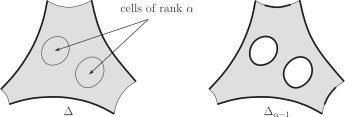
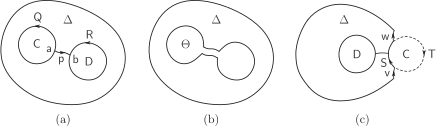
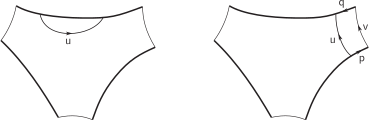
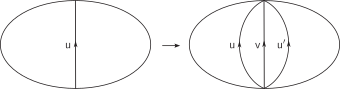
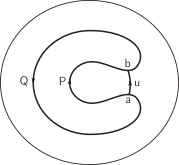
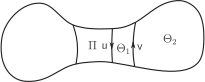

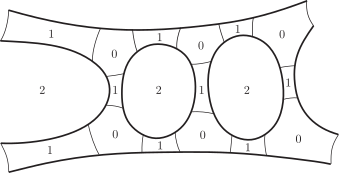
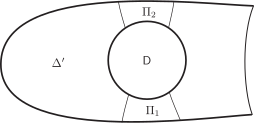
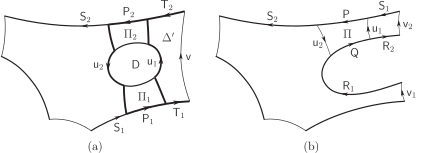


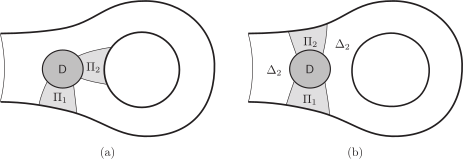
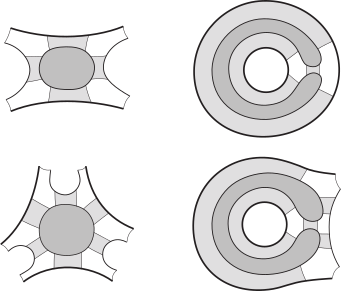


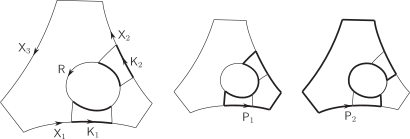
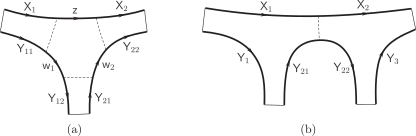
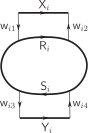

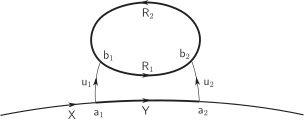
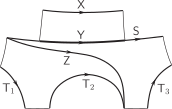

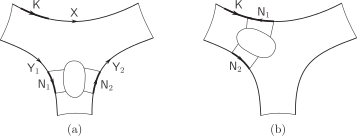
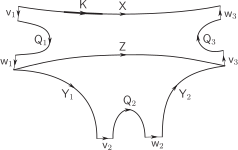

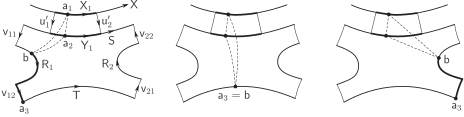
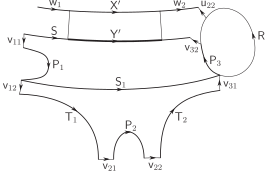
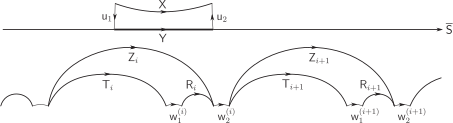

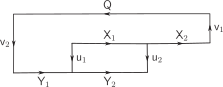
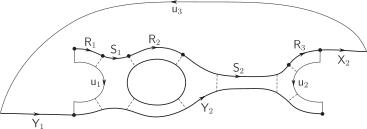
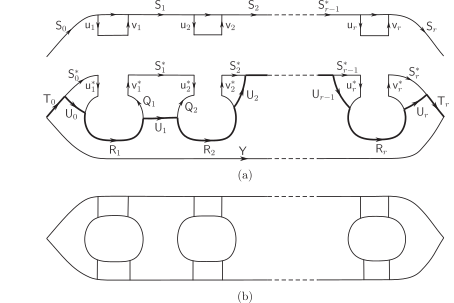
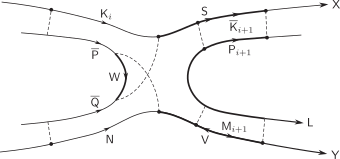
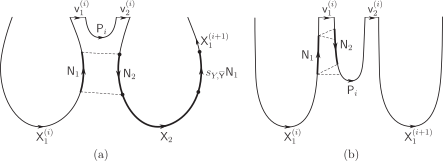
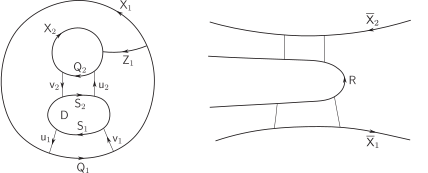
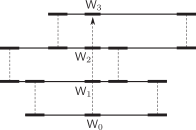

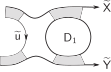
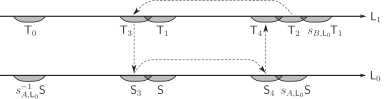
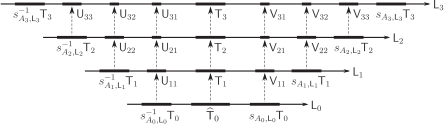



|
 Contact us:
 |
Terms of Use
|
Registration to the website |
Logotypes |
|